What a cup of tea can and cannot do about your stress
The word adaptogen was refused by Europe's medicines regulator in 2008 and has been on every label since. Here is what the trials actually show, what the cortisol numbers hide, and where a herb sits next to sleep.
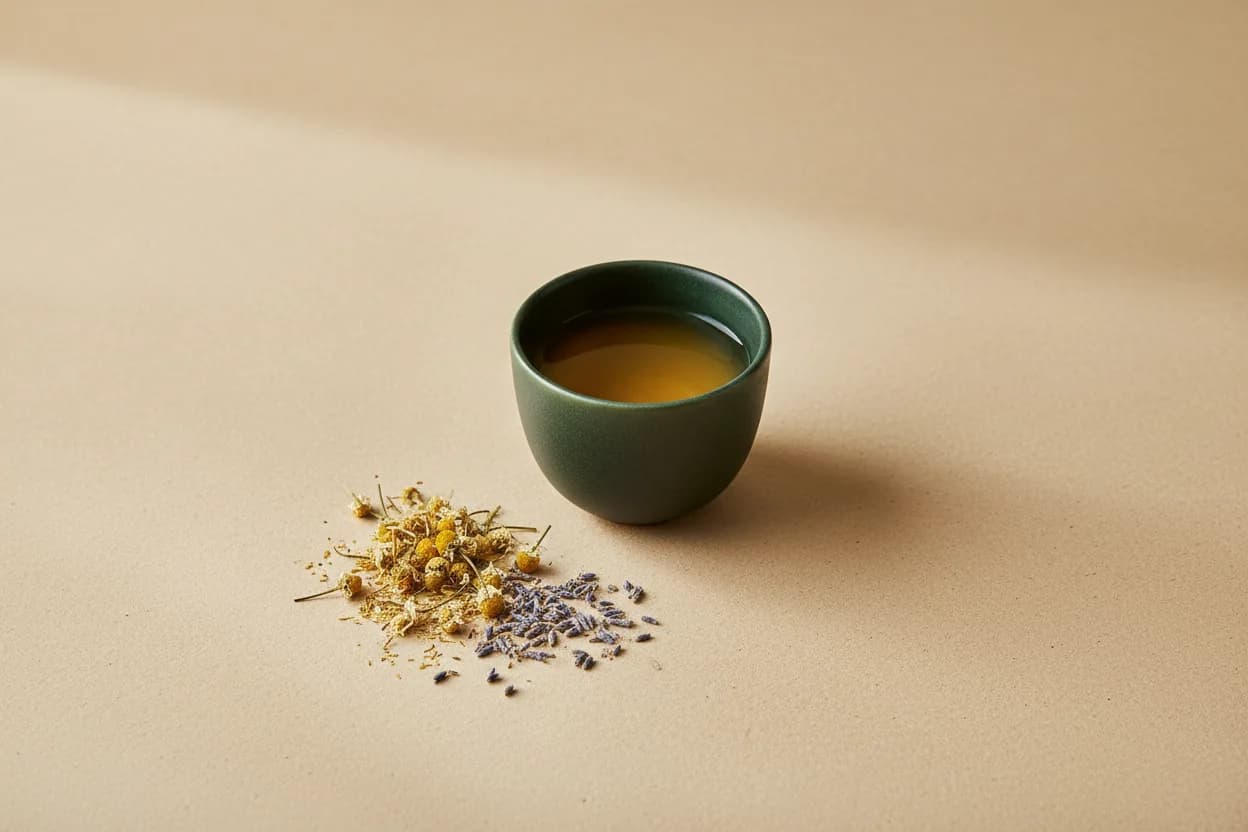
If you work somewhere fast, you are being sold adaptogens. The word is on tea, on powders, on capsules at the checkout, and it carries an air of pharmacology: something that adapts you, that raises your baseline, that lets you take more. I run a site full of herbal tea recipes, so I have an obvious interest in that story being true. This note is what I found when I went looking for whether it is.
The word on the packet
Adaptogen is not a pharmacological category. It is a Soviet coinage from 1947, developed into a formal definition by Brekhman and Dardymov two decades later, built on criteria that are strange when you read them closely. One says an adaptogen should be non-specific, acting against a broad spectrum of adverse factors. Another says its effect is more pronounced the deeper the pathological change in the organism, which is a definition that predicts its own invisibility in a healthy person. 1
In 2008 the European Medicines Agency published a reflection paper on the concept and declined it. Its language is unusually direct for a regulator.
As such, the term is not accepted in pharmacological and clinical terminology that is commonly used in the EU.
That document has sat unrepealed for the entire lifetime of the adaptogen boom. To be fair to it, the agency did not say the idea was worthless: it concluded the data justified further research, and that the concept could be considered in assessing traditional herbal products. 1 But the word on your packet is a marketing category wearing the clothes of a drug class.
The cortisol trap
Before any individual plant, the measurement problem, because once you see it you cannot read a supplement study the same way.
Most trials in this space report cortisol. It is convenient, it is objective, and it sounds like stress. The trouble is how loosely it tracks the thing you actually care about. A systematic review of laboratory studies that measured both how stressed people said they felt and what their bodies did found significant correlations between cortisol and subjective stress in only about a quarter of them. 2 In three out of four well-controlled experiments, the hormone and the feeling went their separate ways.
Cortisol is not even a general stress signal. Pooling 208 laboratory studies, Dickerson and Kemeny found it rose reliably for tasks that were uncontrollable or carried social-evaluative threat, and concluded that this contradicts the belief that cortisol responds to all types of stressors. 3 Which is worth sitting with if you work under pressure: the thing that reliably spikes it is being judged, on something you cannot control.
Then there is direction. Healthy cortisol is not low, it is rhythmic: a sharp peak after waking and a steep fall across the day. In an exploratory study of chamomile in generalised anxiety disorder, the patients who improved most showed significant increases in morning cortisol, and a steeper decline afterwards. 4 Getting better looked like cortisol going up at the right time of day. So lower is not automatically better, and a single spot measurement in a supplement trial tells you very little.
The clearest demonstration is a 2025 meta-analysis of ashwagandha that measured both. Cortisol fell significantly. Perceived stress did not move at all, at p equals 0.40. 5 The paper's own title says it: significant cortisol reduction, no effect on perceived stress. That is the gap the whole category lives in.
Ashwagandha, both halves
Ashwagandha is the market leader, so it deserves the fullest accounting, and that means both halves.
The efficacy side is not nothing. The best independently funded meta-analysis pooled 14 randomised trials and 713 people, at a median 600 mg a day for a median eight weeks, and found meaningful effects on anxiety, stress and sleep. 6 The authors then graded their own evidence as low for anxiety, sleep and stress, and very low for depression, citing few studies per estimate, high heterogeneity and bias threats around blinding. Three of their four pooled analyses had fewer than ten studies, too few to test properly for publication bias. 6
The famous number deserves unpacking. You will see that ashwagandha cuts cortisol by about 28 per cent. That comes from a 2012 trial of 64 people: a 27.9 per cent fall from baseline in the treated group. The placebo group fell 7.9 per cent over the same period, which is the number that never appears in the marketing. The extract was supplied by its manufacturer, and the paper declares no conflict of interest. 7
The safety side is where I changed my mind while writing this. The US National Institutes of Health's LiverTox database assigns ashwagandha a likelihood score of B, meaning a likely cause of clinically apparent liver injury, with a typical onset two to twelve weeks after starting and a cholestatic or mixed pattern. It notes that cases were first reported in 2017 and have increased since, and that rare instances have been fatal or required transplantation, particularly in people with existing liver disease. 8
An Indian series published in 2023 described 23 patients with ashwagandha-associated liver injury. Five had underlying chronic liver disease. Three of those developed acute-on-chronic liver failure and all three died. Chemical analysis found only natural phytochemicals, without adulteration or contamination, which rules out the usual comforting explanation that some other substance was to blame. 9
In 2024 the Dutch national institute RIVM published a risk assessment and could not establish a safe use level, noting that no toxicity studies longer than 28 days were available. It advises consumers, and pregnant women in particular, not to use preparations containing the plant. Its reasoning about who is at risk is worth quoting in substance: it is unlikely that a large part of the population is affected, but sensitive individuals can experience liver injury, thyroid effects and adrenal suppression, and it is unknown which individuals are sensitive. 10 That is exactly why short trials in healthy volunteers cannot reassure you here. Idiosyncratic injury is rare by definition, and a 60-person study is not built to find it.
One detail matters especially for anyone reading a tea site: RIVM explicitly extended its conclusion to ashwagandha tea, on the grounds that no toxicological data exist for it. 10
The best-evidenced one, and who paid for it
Credit where it is due. The strongest botanical evidence in this area belongs to lavender, specifically a standardised oral preparation called Silexan, sold as a licensed medicine in Germany. A meta-analysis of five double-blind placebo-controlled trials covering 1,213 randomised patients found it beat placebo by 2.9 points on the Hamilton Anxiety scale, a standardised effect of 0.35, with a number needed to treat of five. 11 Small to moderate, but real, and with no significant excess of adverse events.
Two things sit alongside that. One of the five trials was flatly negative. And when the authors searched the trial registries specifically for placebo-controlled Silexan studies run independently of the manufacturer, they found none. Every one was conducted by the company that sells it, and the meta-analysis itself was funded by that company, with one of its employees performing the statistical analysis. 11
This is not an accusation. It is the ordinary structure of botanical research, where nobody but a manufacturer has a reason to fund a trial. But it means the best evidence in the field is also entirely sponsor-generated, and you should hold it a little more loosely than the same numbers from an independent group.
The tea arithmetic
L-theanine is the one that should work in a cup, because it is already in tea. And the evidence for it is genuinely interesting, just not for the thing it is sold for. A 2026 meta-analysis of 31 randomised trials in 1,168 people found a robust short-term benefit on attention from a single 200 mg dose taken half an hour to an hour beforehand. The acute stress effect was modest and heavily influenced by studies at high risk of bias, and the anxiety effects were inconsistent and non-significant. 12 The reliable finding is faster reaction time, not calm.
Then there is the dose, which is where this quietly falls apart. Researchers measured what actually comes out of commercial tea under real brewing conditions, one gram of leaf in 100 millilitres at 80 degrees for three minutes. Green tea gave 6.56 milligrams of theanine per gram of leaf, black tea 5.13, and pu-erh none that could be detected at all. The same samples carried three to four times more caffeine than theanine by mass. 13
Work it through. A normal two-gram serving gives you somewhere around ten to thirteen milligrams. The trials use 200. That is fifteen to twenty cups, drunk at once, and with them several hundred milligrams of caffeine, which will do considerably more to your nervous system than the theanine will undo. The content also varies wildly between products, and three minutes of steeping does not even extract all of what is there. 13 There is no such thing as a standardised cup.
Chamomile, honestly
Chamomile has the distinction of being the one botanical here whose key trials nobody sold anything through. A 2009 randomised trial at the University of Pennsylvania, funded by the NIH, gave 57 people with mild to moderate generalised anxiety disorder a standardised extract for eight weeks and found a greater reduction in anxiety than placebo, at p equals 0.047. 14
The best thing in that paper is the authors being hard on themselves. They note that the small sample may have left covariates unevenly distributed, and that the chamomile group started slightly more anxious, which raises the possibility that their positive result was regression toward the mean. 14 That is a research team publicly listing the reasons not to believe them.
The follow-up is the part that rarely gets quoted. The same group ran a long-term trial: 179 enrolled, 93 responders randomised to continue chamomile or switch to placebo for 26 weeks. Relapse was 15.2 per cent on chamomile against 25.5 on placebo, a hazard ratio of 0.52 with a confidence interval from 0.20 to 1.33 and a p value of 0.16. 15 The primary endpoint failed. The direction is encouraging and the study was underpowered, which is an honest description of most of this literature.
Pooled across 12 trials, chamomile's effect on state anxiety is null, at a standardised difference of 0.15 with a confidence interval straddling zero. Its better-supported claim is sleep quality, at 0.73. 16 Which, given everything below, may be the more useful effect anyway.
The proportion
Here is the comparison that reorganised my sense of this whole subject. Set the anxiety effect sizes side by side.
Exercise, across an umbrella review covering 79,551 participants: 0.47. 18 Improving sleep quality, across 65 trials and 8,608 people, with a dose-response relationship so that better sleep gave better mental health: 0.51. 17 The best-evidenced botanical, manufacturer-funded, across 1,213 patients: 0.35. 11 Chamomile for state anxiety: 0.15, not significant. 16
And in the national guideline for generalised anxiety in adults, the first step is not a treatment at all. It is education and active monitoring, which the guidance notes may improve milder presentations without further intervention. Guided self-help comes next, then cognitive behavioural therapy or medication, chosen by patient preference because no evidence shows either is better. 19 Herbal preparations appear exactly once in that summary, and it is a caution: discuss over-the-counter preparations, explain the potential for interactions, and note that insufficient evidence exists to support their safe use. 19
So what is the cup for
I am not going to finish by telling you to throw out your chamomile, because I make it most nights. But I would rather be straight about what it is doing.
The strongest honest claims are narrow. Chamomile has decent evidence for sleep quality, and sleep has the best evidence of anything here for how you feel. Lavender in a standardised medicinal preparation has a real if modest effect, generated entirely by its manufacturer. L-theanine sharpens attention at a dose you cannot drink. Ashwagandha moves a hormone that does not track how people feel, and carries a liver risk serious enough that a national institute tells consumers to avoid it.
What is left is not nothing, and it is not pharmacology either. It is the ten minutes. Boiling the water, waiting for the steep, holding something warm, and stopping. Nobody has run a trial on the ritual because you cannot blind it, and the plant gets the credit for a pause it did not create. That seems worth knowing, and it is not a reason to stop. It is a reason to take the pause seriously and treat the packet's promises lightly.
Sources
Every numbered claim above points here. Links go to the paper, record, or authority itself.
- 1.
European Medicines Agency, Committee on Herbal Medicinal Products. Reflection Paper on the Adaptogenic Concept. EMEA/HMPC/102655/2007, adopted 8 May 2008.
https://www.ema.europa.eu/en/documents/scientific-guideline/reflection-paper-adaptogenic-concept_en.pdf - 2.
Campbell J, Ehlert U. Acute psychosocial stress: does the emotional stress response correspond with physiological responses? Psychoneuroendocrinology. 2012;37(8):1111-1134.
https://doi.org/10.1016/j.psyneuen.2011.12.010 - 3.
Dickerson SS, Kemeny ME. Acute stressors and cortisol responses: a theoretical integration and synthesis of laboratory research. Psychological Bulletin. 2004;130(3):355-391.
https://doi.org/10.1037/0033-2909.130.3.355 - 4.
Keefe JR, Guo W, Li QS, Amsterdam JD, Mao JJ. An exploratory study of salivary cortisol changes during chamomile extract therapy of moderate to severe generalized anxiety disorder. Journal of Psychiatric Research. 2018;96:189-195.
https://doi.org/10.1016/j.jpsychires.2017.10.011 - 5.
Albalawi AA. Dual impact of Ashwagandha: Significant cortisol reduction but no effects on perceived stress. Nutrition and Health. 2025;31(4):1395-1408.
https://doi.org/10.1177/02601060251363647 - 6.
Marchi M, Grenzi P, Travascio A, et al. The effect of Withania somnifera (Ashwagandha) on mental health symptoms in individuals with mental disorders: systematic review and meta-analysis. BJPsych Open. 2025;11:e260.
https://doi.org/10.1192/bjo.2025.10885 - 7.
Chandrasekhar K, Kapoor J, Anishetty S. A prospective, randomized double-blind, placebo-controlled study of safety and efficacy of a high-concentration full-spectrum extract of Ashwagandha root in reducing stress and anxiety in adults. Indian Journal of Psychological Medicine. 2012;34(3):255-262.
https://doi.org/10.4103/0253-7176.106022 - 8.
Ashwagandha. In: LiverTox: Clinical and Research Information on Drug-Induced Liver Injury. Bethesda, MD: National Institute of Diabetes and Digestive and Kidney Diseases. References updated 3 December 2024.
https://www.ncbi.nlm.nih.gov/books/NBK548536/ - 9.
Philips CA, Valsan A, Theruvath AH, et al. Ashwagandha-induced liver injury: A case series from India and literature review. Hepatology Communications. 2023;7(10):e0270.
https://doi.org/10.1097/hc9.0000000000000270 - 10.
de Heer JA. Risk assessment of herbal preparations containing Withania somnifera (Ashwagandha). RIVM letter report 2024-0029. Dutch National Institute for Public Health and the Environment.
https://www.rivm.nl/bibliotheek/rapporten/2024-0029.pdf - 11.
Dold M, Bartova L, Volz HP, Seifritz E, Möller HJ, Schläfke S, Kasper S. Efficacy of Silexan in patients with anxiety disorders: a meta-analysis of randomized, placebo-controlled trials. European Archives of Psychiatry and Clinical Neuroscience. 2023;273:1615-1628.
https://doi.org/10.1007/s00406-022-01547-w - 12.
Gerolymos C, Saddier E, Boyer L, Fond G. Cognitive and affective effects of L-theanine: a systematic review and meta-analysis of 31 randomized trials. Molecular Psychiatry. 2026.
https://doi.org/10.1038/s41380-026-03727-9 - 13.
Boros K, Jedlinszki N, Csupor D. Theanine and Caffeine Content of Infusions Prepared from Commercial Tea Samples. Pharmacognosy Magazine. 2016;12(45):75-79.
https://doi.org/10.4103/0973-1296.176061 - 14.
Amsterdam JD, Li Y, Soeller I, Rockwell K, Mao JJ, Shults J. A randomized, double-blind, placebo-controlled trial of oral Matricaria recutita (chamomile) extract therapy for generalized anxiety disorder. Journal of Clinical Psychopharmacology. 2009;29(4):378-382.
https://doi.org/10.1097/jcp.0b013e3181ac935c - 15.
Mao JJ, Xie SX, Keefe JR, Soeller I, Li QS, Amsterdam JD. Long-term chamomile (Matricaria chamomilla L.) treatment for generalized anxiety disorder: A randomized clinical trial. Phytomedicine. 2016;23(14):1735-1742.
https://doi.org/10.1016/j.phymed.2016.10.012 - 16.
Hieu TH, Dibas M, Surya Dila KA, et al. Therapeutic efficacy and safety of chamomile for state anxiety, generalized anxiety disorder, insomnia, and sleep quality: A systematic review and meta-analysis of randomized trials. Phytotherapy Research. 2019;33(6):1604-1615.
https://doi.org/10.1002/ptr.6349 - 17.
Scott AJ, Webb TL, Martyn-St James M, Rowse G, Weich S. Improving sleep quality leads to better mental health: A meta-analysis of randomised controlled trials. Sleep Medicine Reviews. 2021;60:101556.
https://doi.org/10.1016/j.smrv.2021.101556 - 18.
Munro NR, Teague S, Somoray K, et al. Effect of exercise on depression and anxiety symptoms: systematic umbrella review with meta-meta-analysis. British Journal of Sports Medicine. 2026;60(8):590-599.
https://doi.org/10.1136/bjsports-2025-110301 - 19.
Kendall T, Cape J, Chan M, Taylor C. Management of generalised anxiety disorder in adults: summary of NICE guidance. BMJ. 2011;342:c7460.
https://doi.org/10.1136/bmj.c7460