Most of what a rose is made of does not smell of rose
Citronellol and geraniol are the abundant ones. A large fraction of rose oil is odourless wax. The molecule that makes the smell unmistakable sits far below a tenth of a per cent, and the famous number attached to it turns out not to be a measurement.
Put a vial of real rose otto in the fridge and it stops being a liquid. Waxy crystals form through it and it goes cloudy and stiff. This is not a fault, and it is not the oil going off. It is one of the oldest tests for whether you have been sold the real thing, because a large fraction of steam-distilled rose oil consists of long-chain paraffins that have no smell whatsoever.
That is the first surprise in rose chemistry and not the last. Most of what a rose is physically made of is not what a rose smells like.
The abundant ones
The compounds usually named as rose are the terpene alcohols. Citronellol, C₁₀H₂₀O, is typically the largest single odorous component of rose otto. 1 Geraniol and its cis-isomer nerol share the formula C₁₀H₁₈O and sit alongside it. They are genuinely rosy, they are present in quantity, and if you smelled them alone you would agree they belong to a rose.
You would not, however, say the rose was in the room. They are the body of the smell rather than its signature, which is why perfumers describing a rose accord talk about building a base and then finding the thing that makes it live.
The part that smells of nothing
Then there is the wax. Rose otto carries a substantial fraction of odourless straight-chain alkanes, nonadecane and heneicosane chief among them, collectively called the stearoptene. Reported figures vary widely with cultivar and method, from single digits to well over a third of the oil by weight, so treat any single number with suspicion. What is consistent is that this fraction is large and contributes no aroma at all. It is what crystallises in the cold.
So a bottle of rose otto is, in mass terms, substantially a mixture of scentless wax and pleasant but unremarkable alcohols. The thing you actually recognise has barely registered yet.
Why otto and absolute are not the same flower
There is a clean piece of evidence for how much the method shapes the result. Steam distillation and solvent extraction of the same petals give noticeably different smells, and the usual explanation is phenylethyl alcohol, the compound most responsible for the fresh, sweet, almost jammy top of a fresh rose. It is unusually water-soluble.
A 2023 study measured both fractions from Bulgarian industrial plantations and found phenylethyl alcohol making up between 27 and 70 per cent of the hydrosol, the distillation water left behind. 9 The molecule does not vanish in distillation. It partitions almost entirely into the water the oil was floating on, and gets poured away. Rose absolute, extracted with solvent and never meeting water, keeps it. Two products, one flower, and the difference is mostly a question of what dissolved in what.
The molecule that arrives in traces
In 1959, Seidel and Stoll characterised the low-boiling components of Bulgarian rose oil and described the rose oxides. 4 Eleven years later, a team at the Swiss fragrance house Firmenich, Demole, Enggist, Säuberli, Stoll and Kováts, published the structure and synthesis of a compound they had pulled from the same oil. They called it damascenone, after Rosa damascena. 3
Beta-damascenone is C₁₃H₁₈O, a modest ketone with a cyclohexadiene ring. 2 It is present in rose oil at somewhere around a tenth of a per cent, which is to say almost nowhere. And it is the single compound most responsible for the smell being unmistakably rose rather than merely floral.
The reason a trace can do that is its odour threshold, the smallest concentration a nose can detect. Damascenone's is famously, absurdly low. The figure most often quoted is 0.002 parts per billion in water, which traces to Buttery and colleagues in 1990, working on tomato volatiles. 5 Two parts per trillion. A swimming pool and an eyedropper.
A threshold is not a property of a molecule
Now the part that changed how I read every odour threshold I see quoted, and the reason I am pedantic about naming the medium.
In 2007 a Bordeaux group asked what damascenone actually does in red wine. They found its perception threshold in wine to be more than a thousand times higher than in a simple water and alcohol model. 6 The molecule did not change. The room it was standing in did. Other compounds compete for the same receptors and mask it, and the matrix holds it differently.
So a threshold quoted without its medium is not a fact, it is a fragment. Two parts per trillion is true of damascenone in water. It is not a universal constant, and it is certainly not the number that applies in an oil that is already a third wax.
The number everybody quotes
Which brings me to a figure you will meet everywhere, including in peer-reviewed papers: that damascenone accounts for about seventy per cent of rose oil's odour despite that vanishing concentration. It appears, stated plainly, in a 2021 synthesis paper in Tetrahedron, which puts damascenone at roughly 0.1 per cent of Bulgarian rose extract and credits it with seventy per cent of the oil's scent. 10
I went looking for where that seventy per cent comes from and could not find the measurement. The phrasing that circulates is seventy per cent of the relative proportion in scent units, and scent units is not a defined quantity unless you say exactly how you summed them. The trail leads back toward work by Ohloff on Bulgarian rose oil, which is plausible, and I could not read the source to confirm it. So I will not print it as a fact. It is a repeated approximation that has acquired the confidence of a measurement, which is a thing numbers do.
The honest version is better anyway, because someone did the work properly. The tool is odour activity value: divide a compound's concentration by its detection threshold, and you get a number expressing how much of the perceived smell it can account for, which is the rigorous form of the claim that a trace can dominate. 7 In 2017 a group applied gas chromatography with a human nose at the outlet, aroma extract dilution analysis and odour activity values to rose oil, then did the decisive test: they rebuilt the aroma from only the high-activity compounds and asked people whether it smelled like rose oil. It did. 8
That is the difference between an assertion and a demonstration. Not a percentage anyone can quote, but a reconstruction that a panel could not tell from the original.
What it costs to fill a bottle
The same 2023 Bulgarian study measured oil yield across seven rose genotypes and found it running between 0.015 and 0.048 per cent of fresh flower weight. 9 Invert that and you need somewhere in the range of two to nearly seven tonnes of petals for a kilogram of oil. The figure you will see quoted, three to four thousand kilograms per kilogram, sits comfortably inside that range, which is a good reason to treat it as a sensible rule of thumb rather than a measurement.
The flowers are picked by hand before the sun is properly up, because the volatile oil leaves as the day warms. That is the mechanism, and it is well attested, though I could not find a study putting a number on how fast it goes.
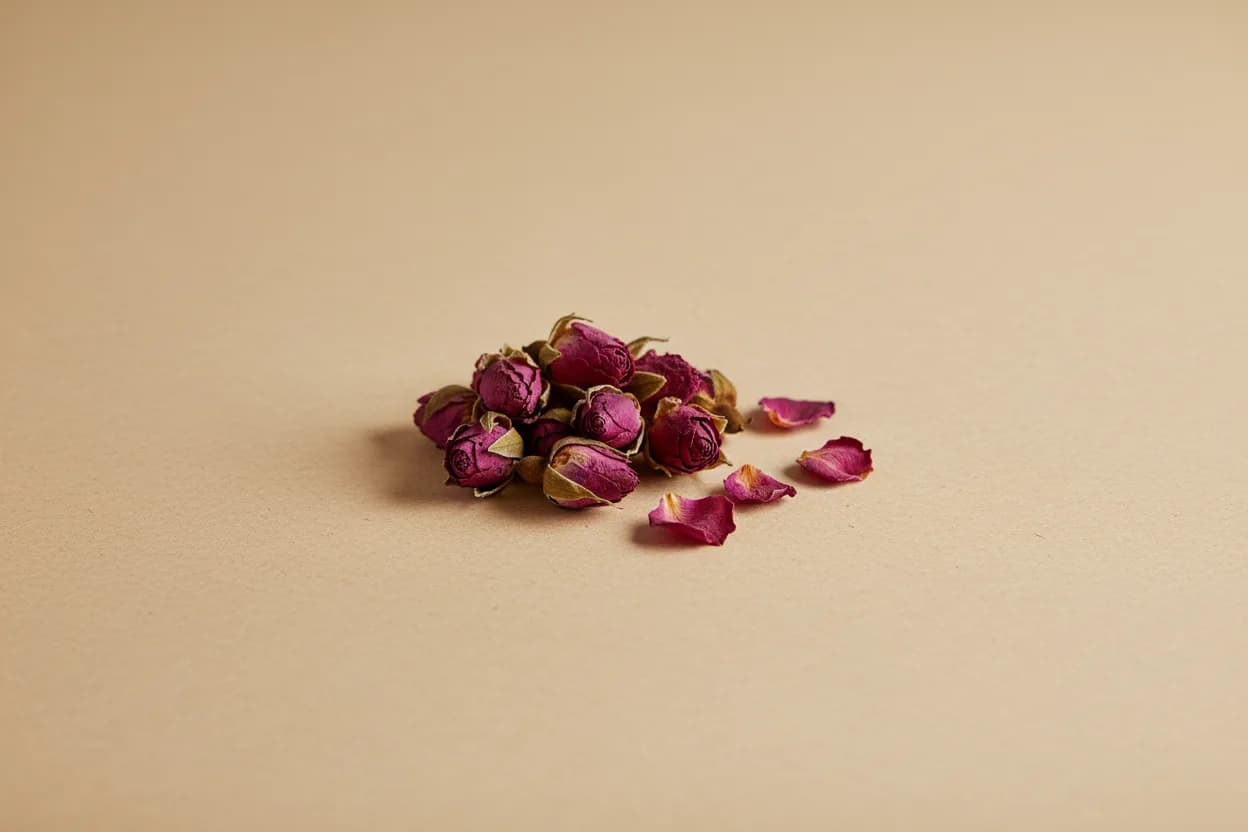
None of which is in your head when you open a jar of dried buds. You get the wax and the alcohols and the two parts per trillion all at once, as one thing, and the one thing is a rose. It seems worth knowing that the flower spends most of its chemistry on the parts you cannot smell, and stakes its whole identity on the part that is barely there.
Sources
Every numbered claim above points here. Links go to the paper, record, or authority itself.
- 1.
PubChem Compound Summary CID 8842, Citronellol. National Center for Biotechnology Information.
https://pubchem.ncbi.nlm.nih.gov/compound/8842 - 2.
PubChem Compound Summary CID 5366074, beta-Damascenone. National Center for Biotechnology Information.
https://pubchem.ncbi.nlm.nih.gov/compound/5366074 - 3.
Demole E, Enggist P, Säuberli U, Stoll M, Kováts E. Structure et synthèse de la damascénone, constituant odorant de l'essence de rose bulgare (Rosa damascena Mill.). Helvetica Chimica Acta. 1970;53(3):541-551.
https://doi.org/10.1002/hlca.19700530310 - 4.
Seidel CF, Stoll M. Zur Kenntnis des Rosenöls. 1. Mitteilung. Über die tiefsiedenden Bestandteile des bulgarischen Rosenöls. Helvetica Chimica Acta. 1959;42(6):1830-1844.
https://doi.org/10.1002/hlca.19590420611 - 5.
Buttery RG, Teranishi R, Ling LC, Turnbaugh JG. Quantitative and Sensory Studies on Tomato Paste Volatiles. Journal of Agricultural and Food Chemistry. 1990;38(1):336-340.
https://doi.org/10.1021/jf00091a074 - 6.
Pineau B, Barbe JC, Van Leeuwen C, Dubourdieu D. Which Impact for beta-Damascenone on Red Wines Aroma? Journal of Agricultural and Food Chemistry. 2007;55(10):4103-4108.
https://doi.org/10.1021/jf070120r - 7.
Grosch W. Evaluation of the Key Odorants of Foods by Dilution Experiments, Aroma Models and Omission. Chemical Senses. 2001;26(5):533-545.
https://doi.org/10.1093/chemse/26.5.533 - 8.
Xiao Z, Li J, Niu Y, Liu Q, Liu J. Verification of key odorants in rose oil by gas chromatography-olfactometry/aroma extract dilution analysis, odour activity value and aroma recombination. Natural Product Research. 2017;31(19):2294-2302.
https://doi.org/10.1080/14786419.2017.1303693 - 9.
Dobreva A, Nedeva D, Mileva M. Comparative Study of the Yield and Chemical Profile of Rose Oils and Hydrosols Obtained by Industrial Plantations of Oil-Bearing Roses in Bulgaria. Resources. 2023;12(7):83.
https://doi.org/10.3390/resources12070083 - 10.
Chaumont-Olive P, Sánchez-Quesada J, Collado Pérez AM, Cossy J. Synthesis of damascenone and derivatives. Tetrahedron. 2021;82:131932.
https://doi.org/10.1016/j.tet.2021.131932