The perfume in the jar is now a protected species
Pliny priced Indian nard at a hundred denarii a pound. Two thousand years later the same Himalayan rhizome is assessed as Critically Endangered, and its assessors report the Indian wild population down by more than eighty per cent in a decade.
There is a scene everyone half remembers. A woman pours out a jar of ointment over Jesus, the room fills with the smell of it, and somebody in the room does the arithmetic out loud and objects to the waste. The ointment is nard.
Worth getting the detail right, because almost every retelling blends two accounts. The alabaster jar belongs to Mark, whose woman breaks it open and pours it over Jesus's head. In John there is no alabaster and no breaking: Mary takes a pound of pure nard, about 327 grams, anoints his feet, and wipes them with her hair, and the house fills with the fragrance. It is John who names the objector. Judas asks why it was not sold for three hundred denarii. 7
That figure gets converted to a year's wages so routinely that it now reads as an ancient fact. It is not. It is a modern inference, resting on a different passage where a denarius is a day's pay for a labourer. Three hundred days is roughly a working year, which makes the gloss reasonable and the certainty unearned.
The price list survives
We do not have to guess what nard cost, because Pliny wrote it down. In the Natural History he describes the plant, warns at length that the market is full of counterfeits, and then quotes rates. Indian nard root: a hundred denarii a pound. Graded nard leaf, in three sizes: forty to seventy-five. Gallic nard, the cheap substitute: three. 6
A thirty-three-fold spread between the real thing and the local imitation, and a Roman naturalist devoting paragraphs to how you are being cheated. Two thousand years on, the adulteration problem has not gone away, as we will get to.
Where it actually comes from
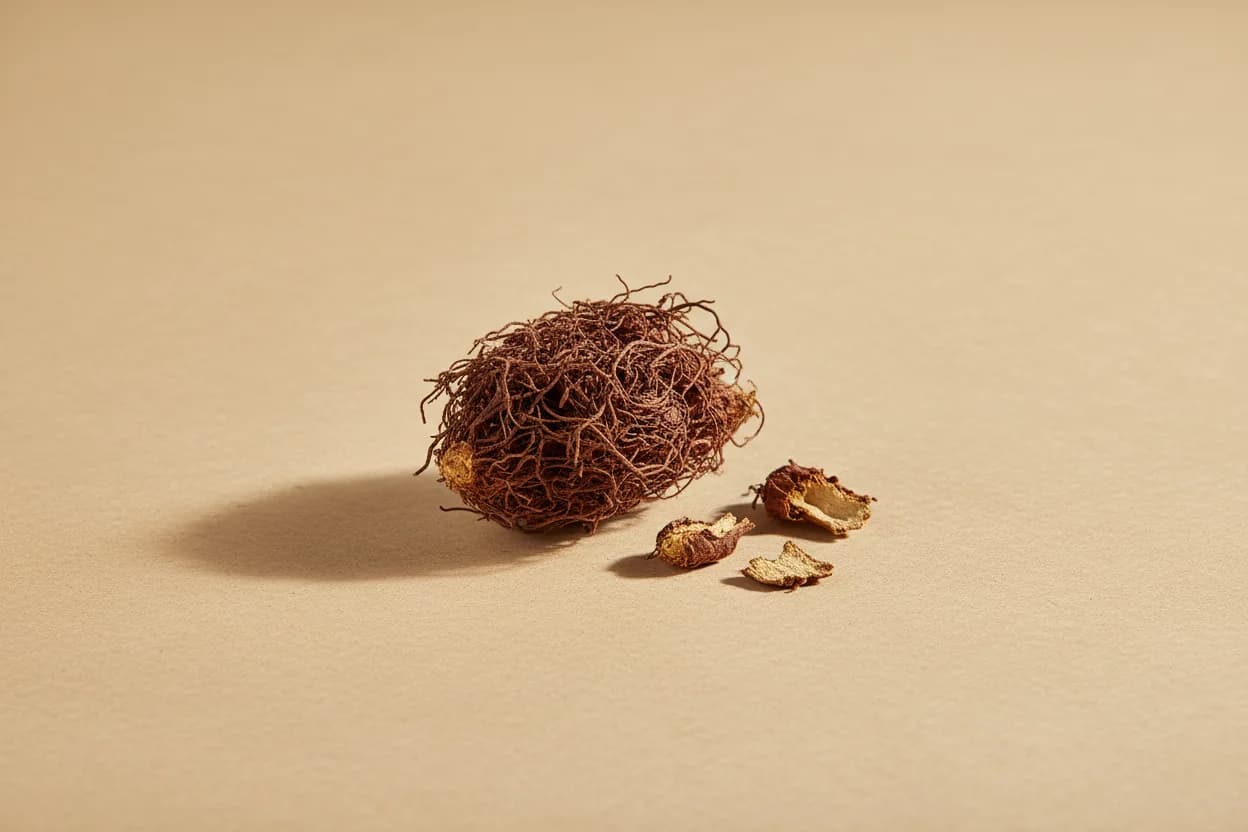
Spikenard is Nardostachys jatamansi, and it does not grow anywhere convenient. It is an alpine plant of the Himalaya, found in meadows roughly between three and five thousand metres across Nepal, India, Bhutan, Myanmar and China. 1 What is harvested is the rhizome, the knotted underground stem, which is where the aromatic oil sits.
Two facts about how it lives explain everything that follows. It is slow: several years pass before a plant reaches harvestable size. And it is bad at reproducing, with germination rates reported in the region of ten to twenty per cent. 5 A plant that takes years to build a rhizome and struggles to set a viable seed has very little margin.
It also cannot be harvested gently. You take the whole rhizome, and the plant does not come back from it. Every unit of trade is an individual removed from the population. 3
One molecule, two roots
Botanically spikenard sits in the Caprifoliaceae, in the group that used to be its own family, Valerianaceae. Which is to say it is a relative of valerian, and the chemistry shows it. The compound most associated with spikenard is jatamansone, better known by its other name, valeranone, C₁₅H₂₆O. 9 It is reported both in Nardostachys and in valerian root oil, which is a small, pleasing piece of continuity: the same sesquiterpene ketone, whether it came out of a Himalayan meadow at four thousand metres or a field in Estonia.
That is the honest chemical overlap. Be more careful with the rest. Valerian's own signature markers, valerenic acid and the valepotriates, are a different matter, and reports of them in material sold as jatamansi should be read with the substitution problem below in mind.
What the evidence actually supports
Spikenard has a long reputation as a sedative, and that reputation is doing more work than the data. A 2020 review in the Journal of Ethnopharmacology, sympathetic to the plant and arguing it is under-exploited, still lists the gaps plainly: dated analytical methods, missing toxicology, and an absence of clinical trials. 4 The pharmacology that exists is overwhelmingly animal and in vitro.
The best human trial I could find is not about sleep at all. It is a small randomised study of forty patients with stage-one hypertension, taking three grams a day for four weeks, which reported meaningful falls in blood pressure against placebo. 11 Forty people, four weeks, single-blind. That is a signal worth following, not a result to build a claim on, and it is not a sleep result.
So: no good human evidence that it does the thing it is famous for. I use it because it smells extraordinary, dark and resinous and slightly animal, and because it gives a tea a bottom note nothing else in the cupboard provides. That is a sufficient reason. It is just not a medical one.
Critically Endangered
Here is the part that changed how I think about the jar in the story.
Nardostachys jatamansi was assessed for the IUCN Red List in 2014, published in 2015, and the category is Critically Endangered, the highest level of threat before extinct in the wild. The population trend is recorded as decreasing. 1 The assessors' rationale is blunt.
More than 80% of the wild population in the Himalayan region of India has declined over the last 10 years.
It is also listed on CITES Appendix II, the tier for species not yet facing extinction but at risk if trade goes unregulated, with the listing generally dated to 1997. 3 Nepal has restricted export of the unprocessed rhizome since the mid-1990s, and enforcement across a high, porous, sparsely policed border has been imperfect ever since. 2
A 2026 field survey across twenty-nine community forests in five Nepali districts put numbers on what that looks like on the ground. Mature plants averaged 331 per hectare, against roughly 500 per hectare recorded in the same general region a decade or so earlier. Only twenty-two to thirty per cent of the plants counted were juveniles. 2 That last figure is the alarming one. A population with almost no young in it can look healthy in the standing biomass and still be finished, because there is nothing coming up behind.
And it may not be what is in the packet
The 2020 review flags something the trade would rather not discuss: a persistent confusion between Nardostachys jatamansi and Valeriana jatamansi, a different genus sold under the same market name. Their phytochemical profiles and reported activities resemble each other closely enough that authentication is a real analytical problem. 4 In 2010 a group published a chromatography method specifically to tell jatamansi from its substitutes, which tells you how routine the substitution is. 10
There is a deeper version of the same uncertainty running all the way back to the jar. That ancient nard was this species is widely assumed and not conclusively established, which is why botanists were still publishing DNA work on the identity of spikenard as recently as 2023. 8 Pliny was worried about knowing what he had bought. So, apparently, are we.
What I take from this is not that you should never brew it. It is that spikenard is the one thing in this cupboard where the ethical question is louder than the chemical one. Buy it rarely, buy it from someone who can say where it came from, use it in grams rather than handfuls, and treat the smell as what it has always been: a luxury, priced accordingly, from a plant that is now genuinely running out. The woman in the story poured out a year of somebody's wages in one gesture and was called wasteful for it. She was working with a plant that still had time.
Sources
Every numbered claim above points here. Links go to the paper, record, or authority itself.
- 1.
Ved D, Saha D, Ravikumar K, Haridasan K. Nardostachys jatamansi. The IUCN Red List of Threatened Species 2015: e.T50126627A50131395. Assessed 2014.
https://doi.org/10.2305/IUCN.UK.2015-2.RLTS.T50126627A50131395.en - 2.
Joshi NR. Status of a Critically Endangered Medicinal and Aromatic Herb Nardostachys jatamansi DC. in Alpine Meadows of Nepal. NPRC Journal of Multidisciplinary Research. 2026;3(1):43-62.
https://doi.org/10.3126/nprcjmr.v3i1.90024 - 3.
Chauhan HK, Oli S, Bisht AK, Meredith C, Leaman D. Review of the biology, uses and conservation of the critically endangered endemic Himalayan species Nardostachys jatamansi (Caprifoliaceae). Biodiversity and Conservation. 2021;30(12):3315-3333.
https://doi.org/10.1007/s10531-021-02269-6 - 4.
Dhiman N, Bhattacharya A. Nardostachys jatamansi (D.Don) DC: Challenges and Opportunities of Harnessing the Untapped Medicinal Plant from the Himalayas. Journal of Ethnopharmacology. 2020;246:112211.
https://doi.org/10.1016/j.jep.2019.112211 - 5.
Kaur H, et al. Nardostachys jatamansi (D.Don) DC.: An invaluable and constantly dwindling resource of the Himalayas. South African Journal of Botany. 2020;135:252-267.
https://doi.org/10.1016/j.sajb.2020.08.010 - 6.
Pliny the Elder, Natural History, Book 12, chapter 26 (sections 42-46), on nard and its price. Rackham translation.
https://www.attalus.org/pliny/hn12a.html - 7.
John 12:1-8 and Mark 14:3-9, on the anointing at Bethany and the value of the nard.
https://www.biblegateway.com/passage/?search=John%2012%3A1-8%3BMark%2014%3A3-9&version=NRSVUE - 8.
Agrawal A, Devi M, Dhiman K, Dkhar J. A note on the identity of the spikenard (Nardostachys jatamansi, Caprifoliaceae) based on DNA sequence data. Phytotaxa. 2023;578(2):213-218.
https://doi.org/10.11646/phytotaxa.578.2.8 - 9.
PubChem Compound Summary CID 10198387, Valeranone (jatamansone). National Center for Biotechnology Information.
https://pubchem.ncbi.nlm.nih.gov/compound/10198387 - 10.
Srivastava A, Tiwari SS, Srivastava S, Rawat AKS. HPTLC Method for Quantification of Valerenic Acid in Ayurvedic Drug Jatamansi and its Substitutes. Journal of Liquid Chromatography & Related Technologies. 2010;33(18):1679-1688.
https://doi.org/10.1080/10826076.2010.519250 - 11.
Bhat MDA, Malik SA. Efficacy of Nardostachys jatamansi (D.Don) DC in essential hypertension: A randomized controlled study. Complementary Therapies in Medicine. 2020;53:102532.
https://doi.org/10.1016/j.ctim.2020.102532