Why arak turns white
Add water to arak and it clouds instantly, with nothing stirred in and nothing added to make it happen. The physics has a name, a 2003 paper behind it, and a second career manufacturing drug-delivery capsules.
Contents
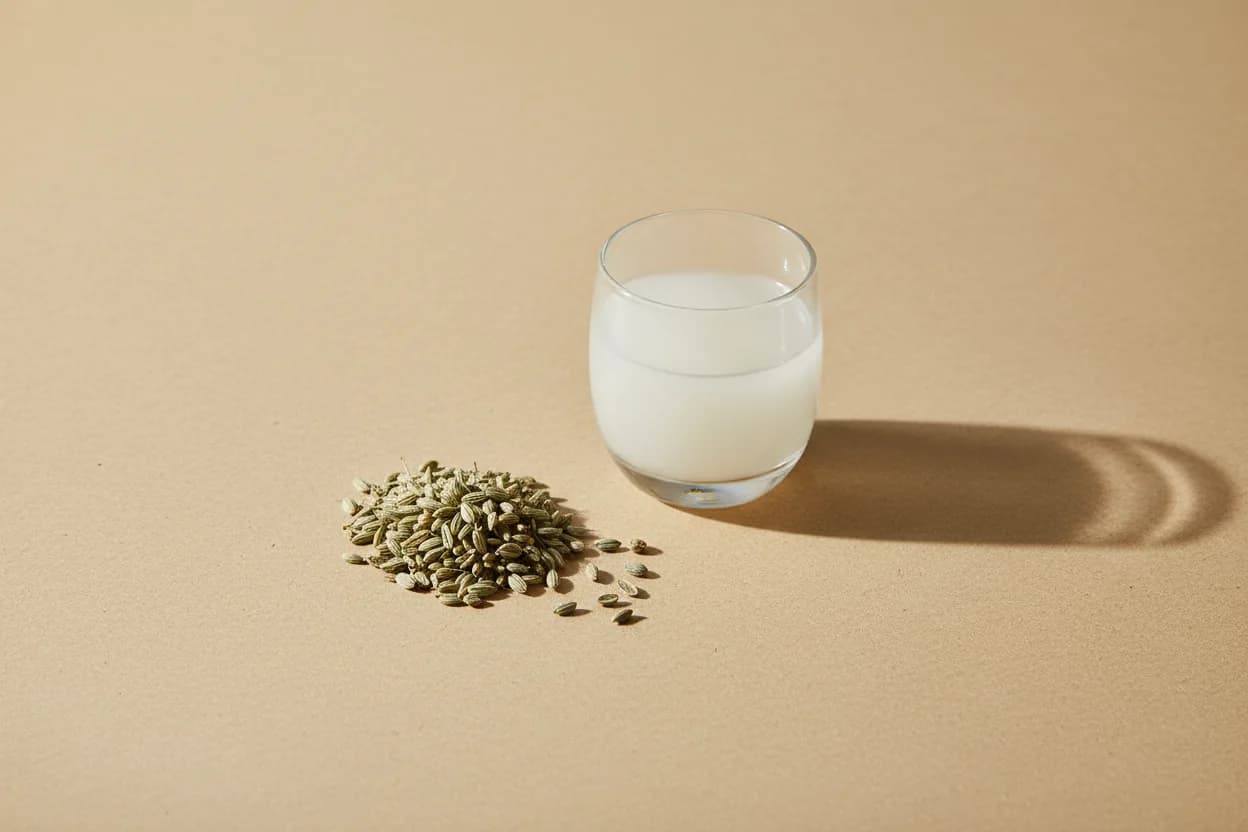
Pour arak into a glass and it is clear. Add water and, in the second it takes the water to fall, the whole glass goes opaque white. Not gradually, and not from the top down. All at once, throughout, like a held breath.
It is worth being precise about what has not happened, because most explanations get this wrong. Nothing was added. Nothing was stirred. No emulsifier is present, and none is needed. Nobody released anything. The drink reorganised itself, and it did so because you changed the solvent underneath it.
A molecule that will not stay dissolved
Anise seed is the fruit of Pimpinella anisum, an annual in the carrot family, and its oil is dominated to an unusual degree by a single compound: trans-anethole, C₁₀H₁₂O. 4 Depending on the source and the harvest it accounts for somewhere in the region of eighty to ninety-five per cent of the essential oil. When you taste anise, you are essentially tasting one molecule.
That molecule has one property that matters here above all others. It dissolves readily in ethanol and very poorly in water. In a bottle of arak at full strength, the alcohol is doing the work of holding a large amount of anethole in solution, and it manages comfortably.
Now add water. You have not touched the anethole, but you have diluted the only thing keeping it dissolved. The solvent quality drops below what the anethole needs, and the mixture finds itself holding more of the compound than it can carry. What happens next is called homogeneous nucleation: the anethole comes out of solution everywhere at once, spontaneously, forming a vast number of tiny droplets throughout the liquid rather than separating into a layer. Those droplets scatter light, and scattered light is white. That is the cloud.
It has a name, and a paper
In 2003, Steven Vitale and Joseph Katz published a study in Langmuir on exactly this class of dispersion, and gave it the name it now carries in the physical chemistry literature. The paper is titled, in part, The Ouzo Effect. 1 There is something very satisfying about a peer-reviewed journal formally adopting the name of a drink because the drink was the clearest available demonstration of the phenomenon.
Two years later a group in Amsterdam went at the anethole system directly and worked out how the resulting emulsion behaves. Their finding is the interesting one. The droplets do not coalesce, which is what an ordinary unstable emulsion does as it collapses. They grow by Ostwald ripening, meaning larger droplets slowly gain material at the expense of smaller ones, and then they stop. The reported saturation radius is around 1.5 micrometres, and once the droplets reach it the cloudy emulsion stays cloudy for months. 2
So the milkiness is not a transient stage on the way to separating, but a stable state, arrived at without a drop of surfactant, by a liquid that was simply pushed past what it could hold.
From the glass to the laboratory
Here is where a table trick becomes genuinely useful. Making very small droplets normally requires brute force: ultrasonic probes, high-shear mixers, machinery that puts energy in until large droplets break into small ones. Spontaneous emulsification does the same job for free, because the droplets never had to be broken. They condensed at that size.
François Ganachaud and Joseph Katz laid this out in 2005 in a paper whose subtitle is the whole argument: spontaneous emulsification as an alternative to ultrasonic and high-shear devices. 3 Dissolve a polymer in a water-miscible solvent, add water, and instead of anethole droplets you get polymer nanoparticles and nanocapsules, of the sort used to carry drugs. The technique is now standard enough that people making pharmaceutical nanoparticles refer to the ouzo region of a phase diagram without any sense that they are quoting a bar.
Three plants, one molecule
The other striking thing about anethole is how many unrelated plants have arrived at it. Anise and fennel are both Apiaceae, the carrot and parsley family, so their shared flavour is unremarkable. Star anise is not. Illicium verum sits in the Schisandraceae, a completely different lineage, and it produces trans-anethole as the dominant component of its own oil, typically somewhere between seventy-two and ninety-two per cent. 5
Two branches of the plant kingdom, separated by an enormous span of evolutionary time, converged on the same aromatic compound. Human beings then tasted them, filed them under the same flavour, and gave them nearly the same name. Our category was built on the chemistry rather than the botany, and in this case the chemistry was right twice.
What it is actually good for, and for whom
Anise has been an after-dinner seed for a very long time, and the European Medicines Agency has a monograph on it. The recognised traditional uses are the ones you would guess: mild spasmodic digestive complaints such as bloating and flatulence, and as an expectorant in coughs associated with a cold. The dosing given is one to three and a half grams of whole or freshly crushed seed in 150 millilitres of boiling water, three times a day, and not for more than two weeks. 6
The same monograph carries the caution that matters. Anise fruit contains estragole as a minor constituent, and the agency's separate statement on estragole is blunt about what it is: a genotoxic carcinogen, on the evidence of rodent studies, with a dose range of 1 to 10 milligrams per kilogram of body weight identified as the relevant range for risk characterisation. 7 That range sits roughly a hundred to a thousand times above what normal use of a herbal product delivers, which is the part worth holding onto. This is a reason to avoid drinking concentrated essential oil, not a reason to fear a cup of tea.
The monograph itself reaches that conclusion in one sentence, saying the genotoxic risk from estragole is not considered relevant under its specified conditions of use, short-term use in adolescents, adults and elderly, because of the small amount present in an infusion made from aniseed. 6
Read the qualifiers, though, because they carry the real advice. The monograph states plainly that use in children under twelve is not recommended, and that in the absence of sufficient data it is not recommended in pregnancy or while breastfeeding. 6 That is worth saying out loud in a region where anise water is a traditional remedy given to infants with colic. The regulator has not evaluated it as safe for that age group. It simply did not include them.
That is not the reason anyone reaches for it. You reach for it because a few seeds crushed into hot water taste like the end of a long meal, and because a glass of arak going white in front of you is one of the few moments where you can watch physics happen at the table. Nothing was added; it simply could not stay dissolved.
Sources
Every numbered claim above points here. Links go to the paper, record, or authority itself.
- 1.
Vitale SA, Katz JL. Liquid Droplet Dispersions Formed by Homogeneous Liquid-Liquid Nucleation: The Ouzo Effect. Langmuir. 2003;19(10):4105-4110.
https://doi.org/10.1021/la026842o - 2.
Sitnikova NL, Sprik R, Wegdam G, Eiser E. Spontaneously Formed trans-Anethol/Water/Alcohol Emulsions: Mechanism of Formation and Stability. Langmuir. 2005;21(16):7083-7089.
https://doi.org/10.1021/la046816l - 3.
Ganachaud F, Katz JL. Nanoparticles and Nanocapsules Created Using the Ouzo Effect: Spontaneous Emulsification as an Alternative to Ultrasonic and High-Shear Devices. ChemPhysChem. 2005;6(2):209-216.
https://doi.org/10.1002/cphc.200400527 - 4.
PubChem Compound Summary CID 637563, trans-Anethole. National Center for Biotechnology Information.
https://pubchem.ncbi.nlm.nih.gov/compound/637563 - 5.
Sharafan M, Jafernik K, Ekiert H, et al. Illicium verum (Star Anise) and Trans-Anethole as Valuable Raw Materials for Medicinal and Cosmetic Applications. Molecules. 2022;27(3):650.
https://doi.org/10.3390/molecules27030650 - 6.
European Medicines Agency, Committee on Herbal Medicinal Products. Community herbal monograph on Pimpinella anisum L., fructus. EMA/HMPC/321184/2012, final, 12 November 2013.
https://www.ema.europa.eu/en/documents/herbal-monograph/final-community-herbal-monograph-pimpinella-anisum-l-fructus_en.pdf - 7.
European Medicines Agency, Committee on Herbal Medicinal Products. Public Statement on the Use of Herbal Medicinal Products Containing Estragole. EMEA/HMPC/137212/2005.
https://www.ema.europa.eu/en/documents/scientific-guideline/public-statement-use-herbal-medicinal-products-containing-estragole_en.pdf