Anise is not thirteen times sweeter than sugar, and nobody has ever checked
Sweet taste runs through a single receptor that will accept a sugar, a protein or a synthetic molecule with equal enthusiasm. Which is how anise tastes sweet with no sugar in it. The famous number attached to that fact, though, traces back to an uncited sentence, and the measurement behind it could not have been made.
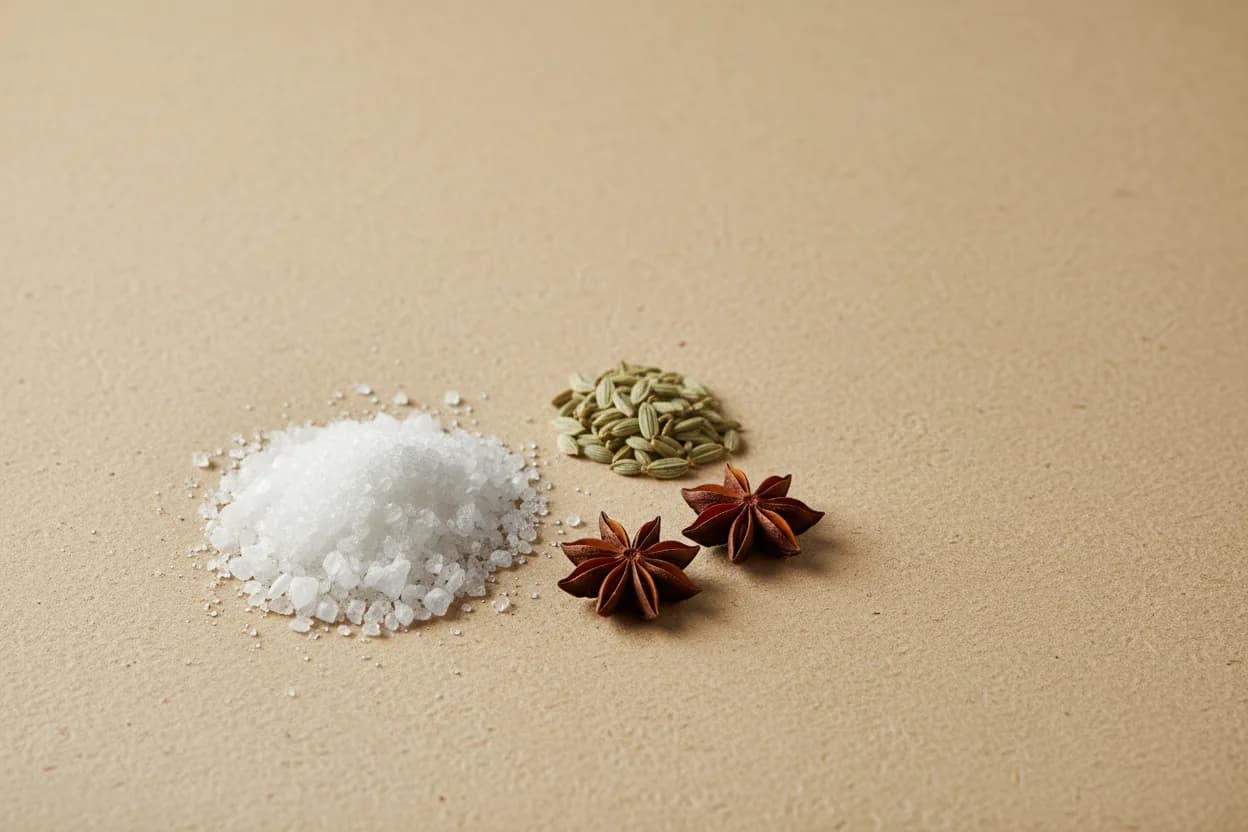
Chew an anise seed and the first thing that arrives, before the liquorice note and the cooling, is sweetness. There is no sugar in it. A seed is mostly oil and fibre, and the compound doing the work is anethole, a small aromatic molecule that looks nothing like sucrose. Somewhere along the way you will read that it is thirteen times sweeter than sugar.
That number is the reason I started this note, and it turned out to be the most interesting thing in it, though not for the reason I expected. Start with the receptor, because the receptor explains the first half of the puzzle completely.
One receptor, and it is not fussy
Everything you have ever found sweet went through the same door. In 2001 and 2002, two groups established that mammalian sweet taste is transduced by a single receptor made of two protein subunits stuck together, T1R2 and T1R3, and that the human version responds to a startlingly wide range of compounds. 1 2 Sugars, synthetic sweeteners, sweet-tasting proteins and various plant glycosides all activate the same heterodimer. There is no second sweet receptor waiting in reserve.
Which raises the obvious question of how one receptor accepts molecules with so little in common. Part of the answer is that it does not have one binding site. The receptor is a large assembly with several places a ligand can dock: the clamshell domains at the top of each subunit, a cysteine-rich linker, and the transmembrane bundle. Different sweeteners use different ones. During 2025 three separate groups published cryo-electron microscopy structures of the human sweet receptor, and they found sucralose and aspartame bound in the T1R2 clamshell. 23 A review this year points out that these structures sit awkwardly against older biochemistry indicating both subunits contribute, so the picture is still being argued over. 24 This is a field where the textbook is being rewritten right now.
Sweetness is something a receptor does
The strongest way to see this is to change the receptor and watch the taste change with it. In 2003 the Zuker lab engineered mice to carry the human T1R2 subunit instead of their own. The mice acquired human sweetener preferences, responding to compounds that normal mice ignore. 3 Nothing about the molecules changed. The animal's opinion of them did.
Losing the receptor does the same thing in reverse. Cats are indifferent to sugar because their Tas1r2 gene is a pseudogene, broken by deletions and no longer producing a working subunit. 4 A wider survey found the same loss in seven carnivorous species, and the detail that makes it convincing is which animals kept the gene. The spotted hyena, an obligate meat-eater, lost it. The aardwolf, a member of the same family that lives almost entirely on termites, kept it. 5 Diet predicts the receptor better than ancestry does.
Two more demonstrations. Lactisole blocks sweetness in humans and does nothing in rats, and the difference comes down to two amino acids in the fifth transmembrane domain of the rat receptor, valine 738 and lysine 735. 6 And miraculin, the protein from the West African miracle berry, sits on the human receptor as an antagonist at neutral pH and converts to an agonist when the pH drops, so the berry makes a lemon taste like lemonade. 7 The molecule in your mouth has not changed. The receptor's reading of it has.
A protein sweeter than sugar
If sweetness were a property of sugar chemistry, sweet proteins could not exist. They do. Thaumatin, from the West African plant Thaumatococcus daniellii, is a folded protein of 207 amino acids. 9 Brazzein is smaller still, 54 residues and about 6,500 daltons, and UniProt classifies it as a defensin-like protein with antimicrobial activity, meaning its evolutionary day job has nothing to do with taste. 11
The 1985 paper that solved thaumatin's structure states the potency plainly: thaumatin and monellin are about 3,000 times sweeter than sugar by weight and roughly 100,000 times sweeter on a molar basis. 8 Per molecule, a protein with no carbohydrate in it is five orders of magnitude better at activating your sweet receptor than sucrose is.
Why every sweetness multiplier is soft
Before returning to the anise, the numbers themselves need a warning label, because they are much less solid than their decimal points suggest.
The paper that introduced brazzein contains the cleanest illustration I have seen. In one sentence, from one panel, the authors report brazzein as 2,000 times sweeter than sucrose compared against a 2 per cent sucrose solution and 500 times compared against a 10 per cent one. 10 Same protein, same laboratory, same afternoon, and a fourfold difference depending only on which reference you pick.
A 2012 study measured this properly across five sweeteners with 34 subjects. Over a range from 3 to 20 per cent sucrose equivalence, sucralose's relative sweetness ran from 220 to 1,900, an eightfold swing, and rebaudioside A from 300 to 440. The authors state that relative sweetness was highly concentration dependent. 12 The reason is in the psychophysics: bulk sweeteners like sucrose have steep intensity curves, while high-potency sweeteners have flat ones, so the gap between them narrows as you climb. Tagatose, whose curve matches sucrose's almost exactly, is the control case, and its ratio really is constant.
That flatness has a consequence people rarely mention. High-potency sweeteners have a ceiling. The standard review of the field lists their first limitation as low maximal sweetness response, ahead of off-tastes and lingering. 14 Formally, their concentration-response curves are hyperbolic where sucrose's is linear, and a hyperbola has an asymptote. 13 You can keep adding sugar and it keeps getting sweeter. Do that with sucralose and at some point it stops, which is one reason nonnutritive sweeteners do not function as supernormal stimuli. 26
One more distortion, and it runs opposite to the way most people assume. Weight-based potency flatters small molecules, because a gram of a heavy molecule contains far fewer molecules. Convert to a molar basis and the ranking inverts: thaumatin goes from 3,000 times sweeter to about 100,000. 8 Aspartame's own discoverers, reporting their taste panel in 1976, put it at 150 to 200 times sucrose, more modest than the round 200 in circulation. 25 Per molecule, nothing synthetic comes close to the plant proteins.
So how sweet is anise
Nobody knows, and the number everyone repeats appears to have been made up.
The trail is short. The claim that anethole is thirteen times sweeter than sugar appears on Wikipedia in a sentence carrying no reference at all. 17 Chemical suppliers reproduce the figure and cite Wikipedia for it. Searches of the full-text biomedical literature turn up no measurement behind it.
The peer-reviewed literature does contain a number, and its provenance is worse. A 2022 paper in Scientific Reports states that anethole is about ten times sweeter than common edible sugar, and cites a source for it. 18 That source is a 2014 pharmacology study of how anethole relaxes smooth muscle in rat erectile tissue, framed as a lead for treating erectile dysfunction. Its abstract reports IC50 values and mentions taste nowhere. 19 A sweetness figure has been laundered through a citation to a paper about something else entirely.
Then there is a physical problem, and it is the part that convinced me. Relative sweetness is measured by finding the concentration of a compound in water that a taste panel judges equally sweet to a stated sucrose solution. Anethole's solubility in water is 0.111 grams per litre. 16 To match a 10 per cent sucrose reference at thirteen times the potency you would need about 7.7 grams per litre, roughly seventy times more anethole than water will hold. Against a gentler 2 per cent reference you would still need fourteen times its solubility. Run it the other way and a fully saturated anethole solution, at thirteen times potency, would taste as sweet as sugar water at 0.14 per cent, which is barely sweet at all. Anise is obviously sweeter than that. The standard experiment cannot have produced this number, because the standard experiment cannot be performed on anethole.
What is actually known
In March 2025 somebody finally put anethole on the receptor. A Japanese group tested plant aroma compounds against cells expressing human T1R2 and T1R3 and found that anethole activates the human receptor, and does not activate the mouse one. 15 So the sweetness is real, it is receptor-mediated, and it is specific to our version of the protein.
The same paper is careful about what it did not establish. Anethole was applied at a single concentration, the authors state they could not calculate EC50 values from their dose-response data, and the human sensory panel in that study tested a different compound. No binding site was localised for anethole. Their broader conclusion is the useful one: highly volatile hydrophobic compounds appear to generate aroma and sweetness through a different mechanism from hydrophilic sweeteners such as sucrose. 15
Which makes sense of the whole thing. Sucrose works by dissolving in saliva and reaching the receptor in bulk. Anethole cannot do that; it is barely soluble. It arrives volatile and lipophilic, partitioning into membranes and mucosa, and reaching the receptor by a route that a solubility-based potency number was never designed to describe. Asking how many times sweeter than sugar it is turns out to be a question with a category error inside it.
The map that was never there
One last correction, since it belongs to any note about sweet taste. The diagram showing sweet at the tip of the tongue, bitter at the back and sour along the sides is wrong, and the way it went wrong is more interesting than the usual telling.
It is often said to come from a mistranslation of a German paper. It does not. Hänig in 1901 measured real, small differences in threshold sensitivity across the tongue. Forty years later Edwin Boring replotted that data in a textbook as normalised reciprocals, a transformation that visually inflated modest differences into apparent territories, and the picture escaped into every classroom in the world. 20 Careful remeasurement in 1974 found all four qualities detectable everywhere there are taste buds. 21 Small regional differences are genuine; the zones are an artefact of a graph.
The receptors are not confined to the tongue either. The same sweet receptor sits in the gut, where it senses glucose and triggers release of the hormone GLP-1, and the effect can be blocked by lactisole, the same inhibitor that blocks sweetness in the mouth. 22 Your intestine tastes sugar. It just does not tell you about it.
The seed
So the honest answer to a good question. Anise tastes sweet because anethole fits a receptor that evolved to detect sugar and turns out to accept a great many things that are not sugar, including a 54-residue antimicrobial protein from a West African vine. How much sweeter than sugar it is remains unmeasured, and the number in circulation is a piece of folklore with a citation trail that ends in a sentence nobody sourced.
I find that oddly reassuring. A spice that has been chewed after meals for several thousand years, in kitchens from Damascus to Delhi, still has an unanswered question sitting in the middle of it, and the question only became askable in the last year or so. Somebody with a taste panel, a solubility problem and some patience could settle it. In the meantime the seed does what it has always done, which is to taste sweet on no evidence at all.
Sources
Every numbered claim above points here. Links go to the paper, record, or authority itself.
- 1.
Nelson G, Hoon MA, Chandrashekar J, Zhang Y, Ryba NJP, Zuker CS. Mammalian sweet taste receptors. Cell. 2001;106(3):381-390.
https://doi.org/10.1016/S0092-8674(01)00451-2 - 2.
Li X, Staszewski L, Xu H, Durick K, Zoller M, Adler E. Human receptors for sweet and umami taste. PNAS. 2002;99(7):4692-4696.
https://doi.org/10.1073/pnas.072090199 - 3.
Zhao GQ, Zhang Y, Hoon MA, Chandrashekar J, Erlenbach I, Ryba NJP, Zuker CS. The receptors for mammalian sweet and umami taste. Cell. 2003;115(3):255-266.
https://doi.org/10.1016/S0092-8674(03)00844-4 - 4.
Li X, Li W, Wang H, et al. Pseudogenization of a sweet-receptor gene accounts for cats' indifference toward sugar. PLoS Genetics. 2005;1(1):27-35.
https://doi.org/10.1371/journal.pgen.0010003 - 5.
Jiang P, Josue J, Li X, et al. Major taste loss in carnivorous mammals. PNAS. 2012;109(13):4956-4961.
https://doi.org/10.1073/pnas.1118360109 - 6.
Winnig M, Bufe B, Meyerhof W. Valine 738 and lysine 735 in the fifth transmembrane domain of rTas1r3 mediate insensitivity towards lactisole of the rat sweet taste receptor. BMC Neuroscience. 2005;6:22.
https://doi.org/10.1186/1471-2202-6-22 - 7.
Koizumi A, Tsuchiya A, Nakajima K, et al. Human sweet taste receptor mediates acid-induced sweetness of miraculin. PNAS. 2011;108(40):16819-16824.
https://doi.org/10.1073/pnas.1016644108 - 8.
de Vos AM, Hatada M, van der Wel H, Krabbendam H, Peerdeman AF, Kim SH. Three-dimensional structure of thaumatin I, an intensely sweet protein. PNAS. 1985;82(5):1406-1409.
https://doi.org/10.1073/pnas.82.5.1406 - 9.
UniProtKB P02883, Thaumatin I, Thaumatococcus daniellii. UniProt Consortium.
https://www.uniprot.org/uniprotkb/P02883/entry - 10.
Ming D, Hellekant G. Brazzein, a new high-potency thermostable sweet protein from Pentadiplandra brazzeana B. FEBS Letters. 1994;355(1):106-108.
https://doi.org/10.1016/0014-5793(94)01184-2 - 11.
UniProtKB P56552, Brazzein, Pentadiplandra brazzeana. UniProt Consortium.
https://www.uniprot.org/uniprotkb/P56552/entry - 12.
Fujimaru T, Park JH, Lim J. Sensory characteristics and relative sweetness of tagatose and other sweeteners. Journal of Food Science. 2012;77(9):S323-S328.
https://doi.org/10.1111/j.1750-3841.2012.02844.x - 13.
DuBois GE. Molecular mechanism of sweetness sensation. Physiology and Behavior. 2016;164(Pt B):453-463.
https://doi.org/10.1016/j.physbeh.2016.03.015 - 14.
DuBois GE, Prakash I. Non-caloric sweeteners, sweetness modulators, and sweetener enhancers. Annual Review of Food Science and Technology. 2012;3:353-380.
https://doi.org/10.1146/annurev-food-022811-101236 - 15.
Horie F, Sanematsu K, Yasumatsu K, Hirokawa T, Shigemura N, Yamashita A, Kusakabe Y. Receptor mechanism producing a sweet taste from plant aroma compounds. Scientific Reports. 2025;15:6795.
https://doi.org/10.1038/s41598-025-89711-9 - 16.
PubChem Compound Summary CID 637563, Anethole. National Center for Biotechnology Information.
https://pubchem.ncbi.nlm.nih.gov/compound/637563 - 17.
Anethole. Wikipedia. Cited here as the object of examination, being the earliest traceable appearance of the figure and carrying no reference for it.
https://en.wikipedia.org/wiki/Anethole - 18.
Lal M, Begum T, Gogoi R, et al. Anethole rich Clausena heptaphylla (Roxb.) Wight and Arn., essential oil pharmacology and genotoxic efficiencies. Scientific Reports. 2022;12(1):9978.
https://doi.org/10.1038/s41598-022-13511-8 - 19.
Cabral PH, de Morais Campos R, Fonteles MC, Santos CF, Leal Cardoso JH, do Nascimento NR. Effects of the essential oil of Croton zehntneri and its major components, anethole and estragole, on the rat corpora cavernosa. Life Sciences. 2014;112(1-2):74-81.
https://doi.org/10.1016/j.lfs.2014.07.022 - 20.
Spence C. The tongue map and the spatial modulation of taste perception. Current Research in Food Science. 2022;5:598-610.
https://doi.org/10.1016/j.crfs.2022.02.004 - 21.
Collings VB. Human taste response as a function of locus of stimulation on the tongue and soft palate. Perception and Psychophysics. 1974;16(1):169-174.
https://doi.org/10.3758/BF03203270 - 22.
Jang HJ, Kokrashvili Z, Theodorakis MJ, et al. Gut-expressed gustducin and taste receptors regulate secretion of glucagon-like peptide-1. PNAS. 2007;104(38):15069-15074.
https://doi.org/10.1073/pnas.0706890104 - 23.
Juen Z, Lu Z, Yu R, Chang AN, Wang B, Fitzpatrick AWP, Zuker CS. The structure of human sweetness. Cell. 2025;188(15):4141-4153.e18.
https://doi.org/10.1016/j.cell.2025.04.021 - 24.
Cornut C, Belloir C, Karolkowski A, Lalis M, Chometton S, Fiorucci S, Topin J, Briand L. Recent advances in the structural biology of the sweet taste receptor. Chemical Senses. 2026;51:bjag010.
https://doi.org/10.1093/chemse/bjag010 - 25.
Mazur RH. Aspartame: a sweet surprise. Journal of Toxicology and Environmental Health. 1976;2(1):243-249.
https://doi.org/10.1080/15287397609529429 - 26.
Antenucci RG, Hayes JE. Nonnutritive sweeteners are not supernormal stimuli. International Journal of Obesity. 2015;39(2):254-259.
https://doi.org/10.1038/ijo.2014.109