Nobody was poisoned by the herb on the label
Chinese hospitals are selling herbal lattes, one Chengdu shop sold sixteen thousand cups of stay-up-late water in six months, and every market figure you will read traces to a single firm. The trend is new, the government plan behind it is ten years old, and the documented harms almost all came from something the packet never mentioned.
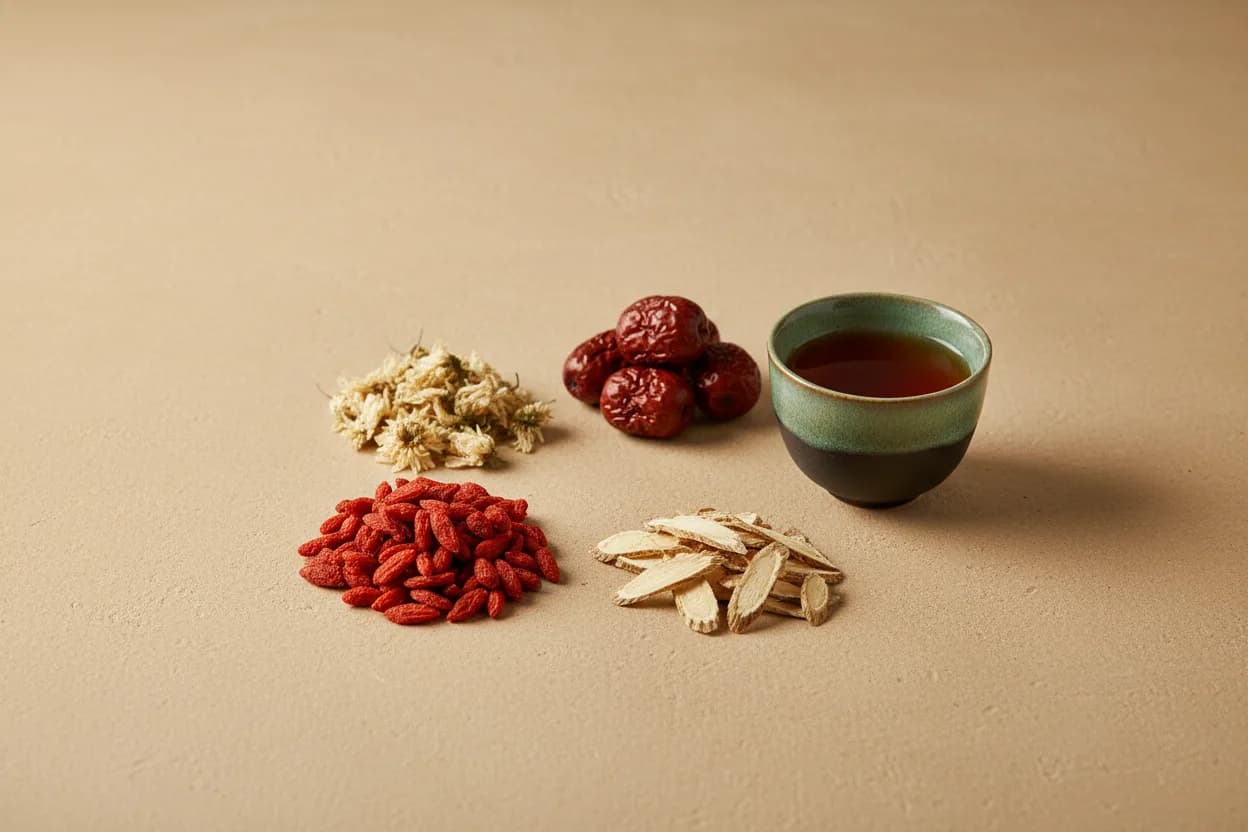
In September 2023 a hospital in Hangzhou broke its own website. The Zhejiang Provincial Hospital of Traditional Chinese Medicine had been selling suanmeitang, the dark sour-plum drink, through its online pharmacy. Demand rose so fast that the servers gave out and the drink sold out; China Daily reported around 200,000 servings in three days, more than ten times the usual volume. 1 Reported figures vary between outlets, which is a warning worth carrying into everything that follows.
What that hospital started is now a category. At the First Affiliated Hospital of Guizhou University of TCM you can buy a longan latte, a tangerine-peel coffee or a sour-plum slush from a menu of more than twenty items; young people are about seventy per cent of the customers and single-day sales have passed 10,000 yuan. The second affiliated hospital runs its own brand and shifts around 200 cups on a good day. 2 In Chengdu, a municipal hospital bakes medicinal breads at 12 yuan each, seventy or so in the morning and another hundred to two hundred in the afternoon, and mostly sells out. 3
Outside the hospitals the same thing is happening faster. One shop of a chain in Chengdu sold more than 16,000 cups of 13.9-yuan "stay-up-late water" in six months, roughly 220,000 yuan from a single line on the menu. 5 By late 2024 there were more than 6,000 wellness-tea shops in China, about double the count a year earlier. 6
The commercial pioneer got there first and did worse. Beijing Tong Ren Tang, a pharmacy house founded in 1669, opened a coffee shop under its Zhima Health brand in the capital's business district in October 2019, selling goji lattes and tangerine-peel lattes at around 35 yuan. The flagship took 20 million yuan in 2020 against an internal forecast of half that. Management then announced plans for 300 stores in Beijing and 50 more elsewhere within a year. At the time of the report they had three. 4 Their new-retail manager was refreshingly blunt about the point of the exercise: the goal is to promote TCM health management by selling coffee, and they are not aiming to make money selling coffee.
The numbers nobody actually has
Here is the thing that took me longest to establish and that changes how you should read every article on this subject. There is no independent measurement of this market. The figure you will meet everywhere, that wellness tea drinks were worth 41.16 billion yuan in 2023 and will pass 100 billion by 2028, comes from a single Chinese commercial research firm, iiMedia Research, which does not publish a methodology for it. Xinhua, China Daily and the Chinese business press all cite the same series, which creates an impression of corroboration where there is one source repeated four times.
Worse, two adjacent categories with confusingly similar names are routinely merged in English coverage. Bottled Chinese-style wellness water was a 450 million yuan category in 2023, forecast to reach 10 billion by 2028. Wellness tea drinks were 41.16 billion, forecast to reach 100 billion. 6 Those differ by two orders of magnitude and the Chinese numerals for them are easy to garble.
The contrast with the official statistics is stark. The Chinese state publishes excellent figures for traditional medicine as medicine: total output value of the TCM pharmaceutical industry at 786.6 billion yuan in 2015, 28.55 per cent of all Chinese pharmaceutical output, 3,966 TCM hospitals, 452,000 practitioners, 910 million visits in a year. 7 For traditional medicine as a beverage, nobody has anything.
It was written into the plan a decade ago
The convenient story is that this is a youth movement, bubbling up from Xiaohongshu into hospital lobbies. Read the State Council's strategic plan for traditional medicine, issued in February 2016, and a different picture appears. Among its instructions: support private capital in running health-preservation institutions and develop them into groups or chains, and encourage TCM institutions to develop health foods, health products and health devices. It also calls explicitly for fusing traditional medicine with tourism and catering. 8 The hospital selling you a longan latte in 2025 is executing a document from 2016.
What the WHO actually did
You will read that the World Health Organization endorsed traditional Chinese medicine in 2019. It is worth going to the primary document, because the claim is wrong in one direction and the dismissal of it is wrong in the other.
ICD-11 added Chapter 26, a supplementary chapter of traditional medicine conditions, harmonising diagnostic categories from China, Japan and Korea. The WHO's own reference guide describes it as a new supplementary chapter for optional use, whose purpose is to let traditional medicine encounters be counted nationally and internationally. It states that the chapter has been designed for morbidity recording and must not be used for mortality coding, and recommends that its codes be used alongside conventional diagnoses so the two can be compared. Then it says this. 9
As with other ICD chapters, the TM1 chapter is a tool for classifying, diagnosing, counting, communicating and comparing TM conditions, it will also assist research and evaluation to assess the safety and efficacy of TM. This chapter not judging or endorsing TM practice or the efficacy of any TM intervention.
So the WHO gave these categories a code set for counting, and said in the same document that it was not endorsing any of them. The criticism was still substantial. Nature's editorial argued that inclusion risks legitimising an unfounded underlying philosophy and some unscientific practice, and that whatever the WHO intends, a person diagnosed with a TCM-labelled condition will probably be prescribed a TCM remedy. 10 Both things can be true: it is not an endorsement, and it is not nothing either.
The tradition underneath
None of this is new in the way trend coverage implies. Cantonese cooling tea, liang cha, was inscribed on China's first list of national intangible cultural heritage by State Council notice in May 2006, at serial number 439, in an unusual three-way nomination by the Guangdong provincial culture bureau together with the Hong Kong and Macao governments. 11 Hong Kong's own heritage office describes it as a decoction of Chinese medicinal herbs made according to traditional Chinese medicine theories, with a history in the territory of over a hundred years, and notes that the tea shops served as neighbourhood social centres. 12
"Cooling" here means something specific inside the tradition's own logic, and it should be explained rather than either endorsed or sneered at. The operative ideas are clearing heat and dispelling dampness. South China's climate is characterised as hot and damp, and different decoctions are drunk to prevent what the tradition calls the heat and damp symptom-complex. 12 These are categories in a humoral-style aetiology. They do not map onto anything in Western physiology, and reading them as thermal or metabolic claims misunderstands what is being said.
What liang cha is made of turns out to be a live question. A 2024 study collected 33 samples of Five Flowers Tea, one of the most popular formulas, from grocery stores, herb retailers, market stalls and pharmacies across thirteen Hong Kong districts. The classical recipe names five species. Across the samples the team identified 23 species from 18 plant families, and observed plainly that there is no official formula for Five Flowers Tea in the Chinese Pharmacopoeia. 13 An older survey of herbal teas in tropical China catalogued 127 source species in use. 14 Liang cha is a category of drink, not a recipe.
The commercial history has one hard date. Wanglaoji, the brand that became the red can, goes back to 1828, and the twentieth century split it in two: a Hong Kong branch sold the original recipe to the company that became JDB while Guangzhou Pharmaceutical kept the mainland trademark. They fought over the can for years, and in August 2017 China's Supreme People's Court held that both had contributed to the brand's reputation and must share the red trade dress. 15
The part that actually matters
In 1993 two young women in Brussels presented with rapidly progressive kidney fibrosis. A survey of the city's nephrology centres found nine women under fifty in terminal or near-terminal renal failure, all of whom had attended the same weight-loss clinic, which had added two Chinese herbs to its regimen in May 1990. Three of a further 25 randomly selected patients from the same programme also had impaired kidney function. Analysis found alkaloids that did not match the labelled plants. 16
By 2000 the cohort had grown to 105 patients. Because the compound was suspected of causing cancer, 39 of them with end-stage renal disease had their kidneys and ureters removed prophylactically. Urothelial carcinoma was found in 18, a prevalence of 46 per cent. Of the remaining 21, nineteen had urothelial dysplasia and two had normal tissue. DNA adducts from the compound were present in every sample analysed. 17 That is not an epidemiological signal teased out of a database. It is a surgical series.
The compound is aristolochic acid, and the IARC classifies both it and the plants containing it as Group 1, carcinogenic to humans, with sufficient evidence in humans for cancer of the renal pelvis and ureter. 18 A Taiwanese study using national insurance records compared 4,594 new urinary tract cancers against 174,701 controls and found a clean dose-response: odds ratios rising from 1.6 to 2.1 with cumulative herb dose, and from 1.4 to 2.0 with estimated aristolochic acid dose, with a significant linear trend. 19 That is what turned a Belgian accident into a public health problem, because it shows the effect at ordinary prescribed doses in an ordinary health system.
Now the structural fact that the sceptical write-ups usually skip. The Belgian harm did not come from a herb anyone meant to use. It came from a name collision: Stephania tetrandra, han fang ji, had been replaced in the supply chain by Aristolochia fangchi, guang fang ji, two different plants sharing a trade name. The British response in 2001 shows exactly how the problem was understood. The order banned the entire genus Aristolochia, and separately banned any product labelled as containing Mu Tong or Fangji, and in doing so also banned eight species that are not toxic at all, including Stephania tetrandra itself. 20 You cannot regulate the species when the marketplace sells by the name.
Whether any of this touches your goji tea
It does not, and saying so precisely matters more than the alarm does. Aristolochic acids are constituents of one plant family, the Aristolochiaceae. Goji is a Solanaceae, a relative of the tomato. Chrysanthemum is an Asteraceae, jujube a Rhamnaceae, hawthorn a Rosaceae, ginseng an Araliaceae. When a 2015 analytical study screened 165 Aristolochiaceous samples it found aristolochic acid I in 86.67 per cent of them, and detected none at all in the non-Aristolochiaceous samples. 21 A single-ingredient chrysanthemum or goji tea from a traceable supplier does not carry this risk.
The residual danger is not botanical, it is the supply chain, and the same 2015 study found it still operating. Of 28 raw drugs bought on the market, four were mislabelled, including one sold as Stephania tetrandra that was actually Aristolochia fangchi. 21 That is the Belgian substitution, unchanged, twenty-two years later, found by researchers who went shopping.
One further caution about how this story gets told. A 2017 paper reported the aristolochic acid mutational signature in 78 per cent of 98 Taiwanese liver cancers and in 47 per cent of Chinese cases in a wider set. 22 A later study screened 1,256 liver tumours from three Chinese centres and found the adducts in 5.10 per cent and a dominant signature in 8.41 per cent, and found that the compound did not increase liver tumours in adult mice. 23 The urinary tract case is settled. The liver case is contested, and a mutational signature records that a mutagen was present, which is not the same as showing it drove that tumour.
Three risks that are actually about wellness drinks
Goji and warfarin is the one that belongs in this piece, because goji tea is not an obscure formula. A 61-year-old woman stable on warfarin developed an INR of 4.1 after four days of drinking three to four glasses of concentrated goji tea daily; stopping the tea returned her to range within a week and she stayed there across seven subsequent readings. 24 Several further cases have been published. Anyone on an anticoagulant should treat a daily goji habit as a change in medication, which is a small ask and a genuinely useful one.
Adulteration is better documented than most people expect. Hong Kong's tertiary toxicology laboratory reviewed every case from 2005 to 2015 in which a proprietary Chinese medicine or health product was confirmed to contain undeclared drugs: 404 cases, 487 products, 1,234 adulterants. The commonest were anti-inflammatories, appetite suppressants and corticosteroids. Sixty-five per cent of those patients had adverse effects, most often psychosis, iatrogenic Cushing syndrome and hypoglycaemia, with fourteen severe cases and two deaths. 25 Once again, the harm came from something the label did not mention.
Liver injury deserves an honest number in both directions. A study of 25,927 confirmed cases of drug-induced liver injury across 308 Chinese medical centres found traditional medicines and herbal or dietary supplements to be the single largest implicated category at 26.81 per cent, ahead of anti-tuberculosis drugs. 26 That is a striking figure. It is also a proportion of injury cases, not a risk per user, and it is inflated by how much traditional medicine China consumes. The study cannot tell you your odds, only what fills the wards.
Where it is good, and the shape of that
Fairness requires the other column. In 2024 Nature Medicine published a trial of Qiliqiangxin, a fixed Chinese herbal capsule, in heart failure with reduced ejection fraction: 3,110 patients across 133 hospitals, double-blind and placebo-controlled, median follow-up 18.3 months. The primary composite of heart-failure hospitalisation and cardiovascular death fell from 30.03 to 25.02 per cent, a hazard ratio of 0.78. 27 That is a properly powered trial with hard endpoints, and it is positive. It is also a standardised manufactured capsule rather than a decoction, all its sites were in one country, and nobody has replicated it elsewhere yet.
The field's greatest success points the same way. Artemisinin came out of a systematic screen of traditional remedies and it cures malaria. The WHO's position on the plant it came from is that it does not support the promotion or use of Artemisia plant material in any form for preventing or treating malaria. 28 The screen worked. The brew did not.
As for the wider literature, two numbers are worth holding together. Of 42 Cochrane reviews of Chinese herbal medicine, 22 concluded there was not enough good evidence to say anything, and 20 found a suggestion of benefit qualified by a caveat about the quality and quantity of the studies. 29 And when researchers took 3,137 apparent randomised trials from a Chinese database and telephoned the original authors to ask how participants were actually allocated, only 207 of them, 6.8 per cent, turned out to have been randomised. 30 That is why a meta-analysis of thirty trials can be worth less than one good one, and why the heart failure trial above is worth taking seriously precisely because it was built differently.
What to take to the counter
The verified record splits along a line that has nothing to do with East and West. It runs between identified molecules and unidentified mixtures. Where a compound has been isolated and dosed, this tradition has produced both a Nobel Prize and a Group 1 carcinogen. Where the object is a mixture of unstated composition, the evidence thins to inconclusive reviews and the harms multiply.
And the thing that keeps recurring in the case reports is that almost nobody was hurt by the plant named on the packet. They were hurt by a substituted root, an undeclared steroid, a trade name shared by two species, a supplement whose label was a work of fiction. A hospital in Guiyang selling a longan latte over the counter, with a pharmacist and an ingredient list, is a different object from a sachet of unnamed powder bought online. So drink the chrysanthemum. Ask what is in the sachet.
Sources
Every numbered claim above points here. Links go to the paper, record, or authority itself.
- 1.
Rising demand for sour plum soup creates frenzy among youth. China Daily, 7 September 2023.
https://global.chinadaily.com.cn/a/202309/07/WS64f9cb63a310d2dce4bb48a3.html - 2.
Across China: Herbal drinks brew new wellness trend among Chinese youth. Xinhua, 11 October 2025.
https://english.news.cn/20251011/7dde2e2b00fd498dad0717fa05ef5f4c/c.html - 3.
Traditional Chinese medicine transforms into trendy beverages. China Daily, 24 January 2026.
https://www.chinadaily.com.cn/a/202601/24/WS69742d0aa310d6866eb35878_2.html - 4.
China's Tongrentang Eyes New Gains via Herbal TCM Coffee. Yicai Global, 14 January 2021.
https://www.yicaiglobal.com/news/china-tongrentang-eyes-new-gains-via-herbal-tcm-coffee- - 5.
一杯熬夜水半年单店卖出1.6万杯 [One shop sold 16,000 cups of stay-up-late water in six months]. Economic Observer (经济观察网), 12 November 2024.
https://finance.sina.com.cn/roll/2024-11-12/doc-incvupae8424879.shtml - 6.
小雪|中式养生水,"熬"出头了?[Chinese-style wellness water]. 21st Century Business Herald (21世纪经济报道), 22 November 2024.
https://www.21jingji.com/article/20241122/herald/229db59dd8e71a826baa8aab08a73c09.html - 7.
Traditional Chinese Medicine in China (white paper). State Council Information Office of the People's Republic of China, 6 December 2016.
http://english.www.gov.cn/archive/white_paper/2016/12/06/content_281475509333700.htm - 8.
中医药发展战略规划纲要(2016—2030年)[Outline of the Strategic Plan on the Development of Traditional Chinese Medicine 2016-2030]. State Council, 国发〔2016〕15号, 22 February 2016.
https://www.ndrc.gov.cn/fggz/fzzlgh/gjjzxgh/201705/t20170512_1196760.html - 9.
ICD-11 Reference Guide, sections 1.5 and 2.23.22, Traditional Medicine Conditions Module 1. World Health Organization.
https://icdcdn.who.int/icd11referenceguide/en/html/index.html - 10.
Editorial. The World Health Organization's decision about traditional Chinese medicine could backfire. Nature. 2019;570:5.
https://doi.org/10.1038/d41586-019-01726-1 - 11.
国务院关于公布第一批国家级非物质文化遗产名录的通知 [Notice on the first batch of national intangible cultural heritage]. State Council, 国发〔2006〕18号, 20 May 2006.
https://www.gov.cn/gongbao/content/2006/content_334718.htm - 12.
Herbal Tea. Intangible Cultural Heritage Office, Leisure and Cultural Services Department, Government of the Hong Kong Special Administrative Region.
https://www.icho.hk/en/web/icho/representative_list_herbaltea.html - 13.
Chan KT, Wu HY, Tin WY, But PPH, Cheung SCH, Shaw PC. Ethnopharmacology of five flowers herbal tea, a popular traditional beverage in Hong Kong and South China. Journal of Ethnobiology and Ethnomedicine. 2024;20:36.
https://doi.org/10.1186/s13002-024-00674-z - 14.
Hu SY. Herbal teas and populace health care in tropical China. American Journal of Chinese Medicine. 1997;25(1):103-134.
https://pubmed.ncbi.nlm.nih.gov/9167003/ - 15.
Herbal Tea Rivals Must Share Trademark, Supreme Court Says. Sixth Tone, August 2017.
https://www.sixthtone.com/news/1000705/herbal-tea-rivals-must-share-trademark-supreme-court-says - 16.
Vanherweghem JL, Depierreux M, Tielemans C, et al. Rapidly progressive interstitial renal fibrosis in young women: association with slimming regimen including Chinese herbs. Lancet. 1993;341(8842):387-391.
https://pubmed.ncbi.nlm.nih.gov/8094166/ - 17.
Nortier JL, Martinez MC, Schmeiser HH, et al. Urothelial carcinoma associated with the use of a Chinese herb (Aristolochia fangchi). New England Journal of Medicine. 2000;342(23):1686-1692.
https://pubmed.ncbi.nlm.nih.gov/10841870/ - 18.
Plants Containing Aristolochic Acid. In: IARC Monographs on the Evaluation of Carcinogenic Risks to Humans, Volume 100A: Pharmaceuticals. Lyon: International Agency for Research on Cancer; 2012.
https://www.ncbi.nlm.nih.gov/books/NBK304331/ - 19.
Lai MN, Wang SM, Chen PC, Chen YY, Wang JD. Population-based case-control study of Chinese herbal products containing aristolochic acid and urinary tract cancer risk. Journal of the National Cancer Institute. 2010;102(3):179-186.
https://doi.org/10.1093/jnci/djp467 - 20.
The Medicines (Aristolochia and Mu Tong etc.) (Prohibition) Order 2001, SI 2001/1841. United Kingdom, made 9 May 2001, in force 1 July 2001.
https://www.legislation.gov.uk/uksi/2001/1841/made - 21.
Wu L, Sun W, Wang B, et al. An integrated system for identifying the hidden assassins in traditional medicines containing aristolochic acids. Scientific Reports. 2015;5:11318.
https://doi.org/10.1038/srep11318 - 22.
Ng AWT, Poon SL, Huang MN, et al. Aristolochic acids and their derivatives are widely implicated in liver cancers in Taiwan and throughout Asia. Science Translational Medicine. 2017;9(412):eaan6446.
https://doi.org/10.1126/scitranslmed.aan6446 - 23.
Chen S, Dong Z, et al. Aristolochic acids exposure was not the main cause of liver tumorigenesis in adulthood. Acta Pharmaceutica Sinica B. 2022;12(5):2252-2267.
https://doi.org/10.1016/j.apsb.2021.11.011 - 24.
Lam AY, Elmer GW, Mohutsky MA. Possible interaction between warfarin and Lycium barbarum L. Annals of Pharmacotherapy. 2001;35(10):1199-1201.
https://pubmed.ncbi.nlm.nih.gov/11675844/ - 25.
Ching CK, Chen SPL, Lee HHC, et al. Adulteration of proprietary Chinese medicines and health products with undeclared drugs: experience of a tertiary toxicology laboratory in Hong Kong. British Journal of Clinical Pharmacology. 2018;84(1):172-178.
https://doi.org/10.1111/bcp.13420 - 26.
Shen T, Liu Y, Shang J, et al. Incidence and etiology of drug-induced liver injury in mainland China. Gastroenterology. 2019;156(8):2230-2241.e11.
https://doi.org/10.1053/j.gastro.2019.02.002 - 27.
Cheang I, Yao W, Zhou Y, et al. The traditional Chinese medicine Qiliqiangxin in heart failure with reduced ejection fraction: a randomized, double-blind, placebo-controlled trial. Nature Medicine. 2024;30(8):2295-2302.
https://doi.org/10.1038/s41591-024-03169-2 - 28.
The use of non-pharmaceutical forms of Artemisia. WHO/CDS/GMP/2019.14. World Health Organization, 10 October 2019.
https://www.who.int/publications/i/item/WHO-CDS-GMP-2019.14 - 29.
Manheimer E, Wieland S, Kimbrough E, Cheng K, Berman BM. Evidence from the Cochrane Collaboration for traditional Chinese medicine therapies. Journal of Alternative and Complementary Medicine. 2009;15(9):1001-1014.
https://pubmed.ncbi.nlm.nih.gov/19757977/ - 30.
Wu T, Li Y, Bian Z, Liu G, Moher D. Randomized trials published in some Chinese journals: how many are randomized? Trials. 2009;10:46.
https://doi.org/10.1186/1745-6215-10-46