Two plants called sage
The sage that Europe's thujone warnings are written about is not native to the Levant, and the one in your maramiyya is a different species with different chemistry. Also: what a cup actually carries, why the essential oil is the dangerous form, and why burning any leaf is a combustion problem rather than a botany one.
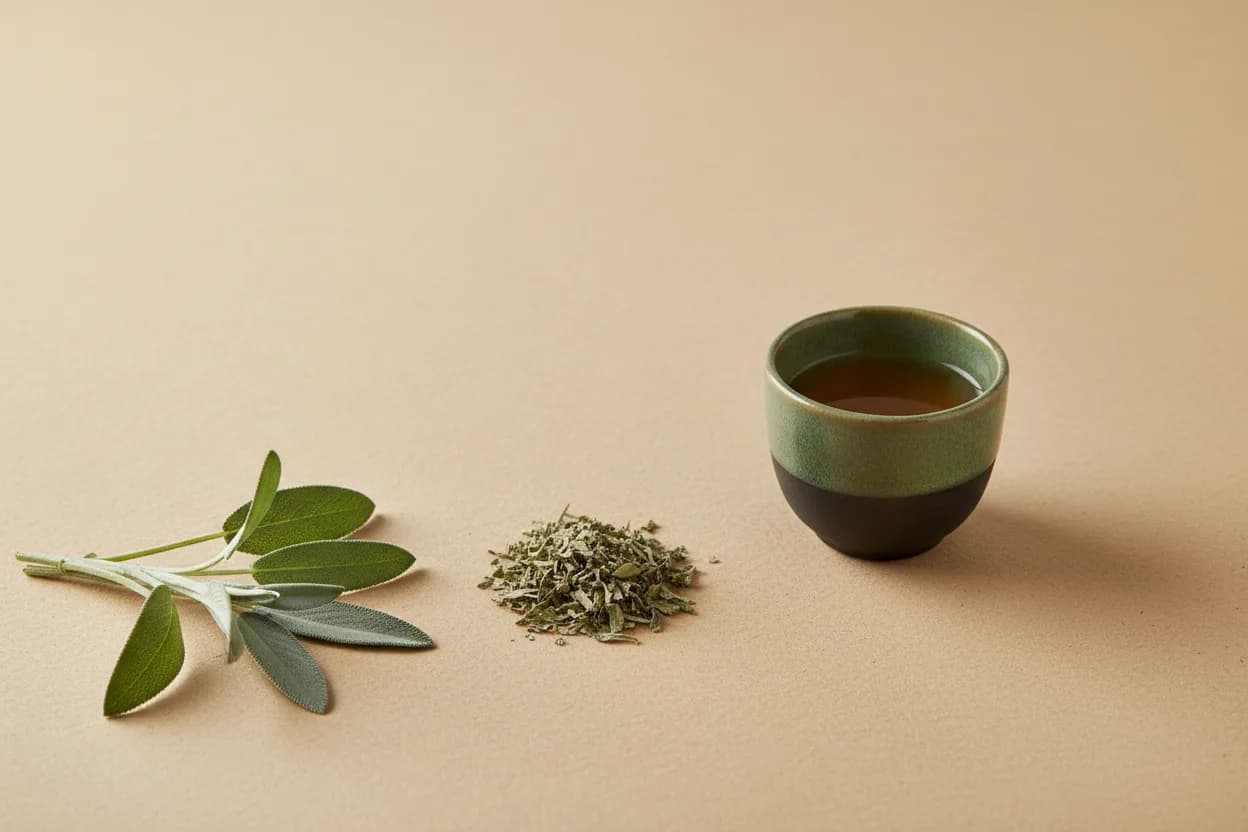
Between 1999 and 2005 a team of ethnobotanists visited forty Muslim graveyards in northern Israel and catalogued what grows in them and what people do with it, interviewing eighty informants across thirty-five villages. One plant turned up in 93.1 per cent of the cemeteries. 1 Sage is put on a tray with barley at birth rites, burned as incense on coals at weddings and feasts, woven into garlands at funerals, and used against the evil eye. It is a plant people meet at every threshold of a life.
The kitchen record is just as emphatic. A 2008 survey of wild edible plants across the northern West Bank collected 190 informants across five districts and 100 species; sage ranked second, with 131 citations, behind only za'atar. 2 In a separate survey of 100 traditional healers and herbalists on plants for diarrhoea, sage reached a fidelity level of 97 per cent, meaning that of the healers who named it, almost all named it for that one purpose. 3
So it seemed worth asking what is actually in the cup, and I ended up somewhere I did not expect: the sage that Europe's safety warnings are written about is a different plant.
Two plants called sage
English "sage" means Salvia officinalis, common or Dalmatian sage. Look up its native range at Kew and it runs from southwest Germany to southern Europe. In Lebanon and Syria it is recorded as introduced. 4 It is not a native Levantine plant. The sages that are native here are Salvia fruticosa, three-lobed or Greek sage, and Salvia palaestina, and it is S. fruticosa that is generally sold and drunk as maramiyya.
This is not a distinction I am imposing from outside. Europe's own medicines regulator assesses the two species in separate documents, and its report on S. fruticosa says out loud that this plant's medicinal uses were improperly included in the repertory of usages of S. officinalis. 5 The confusion is old enough to have reached the ancient sources, and modern regulators have been quietly untangling it.
The chemistry follows the botany. The same assessment gives S. fruticosa oil as 40 to 67 per cent 1,8-cineole, 2 to 25 per cent camphor, and alpha- and beta-thujone together under 5 per cent. 5 The counterpart document for S. officinalis gives alpha-thujone at 10 to 60 per cent and beta-thujone at 4 to 36, with cineole down at 1 to 15. 7 Two plants, both called sage, with their two dominant molecules essentially swapped.
Now the honest qualification, because the tidy version of this would be wrong. Thujone content in S. fruticosa varies enormously with provenance, and Turkish material has been measured at nearly 30 per cent alpha-thujone. 8 So the correct claim is not that maramiyya is a thujone-free plant. It is that the thujone apparatus in European law was built on a different species, and that where your sage grew matters more than what the packet calls it.
The warnings are about the other one
Those warnings are worth reading closely, because they say something more specific than the internet reports. The EU herbal monograph for S. officinalis leaf requires that the amount of thujone be specified and that daily exposure stay below 6.0 mg. It adds that thujone is reported to be neurotoxic, so chemotypes with low thujone content should be preferred. 6 Read that second sentence again: it is an instruction to growers and manufacturers about which sage to plant, not a warning to somebody holding a teapot.
And in food law, sage is not regulated for thujone at all. The EU flavourings regulation sets maximum thujone levels in exactly three categories: alcoholic beverages at 10 mg/kg, alcoholic beverages made from Artemisia at 35, and non-alcoholic beverages made from Artemisia at 0.5. 9 There is no limit for sage, for sage-seasoned food, or for a herbal infusion. The concentrated medicinal preparations are the regulated ones. The tea is not.
What a cup actually carries
Somebody has measured this properly, on the thujone-rich species, which makes it a worst case for maramiyya. A 2011 study analysed 86 sage products including 39 teas, brewed them to a standard protocol, and measured the infusion itself rather than the leaf. Dried leaf held 944 to 1353 mg of thujone per kilogram. Culinary teas averaged 4.4 mg per litre of infusion and medicinal-grade teas 11.3. Per cup, that works out at 0.03 to 4.56 mg. 10
Two mechanisms keep it there. Water is a poor solvent for thujone: about 30 per cent of what is in the leaf crosses into an aqueous infusion, against 60 per cent into ethanol. And the extraction plateaus after roughly five minutes, so you cannot brew your way past it. The authors' own conclusion is that between three and six cups of sage tea could be consumed daily without reaching toxicological thresholds, and that they see no risk in the traditional use as a herbal tea. 10
Set the same leaf in alcohol and the numbers change completely. Tinctures in that study ran 135 to 492 mg per litre, which puts a teaspoon of tincture somewhere between fifteen and fifty times a cup of tea. 10 Every documented human seizure attributable to sage involves the essential oil rather than an infusion: a systematic review of essential-oil-induced seizures records a 5.5-year-old who took about 5 mL and convulsed for ten minutes, and a 53-year-old man who took roughly ten drops and had a seizure within twenty. 11
The regulator's own behaviour makes the same point more elegantly than any warning could. Europe adopted a herbal monograph for sage leaf. For sage essential oil it declined, on the grounds that the genotoxicity data were inadequate. 7 Same plant, same molecule, and the leaf got a licence while the oil did not.
Fresh, and dried
Most maramiyya is drunk dried, and drying is not a neutral act. In a study comparing six drying methods on sage, raising the drying temperature by 20 degrees measurably increased the losses of essential oil, and the different methods produced different compositions rather than simply more or less of the same thing. 14 Shade drying is slow and conservative; hot air is fast and expensive in aroma. A grandmother's roof in August is, as usual, doing something defensible.
The claim about milk
Across the Levant, and across Europe too, sage is said to dry up breast milk, and it is recommended for weaning on exactly that basis. Two lactation pharmacology databases, both updated in 2025, went looking for the evidence. The US National Institutes of Health's LactMed record states that no scientific studies could be located that evaluate the effect of sage on the milk supply, and that relevant published information was not found. 12 The Spanish database e-lactancia says the same in fewer words: sage has been used to reduce milk production, and there is no evidence for either property. 13
The detail that settles it for me is in the LactMed entry itself. While sage is used in some places to reduce milk, a related species, Salvia nemorosa, is reportedly used in Türkiye to increase it. 12 A plant cannot reliably do a thing and reliably do its opposite. That contradiction is the signature of a belief rather than a pharmacology, and it is the kind of thing you only see when somebody bothers to compare two traditions.
Burning it, and what that costs
Sage is also burned here. The graveyard survey records it going onto coals as incense at weddings and feasts. 1 Before the safety part, one distinction has to be made carefully, because the internet collapses it constantly.
Smudging is a North American Indigenous ceremonial practice, and the plant in the commercial smudge-stick trade is white sage, Salvia apiana, a shrub of the coastal sage scrub of southern California and northern Baja California. Different species, different continent, different ceremony. It also has a conservation problem: NatureServe ranks it G3, vulnerable, and its rank rationale names poaching for commercial smudge sticks as an ongoing driver of population decline and extirpation across its range, with a short-term decline estimated at 20 to 50 per cent. 15 A wellness market is stripping a plant that belongs to a living ceremony, and the demand mostly comes from outside that ceremony.
Now the disclaimer, and it is not about sage in particular. What makes smoke harmful is combustion, not botany, and the cleanest demonstration comes from herbal cigarettes. Researchers ran a commercial non-tobacco herbal cigarette and a tar-matched tobacco cigarette through a smoking machine. The herbal one delivered more tar (7.45 against 6.02 mg), more benzo[a]pyrene (2.77 against 2.29 ng), and roughly double the carbon monoxide (12.30 against 6.07 mg). Its smoke condensate was marginally more mutagenic in the Ames test. What it lacked was nicotine and the tobacco-specific nitrosamines. 16 Take out the plant everyone worries about and you keep almost all of the damage.
The American Cancer Society puts it in one sentence: even herbal cigarettes with no tobacco are still dangerous to your health because they give off tar, particulates, and carbon monoxide. 17
Incense is measured too. In a Taiwanese temple, total suspended particulates ran 1,316 micrograms per cubic metre indoors against 73 outdoors, and total polycyclic aromatic hydrocarbons 6,258 nanograms per cubic metre against 231, about twenty-sevenfold. 18 For scale, the US standard for fine particulates is 35 micrograms per cubic metre averaged over 24 hours. 19 The World Health Organization attributes an estimated 2.9 million deaths a year to household air pollution. 26
Be fair about the epidemiology, though, because it is genuinely mixed. The best prospective study, following 61,320 people in Singapore, found raised risk of squamous cell carcinoma of the respiratory tract among the heaviest and longest-term incense users, at a hazard ratio of 1.8. It also found a hazard ratio of 1.0 for lung cancer overall and 0.8 for nasopharyngeal carcinoma, both flatly null. 20 Headlines saying incense causes cancer flattened a nuanced result.
One last thing, since it is cited constantly. The paper that supposedly proves sage smoke purifies a room reported a 94 per cent drop in airborne bacteria after an hour of medicinal smoke. What it burned was havan samagri, an Indian ritual mixture of wood and herbs, not sage. It describes no control arm, measured no combustion by-products, and measured no human health outcome. 21 Killing airborne bacteria is what smoke does, and it is the same property that irritates an airway. Note also that no study of inhaled or pyrolysed thujone exists at all, so blaming the smoke on thujone would be an invented mechanism. The hazard of burning a leaf is the ordinary chemistry of burning a leaf.
The name, and the mistake inside it
Everyone will tell you that maramiyya is named for Maryam, the Virgin Mary, usually with a story attached about her washing a garment or resting in the shade of it. I went looking for a scholarly source and could not find one. What the philology gives instead is an inherited Semitic plant name: Aramaic marwa or marya, catalogued by Immanuel Löw in 1881, a word that in Syriac lexicography glosses not sage but marjoram. 22 The Arabic form appears to have been reshaped later by attraction to the personal name. The pious etymology is the folk etymology, and it arrived after the word did.
The Latin has a similar shape. Salvia is usually derived from salvus, safe or well, which is the origin of the English proverb about why a man should die who has sage growing in his garden. The standard etymological dictionary of Latin supports the derivation but hedges it, and adds that the sense "sage" is secondary. 23 The plant seems to have been named for health after the fact, in both languages, by people who were already using it.
Picking it
One more thing that a note about Levantine sage cannot leave out. In Israel, three wild culinary herbs are legally protected and may not be freely gathered: za'atar, akkoub, and maramiyya. The Nature and Parks Authority's own guidance names all three, permitting only single leaves of za'atar and sage for local personal consumption. 24 Za'atar was declared protected in 1977 and akkoub in 2005; I could not establish the date for sage and will not guess at one.
The enforcement has been real. In 2019 the legal centre Adalah intervened over the policy, citing 26 indictments and 151 fine notices issued between 2016 and 2018 in connection with these plants, and the authority undertook to reconsider its approach, with subsequent reporting indicating a shift toward targeting commercial-scale collection rather than household picking. 25 The conservation rationale is not fabricated; overharvesting of wild populations is a genuine problem, as the white sage case shows. But it means that in part of the region, the herb in nine out of ten graveyards is also a herb you can be fined for carrying home.
The cup
So: a native plant, drunk daily, ranked second among a hundred wild edibles by the people who actually gather them, whose safety file in Europe was written about a related species that does not grow here. A cup of it carries a fraction of a milligram to a few milligrams of the molecule everyone worries about, against a regulatory ceiling of six, and the water itself limits the dose. The dangerous form is the oil, which is the form almost nobody in a Levantine kitchen has ever owned.
My grandmother would boil it with a little black tea and too much sugar and hand it over without diagnosis, on the general theory that it was good for whatever you had. The chemistry says she was administering a well-buffered dose of a cineole-dominant infusion with a rosmarinic acid content that would embarrass most supplements. She would not have put it that way. She would have said drink it while it is hot.
Sources
Every numbered claim above points here. Links go to the paper, record, or authority itself.
- 1.
Dafni A, Lev E, Beckmann S, Eichberger C. Ritual plants of Muslim graveyards in northern Israel. Journal of Ethnobiology and Ethnomedicine. 2006;2:38.
https://doi.org/10.1186/1746-4269-2-38 - 2.
Ali-Shtayeh MS, Jamous RM, Al-Shafie' JH, et al. Traditional knowledge of wild edible plants used in Palestine (Northern West Bank): A comparative study. Journal of Ethnobiology and Ethnomedicine. 2008;4:13.
https://doi.org/10.1186/1746-4269-4-13 - 3.
Jaradat NA, Ayesh OI, Anderson C. Ethnopharmacological survey about medicinal plants utilized by herbalists and traditional practitioner healers for treatments of diarrhea in the West Bank/Palestine. Journal of Ethnopharmacology. 2016;182:57-66.
https://doi.org/10.1016/j.jep.2016.02.013 - 4.
Salvia officinalis L. Plants of the World Online, Royal Botanic Gardens, Kew.
https://powo.science.kew.org/taxon/urn:lsid:ipni.org:names:456249-1 - 5.
Committee on Herbal Medicinal Products. Assessment report on Salvia fruticosa Mill., folium. EMA/HMPC/599992/2014. European Medicines Agency, 31 May 2016.
https://www.ema.europa.eu/en/documents/herbal-report/final-assessment-report-salvia-fruticosa-mill-folium_en.pdf - 6.
Committee on Herbal Medicinal Products. European Union herbal monograph on Salvia officinalis L., folium. EMA/HMPC/277152/2015. European Medicines Agency, adopted 20 September 2016.
https://www.ema.europa.eu/en/documents/herbal-monograph/final-european-union-herbal-monograph-salvia-officinalis-l-folium-revision-1_en.pdf - 7.
Committee on Herbal Medicinal Products. Assessment report on Salvia officinalis L., folium and Salvia officinalis L., aetheroleum. EMA/HMPC/150801/2015. European Medicines Agency, 20 September 2016.
https://www.ema.europa.eu/en/documents/herbal-report/final-assessment-report-salvia-officinalis-l-folium-and-salvia-officinalis-l-aetheroleum-revision-1_en.pdf - 8.
Özliman S, et al. Essential oil composition of Turkish Salvia taxa. BMC Plant Biology. 2026;26:1043.
https://doi.org/10.1186/s12870-026-08821-2 - 9.
Regulation (EC) No 1334/2008 of the European Parliament and of the Council on flavourings and certain food ingredients with flavouring properties, Annex III.
https://eur-lex.europa.eu/legal-content/EN/TXT/HTML/?uri=CELEX:32008R1334 - 10.
Walch SG, Kuballa T, Stühlinger W, Lachenmeier DW. Determination of the biologically active flavour substances thujone and camphor in foods and medicines containing sage (Salvia officinalis L.). Chemistry Central Journal. 2011;5:44.
https://doi.org/10.1186/1752-153X-5-44 - 11.
Bahr TA, Rodriguez D, Beaumont C, Allred K. The Effects of Various Essential Oils on Epilepsy and Acute Seizure: A Systematic Review. Evidence-Based Complementary and Alternative Medicine. 2019;2019:6216745.
https://doi.org/10.1155/2019/6216745 - 12.
Sage. In: Drugs and Lactation Database (LactMed). Bethesda: National Institute of Child Health and Human Development; updated 15 July 2025.
https://www.ncbi.nlm.nih.gov/books/NBK501816/ - 13.
Salvia officinalis. e-lactancia, Asociación para la Promoción e Investigación científica y cultural de la Lactancia Materna (APILAM); updated 13 October 2025.
https://e-lactancia.org/breastfeeding/salvia-officinalis/synonym/ - 14.
Sellami IH, Bettaieb Rebey I, Sriti J, Rahali FZ, Limam F, Marzouk B. Drying sage (Salvia officinalis L.) plants and its effects on content, chemical composition, and radical scavenging activity of the essential oil. Food and Bioprocess Technology. 2012;5:2978-2989.
https://doi.org/10.1007/s11947-011-0661-0 - 15.
Salvia apiana (White Sage), global conservation status rank G3. NatureServe Explorer, rank reviewed 13 March 2026.
https://explorer.natureserve.org/Taxon/ELEMENT_GLOBAL.2.134409/Salvia_apiana - 16.
Bak JH, Lee SM, Lim HB. Safety Assessment of Mainstream Smoke of Herbal Cigarette. Toxicological Research. 2015;31(1):41-48.
https://doi.org/10.5487/TR.2015.31.1.041 - 17.
Is Any Type of Tobacco Product Safe? American Cancer Society, last revised 19 November 2024.
https://www.cancer.org/cancer/risk-prevention/tobacco/is-any-type-of-smoking-safe.html - 18.
Lin TC, Krishnaswamy G, Chi DS. Incense smoke: clinical, structural and molecular effects on airway disease. Clinical and Molecular Allergy. 2008;6:3.
https://doi.org/10.1186/1476-7961-6-3 - 19.
NAAQS Table: National Ambient Air Quality Standards. United States Environmental Protection Agency.
https://www.epa.gov/criteria-air-pollutants/naaqs-table - 20.
Friborg JT, Yuan JM, Wang R, Koh WP, Lee HP, Yu MC. Incense use and respiratory tract carcinomas: a prospective cohort study. Cancer. 2008;113(7):1676-1684.
https://doi.org/10.1002/cncr.23788 - 21.
Nautiyal CS, Chauhan PS, Nene YL. Medicinal smoke reduces airborne bacteria. Journal of Ethnopharmacology. 2007;114(3):446-451.
https://doi.org/10.1016/j.jep.2007.08.038 - 22.
Löw I. Aramäische Pflanzennamen. Leipzig: Wilhelm Engelmann; 1881, §193, pp. 251-252.
https://archive.org/details/AramaeischePflanzennamen - 23.
Ernout A, Meillet A. Dictionnaire étymologique de la langue latine, s.v. saluia and saluus.
https://archive.org/details/ernout-a.-meillet-a.-dictionnaire-etymologique-de-langue-latine - 24.
צמחי תבלין [Spice plants] policy page. Israel Nature and Parks Authority (רשות הטבע והגנים).
https://www.parks.org.il/new/tavlin/ - 25.
Following Adalah intervention: Israel reformulating ban on harvesting wild herbs. Adalah, The Legal Center for Arab Minority Rights in Israel, 20 August 2019.
https://www.adalah.org/en/content/view/9794 - 26.
Household air pollution and health. Fact sheet. World Health Organization, 16 December 2025.
https://www.who.int/news-room/fact-sheets/detail/household-air-pollution-and-health