الزعفران لم يعقد بذرة منذ العصر البرونزي
التابل الذي ينسبه الجميع إلى فارس استُؤنس في أتيكا، وحدث ذلك مرة واحدة. التسلسل الجيني الشامل يضع ٩٩٫٣ في المئة من أليلات الزعفران داخل نوع بري يوناني واحد، وثلاث وأربعون عيّنة من إحدى عشرة دولة لا تعطي شريطًا متعدد الأشكال واحدًا.
المحتويات
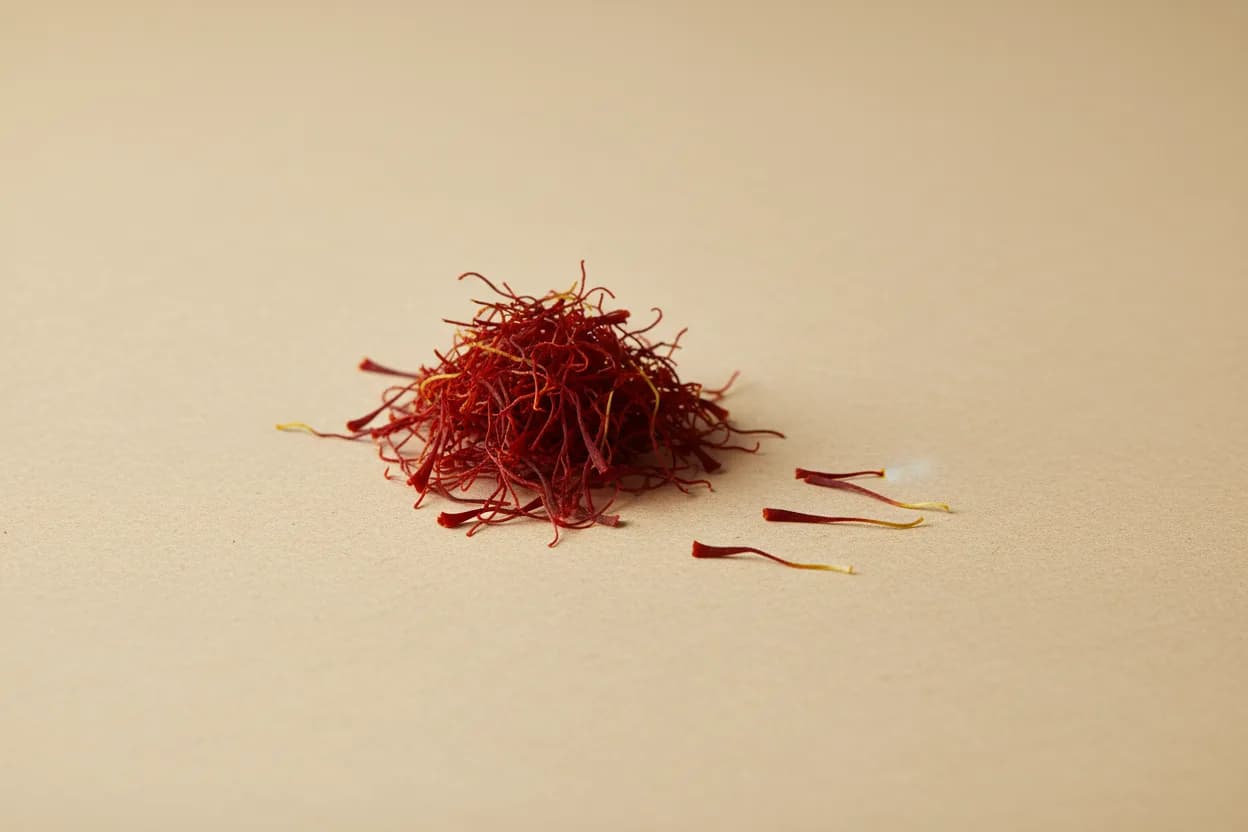
زهرة الزعفران تعطي ثلاث مياسم. تجلس داخل الزهرة كثلاثة خيوط حمراء ملتحمة عند القاعدة، يتّسع كل واحد منها عند طرفه إلى بوق صغير، وعلى أحدهم أن يفتح الزهرة وينتزعها بأصابعه ويضعها لتجفّ. للحصول على كيلوغرام واحد من الزعفران المجفف يلزم نحو ١٥٠٬٠٠٠ زهرة وما بين ٣٧٠ و٤٧٠ ساعة من هذا العمل. ١
الجزء الذي نادرًا ما يُقال بصوت عالٍ هو أن النبتة التي تفعل ذلك عاجزة عن تكوين بذرة. Crocus sativus ثلاثي الصيغة الصبغية، يحمل ثلاث نسخ من كل كروموسوم بدل نسختين، ثمانية ثلاثيات في المجموع، وعند الانقسام المنصّف لا يجد سبيلًا نظيفًا للاقتران. ٢ الأزهار عقيمة. كل حقل زعفران زُرع يومًا جاء من الكورمات، وهي السيقان الأرضية المنتفخة التي تصنعها النبتة لنفسها، تُقتلع وتُقسّم وتُنقل باليد. ١
من أين جاء فعلًا
يترك ذلك سؤالًا تجادل فيه الناس قرابة قرن كامل: إذا كان الزعفران لا يتهجّن مع شيء، فمن أين بدأ، وعن أي أصل؟ ٢ دار النقاش حول المنطقة، وحول التاريخ، وحول أي الأنواع البرية أسهم فيه. ٦ هيمنة إيران الحديثة جعلت الجواب البديهي يبدو محسومًا، واسمُه الذي وصل الإنجليزية عبر العربية عزّز ذلك.
ثلاثة خطوط من الأدلة انتهت إلى جواب مختلف خلال سنتين. في ٢٠١٨ قامت مجموعة في معهد لايبنتس في غاترسليبن بتسلسل مواقع جينية متعددة عبر مجموعة أنواع الزعفران، فوجدت C. sativus جالسًا داخل نوع بري واحد هو Crocus cartwrightianus، دون ما يشير إلى إسهام أي نوع آخر. ٤ وفي ٢٠١٩ أجرت المجموعة نفسها تنميطًا جينيًا على مستوى الجينوم فوضعت ٩٩٫٣ في المئة من أليلات الزعفران داخل C. cartwrightianus، وسمّته السلف الوحيد. أقرب تجمّع بري إلى المحصول ينمو في جوار أثينا، ويبدو أن المحصول نشأ في أتيكا بالجمع بين نمطين جينيين مختلفين من ذلك النوع الواحد. ٣ ومجموعة أخرى لوّنت الكروموسومات بمجسّات متعددة الألوان، دون أي تسلسل جيني على الإطلاق، فقرأت البنية نفسها من النمط الكروموسومي مباشرة. ٢
هنا يلزم تحفّظ واحد. في ٢٠١٥ كانت مجموعة من ليستر تستخدم واسمات العناصر الرجعية قد رجّحت الآلية المعاكسة: ثلاثي صيغة مهجّن من نوعين لا من نوع واحد، على الأرجح C. cartwrightianus مع C. pallasii. ٥ الخلاف أضيق مما يبدو. هو حول ما إذا كانت مجموعات الكروموسومات الثلاث أتت من نوع واحد أو نوعين، لا حول كون النبتة يونانية، ونظام الواسمات المستخدم أدنى دقة من العمل الجينومي الشامل والخلوي الذي تلاه. وبحلول ٢٠٢٢ كان أعضاء من الفريقين معًا يكتبون أن الأعمال الفنية القديمة والوراثة تتقاربان على اليونان القديمة. ٦ الجملة المنصفة هي أن الأدلة تشير الآن إلى أتيكا، وهو ما يقوله أولئك الباحثون أنفسهم، لا أن المسألة أُغلقت.
نبتة واحدة وإحدى عشرة دولة
ما يتفق عليه المعسكران أشد لفتًا مما يفرّقهما. كلاهما يخلص إلى أن الأمر حدث مرة واحدة. وكلاهما يجد الشيء نفسه بعد ذلك. مجموعة ليستر لم تر أي تعدد أشكال على الإطلاق بين سبع عشرة عيّنة زعفران جُمعت من كشمير مرورًا بإيران وحتى إسبانيا، في فحص لم يجد صعوبة في التفريق بين الأقارب البرية التي فُحصت إلى جانبها. ٥ وكانت مجموعة إسبانية قد اختبرت قبل ذلك ثلاثًا وأربعين عيّنة من إحدى عشرة دولة مقابل ثلاثين بادئة RAPD وثماني وأربعين بادئة ISSR وخمسة عشر واسمًا مكرريًا دقيقًا، فلم تسترجع شريطًا واحدًا متعدد الأشكال. ٧
إذن فالزعفران الإيراني والزعفران الإسباني والزعفران الكشميري على الرف ليست أصنافًا. إنها سلالة نسيلية واحدة، تُقتطع وتُزرع من جديد منذ ما يزيد على ثلاثة آلاف سنة. ٦ وكل ما يختلف بينها فعلته بها الأجواء والتربة والمعاملة، لأن لا شيء آخر أُتيحت له فرصة الاختلاف.
وتبيّن أن ذلك قابل للقياس، وهو أكثر نتيجة مدهشة بهدوء في هذا الأدب كله. فريق إيطالي إسباني أجرى تحليل AFLP على أصول وراثية إسبانية فوجد تباينًا ضئيلًا فعلًا: ٤٫٢٣ في المئة من القمم متعددة الأشكال، واثنا عشر نمطًا جينيًا مختلفًا فعليًا، وهي بقايا طفرات جسدية تتراكم في نبتة لا سبيل أمامها غير ذلك للتغيّر. ثم أجرى الفريق النسخة الحساسة للمثيلة من الفحص نفسه على المادة نفسها فحصل على ٣٣٫٥٧ في المئة من القمم متعددة الأشكال وثمانية وعشرين نمطًا فوق جيني مختلفًا، منتظمة بحسب المكان الذي نمت فيه الكورمات. ٨ أي نحو ثمانية أضعاف من التباين في العلامات الموضوعة على الجينوم مقارنة بالجينوم نفسه.
الجدارية تُظهر الأصل البري
هناك مستوطنة من العصر البرونزي في أكروتيري على جزيرة ثيرا، دفنها ثوران بركاني ثم أُخرجت وجدارياتها سليمة. في المبنى الذي يسمّيه المنقّبون Xeste 3 تُظهر اللوحات نساء يجمعن أزهار الزعفران ويحملن المياسم إلى هيئة أنثوية جالسة. وفيرنس وبندرسكي، في قراءتهما للجداريات سنة ٢٠٠٤، يحدّدان النبتة على أنها Crocus cartwrightianus ويريان أن الهيئة الجالسة ربّة شفاء يظهر الزعفران بوصفه صفتها المميزة. ٩
خذ الجانب اللاهوتي بوصفه حجّة، فهذا ما هو عليه. أما علم النبات فهو الجزء الذي يتطابق. النوع المرسوم على ذلك الجدار هو الأصل البري الذي تشير إليه الوراثة، ينمو في المنطقة التي تشير إليها الوراثة، ويجنيه أناس كانوا قد نظّموا العمل بالفعل في مراحل. ٩ حقلان معرفيان لا يتشاركان منهجًا ولا دليلًا وصلا إلى الزاوية نفسها من بحر إيجه.
ما في الخيط فعلًا
يوزّع الزعفران مهامه بنظافة غير معتادة. اللون من الكروسينات، والطعم من البيكروكروسين، والرائحة من السفرانال. ١٠ والكروسينات هي الغريبة: فهي كاروتينويدات، والكاروتينويدات يُفترض أن تكون ذائبة في الدهون، لكن هنا تُؤسترَ سكّريات على طرفي هيكل الكروسيتين، غلوكوز وجنتيوبيوز ونيابوليتانوز، فيذوب الجزيء في الماء بدلًا من ذلك. ١١ كما أنه يتراكم إلى ما هو أبعد بكثير مما تفعله صبغة عادة، فيبلغ ١٠ في المئة من الوزن الجاف للميسم ويُخزَّن في الفجوة العصارية، وهي حجرة مائية ما كان لكاروتينويد عادي أن يدخلها. ١٢ بضعة خيوط تكفي لتلوين قدر كامل دون أي دهن يحملها.
وللرائحة قصة أفضل. السفرانال هو أغليكون البيكروكروسين: المركّب المرّ نفسه بعد نزع سكّره. ١١ التجفيف لا يصنع رائحة الزعفران، بل يكشفها، إما إنزيميًا عبر وسيط أو مباشرة بالتحلل الحراري. ١١ المرارة والعطر مركّب واحد في طورين، وهي معلومة نافعة يُحسن المرء استحضارها وهو يقرر كم يطيل تدفئة قرصة منه.
ثلاثة وأربعون في المئة
غالي الثمن ومجفّف وعلى هيئة خيط: تركيبة سيئة. دراسة من سنة ٢٠٢٤ اختبرت ١٠٤ عيّنات سوقية من ست عشرة دولة بالفحص الشكلي وHPLC وHPTLC والباركود الجيني DNA، فوجدت خمسًا وأربعين منها، أي ٤٣ في المئة، مغشوشة. وكشف الباركود عشرين نوعًا نباتيًا غاشًا مختلفًا، بعضها غير آمن للأكل. ١٣ ومراجعة منهجية من سنة ٢٠٢٦ تقدّر الغش عالميًا بين ٢٠ و٣٠ في المئة مع تفاوت إقليمي هائل، من ٣٫٥ في المئة في أسواق الاتحاد الأوروبي المنظّمة إلى ٦٠ في المئة في الهند، مع العصفر والقطيفة والكركم كبدائل معتادة، وأصباغ صناعية منها مركّبات Sudan وauramine-O كأخطرها. ١٤
هناك دليل أمين واحد، وهو كيميائي لا بصري. لم يُعثر على البيكروكروسين إلا في جنس Crocus، ولا يوجد تابل آخر يعيد إنتاج ذلك الطعم، فهو يصلح واسمًا للأصلي. ١١ مطمئن في مختبر. عديم النفع تمامًا أمام بسطة في سوق، وهذا هو بيت القصيد.
خارج الإحصاءات
غرابة أخيرة. قاعدة بيانات الإنتاج الزراعي لمنظمة الأغذية والزراعة تحمل ٧٩٢ بندًا مستقلًا. للفلفل الأسود بند خاص به، وكذلك للفانيليا والقرفة والقرنفل وجوز الطيب واليانسون والزنجبيل. أما الزعفران فلا بند له. يقع ضمن البند ٧٢٣، وهو فئة متبقية تُسمّى محاصيل منبّهة وتابلية وعطرية أخرى غير مصنّفة. ١٥ أغلى تابل في العالم ١٢ غير مرئي إحصائيًا في السجل الدولي الأساسي لما تزرعه المزارع.
ولذلك أثر على الرقم الذي يستشهد به الجميع. القول إن إيران تنتج أكثر من ٩٠ في المئة من زعفران العالم مصدره صفحة للمنظمة تصف برنامج تراث زراعي في گناباد: بلا تاريخ، وبلا حمولة مرفقة، وليست إصدارًا إحصائيًا. ١٦ وهو على الأرجح قريب من الصواب. غير أنه ببساطة ليس مقيسًا بالطريقة التي يُقاس بها رقم الفلفل، وأفضل رقم متاح للإنتاج العالمي، نحو ٤٣٠ طنًا في السنة، يصلنا هو الآخر بوساطة. ١
لا شيء من هذا يغيّر ما تفعله بالخيوط. دفّئها، انقعها، استعمل أقل مما كنت ستستعمل. لكنه يغيّر ما تحمله في يدك. زهرة عاجزة عن عقد بذرة بقيت حيّة ثلاثة آلاف سنة لسبب واحد فقط: أن الناس ظلّوا يقررون، موسمًا بعد موسم، أن يرفعوا كورماتها ويعيدوها إلى التراب. لا تستطيع أن تتكيّف ولا أن تنتشر وحدها، وعلى هذا الترتيب وحده سافرت من أتيكا إلى كشمير إلى إسبانيا. الأزهار تتفتّح في الخريف، في الصباح، ولا بد أن تُقطف في اليوم نفسه.
المصادر
كلُّ دعوى مُرقَّمةٍ أعلاه تشيرُ إلى ما هٰهنا. والروابطُ تُفضي إلى البحث أو الوثيقة أو الجهة نفسها.
- ١.
Cid-Perez TS, Nevarez-Moorillon GV, Ochoa-Velasco CE, Navarro-Cruz AR, Hernandez-Carranza P, Avila-Sosa R. The relation between drying conditions and the development of volatile compounds in saffron (Crocus sativus). Molecules. 2021;26(22):6954. Source for the three stigmas per flower and their trumpet-shaped tips, for the sterility of the flowers and propagation by corms, for approximately 150,000 flowers and 370 to 470 hours of work per kilogram of saffron, and for world production of roughly 430 tons a year.
https://doi.org/10.3390/molecules26226954 - ٢.
Schmidt T, Heitkam T, Liedtke S, Schubert V, Menzel G. Adding color to a century-old enigma: multi-color chromosome identification unravels the autotriploid nature of saffron (Crocus sativus) as a hybrid of wild Crocus cartwrightianus cytotypes. New Phytologist. 2019;222(4):1965-1980. Source for saffron as a sterile triploid carrying eight chromosome triplets and propagated only as a clonal lineage by corms, for the origin question having been argued for almost a century, and for the chromosome-painting evidence that saffron is an autotriploid derived from heterogeneous Crocus cartwrightianus cytotypes.
https://doi.org/10.1111/nph.15715 - ٣.
Nemati Z, Harpke D, Gemicioglu A, Kerndorff H, Blattner FR. Saffron (Crocus sativus) is an autotriploid that evolved in Attica (Greece) from wild Crocus cartwrightianus. Molecular Phylogenetics and Evolution. 2019;136:14-20. Source for 99.3 per cent of saffron's genotyping-by-sequencing alleles being placed within Crocus cartwrightianus, identifying it as the sole progenitor; for the wild population near Athens being the most similar to the crop; for the conclusion that saffron arose in Attica by combining two genotypes of that one species; and for triploid sterility and vegetative propagation having produced worldwide cultivation of a unique clonal lineage.
https://doi.org/10.1016/j.ympev.2019.03.022 - ٤.
Nemati Z, Blattner FR, Kerndorff H, Erol O, Harpke D. Phylogeny of the saffron-crocus species group, Crocus series Crocus (Iridaceae). Molecular Phylogenetics and Evolution. 2018;127:891-897. Source for multi-locus and genome-wide SNP data placing Crocus sativus within Crocus cartwrightianus with no indication that other Crocus species contributed to the triploid, making an autotriploid origin very likely.
https://doi.org/10.1016/j.ympev.2018.06.036 - ٥.
Alsayied NF, Fernandez JA, Schwarzacher T, Heslop-Harrison JS. Diversity and relationships of Crocus sativus and its relatives analysed by inter-retroelement amplified polymorphism (IRAP). Annals of Botany. 2015;116(3):359-368. The dissenting analysis, concluding saffron is an allotriploid whose most likely ancestors are Crocus cartwrightianus and Crocus pallasii subsp. pallasii. Also the source for the conclusion that the triploid arose only once, and for no polymorphisms being seen among seventeen saffron accessions obtained from Kashmir through Iran to Spain.
https://doi.org/10.1093/aob/mcv103 - ٦.
Kazemi-Shahandashti SS, Mann L, El-nagish A, Harpke D, Nemati Z, Usadel B, Heitkam T. Ancient artworks and Crocus genetics both support saffron's origin in early Greece. Frontiers in Plant Science. 2022;13:834416. Source for the origin having been a century-old debate over area, time and parental species; for the ancient arts and the sequencing and cytogenetic work converging on emergence and domestication in ancient Greece; and for cultivation across the Mediterranean for over three millennia. Written jointly by members of both 2019 teams, so it is a synthesis rather than independent confirmation.
https://doi.org/10.3389/fpls.2022.834416 - ٧.
Rubio-Moraga A, Castillo-Lopez R, Gomez-Gomez L, Ahrazem O. Saffron is a monomorphic species as revealed by RAPD, ISSR and microsatellite analyses. BMC Research Notes. 2009;2:189. Source for no polymorphic bands being detected in any accession across the combined approaches, and for the conclusion that the accessions are identical clones morphologically and at the molecular level.
https://doi.org/10.1186/1756-0500-2-189 - ٨.
Busconi M, Colli L, Sanchez RA, Santaella M, De-Los-Mozos Pascual M, Santana O, Roldan M, Fernandez JA. AFLP and MS-AFLP analysis of the variation within saffron crocus (Crocus sativus L.) germplasm. PLOS ONE. 2015;10(4):e0123434. Source for 4.23 per cent polymorphic peaks and twelve effective genotypes by AFLP against 33.57 per cent polymorphic peaks and twenty-eight effective epigenotypes by methylation-sensitive AFLP in the same material, and for the conclusion that saffron is not strictly monomorphic but carries little genetic variability.
https://doi.org/10.1371/journal.pone.0123434 - ٩.
Ferrence SC, Bendersky G. Therapy with saffron and the goddess at Thera. Perspectives in Biology and Medicine. 2004;47(2):199-226. Source for Crocus cartwrightianus and saffron being the primary subjects of the Xeste 3 frescoes at Akrotiri, for the authors' argument that the frescoes portray a divinity of healing associated with saffron, and for their reading of the paintings as depicting a production line and the earliest botanically accurate image of a herbal medication.
https://doi.org/10.1353/pbm.2004.0026 - ١٠.
Frusciante S, Diretto G, Bruno M, Ferrante P, Pietrella M, Prado-Cabrero A, Rubio-Moraga A, Beyer P, Gomez-Gomez L, Al-Babili S, Giuliano G. Novel carotenoid cleavage dioxygenase catalyzes the first dedicated step in saffron crocin biosynthesis. Proceedings of the National Academy of Sciences. 2014;111(33):12246-12251. Source for Crocus sativus stigmas accumulating crocetin, crocins, picrocrocin and safranal as the compounds responsible for colour, taste and aroma, and for CCD2 catalysing the first dedicated step in crocin biosynthesis.
https://doi.org/10.1073/pnas.1404629111 - ١١.
Moratalla-Lopez N, Bagur MJ, Lorenzo C, Martinez-Navarro ME, Salinas MR, Alonso GL. Bioactivity and bioavailability of the major metabolites of Crocus sativus L. flower. Molecules. 2019;24(15):2827. Source for the crocetin esters being water-soluble carotenoids and for glucose, gentiobiose and neapolitanose being the sugars that esterify crocetin; for safranal being the aglycone of picrocrocin and for the two routes by which picrocrocin converts to safranal; and for picrocrocin having been identified only in the genus Crocus, making it a molecular marker of real saffron.
https://doi.org/10.3390/molecules24152827 - ١٢.
Demurtas OC, Frusciante S, Ferrante P, Diretto G, Azad NH, Pietrella M, Aprea G, Taddei AR, Romano E, Mi J, Al-Babili S, Frigerio L, Giuliano G. Candidate enzymes for saffron crocin biosynthesis are localized in multiple cellular compartments. Plant Physiology. 2018;177(3):990-1006. Source for saffron being the most expensive spice in the world and for crocins accumulating in the vacuole to a level of up to 10 per cent of the stigma dry weight.
https://doi.org/10.1104/pp.17.01815 - ١٣.
Bhooma V, Vassou SL, Kaliappan I, Parani M. Identification of adulteration in the market samples of saffron using morphology, HPLC, HPTLC, and DNA barcoding methods. Genome. 2024;67(2):43-52. Source for 104 saffron market samples collected from 16 countries being tested by morphology, HPLC, HPTLC and DNA barcoding, for 45 of them (43 per cent) being adulterated, and for DNA barcoding identifying twenty adulterant plant species, some of them unsafe for human consumption.
https://doi.org/10.1139/gen-2022-0059 - ١٤.
Mehdizadeh T, Omidi F, Morya S, Abideen ZU. Combating saffron fraud: a systematic review of adulteration practices, detection technologies, recommendations and challenges. Critical Reviews in Food Science and Nutrition. 2026;66(7):1387-1403. Source for 20 to 30 per cent of commercial saffron being adulterated globally with regional disparities from 3.5 per cent in regulated EU markets to 60 per cent in India, and for substitution with safflower, marigold or turmeric and the addition of synthetic dyes including Sudan compounds and auramine-O.
https://doi.org/10.1080/10408398.2025.2544767 - ١٥.
Food and Agriculture Organization of the United Nations. FAOSTAT Crops and Livestock Products, bulk data download (Production_Crops_Livestock_E_All_Data, normalized), release of 23 December 2025. The dataset carries 792 distinct items and no saffron item. Pepper (item 687), vanilla (692), cinnamon (693), cloves (698), nutmeg (702), anise (711) and ginger (720) each have their own line; item 723 is the residual category Other stimulant, spice and aromatic crops, n.e.c.
https://bulks-faostat.fao.org/production/ - ١٦.
Food and Agriculture Organization of the United Nations, Globally Important Agricultural Heritage Systems. Qanat-based saffron farming system in Gonabad, Iran. Undated programme page, source for the statement that Iran is the largest producer of saffron in the world and has over 90 per cent of world saffron production. A programme description rather than a statistical release: it gives no year and no tonnage.
https://www.fao.org/giahs/giahs-around-the-world/iran-qanat-based-saffron-system/en