Saffron has not set seed since the Bronze Age
The spice everyone calls Persian was domesticated in Attica, and it happened once. Genome-wide sequencing puts 99.3 per cent of saffron's alleles inside a single Greek wild crocus, and forty-three accessions from eleven countries return not one polymorphic band.
Contents
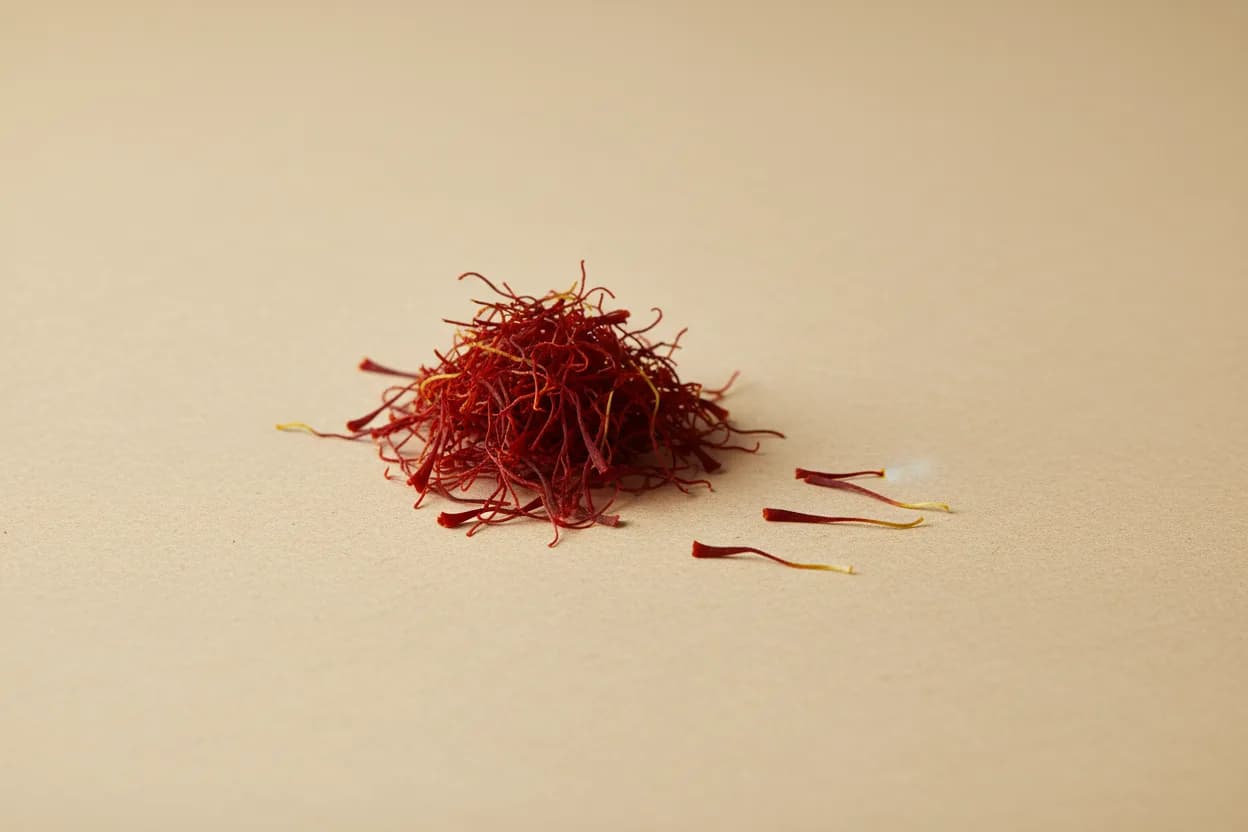
A crocus flower gives up three stigmas. They sit inside the flower as three red filaments joined at the base, each one widening at the tip into a small trumpet, and someone has to open the flower, pinch them out, and set them to dry. To get a kilogram of dried saffron takes roughly 150,000 flowers and somewhere between 370 and 470 hours of that work. 1
The part that rarely gets said out loud is that the plant doing this cannot make a seed. Crocus sativus is a triploid, carrying three copies of every chromosome instead of two, eight triplets in all, and at meiosis they have no clean way to pair off. 2 The flowers are sterile. Every saffron field ever planted came from corms, the swollen underground stems the plant makes for itself, dug up and divided and carried by hand. 1
Where it actually came from
That leaves a question people argued over for nearly a century: if saffron never crosses with anything, where did it begin, and out of what? 2 The debate ran on area, on date, and on which wild species had contributed. 6 Iran's modern dominance made the obvious answer feel settled, and the name arriving in English through Arabic reinforced it.
Three lines of evidence closed on a different answer inside two years. In 2018 a group at the Leibniz Institute in Gatersleben sequenced multiple loci across the saffron crocus species group and found C. sativus sitting inside one wild species, Crocus cartwrightianus, with nothing to suggest any other species had contributed. 4 In 2019 the same group genotyped across the genome and placed 99.3 per cent of saffron's alleles within C. cartwrightianus, naming it the sole progenitor. The wild population most similar to the crop grows in the vicinity of Athens, and the crop appears to have arisen in Attica by combining two different genotypes of that single species. 3 A separate group painted the chromosomes with multi-colour probes, doing no sequencing at all, and read the same structure straight off the karyotype. 2
One qualification belongs here. In 2015 a Leicester group using retroelement markers had argued the opposite mechanism: an allotriploid built from two species rather than one, most likely C. cartwrightianus crossed with C. pallasii. 5 The disagreement is narrower than it sounds. It is about whether three chromosome sets came from one species or two, not about whether the plant is Greek, and the marker system is lower resolution than the genome-wide and cytogenetic work that followed it. By 2022 members of both 2019 teams were writing jointly that the artworks and the genetics converge on ancient Greece. 6 The fair sentence is that the evidence now points to Attica, which is what those authors say, rather than that the matter is closed.
One plant, eleven countries
What both camps agree on is more striking than what divides them. Both conclude it happened once. And both find the same thing afterwards. The Leicester group saw no polymorphisms at all among seventeen saffron accessions collected from Kashmir through Iran to Spain, in an assay that had no trouble separating the wild relatives run alongside them. 5 A Spanish group had already tested forty-three accessions from eleven countries against thirty RAPD primers, forty-eight ISSR primers and fifteen microsatellites, and recovered not one polymorphic band. 7
So the Iranian saffron and the Spanish saffron and the Kashmiri saffron on a shelf are not varieties. They are one clonal lineage, cut and replanted for something over three millennia. 6 Whatever differs between them was done to them by weather, soil and handling, because nothing else has had the chance to differ.
That turns out to be measurable, and it is the most quietly astonishing result in the literature. An Italian and Spanish team ran AFLP across Spanish germplasm and did find a little variation: 4.23 per cent of peaks polymorphic, twelve effectively distinct genotypes, the residue of somatic mutation piling up in a plant with no other route to change. Then they ran the methylation-sensitive version of the same assay on the same material and got 33.57 per cent polymorphic peaks and twenty-eight distinct epigenotypes, patterned by where the corms had been grown. 8 Roughly eight times more variation in the marks laid on the genome than in the genome itself.
The wall painting shows the wild parent
There is a Bronze Age settlement at Akrotiri on Thera, buried by a volcanic eruption and dug out with its wall paintings intact. In the building excavators label Xeste 3, the paintings show women gathering crocus flowers and carrying the stigmas to a seated female figure. Ferrence and Bendersky, reading the frescoes in 2004, identify the plant as Crocus cartwrightianus and argue that the seated figure is a divinity of healing shown with saffron as her attribute. 9
Take the theology as an argument, because that is what it is. The botany is the part that lines up. The species painted on that wall is the wild parent the genetics points to, growing in the region the genetics points to, being harvested by people who had already organised the work into stages. 9 Two disciplines that share no methods and no evidence arrived at the same corner of the Aegean.
What is actually in the thread
Saffron divides its labour unusually cleanly. Colour comes from the crocins, taste from picrocrocin, aroma from safranal. 10 The crocins are the odd ones: they are carotenoids, and carotenoids are meant to be fat-soluble, but here sugars are esterified onto both ends of a crocetin backbone, glucose and gentiobiose and neapolitanose, and the molecule dissolves in water instead. 11 It also accumulates far beyond what a pigment normally does, reaching 10 per cent of the stigma's dry weight and stored in the vacuole, a water compartment an ordinary carotenoid could never enter. 12 A few threads will colour a whole pot without any fat to carry them.
The aroma has the better story. Safranal is the aglycone of picrocrocin: the bitter compound with its sugar taken off. 11 Drying does not create saffron's smell, it uncovers it, either enzymatically through an intermediate or directly by thermal degradation. 11 The bitterness and the perfume are one compound at two stages, which is a useful thing to hold in mind while deciding how long to warm a pinch of it.
Forty-three per cent
Expensive, dried, and shaped like a thread is a poor combination. A 2024 study tested 104 market samples from sixteen countries by morphology, HPLC, HPTLC and DNA barcoding, and found forty-five of them, 43 per cent, adulterated. Barcoding turned up twenty different adulterant plant species, some of them unsafe to eat. 13 A 2026 systematic review puts global adulteration at 20 to 30 per cent with a huge regional spread, from 3.5 per cent in regulated EU markets to 60 per cent in India, with safflower, marigold and turmeric as the usual substitutes and synthetic dyes including Sudan compounds and auramine-O as the dangerous ones. 14
There is one honest tell, and it is chemical rather than visual. Picrocrocin has been found only in the genus Crocus, and no other spice reproduces the taste, so it works as a marker for the real thing. 11 Reassuring in a laboratory. Of no use whatever at a market stall, which is the point.
Not in the statistics
One last oddity. FAO's crop production database carries 792 distinct items. Pepper has its own line, so do vanilla, cinnamon, cloves, nutmeg, anise and ginger. Saffron has none. It falls into item 723, a residual category called Other stimulant, spice and aromatic crops, n.e.c. 15 The most expensive spice in the world 12 is statistically invisible in the main international record of what farms grow.
Which has a consequence for the figure everybody quotes. That Iran grows more than 90 per cent of the world's saffron comes from an FAO page describing a heritage-farming programme in Gonabad: undated, with no tonnage attached, and not a statistical release. 16 It is probably close to right. It is simply not measured the way the pepper figure is measured, and the best available number for world production, roughly 430 tons a year, comes to us second-hand too. 1
None of that alters what to do with the threads. Warm them, steep them, use fewer than you were going to. But it changes what is in your hand. A flower that cannot set a seed has been kept alive for three thousand years purely because people kept deciding, season after season, to lift its corms and put them back in the ground. It cannot adapt and it cannot spread on its own, and on that arrangement alone it has travelled from Attica to Kashmir to Spain. The flowers open in autumn, in the morning, and they have to be picked the same day.
Sources
Every numbered claim above points here. Links go to the paper, record, or authority itself.
- 1.
Cid-Perez TS, Nevarez-Moorillon GV, Ochoa-Velasco CE, Navarro-Cruz AR, Hernandez-Carranza P, Avila-Sosa R. The relation between drying conditions and the development of volatile compounds in saffron (Crocus sativus). Molecules. 2021;26(22):6954. Source for the three stigmas per flower and their trumpet-shaped tips, for the sterility of the flowers and propagation by corms, for approximately 150,000 flowers and 370 to 470 hours of work per kilogram of saffron, and for world production of roughly 430 tons a year.
https://doi.org/10.3390/molecules26226954 - 2.
Schmidt T, Heitkam T, Liedtke S, Schubert V, Menzel G. Adding color to a century-old enigma: multi-color chromosome identification unravels the autotriploid nature of saffron (Crocus sativus) as a hybrid of wild Crocus cartwrightianus cytotypes. New Phytologist. 2019;222(4):1965-1980. Source for saffron as a sterile triploid carrying eight chromosome triplets and propagated only as a clonal lineage by corms, for the origin question having been argued for almost a century, and for the chromosome-painting evidence that saffron is an autotriploid derived from heterogeneous Crocus cartwrightianus cytotypes.
https://doi.org/10.1111/nph.15715 - 3.
Nemati Z, Harpke D, Gemicioglu A, Kerndorff H, Blattner FR. Saffron (Crocus sativus) is an autotriploid that evolved in Attica (Greece) from wild Crocus cartwrightianus. Molecular Phylogenetics and Evolution. 2019;136:14-20. Source for 99.3 per cent of saffron's genotyping-by-sequencing alleles being placed within Crocus cartwrightianus, identifying it as the sole progenitor; for the wild population near Athens being the most similar to the crop; for the conclusion that saffron arose in Attica by combining two genotypes of that one species; and for triploid sterility and vegetative propagation having produced worldwide cultivation of a unique clonal lineage.
https://doi.org/10.1016/j.ympev.2019.03.022 - 4.
Nemati Z, Blattner FR, Kerndorff H, Erol O, Harpke D. Phylogeny of the saffron-crocus species group, Crocus series Crocus (Iridaceae). Molecular Phylogenetics and Evolution. 2018;127:891-897. Source for multi-locus and genome-wide SNP data placing Crocus sativus within Crocus cartwrightianus with no indication that other Crocus species contributed to the triploid, making an autotriploid origin very likely.
https://doi.org/10.1016/j.ympev.2018.06.036 - 5.
Alsayied NF, Fernandez JA, Schwarzacher T, Heslop-Harrison JS. Diversity and relationships of Crocus sativus and its relatives analysed by inter-retroelement amplified polymorphism (IRAP). Annals of Botany. 2015;116(3):359-368. The dissenting analysis, concluding saffron is an allotriploid whose most likely ancestors are Crocus cartwrightianus and Crocus pallasii subsp. pallasii. Also the source for the conclusion that the triploid arose only once, and for no polymorphisms being seen among seventeen saffron accessions obtained from Kashmir through Iran to Spain.
https://doi.org/10.1093/aob/mcv103 - 6.
Kazemi-Shahandashti SS, Mann L, El-nagish A, Harpke D, Nemati Z, Usadel B, Heitkam T. Ancient artworks and Crocus genetics both support saffron's origin in early Greece. Frontiers in Plant Science. 2022;13:834416. Source for the origin having been a century-old debate over area, time and parental species; for the ancient arts and the sequencing and cytogenetic work converging on emergence and domestication in ancient Greece; and for cultivation across the Mediterranean for over three millennia. Written jointly by members of both 2019 teams, so it is a synthesis rather than independent confirmation.
https://doi.org/10.3389/fpls.2022.834416 - 7.
Rubio-Moraga A, Castillo-Lopez R, Gomez-Gomez L, Ahrazem O. Saffron is a monomorphic species as revealed by RAPD, ISSR and microsatellite analyses. BMC Research Notes. 2009;2:189. Source for no polymorphic bands being detected in any accession across the combined approaches, and for the conclusion that the accessions are identical clones morphologically and at the molecular level.
https://doi.org/10.1186/1756-0500-2-189 - 8.
Busconi M, Colli L, Sanchez RA, Santaella M, De-Los-Mozos Pascual M, Santana O, Roldan M, Fernandez JA. AFLP and MS-AFLP analysis of the variation within saffron crocus (Crocus sativus L.) germplasm. PLOS ONE. 2015;10(4):e0123434. Source for 4.23 per cent polymorphic peaks and twelve effective genotypes by AFLP against 33.57 per cent polymorphic peaks and twenty-eight effective epigenotypes by methylation-sensitive AFLP in the same material, and for the conclusion that saffron is not strictly monomorphic but carries little genetic variability.
https://doi.org/10.1371/journal.pone.0123434 - 9.
Ferrence SC, Bendersky G. Therapy with saffron and the goddess at Thera. Perspectives in Biology and Medicine. 2004;47(2):199-226. Source for Crocus cartwrightianus and saffron being the primary subjects of the Xeste 3 frescoes at Akrotiri, for the authors' argument that the frescoes portray a divinity of healing associated with saffron, and for their reading of the paintings as depicting a production line and the earliest botanically accurate image of a herbal medication.
https://doi.org/10.1353/pbm.2004.0026 - 10.
Frusciante S, Diretto G, Bruno M, Ferrante P, Pietrella M, Prado-Cabrero A, Rubio-Moraga A, Beyer P, Gomez-Gomez L, Al-Babili S, Giuliano G. Novel carotenoid cleavage dioxygenase catalyzes the first dedicated step in saffron crocin biosynthesis. Proceedings of the National Academy of Sciences. 2014;111(33):12246-12251. Source for Crocus sativus stigmas accumulating crocetin, crocins, picrocrocin and safranal as the compounds responsible for colour, taste and aroma, and for CCD2 catalysing the first dedicated step in crocin biosynthesis.
https://doi.org/10.1073/pnas.1404629111 - 11.
Moratalla-Lopez N, Bagur MJ, Lorenzo C, Martinez-Navarro ME, Salinas MR, Alonso GL. Bioactivity and bioavailability of the major metabolites of Crocus sativus L. flower. Molecules. 2019;24(15):2827. Source for the crocetin esters being water-soluble carotenoids and for glucose, gentiobiose and neapolitanose being the sugars that esterify crocetin; for safranal being the aglycone of picrocrocin and for the two routes by which picrocrocin converts to safranal; and for picrocrocin having been identified only in the genus Crocus, making it a molecular marker of real saffron.
https://doi.org/10.3390/molecules24152827 - 12.
Demurtas OC, Frusciante S, Ferrante P, Diretto G, Azad NH, Pietrella M, Aprea G, Taddei AR, Romano E, Mi J, Al-Babili S, Frigerio L, Giuliano G. Candidate enzymes for saffron crocin biosynthesis are localized in multiple cellular compartments. Plant Physiology. 2018;177(3):990-1006. Source for saffron being the most expensive spice in the world and for crocins accumulating in the vacuole to a level of up to 10 per cent of the stigma dry weight.
https://doi.org/10.1104/pp.17.01815 - 13.
Bhooma V, Vassou SL, Kaliappan I, Parani M. Identification of adulteration in the market samples of saffron using morphology, HPLC, HPTLC, and DNA barcoding methods. Genome. 2024;67(2):43-52. Source for 104 saffron market samples collected from 16 countries being tested by morphology, HPLC, HPTLC and DNA barcoding, for 45 of them (43 per cent) being adulterated, and for DNA barcoding identifying twenty adulterant plant species, some of them unsafe for human consumption.
https://doi.org/10.1139/gen-2022-0059 - 14.
Mehdizadeh T, Omidi F, Morya S, Abideen ZU. Combating saffron fraud: a systematic review of adulteration practices, detection technologies, recommendations and challenges. Critical Reviews in Food Science and Nutrition. 2026;66(7):1387-1403. Source for 20 to 30 per cent of commercial saffron being adulterated globally with regional disparities from 3.5 per cent in regulated EU markets to 60 per cent in India, and for substitution with safflower, marigold or turmeric and the addition of synthetic dyes including Sudan compounds and auramine-O.
https://doi.org/10.1080/10408398.2025.2544767 - 15.
Food and Agriculture Organization of the United Nations. FAOSTAT Crops and Livestock Products, bulk data download (Production_Crops_Livestock_E_All_Data, normalized), release of 23 December 2025. The dataset carries 792 distinct items and no saffron item. Pepper (item 687), vanilla (692), cinnamon (693), cloves (698), nutmeg (702), anise (711) and ginger (720) each have their own line; item 723 is the residual category Other stimulant, spice and aromatic crops, n.e.c.
https://bulks-faostat.fao.org/production/ - 16.
Food and Agriculture Organization of the United Nations, Globally Important Agricultural Heritage Systems. Qanat-based saffron farming system in Gonabad, Iran. Undated programme page, source for the statement that Iran is the largest producer of saffron in the world and has over 90 per cent of world saffron production. A programme description rather than a statistical release: it gives no year and no tonnage.
https://www.fao.org/giahs/giahs-around-the-world/iran-qanat-based-saffron-system/en