spikenard root
Nardostachys jatamansi
IN ARABIC جذر سنبل الطيب
Resinous, earthy root long prized for sleep.
ABOUT
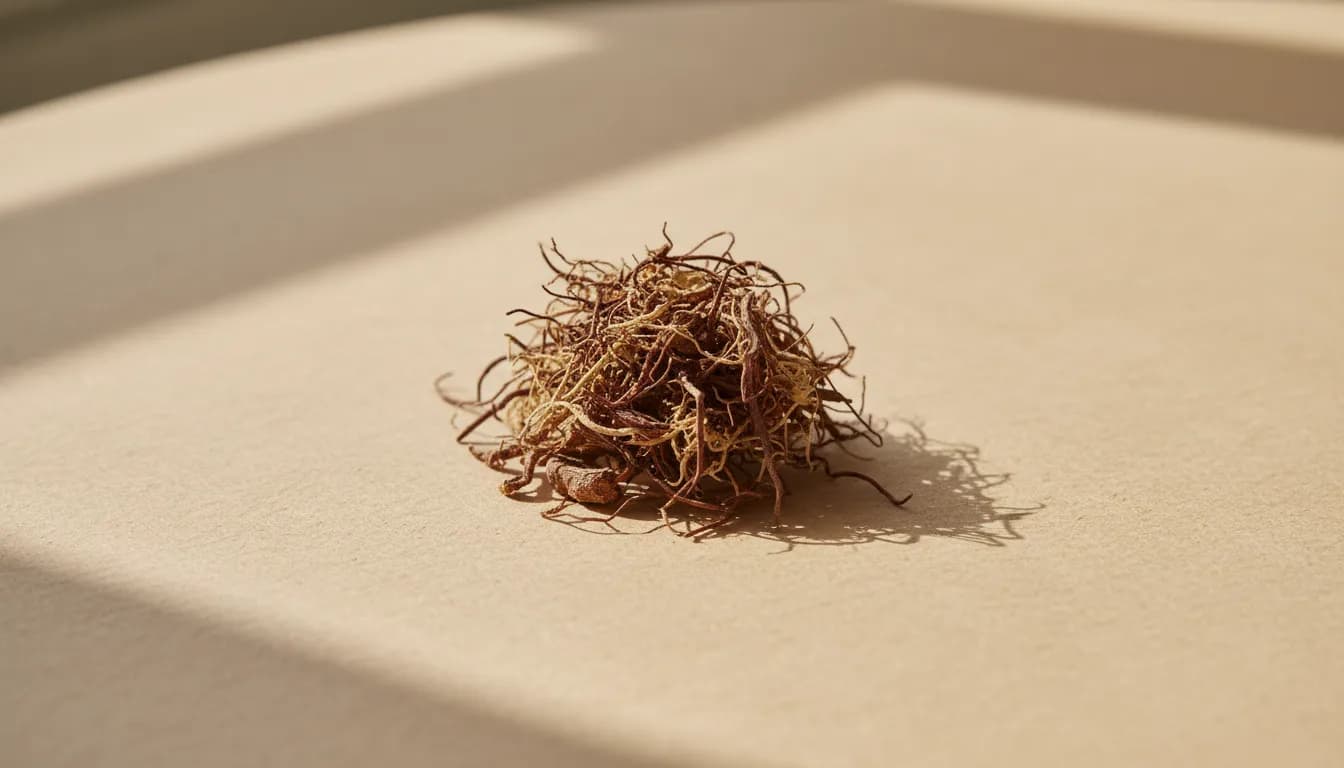
Nardostachys jatamansi's rhizome, dried, appears in two teas here, both at the same careful 0.5 grams, about a quarter teaspoon, steeped slow and long, eight to ten minutes, alongside star anise and, in one, lavender. That restraint is not incidental. The plant was assessed Critically Endangered for the IUCN Red List in 2014, published in 2015, more than 80 per cent of its wild Himalayan population gone over the prior decade, and the Journal's note on spikenard argues for using it in grams rather than handfuls. This library's own doses already sit at the sparing end of that advice.
The earthy, sedative note is jatamansone, a sesquiterpene ketone also known as valeranone, and the name points at a real relationship: spikenard sits in what used to be classed as its own family, Valerianaceae, a close relative of valerian, and jatamansone turns up in valerian root oil too, the same molecule out of a Himalayan meadow or an Estonian field. The overlap stops there. Valerian's other signature markers, valerenic acid and the valepotriates, are a separate matter, and material sold as jatamansi is frequently confused in trade with an unrelated plant, Valeriana jatamansi, sold under the same market name; a chromatography method had to be published in 2010 specifically to tell the two apart.
Spikenard's reputation as a sedative outruns what anyone has actually tested. A 2020 review in the Journal of Ethnopharmacology, written by researchers sympathetic to the plant, still lists the gaps plainly: dated analytical methods, missing toxicology, no clinical trials, with the pharmacology that exists almost entirely animal and in vitro. The best human trial is not even about sleep: forty patients with stage-one hypertension took three grams a day for four weeks in a single-blind study and showed a meaningful drop in blood pressure against placebo, a signal worth following, not a result to build a sleep claim on. So the honest use of these two cups is the one the Journal itself lands on: spikenard smells extraordinary, dark and resinous, and earns its place in the pot for that, not for a night's sleep it has not been shown to deliver.
CHEMISTRY
1The characteristic compounds documented in this ingredient, plus any the library traces to it in a recipe. Not an exhaustive phytochemistry.
earthy, sedative
USED IN
2Spikenard & Star Anise
0.5 g · dried; ≈ 1/4 tsp
STEP 1 Combine the spikenard root and broken star anise in a small pot.
Spikenard, Lavender & Star Anise
0.5 g · dried; ≈ 1/4 tsp
STEP 1 Combine the spikenard, lavender, and star anise in a small pot.