tamarind
Tamarindus indica
IN ARABIC تمر هندي
Sour pod pulp, the backbone of coolers.
ABOUT
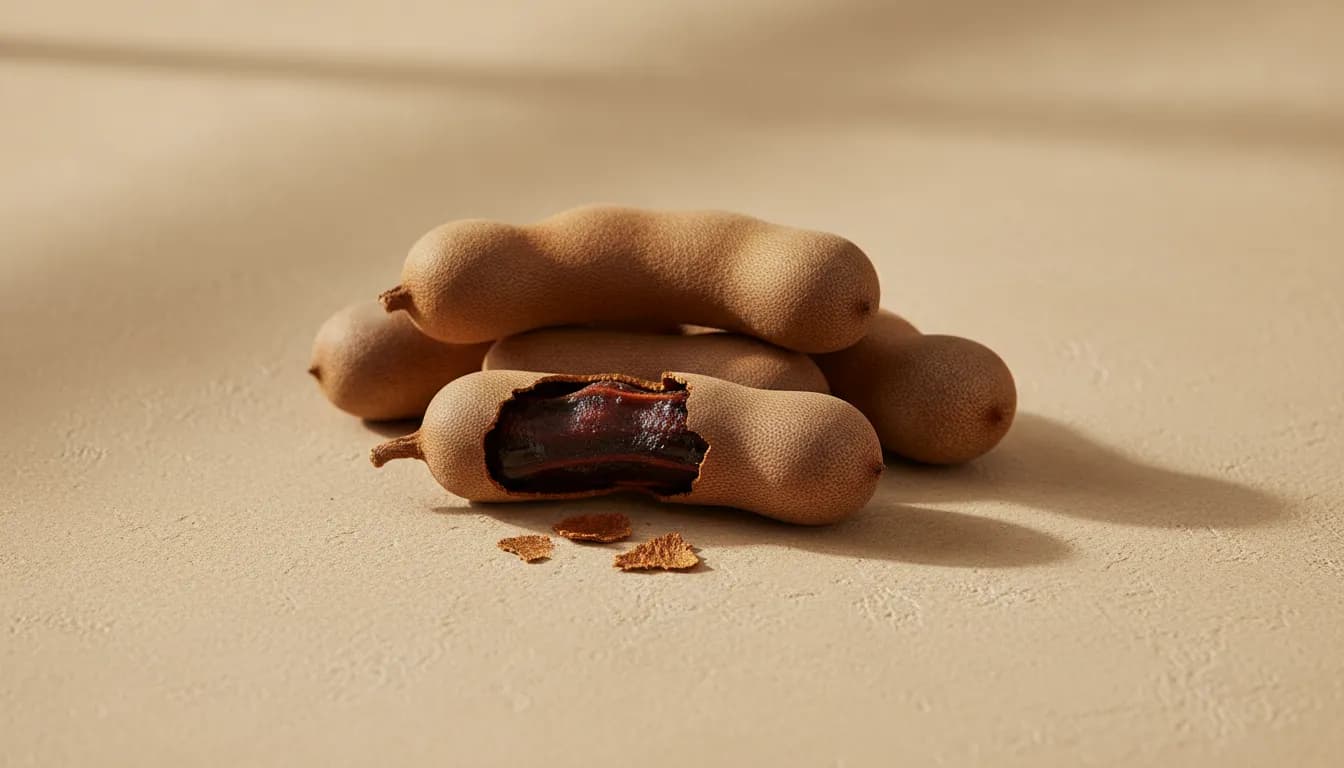
Tamarind is the pulp of Tamarindus indica, which the Journal's note on fruit types calls a legume that never opens at all, a brittle shell around sour pulp. One recipe in this library uses it, the Tamarind Drink: a 200 g block soaked for 30 to 45 minutes in 1,500 ml of warm water, squeezed and mashed to release the pulp, then strained of seeds and fibres. Only after that do 60 g of sugar and 1.5 g of salt go in, adjusted to taste, and the pitcher is chilled well before serving.
The sourness is the unusual part. The Journal's note on tamarind's name says most sour fruit runs on citric or malic acid, while tamarind's main acid is tartaric, which a Brazilian analysis called uncommon in fruits; the same study measured the pulp at pH 2.95. The Journal's note on food acids adds that a survey of 96 genotypes from Karnataka found five acids at once: tartaric, malic, acetic, citric and oxalic, so the pulp is closer to a chord than a solo. How much tartaric acid it holds is unsettled, with published figures of 8 to 12 per cent and 12 to 18 per cent. The leaves are sourer than the fruit: 84 mg of tartaric acid per gram dry weight, against 21 in the pulp.
The name is a trade label that stuck. Tamr hindi, Arabic for date of India, arrived in Europe as tamarind, yet Kew's checklist gives the native range as Comoros and Madagascar and files India under introduced. Genetic work points to the East African mainland instead, and no securely dated tamarind seed exists from anywhere. One caution from the same note: tartaric acid is the compound now proposed, though not proved, as the toxic principle behind grape and raisin poisoning in dogs, a case that came partly from dogs that had eaten cream of tartar and tamarinds.
CHEMISTRY
2The characteristic compounds documented in this ingredient, plus any the library traces to it in a recipe. Not an exhaustive phytochemistry.
sharp, sour
USED IN
1Tamarind Drink
200 g · block
STEP 1 Soak the tamarind block in the warm water.
STEP 2 Squeeze and mash it thoroughly to release the pulp.