An Indian name on an African tree
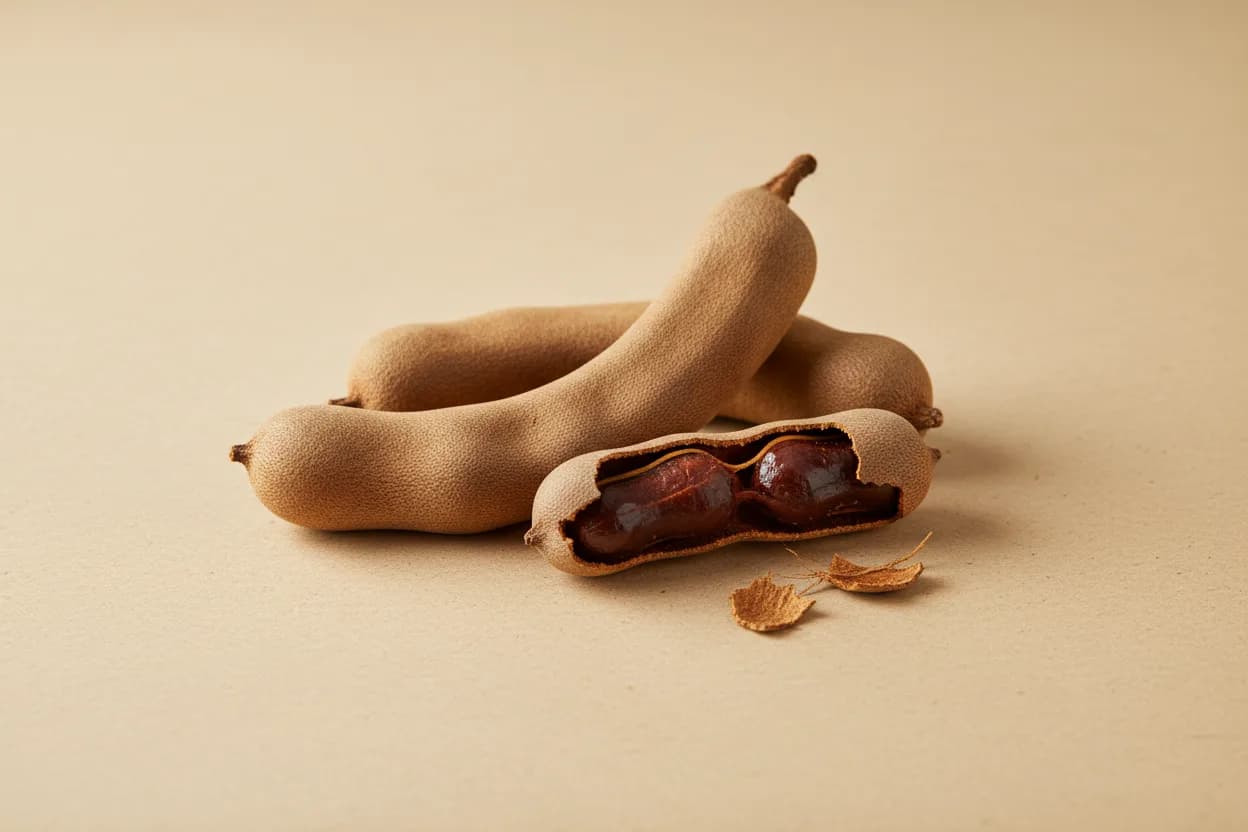
Arabic traders called it tamr hindi, the date of India. Linnaeus wrote that down as Tamarindus indica in 1753 and the label has held ever since, for a tree that no botanical authority today places in India at all. The name is a receipt from a spice market, and it outlived every fact it got wrong.
Contents
Somewhere in the medieval spice trade, an Arabic-speaking merchant sold a sticky brown pod to a buyer who wanted to know what it was called. The answer was tamr hindi. The date of India.
That phrase travelled west, lost its spacing, and arrived in Europe as tamarind. In 1753 Linnaeus set it in Latin on page 34 of the first volume of Species Plantarum, as Tamarindus indica, and there it has stayed for two hundred and seventy years.1 The genus is credited Tourn. ex L., which means Linnaeus did not even coin it. He ratified a name Tournefort had already been using.1
No botanical authority working today places the tree's origin in India.
What the name actually records
The Hobson-Jobson glossary, that magnificent Victorian record of the words English took from South Asia, traces the etymology and then adds a complication I did not expect. The first element may not be tamr, date, at all. It may be thamar, the more general Arabic word for fruit.3 If so the name is wrong twice over, and the pod is neither a date nor Indian.
Hobson-Jobson also preserves the moment the mistake became visible. Garcia da Orta, the Portuguese physician writing from Goa in 1563, records that it was the Arabs who called the fruit the date of India, while the people actually living around him used other names entirely: puli in Malabar, ambili in Gujarat.3 The local names stayed local. The trade label got on the ship.
Tamarindus is a genus of one. The taxonomic backbone lists a single accepted species and eight discarded synonyms, and two of those rejected names are Tamarindus somalensis and Tamarindus erythraeus, both published by the Italian botanist Giovanni Mattei.2 Somali, and Red Sea. Botanists who looked at African trees and thought they had found something new were, in a sense, closer to the truth than the name that beat them to the register. The Indian name won on nothing but priority.
Where it is actually from
Kew's World Checklist of Vascular Plants, which is about as close as botany gets to a register of record, gives the native range of Tamarindus indica in three words: Comoros, Madagascar.4 Everywhere else the tree grows is filed on the same page under a second heading, Introduced into, and that list runs past a hundred territories. Egypt is on it. Nigeria is on it. Kenya and Tanzania are on it. So, in alphabetical order between Hawaii and Iraq, is India.4
The plant whose Latin name means of India is logged by the world checklist as an introduction to India.
That is a tighter line than most authorities draw, and it is a checklist position rather than a settled fact. The tree has been carried and planted for so long, and escapes cultivation so readily, that telling genuinely wild stands from ancient runaways is close to impossible, and the boundary moves depending on who is drawing it.
The genetics point somewhere more specific. A team led by Priscilla Nyadoi typed six gene regions of the mitochondrial and chloroplast genomes across 311 tamarind trees, sampled from Sri Lanka, Indonesia, Zanzibar, Uganda, Tanzania, Kenya, the Sahel, Thailand and Mexico. The rare haplotypes cluster in East Africa: fourteen of the sixteen chloroplast types found there are local endemics, and of twenty cytotypes identified, fourteen belong to Kenya, Tanzania and Uganda. Their conclusion is that East African tamarind populations deserve conservation priority as centre of diversity.5
What I like about that paper is that it argues against itself in the discussion. High diversity usually marks a centre of origin, and they say so. Then they note the alternative: those haplotypes may have been widespread once and reduced to small restricted populations by bottlenecks.5 The genetics narrow the question without closing it.
So the register of record confines the native range to two island groups. The genetics point at the East African mainland. An agricultural historian reviewing the whole literature settles on tropical central Africa.6 They disagree about which part of Africa, and by a good deal. Not one of them puts the native range in India.
The evidence that is missing
Two teams published tamarind genomes in 2026. One is a chromosome-level assembly built to explain how the tree makes its triterpenes and its acid.7 The other is a telomere-to-telomere assembly, meaning the sequence runs from one end of every chromosome to the other with no gaps left to guess at.8 We can read the plant to the base pair.
And there is no securely dated tamarind seed from anywhere. Not from Africa, not from India. The archaeobotanical record that anchored cumin to a Syrian storeroom simply does not exist here. We have a complete genome of a tree whose arrival nobody can date.
Why India got the credit anyway
The usual argument for Indian antiquity is linguistic: Sanskrit has words for tamarind, amlika and tintidi, and Sanskrit is old. The agricultural historian N. C. Shah takes that apart. Those same words also denote kokam, the sour Garcinia fruit of the western coast, so a Sanskrit sour-fruit word is not evidence about which sour fruit.6 The earliest defensible attestation he finds is the Amarakosha, around the sixth century of our era, which is late enough to be consistent with an African tree arriving and taking over the local vocabulary for sourness.
An immigrant inherited the name of the fruit it displaced, and then exported that name to the rest of the world.
What the sourness is
Most sour fruit is sour with citric acid or malic acid. Tamarind is sour with tartaric, and a Brazilian analysis states the oddity plainly: tartaric acid is the main acid in tamarind pulp, the presence of this acid is uncommon in fruits, and its metabolic origin is unknown.9 The same study measured the pulp at pH 2.95.9 That is roughly vinegar territory, in something people drink for pleasure.
The genome paper turned up something I have not been able to stop thinking about. The leaves are sourer than the fruit. Tartaric acid runs at 84 milligrams per gram of dry weight in tamarind leaves against 21 in the pulp.7 The part nobody eats is four times as acid as the part the whole trade exists for.
There is a stranger footnote. Tartaric acid is the compound now proposed as the toxic principle behind grape and raisin poisoning in dogs, and the case that pointed veterinarians at it came partly from dogs that had eaten cream of tartar, and tamarinds.10 Proposed, not proved, and the finding was argued over in the same journal. But the sourness in your tamarind cooler is chemically the same thing that makes a handful of raisins a veterinary emergency.
The route the name hid
One detail in the Nyadoi data does more work than anything else in this note. Among the mitochondrial haplotypes, one is restricted to Kenya, Tanzania and Mexico. The cytotype data show the same three-country pattern.5 Mexican tamarind sits in a lineage shared with East African trees and absent from the Indian and Sri Lankan samples. The sample sizes are modest and the authors would not want it read as proof, but the direction is clear enough: the tamarind in an agua de tamarindo came out of East Africa. The name it carries came out of Arabic, through Latin, by an entirely different road.
Meanwhile the tree got on with being a tree. In the gallery forests of southern Madagascar it is a keystone, and ring-tailed lemurs are its dispersers, carrying seeds away from the parent canopy in the ordinary way of things.11 India, for its part, grew 201,270 tonnes of it in 2017 and 2018, filed in the national statistics not under fruit but under spices.12 I could find no defensible world total at all.
The recipe in this index calls it tamarind, because that is what the packet says and what you would ask a shopkeeper for. The name is a piece of paperwork from a market stall, filled in by someone who was guessing, notarised by a Swedish botanist who had never seen the tree growing, and never corrected because by then everyone had already learned it.
Sources
Every numbered claim above points here. Links go to the paper, record, or authority itself.
- 1.
International Plant Names Index, record 520167-1: Tamarindus indica L., Species Plantarum 1: 34 (1753). The genus is attributed Tourn. ex L., recording Tournefort's prior use.
https://www.ipni.org/n/520167-1 - 2.
GBIF Backbone Taxonomy, Tamarindus indica L. (usage key 2975768). One accepted species in the genus, with eight synonyms, among them Tamarindus somalensis Mattei and Tamarindus erythraeus Mattei.
https://www.gbif.org/species/2975768 - 3.
Yule H, Burnell AC. Hobson-Jobson: A Glossary of Colloquial Anglo-Indian Words and Phrases, entry TAMARIND. Digital Dictionaries of South Asia, University of Chicago. Records the Arabic etymology, the possible thamar reading, and Garcia da Orta's 1563 report of the Arab and local names.
https://dsal.uchicago.edu/cgi-bin/app/hobsonjobson_query.py?qs=TAMARIND&searchhws=yes - 4.
Plants of the World Online, Royal Botanic Gardens Kew: Tamarindus indica L., drawing on the World Checklist of Vascular Plants. Read in a browser, the site refusing automated requests. Native to: Comoros, Madagascar. India appears in the same record's Introduced into list.
https://powo.science.kew.org/taxon/urn:lsid:ipni.org:names:520167-1 - 5.
Nyadoi P, Jamnadass R, Okori P, Okullo JBL, Obua J, Nasoro M, Saleh H, Pushpakumara DKNG, Roshetko J, Kalinganire A, Muchugi A, Temu AB, Fluch S, Burg K. Tamarindus indica tropical populations genetic structure. Paper hosted in the CIFOR-ICRAF publications repository; it carries no DOI. Cited from the repository PDF.
https://www.cifor-icraf.org/publications/downloads/Publications/PDFS/JA10070.pdf - 6.
Shah NC. Tamarindus indica: an Indian or an African plant? Asian Agri-History. 2014;18(4):343-355.
https://www.asianagrihistory.org/pdf/articles/nc-shah-18-4.pdf - 7.
Singh M, Bisht MS, Abhijith MG, Mahajan S, Sharma VK. Chromosome-level genome assembly of Tamarindus indica provides new insights into the evolution of triterpenes and tartaric acid biosynthetic pathway. Molecular Horticulture. 2026;6(1):36.
https://doi.org/10.1186/s43897-025-00222-7 - 8.
Li Z, Wang S, Wang S, Wang C, Zhang H, Chen F, Wang W. Tamarindus indica telomere-to-telomere genome reveals tartaric acid accumulation in fruit. Plant Diversity. 2026;48(2):429-432.
https://doi.org/10.1016/j.pld.2025.12.011 - 9.
Hamacek FR, Santos PRG, Cardoso LM, Pinheiro-Sant'Ana HM. Nutritional composition of tamarind (Tamarindus indica L.) from the Cerrado of Minas Gerais, Brazil. Fruits. 2013;68(5):381-395.
https://doi.org/10.1051/fruits/2013083 - 10.
Wegenast CA, Meadows ID, Anderson RE, Southard T, Gonzalez Barrientos CR, Wismer TA. Acute kidney injury in dogs following ingestion of cream of tartar and tamarinds and the connection to tartaric acid as the proposed toxic principle in grapes and raisins. Journal of Veterinary Emergency and Critical Care. 2022;32(6):812-816. The proposal was subsequently debated in correspondence in the same journal.
https://doi.org/10.1111/vec.13234 - 11.
Mertl-Millhollen AS, Blumenfeld-Jones K, Raharison SM, Tsaramanana DR, Rasamimanana H. Tamarind tree seed dispersal by ring-tailed lemurs. Primates. 2011;52(4):391-396.
https://doi.org/10.1007/s10329-011-0253-7 - 12.
Horticultural Statistics at a Glance 2018, Horticulture Statistics Division, Department of Agriculture, Cooperation and Farmers Welfare, Government of India. Table 7.3.47 gives tamarind production of 201,270 tonnes for 2017-18, listed under spices.
https://nhb.gov.in/statistics/Publication/Horticulture%20Statistics%20at%20a%20Glance-2018.pdf