Cumin, and the word that outlived its empires
The oldest cumin we can point to came out of a well that is now underwater. What happened next is a four-thousand-year chain of borrowed words and one small aromatic molecule.
Contents
The oldest cumin anyone can point to was pulled out of a well that is now under the sea. Atlit-Yam is a Neolithic village on the seabed off the Carmel coast, a few hundred metres from the shore, drowned by rising water and excavated by divers. When archaeologists emptied one of its wells they found seeds from six plants that no longer grow anywhere near that coast. Cumin was one of them, and the whole assemblage was read as a thermometer: the climate there had once been colder and wetter than it is today. 1
It is an odd way to be introduced to a spice. Cumin enters the human record not as treasure or tribute but as evidence about the weather, sitting at the bottom of a well with the rest of somebody's ordinary life.
A word older than most alphabets
What happens next is easier to trace in language than in soil. The Sumerian gamun becomes the Akkadian kamunu, which becomes the Hebrew kammon and the Arabic kammun, which the Greeks borrow as kyminon and the Romans as cuminum, which arrives in English, essentially unchanged, as cumin. Four thousand years of conquest, collapse, and translation, and the sound survives almost intact. Very few words have that kind of half-life. It tends to happen to things people cannot stop buying.
The written trail is just as old. Cumin appears by name on the Old Babylonian tablets held at Yale that are usually called the oldest written recipes in the world, dated to around 1750 BC. It shows up in the Hebrew Bible twice, and one of those mentions carries a detail any spice farmer would still recognise: cumin is not threshed under a sledge like wheat, because the seed is too delicate for it. You beat it out with a rod. 2
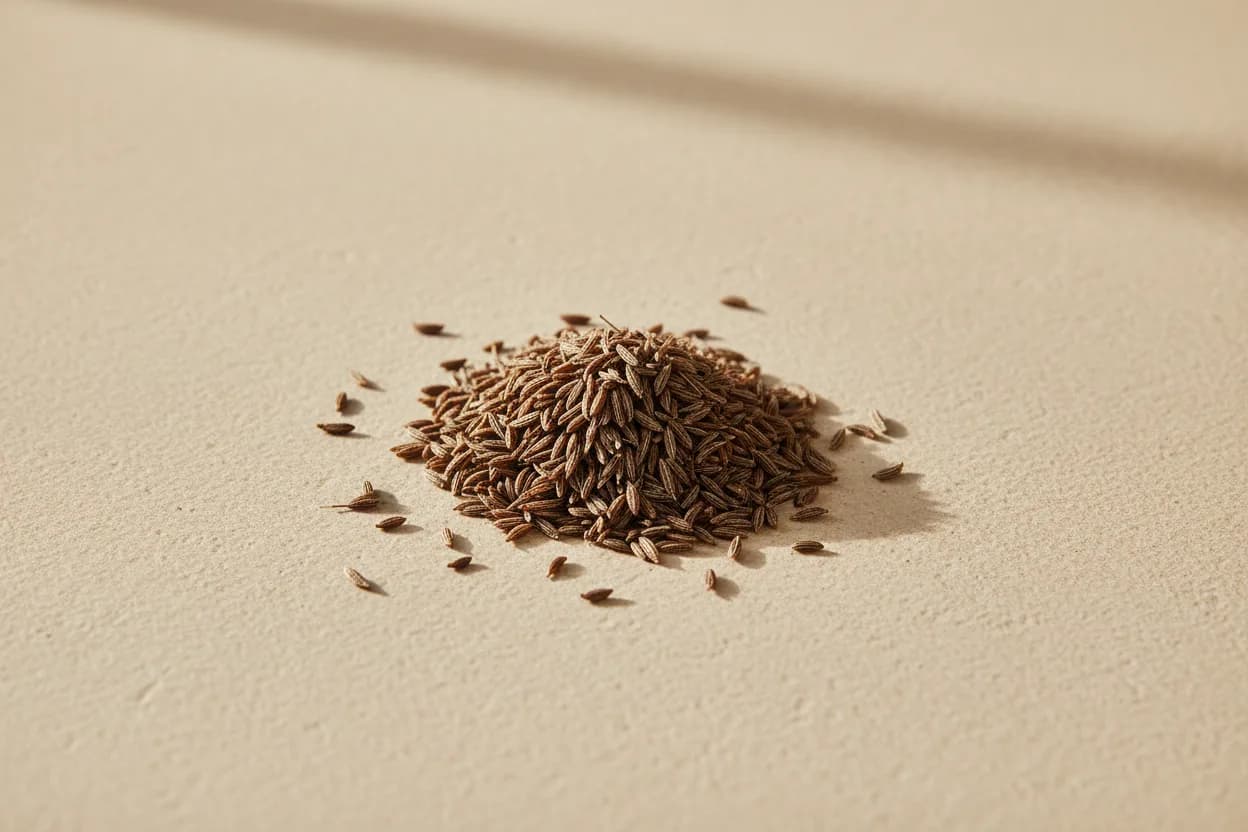
Cumin is beaten out with a rod. It is not threshed with a sledge, because the seed would be crushed.
What the seed is actually building
The smell we call cumin is dominated by a single small molecule: cuminaldehyde, formally 4-isopropylbenzaldehyde, a benzene ring with an isopropyl group at one end and an aldehyde at the other, C₁₀H₁₂O and 148 grams per mole. 3 It is reliably the largest single component of cumin's essential oil, though the share moves a lot with where the plant grew: analyses of four Iranian populations put it between 21 and 34 per cent, and samples from elsewhere run higher still. 4 This is worth knowing before you trust any recipe that specifies cumin by the gram. Two jars from two countries are not the same jar.
The more interesting part is how the seed gets there. Work on the biosynthetic route shows the plant building a terpene backbone, cyclising it into gamma-terpinene, aromatising that into p-cymene, then oxidising it with a cytochrome P450 enzyme into cuminaldehyde, all inside glandular tissue in the fruit. 5 Read the intermediate names and you can smell the sequence: p-cymene is the same compound that runs through thyme and oregano oil. The seed is walking a green, resinous terpene toward a warm, roasted aromatic before any heat touches it. By the time you put it in a dry pan, the plant has already done the hard part.
Toasting finishes the job by brute force. Heat ruptures the oil-bearing structures in the seed coat and drives the volatiles out, so a toasted seed announces itself across a kitchen and a raw one does not. It is worth saying plainly that the tidy numbers circulating online for exactly how much cuminaldehyde toasting creates do not trace back to any real measurement. The effect is obvious to anyone with a pan. The published data is thinner than the confidence of the internet.
The gap in the middle
Cumin is often written up as though it marched continuously from Mesopotamia to the modern spice rack. The medieval European record complicates that. Work compiling late-medieval English and French elite recipes and the purchase lists for fifteenth-century London guild feasts turns up pepper, cinnamon, cloves, ginger, saffron, and mace in quantity, and not much cumin. Its continuity is real, but it runs through Middle Eastern, North African, and South Asian kitchens, not through the banquet halls that happen to have left the best-catalogued shopping lists. Whose records survive is not the same question as what people ate.
What the trials actually say
Cumin has carried a reputation as a digestive for as long as it has been written about, so it is fair to ask what has been measured. The most rigorous summary available is a 2025 systematic review that pooled nine randomised trials covering 531 adults and graded the certainty of its own findings. It reports reductions in fasting blood sugar, triglycerides, and waist circumference, and a rise in HDL. It also rates the evidence behind most of those outcomes as low quality, with heterogeneity between trials running as high as 95 per cent and incomplete reporting in five of the nine. 6
That is not nothing, and it is not a health claim. The most concrete single result is narrower and more interesting: a triple-blind trial in patients recovering from abdominal surgery found that cumin extract measurably sped the return of bowel function, with gas passing at nine hours against nearly twelve, and first defecation at seventeen hours against twenty-six. 7 One trial, in one hospital, not yet replicated. Worth watching rather than repeating as fact.
That is not why anyone actually reaches for it. You reach for it because a spoonful of ground cumin hitting warm fat smells like most of the food I grew up eating. The chemistry explains the smell, but not the reaching.
Sources
Every numbered claim above points here. Links go to the paper, record, or authority itself.
- 1.
Kislev ME, Hartmann A, Galili E. Archaeobotanical and archaeoentomological evidence from a well at Atlit-Yam indicates colder, more humid climate on the Israeli coast during the PPNC period. Journal of Archaeological Science. 2004;31(9):1301-1310.
https://doi.org/10.1016/j.jas.2004.02.010 - 2.
Isaiah 28:25-27, on sowing and threshing cumin (Hebrew kammon) alongside dill, wheat, and barley.
https://www.biblegateway.com/passage/?search=Isaiah%2028%3A25-27&version=NRSVUE - 3.
PubChem Compound Summary CID 326, Cuminaldehyde (4-propan-2-ylbenzaldehyde). National Center for Biotechnology Information.
https://pubchem.ncbi.nlm.nih.gov/compound/326 - 4.
Nouri A, Mofasseri M, Jahani R, et al. Phytochemical composition, hypnotic activity, and antinociceptive properties of cumin essential oil collected from various geographical regions. Food Science & Nutrition. 2024;12(11):9025-9034.
https://doi.org/10.1002/fsn3.4432 - 5.
Deciphering the biosynthesis pathway of gamma-terpinene, cuminaldehyde and para-cymene in the fruit of Bunium persicum. Scientific Reports. 2025. PMID 40594152.
https://pubmed.ncbi.nlm.nih.gov/40594152/ - 6.
Liu M, Wu S, Falahatzadeh M. Potential benefits of Cuminum cyminum L supplementation on components of metabolic syndrome in adults: a GRADE-assessed systematic review and meta-analysis of randomised controlled trials. Frontiers in Nutrition. 2025;12:1618108.
https://doi.org/10.3389/fnut.2025.1618108 - 7.
Esmaeili Abdar A, Elahabadi I, Raeiszadeh M, Sadeghi T. The effect of Cuminum cyminum on the return of bowel motility after abdominal surgery: a triple-blind randomised controlled trial. BMC Complementary Medicine and Therapies. 2024;24:254.
https://doi.org/10.1186/s12906-024-04530-1