Why molokhia is slippery, and what lemon does not do
The texture that divides every table where molokhia is served is a pectin-like polysaccharide, a tenth of the dried leaf by weight. What it is, how heat and calcium change it, and which of the kitchen rules about chopping, lemon and salt anyone has actually measured.
Contents
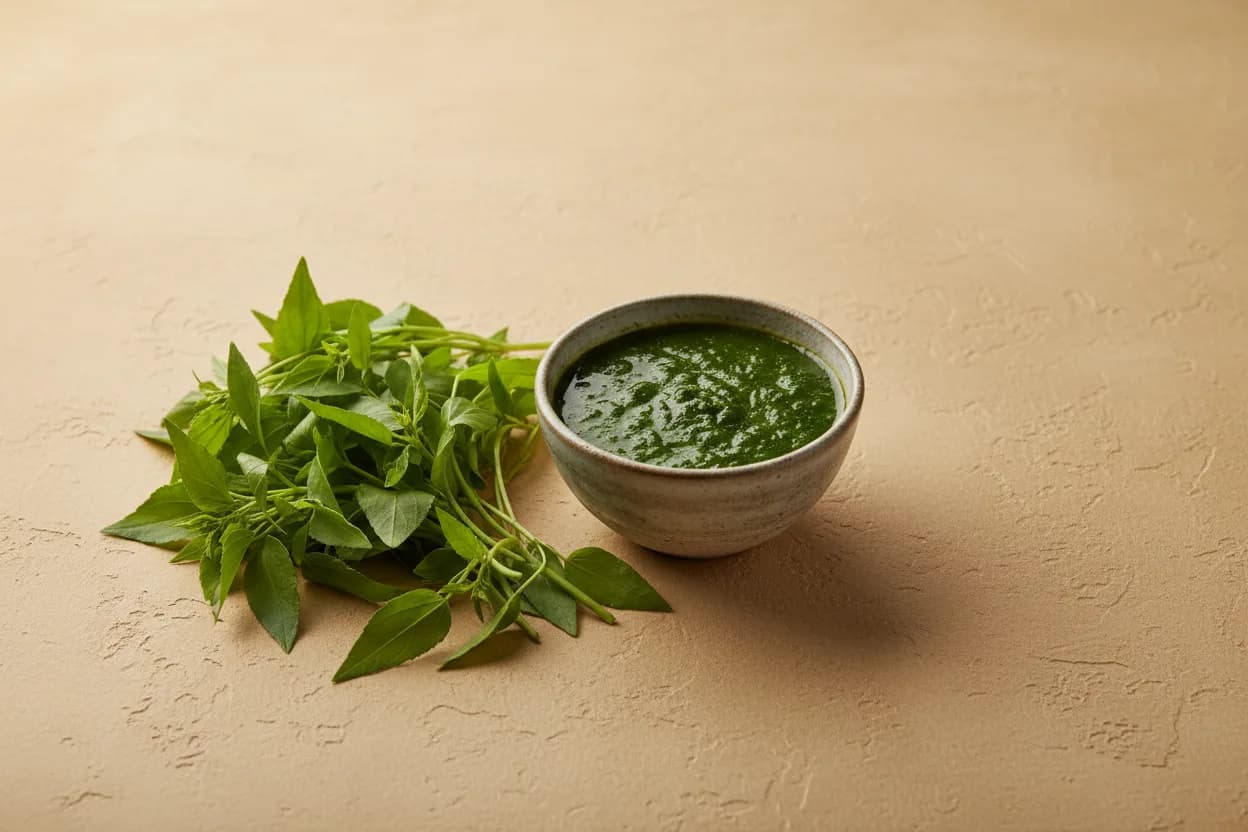
The Journal's earlier note on molokhia dealt with the caliph who banned it, the name that has nothing to do with kings, and the plant that became a vegetable on one continent and a sack on another. This one is about the texture. Stewed, the chopped leaves of Corchorus olitorius turn a pot of broth into something between a soup and a gel, with a slip on the spoon that one Georgetown writer describes as silky, almost butter-like, and that plenty of people cannot get past. 6 The slip has been measured, and so, more recently, have some of the things cooks do to it.
What the slime is
Extracted from the leaves, the mucilage comes to about a tenth of the dry weight. A 2022 analysis broke it into its sugars: rhamnose at 24 per cent, galacturonic acid at 19, glucuronic acid at 15 and a half, galactose at 14, with arabinose, glucose, xylose and fucose behind them. 1 A third of it is uronic acid, which puts it in the pectin family, a rhamnogalacturonan backbone decorated with side chains, a cousin of the pectin that sets jam rather than a neutral gum. 1 The molecule is enormous: a companion study measured it at 1.9 million daltons, in the range of flaxseed mucilage, and noted that older reports had put it far lower, which the authors attribute to how it was pulled out of the leaf. 2 Everything a cook notices follows from a very long, negatively charged chain unspooling in water.
How it thickens
In solution the mucilage's viscosity climbed from about 4 to 155 centipoise as its concentration rose, and a 1 per cent solution runs at roughly the thickness of 0.2 per cent xanthan gum, so gram for gram it is a modest thickener; the leaves supply it in quantity. 1 2 Heat helps it out of the leaf: the mucilage's solubility rose from 46 per cent at 25 degrees to 59 at 45 and 79 at 65, so a hot broth extracts more of it than a warm one, though nobody has followed the curve to a rolling boil or measured what a long simmer does to the chain. 1 Calcium does the opposite. In dilute solution, two millimolar calcium chloride lowered the mucilage's intrinsic viscosity and pulled its flow index toward Newtonian, because the divalent ion screens the charges along the chain and lets it curl up. 3 Hard water, on that measurement, would make a slightly thinner molokhia; the effect was measured in a laboratory solution, not in a pot with chicken in it.
The kitchen rules, held up to the record
Three things every cook says about molokhia. Chop it finer and it gets slimier: plausible, because every laboratory that wants the mucilage grinds the leaf first, one protocol to 300 microns before an hour's infusion at 60 degrees, since the polysaccharide has to be released from ruptured cells before it can do anything, but no one has measured viscosity against knife work. 3 Lemon cuts the slime: the one rheology study that touched pH held it fixed at 7.4 and never varied it, so there is no pH-viscosity curve for this mucilage anywhere in the literature, and the claim is unmeasured rather than wrong. 2 Salt changes it: no data in either direction. It is a little humbling that the most repeated instruction about the dish, the squeeze of lemon at the end, rests on nothing but the fact that people keep doing it.
The ta'liya
What is measured is the finishing fry, the garlic and ground coriander sizzled in fat and stirred in at the end. A whole garlic clove contains almost no allicin; crushing brings the enzyme alliinase into contact with alliin and makes it on the spot, and in the pan allicin, which is unstable, converts quickly into diallyl sulfide, disulfide and trisulfide, the compounds of cooked garlic, so that processed garlic carries a wider range of sulfur compounds than the raw clove. 4 Coriander seed's oil is mostly linalool, from about 38 per cent in Bangladeshi seed to 88 in Tunisian, which is the floral note that lifts the green. 5 The Georgetown writer sautéed a whole head of minced garlic with fresh-ground coriander in olive oil, added the leaves, and doused them with lemon at once, which is one household's order of operations and as good as any. 6
What a bowl gives you
Per 100 grams of raw leaf, the USDA's entry for jute potherb gives 34 kilocalories, 4.65 grams of protein, 208 milligrams of calcium, 4.8 milligrams of iron, 559 of potassium, 37 of vitamin C, 123 micrograms of folate and 278 micrograms of vitamin A as retinol equivalents; it lists no fibre value at all. 7 The figures that circulate several-fold higher are almost certainly from dried leaf powder, where removing the water concentrates everything. A Ghanaian analysis of dried leaf powder found oxalate at 2.7 per cent and phytate at 3.1, judged within permissible limits, and noted that cooking reduces both. 8 One review adds a caution that regular consumption might load the liver with the leaf's oxalate, nitrate and cyanide, and gives cooking as the answer; it offers no dose at which that would matter. 9 The health claims run ahead of the evidence: a 2023 systematic review found twenty rodent studies of the leaf extract in obesity and diabetes, several with lower glucose, at least one with no effect, and no human trial of any kind. 10 The seeds are another matter and never reach the kitchen; they carry cardiac glycosides that act on the heart muscle and are, in the words of one review, mostly highly toxic. 11
So the slip is a very long pectin chain, a tenth of the leaf, drawn out by heat and the knife, thinned a little by calcium, and, as far as anyone has checked, indifferent to the lemon. The lemon stays. It was never for the slime.
Questions this note answers
- Why is molokhia slimy?
- Its leaves hold a mucilage, about a tenth of their dry weight, that is a pectin-like rhamnogalacturonan of nearly two million daltons. Chopping ruptures the cells and hot broth dissolves it, and the long charged chains thicken the liquid the way a gum would. 1 2
- Does lemon juice reduce the sliminess?
- Nobody has measured it. The only rheology study of this mucilage that considered pH held it constant at 7.4, so there is no pH-viscosity curve to cite in either direction. Calcium, by contrast, was measured and thins the mucilage slightly. 2 3
- Is molokhia good for you?
- As a leafy green, yes: per 100 grams raw it carries 208 milligrams of calcium, 4.8 of iron, 278 micrograms of vitamin A and 123 of folate. The stronger claims rest on rodent studies of leaf extract, twenty of them with mixed results and no human trial. Cook it; the leaf's oxalate falls with cooking. 7 10 8
Sources
Every numbered claim above points here. Links go to the paper, record, or authority itself.
- 1.
Oh S, Kim DY. Characterization, Antioxidant Activities, and Functional Properties of Mucilage Extracted from Corchorus olitorius L. Polymers. 2022;14(12):2488.
https://pmc.ncbi.nlm.nih.gov/articles/PMC9228403/ - 2.
Kim DY, Kim H. Effect of Mucilage Extracted from Corchorus olitorius Leaves on Bovine Serum Albumin (BSA)-Stabilized Oil-in-Water Emulsions. Polymers. 2023;15(1):113.
https://pmc.ncbi.nlm.nih.gov/articles/PMC9823750/ - 3.
Nkenmogne Kamdem IE, Saidou C, Ngassoum MB, Ndjouenkeu R. Synergistic interactions in dilute aqueous solutions between alginate and tropical vegetal hydrocolloids. Heliyon. 2020;6(7):e04348.
https://pmc.ncbi.nlm.nih.gov/articles/PMC7341354/ - 4.
Sunanta P, Kontogiorgos V, Pankasemsuk T, et al. The nutritional value, bioactive availability and functional properties of garlic and its related products during processing. Frontiers in Nutrition. 2023;10:1142784.
https://pmc.ncbi.nlm.nih.gov/articles/PMC10409574/ - 5.
Mahleyuddin NN, Moshawih S, Ming LC, et al. Coriandrum sativum L.: A Review on Ethnopharmacology, Phytochemistry, and Cardiovascular Benefits. Molecules. 2021;27(1):209.
https://pmc.ncbi.nlm.nih.gov/articles/PMC8747064/ - 6.
Tahhan A. Tabletop Debates: Reflections on Molokhia, Identity, and Forks vs. Spoons. Center for Contemporary Arab Studies Newsmagazine, Georgetown University; Winter/Spring 2022.
https://ccas.georgetown.edu/ccas-newsmagazine/tabletop-debates-reflections-on-molokhia-identity-and-forks-vs-spoons/ - 7.
USDA FoodData Central. Jute, potherb, raw (Corchorus olitorius). SR Legacy, FDC ID 168419.
https://fdc.nal.usda.gov/portal-data/external/168419 - 8.
Osei-Owusu J, et al. Evaluation of phytochemical, proximate, antioxidant, and anti-nutrient properties of Corchorus olitorius, Solanum macrocarpon and Amaranthus cruentus in Ghana. International Journal of Biochemistry and Molecular Biology. 2023;14(2):17-24.
https://pmc.ncbi.nlm.nih.gov/articles/PMC10195395/ - 9.
Abdel-Razek MAM, Abdelwahab MF, Abdelmohsen UR, Hamed ANE. Pharmacological and phytochemical biodiversity of Corchorus olitorius. RSC Advances. 2022;12(54):35103-35114.
https://pmc.ncbi.nlm.nih.gov/articles/PMC9727694/ - 10.
Mokgalaboni K, Phoswa WN. Corchorus olitorius extract exhibit anti-hyperglycemic and anti-inflammatory properties in rodent models of obesity and diabetes mellitus. Frontiers in Nutrition. 2023;10:1099880.
https://pmc.ncbi.nlm.nih.gov/articles/PMC10113448/ - 11.
Biswas A, Dey S, Huang S, et al. A Comprehensive Review of C. capsularis and C. olitorius: A Source of Nutrition, Essential Phytoconstituents and Pharmacological Activities. Antioxidants. 2022;11(7):1358.
https://pmc.ncbi.nlm.nih.gov/articles/PMC9311623/