Bloating, and what a smoothie can actually do about it
The belly that swells by evening usually holds barely more gas than it did at breakfast. What the CT scans found, which trials a kiwifruit has actually moved, why the yogurt is allowed and the honey is not, and the enzyme claims that do not survive the stomach.
Contents
By evening the belly has a shape it did not have at breakfast, and the internet has a smoothie for it, usually green, usually labelled debloat. In Barcelona a group of gastroenterologists put 56 people through a CT scanner during a bad episode of exactly that swelling and measured how much extra was inside. In the 47 with a functional gut disorder rather than a motility disease, the whole abdomen had gained about 0.3 litres. The bulge was real, 14 millimetres of forward wall, but it came from the diaphragm dropping 12 millimetres and pushing the contents down and out, not from the volume. 1 That result is the frame for everything a blender can and cannot do.
It is not the gas
Rome IV, the criteria clinicians use, defines functional bloating as recurrent bloating or distension on at least one day a week, and allows the two to occur separately: bloating is the sensation, distension the measurable girth. 2 3 The same Barcelona group then infused an identical load of gas into the colons of 20 bloating patients and 15 healthy people while recording the muscles. The healthy diaphragm relaxed upward and the abdominal wall tightened to absorb the volume; in the patients the diaphragm contracted paradoxically and the internal oblique let go, and the same gas produced visibly more distension. They named it abdomino-phrenic dyssynergia. 4 Their summary of this line of work is one sentence: the problem does not seem to be too much gas, but abnormal responses to gas. 5 Fermentable carbohydrate still matters, because MRI shows it draws water into the small bowel and raises colonic gas, but whether that turns into a symptom depends on how sensitive the gut is, not on the raw volume. 6 So the question for the glass is narrower than the label promises: what in it has moved a measured outcome in a trial, and what is along for the ride.
What has actually moved in a trial
The low-FODMAP diet has. In the 2014 crossover trial that made its name, 30 people with irritable bowel syndrome ate three weeks of provided food low in fermentable sugars and three weeks of a typical Australian diet, and their symptom score roughly halved on the first, 22.8 against 44.9 on a 100-millimetre scale, with bloating, pain and wind all lower; the eight healthy controls reported minimal symptoms, unchanged by either diet. 7 A 2022 network meta-analysis of 13 trials and 944 patients ranked it first for bloating severity against every comparator, including standard dietary advice. 8 The American College of Gastroenterology recommends it as a limited trial, and the studies themselves were three-week elimination phases with the food supplied; almost none looked at what happens when foods are brought back, so the evidence is for a short, structured experiment rather than a way of eating. 9 8
Kiwifruit has, three times. In 2023 an international trial gave 63 healthy people, 60 with functional constipation and 61 with constipation-type IBS either two green kiwifruit a day or 7.5 grams of psyllium for four weeks, then swapped them over: the fruit added 1.5 to 1.7 complete bowel movements a week in the two constipated groups and improved a validated comfort score, and the comparator was psyllium, not a placebo. 10 A 2007 Hong Kong trial fed kiwifruit twice a day to 33 constipated patients and found a 54.5 per cent responder rate and complete movements doubling from 2.2 to 4.4 a week, with no change at all in the 20 healthy volunteers eating the same fruit. 11 A Taiwanese trial in 2010 put 41 patients with constipation-type IBS on two Hayward kiwifruit a day and measured more movements and shorter colon transit than in the 13 on placebo capsules. 12 All three fed the whole fruit, so nobody can say whether the fibre, the actinidin enzyme or something else did the work, and Monash lists the fruit as low FODMAP, with two small kiwifruit making up its 150-gram fruit serve. 13 14 It is the one ingredient in a bloating smoothie that arrives with a dose.
What the tables say about the rest of the blender
Monash University's FODMAP programme measures the fermentable sugars in foods in its own laboratory and publishes the cutoffs. 15 16 Its public list puts apples, pears, mango, cherries, peaches, watermelon and all dried fruit on the high side for excess fructose and sorbitol, and kiwifruit, orange, mandarin, pineapple, blueberry and cantaloupe on the low. 17 Banana was retested in 2017 after complaints and split in two: firm banana is low, ripe banana is high in fructans, because cold storage and ripening build them, and the serve of ripe banana is a third of one. 18 Among sweeteners, honey and high-fructose syrups are high and maple syrup and plain sugar are low, the difference being fructose in excess of glucose, which the gut absorbs slowly. 17 19 The sugar alcohols in sugar-free products are the other trap: in Monash's own challenge, 10 grams of sorbitol or mannitol raised symptoms in 20 people with IBS and not in 21 healthy controls, independent of how much was malabsorbed. 20 Erythritol fares better; 20 and 35 grams in water provoked nothing significant and 50 grams only nausea and rumbling, where 35 grams of xylitol already loosened the stool. 21 Milks are a serving question. Oat milk is low up to 104 millilitres and high at 250; soy milk pressed from whole beans is high in galacto-oligosaccharides while soy protein milk is low; almond milk is low; and protein powders that advertise prebiotic fibre are advertising inulin and chicory root, which are fructans. 22 23
| In the blender | Monash rating | Why |
|---|---|---|
| Firm banana | Low | fructans rise with ripening |
| Ripe banana | High | a third of one is the serve |
| Mango, apple, pear, watermelon, dried fruit | High | excess fructose, sorbitol |
| Kiwifruit, orange, pineapple, blueberry | Low | fructose matched by glucose |
| Honey | High | excess fructose |
| Maple syrup, table sugar | Low | fructose matched by glucose |
| Cow's milk, 250 ml | High | 12.5 to 15.75 g lactose |
| Natural yogurt, 170 g | High | 8.5 g lactose on average |
| Oat milk | Low to 104 ml | high at 250 ml |
| Soy milk, whole bean | High | galacto-oligosaccharides |
| Soy protein milk, almond milk | Low | the sugars stay behind |
The yogurt, and a retracted number
Dairy is where the tables and the physiology part ways, usefully. Monash's lactose table, drawn from the Australian food composition database, gives 15.75 grams in 250 millilitres of full-cream milk and an average 8.5 grams in 170 grams of natural yogurt, and rates both high. 24 But the same page, and a 410-page evidence review for the US Agency for Healthcare Research and Quality, put what most lactose-intolerant adults tolerate at about 12 grams in one sitting, roughly a cup of milk, and up to twice that spread across a day. 24 25 Monash also cites a 1997 trial in which people who called themselves intolerant tolerated two cups of milk a day. 26 Yogurt gets a further discount that has nothing to do with its lactose count. In 1984 Kolars and colleagues fed volunteers 18 grams of lactose as yogurt, as milk and in water, and measured a third as much breath hydrogen after the yogurt: the bacteria that soured the milk carried their own lactase into the gut and finished the job there. 27 Kefir does the same, and in minipigs a kefir with live enzyme raised the blood galactose peak 30 per cent above a kefir made from heat-treated grains, which pins the effect on the microbial lactase. 28 So a 100-gram spoon of plain yogurt holds about 5 grams of lactose, under half the threshold, part of it digested on arrival. Lactose-free yogurt blends identically for anyone who would rather not test it.
One number in this territory needs retiring. The claim that 68 per cent of the world's adults malabsorb lactose, 70 per cent in the Middle East against 28 in Europe, comes from a 2017 meta-analysis in the Lancet's gastroenterology journal that the journal retracted in January 2025. 29 The figure is still on the US National Institute of Diabetes and Digestive and Kidney Diseases' public page on lactose intolerance, which cites the retracted paper for it. 30 What survives is the genetics: lactase persistence is common in people of European ancestry and in some African, Middle Eastern and South Asian groups, and rare or absent elsewhere. 31 The direction holds. The percentages, for now, do not.
Ginger, mint, cultures and cucumber
Ginger has a measured effect, and it is not the one on the label. In Kaohsiung, 24 healthy volunteers took 1,200 milligrams of ginger or placebo and then drank soup while an ultrasound watched the stomach: the half-emptying time fell from 26.7 to 13.1 minutes and the antrum contracted more often, and there was no significant difference in any gastrointestinal symptom. 32 The same group repeated it in 11 people with functional dyspepsia, 12.3 against 16.1 minutes, and wrote in the conclusion that ginger had no impact on gastrointestinal symptoms or gut peptides. 33 Whether a thumb of fresh root matches that capsule is unknowable from the outside: across nine commercial ginger products the coefficient of variation in 6-gingerol content was 115 per cent, and for 10-gingerol 142. 34 The peppermint evidence is better and belongs to a different object. Nine trials and 726 patients gave a relative risk of 2.23 for global improvement in IBS, and a 2022 update of ten trials and 1,030 patients put the number needed to treat at four while grading the evidence very low; every one of those trials used an enteric-coated oil capsule built to pass the stomach, and the commonest side effect was heartburn. 35 36 Menthol works on the TRPM8 cold receptor, whose expression in IBS biopsies tracks with pain scores, and peppermint oil relaxes smooth muscle from the lower oesophageal sphincter down, so the reflux caution is a fair inference from the pharmacology rather than a measured result. 37 38 Leaves in a blender are there for the cold on the tongue. Probiotics divide the same way: one bifidobacterium strain at exactly 10 to the 8 colony-forming units a day beat placebo on bloating in 362 women, with the doses above and below it doing nothing, and the pooled trials since disagree with each other, a 2023 analysis finding a small effect on bloating and none on overall severity. 39 40 Cucumber, finally, is 95 per cent water by the USDA's count, and a search for cucurbitacins and any human digestive outcome returns nothing; it goes in for the water. 41
The enzymes and the detox
Papain from papaya and bromelain from pineapple do cut protein; that is what makes them meat tenderisers. Bromelain works between pH 5.5 and 8, well above a stomach at rest, and papain's band reaches down to 3 only for some substrates. 42 43 A 2006 study followed the papaya proteases into acid and watched them collapse, instantaneously, into unstable molten globules that pepsin then degraded, irreversibly. 45 No trial isolates what either enzyme does for a digestive complaint on its own: the one human study with bromelain in it gave 53 dyspepsia patients a four-ingredient tablet with no placebo arm, and the review that credits papain with helping dyspepsia cites, for support, that same 2006 paper. 44 43 Apple cider vinegar has no trial against bloating, and the one small crossover that measured what it does to the stomach, in ten people with diabetic gastroparesis, found 30 millilitres a day slowed emptying further; a 2019 appraisal of popular oesophageal remedies concluded that a substantial gap persists between the anecdotes and the data. 46 47 Celery juice has no trial for bloating, gut healing or detox. The alkaline claim gets the mechanism backwards: fruit and vegetables lower the diet's potential renal acid load, and what the literature ties that to is a slow association with chronic disease over years, not a same-day clearing of anything. 48 Activated charcoal at least has controlled trials, and they split down the middle: two found less breath hydrogen after a gas-producing meal, one of them with less bloating, and two, including one that measured the gases in stool directly, found no effect at all. 49 50 51 52 A 2017 pilot in patients with real gas overproduction saw a charcoal product trail an antibiotic, a gap its authors called a promising trend rather than a result. 53 Chia and flax deserve a fairer hearing. Their mucilage is viscous, and viscosity and fermentability are different axes: the fibre that produces little gas is the long-chain, moderately fermentable kind, like psyllium, while short-chain oligosaccharides ferment fast and bloat. 54 Nobody has run the seeds themselves through a symptom trial, but the best data on adapting to a new fermentable load, from beans, show 45 per cent reporting more wind in week one and 15 to 23 per cent by weeks six to twelve, so a first week of chia is more likely to add gas than take it away, and then to settle. 55 Psyllium itself, in a 275-patient primary-care trial, beat placebo in the first two months, 57 against 35 per cent responders, while bran drove the most dropouts for making symptoms worse. 56
So what goes in the glass
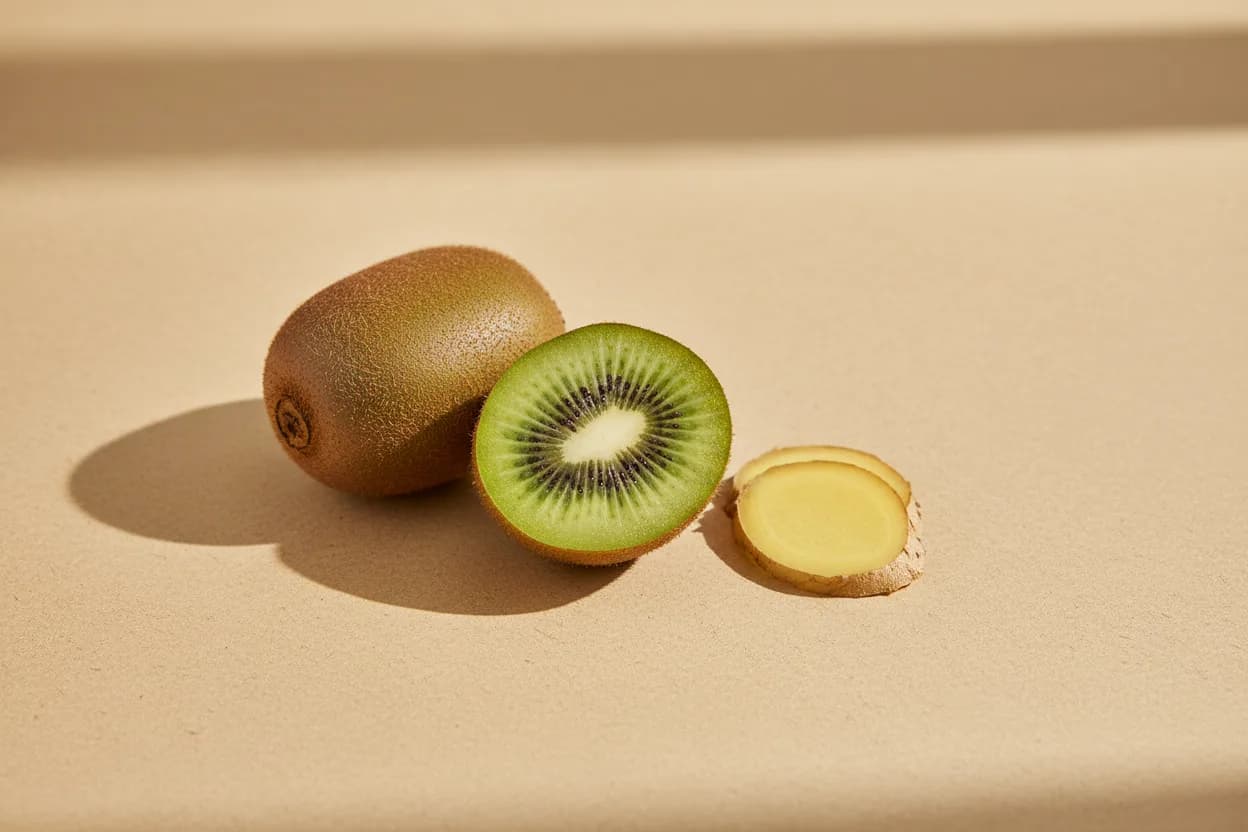
Two green kiwifruit, because that is the dose. A hundred grams of plain yogurt, because its lactose is under the threshold and partly digested before it arrives, or lactose-free if the threshold is not yours. A third of a cucumber for water. A thumb-tip of ginger and a few mint leaves, for heat and cold, with the trials as footnotes rather than promises. No banana unless it is firm, no honey, no mango, no sugar-free syrup, no prebiotic protein powder. Then the honest part. If the swelling is the abdominal wall and the diaphragm misreading a normal amount of gas, no glass addresses that, and it belongs in a gastroenterologist's office rather than a blender. 1 4 A smoothie can keep the fermentable load low, move a sluggish bowel, and taste like something. On most mornings that is enough to ask of a breakfast.
Questions this note answers
- Does a smoothie help with bloating?
- Only in the narrow ways the trials support: keeping the fermentable sugar load low, and, with two green kiwifruit, moving a constipated bowel. If the swelling is the diaphragm and abdominal wall misreading a normal gas load, which the CT and EMG studies found in most bloating patients, no blend addresses it. 1 10
- Is banana low FODMAP?
- Firm banana is. Ripe banana is high in fructans, which build during cold storage and ripening, and Monash's serve of ripe banana is a third of one. 18
Sources
Every numbered claim above points here. Links go to the paper, record, or authority itself.
- 1.
Accarino A, Perez F, Azpiroz F, Quiroga S, Malagelada JR. Abdominal distention results from caudo-ventral redistribution of contents. Gastroenterology. 2009;136(5):1544-1551.
https://doi.org/10.1053/j.gastro.2009.01.067 - 2.
Rome Foundation. Rome IV Criteria: Functional Abdominal Bloating/Distension (C4).
https://theromefoundation.org/rome-iv/rome-iv-criteria/ - 3.
Lacy BE, Cangemi D, Vazquez-Roque M. Management of Chronic Abdominal Distension and Bloating. Clinical Gastroenterology and Hepatology. 2021;19(2):219-231.
https://doi.org/10.1016/j.cgh.2020.03.056 - 4.
Villoria A, Azpiroz F, Burri E, Cisternas D, Soldevilla A, Malagelada JR. Abdomino-phrenic dyssynergia in patients with abdominal bloating and distension. American Journal of Gastroenterology. 2011;106(5):815-819.
https://doi.org/10.1038/ajg.2010.408 - 5.
Azpiroz F, Malagelada JR. The pathogenesis of bloating and visible distension in irritable bowel syndrome. Gastroenterology Clinics of North America. 2005;34(2):257-269.
https://doi.org/10.1016/j.gtc.2005.02.006 - 6.
Staudacher HM, Whelan K. The low FODMAP diet: recent advances in understanding its mechanisms and efficacy in IBS. Gut. 2017;66(8):1517-1527.
https://doi.org/10.1136/gutjnl-2017-313750 - 7.
Halmos EP, Power VA, Shepherd SJ, Gibson PR, Muir JG. A diet low in FODMAPs reduces symptoms of irritable bowel syndrome. Gastroenterology. 2014;146(1):67-75.
https://doi.org/10.1053/j.gastro.2013.09.046 - 8.
Black CJ, Staudacher HM, Ford AC. Efficacy of a low FODMAP diet in irritable bowel syndrome: systematic review and network meta-analysis. Gut. 2022;71(6):1117-1126.
https://doi.org/10.1136/gutjnl-2021-325214 - 9.
Lacy BE, Pimentel M, Brenner DM, et al. ACG Clinical Guideline: Management of Irritable Bowel Syndrome. American Journal of Gastroenterology. 2021;116(1):17-44.
https://doi.org/10.14309/ajg.0000000000001036 - 10.
Gearry R, Fukudo S, Barbara G, et al. Consumption of 2 Green Kiwifruits Daily Improves Constipation and Abdominal Comfort: Results of an International Multicenter Randomized Controlled Trial. American Journal of Gastroenterology. 2023;118(6):1058-1068.
https://pmc.ncbi.nlm.nih.gov/articles/PMC10226473/ - 11.
Chan AO, Leung G, Tong T, Wong NY. Increasing dietary fiber intake in terms of kiwifruit improves constipation in Chinese patients. World Journal of Gastroenterology. 2007;13(35):4771-4775.
https://doi.org/10.3748/wjg.v13.i35.4771 - 12.
Chang CC, Lin YT, Lu YT, Liu YS, Liu JF. Kiwifruit improves bowel function in patients with irritable bowel syndrome with constipation. Asia Pacific Journal of Clinical Nutrition. 2010;19(4):451-457.
https://pubmed.ncbi.nlm.nih.gov/21147704/ - 13.
Monash FODMAP. Two kiwi fruit a day keep constipation at bay. Monash University FODMAP Blog, 12 December 2017.
https://www.monashfodmap.com/blog/two-kiwi-fruit-day-keep-constipation-bay/ - 14.
Monash FODMAP. How to include plenty of fruit on a low FODMAP diet. Monash University FODMAP Blog, 26 June 2017.
https://www.monashfodmap.com/blog/how-to-include-plenty-of-fruit-on-low/ - 15.
Muir JG, Shepherd SJ, Rosella O, Rose R, Barrett JS, Gibson PR. Fructan and free fructose content of common Australian vegetables and fruit. Journal of Agricultural and Food Chemistry. 2007;55(16):6619-6627.
https://doi.org/10.1021/jf070623x - 16.
Varney J, Barrett J, Scarlata K, Catsos P, Gibson PR, Muir JG. FODMAPs: food composition, defining cutoff values and international application. Journal of Gastroenterology and Hepatology. 2017;32(Suppl 1):53-61.
https://doi.org/10.1111/jgh.13698 - 17.
Monash FODMAP. High and low FODMAP foods. Monash University.
https://www.monashfodmap.com/about-fodmap-and-ibs/high-and-low-fodmap-foods/ - 18.
Webber S, Collins L. Update: Bananas re-tested! Monash University FODMAP Blog, 16 May 2017.
https://www.monashfodmap.com/blog/update-bananas-re-tested/ - 19.
Monash FODMAP. Sweeteners and the low FODMAP diet. Monash University FODMAP Blog, 20 May 2020.
https://www.monashfodmap.com/blog/sweeteners-and-low-fodmap-diet/ - 20.
Yao CK, Tan HL, van Langenberg DR, et al. Dietary sorbitol and mannitol: food content and distinct absorption patterns between healthy individuals and patients with irritable bowel syndrome. Journal of Human Nutrition and Dietetics. 2014;27(Suppl 2):263-275.
https://doi.org/10.1111/jhn.12144 - 21.
Storey D, Lee A, Bornet F, Brouns F. Gastrointestinal tolerance of erythritol and xylitol ingested in a liquid. European Journal of Clinical Nutrition. 2007;61(3):349-354.
https://doi.org/10.1038/sj.ejcn.1602532 - 22.
Monash FODMAP. Dairy alternatives: beverage and yoghurt low FODMAP options. Monash University FODMAP Blog, 20 February 2024.
https://www.monashfodmap.com/blog/dairy-alternatives-beverage-and-yoghurt-low-fodmap-options/ - 23.
Monash FODMAP. Protein powders and IBS. Monash University FODMAP Blog, 4 March 2021.
https://www.monashfodmap.com/blog/protein-powders-and-ibs/ - 24.
Collins L. What is lactose intolerance? Monash University FODMAP Blog, 10 April 2016.
https://www.monashfodmap.com/blog/what-is-lactose-intolerance/ - 25.
Wilt TJ, Shaukat A, Shamliyan T, et al. Lactose Intolerance and Health. Evidence Report/Technology Assessment No. 192. Agency for Healthcare Research and Quality; 2010.
https://pmc.ncbi.nlm.nih.gov/articles/PMC4781456/ - 26.
Collins L. Lactose and dairy products on a low FODMAP diet. Monash University FODMAP Blog, 17 January 2017.
https://www.monashfodmap.com/blog/lactose-and-dairy-products-on-low/ - 27.
Kolars JC, Levitt MD, Aouji M, Savaiano DA. Yogurt, an autodigesting source of lactose. New England Journal of Medicine. 1984;310(1):1-3.
https://doi.org/10.1056/NEJM198401053100101 - 28.
de Vrese M, Keller B, Barth CA. Enhancement of intestinal hydrolysis of lactose by microbial beta-galactosidase (EC 3.2.1.23) of kefir. British Journal of Nutrition. 1992;67(1):67-75.
https://doi.org/10.1079/bjn19920009 - 29.
Retraction: Country, regional, and global estimates for lactose malabsorption in adults: a systematic review and meta-analysis. Lancet Gastroenterology and Hepatology. 2025;10(1):13.
https://doi.org/10.1016/S2468-1253(24)00398-4 - 30.
National Institute of Diabetes and Digestive and Kidney Diseases. Definition and Facts for Lactose Intolerance.
https://www.niddk.nih.gov/health-information/digestive-diseases/lactose-intolerance/definition-facts - 31.
Itan Y, Jones BL, Ingram CJ, Swallow DM, Thomas MG. A worldwide correlation of lactase persistence phenotype and genotypes. BMC Evolutionary Biology. 2010;10:36.
https://doi.org/10.1186/1471-2148-10-36 - 32.
Wu KL, Rayner CK, Chuah SK, et al. Effects of ginger on gastric emptying and motility in healthy humans. European Journal of Gastroenterology and Hepatology. 2008;20(5):436-440.
https://doi.org/10.1097/MEG.0b013e3282f4b224 - 33.
Hu ML, Rayner CK, Wu KL, et al. Effect of ginger on gastric motility and symptoms of functional dyspepsia. World Journal of Gastroenterology. 2011;17(1):105-110.
https://doi.org/10.3748/wjg.v17.i1.105 - 34.
Schwertner HA, Rios DC. High-performance liquid chromatographic analysis of 6-gingerol, 8-gingerol, 10-gingerol, and 6-shogaol in ginger-containing dietary supplements, spices, teas, and beverages. Journal of Chromatography B. 2007;856(1-2):41-47.
https://doi.org/10.1016/j.jchromb.2007.05.011 - 35.
Khanna R, MacDonald JK, Levesque BG. Peppermint oil for the treatment of irritable bowel syndrome: a systematic review and meta-analysis. Journal of Clinical Gastroenterology. 2014;48(6):505-512.
https://doi.org/10.1097/MCG.0b013e3182a88357 - 36.
Ingrosso MR, Ianiro G, Nee J, et al. Systematic review and meta-analysis: efficacy of peppermint oil in irritable bowel syndrome. Alimentary Pharmacology and Therapeutics. 2022;56(6):932-941.
https://doi.org/10.1111/apt.17179 - 37.
Peiris M, Weerts ZZRM, Aktar R, et al. A putative anti-inflammatory role for TRPM8 in irritable bowel syndrome, an exploratory study. Neurogastroenterology and Motility. 2021;33(9):e14170.
https://doi.org/10.1111/nmo.14170 - 38.
Scarpellini E, Broeders B, Schol J, et al. The Use of Peppermint Oil in Gastroenterology. Current Pharmaceutical Design. 2023;29(8):576-583.
https://doi.org/10.2174/1381612829666230328163449 - 39.
Whorwell PJ, Altringer L, Morel J, et al. Efficacy of an encapsulated probiotic Bifidobacterium infantis 35624 in women with irritable bowel syndrome. American Journal of Gastroenterology. 2006;101(7):1581-1590.
https://doi.org/10.1111/j.1572-0241.2006.00734.x - 40.
Konstantis G, Efstathiou S, Pourzitaki C, et al. Efficacy and safety of probiotics in the treatment of irritable bowel syndrome: a systematic review and meta-analysis of randomised clinical trials using ROME IV criteria. Clinical Nutrition. 2023;42(5):800-809.
https://doi.org/10.1016/j.clnu.2023.03.019 - 41.
USDA FoodData Central. Cucumber, with peel, raw. SR Legacy, FDC ID 168409.
https://fdc.nal.usda.gov/portal-data/external/168409 - 42.
Pavan R, Jain S, Shraddha, Kumar A. Properties and Therapeutic Application of Bromelain: A Review. Biotechnology Research International. 2012;2012:976203.
https://pmc.ncbi.nlm.nih.gov/articles/PMC3529416/ - 43.
Amri E, Mamboya F. Papain, a Plant Enzyme of Biological Importance: A Review. American Journal of Biochemistry and Biotechnology. 2012;8(2):99-104.
https://doi.org/10.3844/ajbbsp.2012.99.104 - 44.
Pellicano R, Strona S, Simondi D, et al. Benefit of dietary integrators for treating functional dyspepsia: a prospective pilot study. Minerva Gastroenterologica e Dietologica. 2009;55(3):227-235.
https://pubmed.ncbi.nlm.nih.gov/19829282/ - 45.
Huet J, Looze Y, Bartik K, Raussens V, Wintjens R, Boussard P. Structural characterization of the papaya cysteine proteinases at low pH. Biochemical and Biophysical Research Communications. 2006;341(2):620-626.
https://pubmed.ncbi.nlm.nih.gov/16434027/ - 46.
Hlebowicz J, Darwiche G, Björgell O, Almér LO. Effect of apple cider vinegar on delayed gastric emptying in patients with type 1 diabetes mellitus: a pilot study. BMC Gastroenterology. 2007;7:46.
https://doi.org/10.1186/1471-230X-7-46 - 47.
Ahuja A, Ahuja NK. Popular Remedies for Esophageal Symptoms: A Critical Appraisal. Current Gastroenterology Reports. 2019;21(8):39.
https://pubmed.ncbi.nlm.nih.gov/31289950/ - 48.
Osuna-Padilla IA, Leal-Escobar G, Garza-García CA, Rodríguez-Castellanos FE. Dietary Acid Load: Mechanisms and Evidence of its Health Repercussions. Nefrología. 2019;39(4):343-354.
https://pubmed.ncbi.nlm.nih.gov/30737117/ - 49.
Hall RG Jr, Thompson H, Strother A. Effects of orally administered activated charcoal on intestinal gas. American Journal of Gastroenterology. 1981;75(3):192-196.
https://pubmed.ncbi.nlm.nih.gov/7015846/ - 50.
Jain NK, Patel VP, Pitchumoni CS. Efficacy of activated charcoal in reducing intestinal gas: a double-blind clinical trial. American Journal of Gastroenterology. 1986;81(7):532-535.
https://pubmed.ncbi.nlm.nih.gov/3521259/ - 51.
Potter T, Ellis C, Levitt M. Activated charcoal: in vivo and in vitro studies of effect on gas formation. Gastroenterology. 1985;88(3):620-624.
https://doi.org/10.1016/0016-5085(85)90129-5 - 52.
Suarez FL, Furne J, Springfield J, Levitt MD. Failure of activated charcoal to reduce the release of gases produced by the colonic flora. American Journal of Gastroenterology. 1999;94(1):208-212.
https://doi.org/10.1111/j.1572-0241.1999.00798.x - 53.
Melchior C, Gourcerol G, Bridoux V, Ducrotté P, Quinton JF, Leroi AM. Efficacy of antibiotherapy for treating flatus incontinence associated with small intestinal bacterial overgrowth: A pilot randomized trial. PLoS ONE. 2017;12(8):e0180835.
https://pubmed.ncbi.nlm.nih.gov/28763464/ - 54.
El-Salhy M, Ystad SO, Mazzawi T, Gundersen D. Dietary fiber in irritable bowel syndrome (Review). International Journal of Molecular Medicine. 2017;40(3):607-613.
https://pubmed.ncbi.nlm.nih.gov/28731144/ - 55.
Winham DM, Hutchins AM. Perceptions of flatulence from bean consumption among adults in 3 feeding studies. Nutrition Journal. 2011;10:128.
https://pmc.ncbi.nlm.nih.gov/articles/PMC3228670/ - 56.
Bijkerk CJ, de Wit NJ, Muris JW, Whorwell PJ, Knottnerus JA, Hoes AW. Soluble or insoluble fibre in irritable bowel syndrome in primary care? Randomised placebo controlled trial. BMJ. 2009;339:b3154.
https://doi.org/10.1136/bmj.b3154