A ball of jameed is a spring of milk, dried
The stone-hard white balls behind mansaf are sheep's milk soured, churned, salted and sun-dried until nothing can spoil it. What is in one, why it keeps for years on a shelf, why the sauce is stirred without stopping, and how recent the dish it defines turns out to be.
Contents
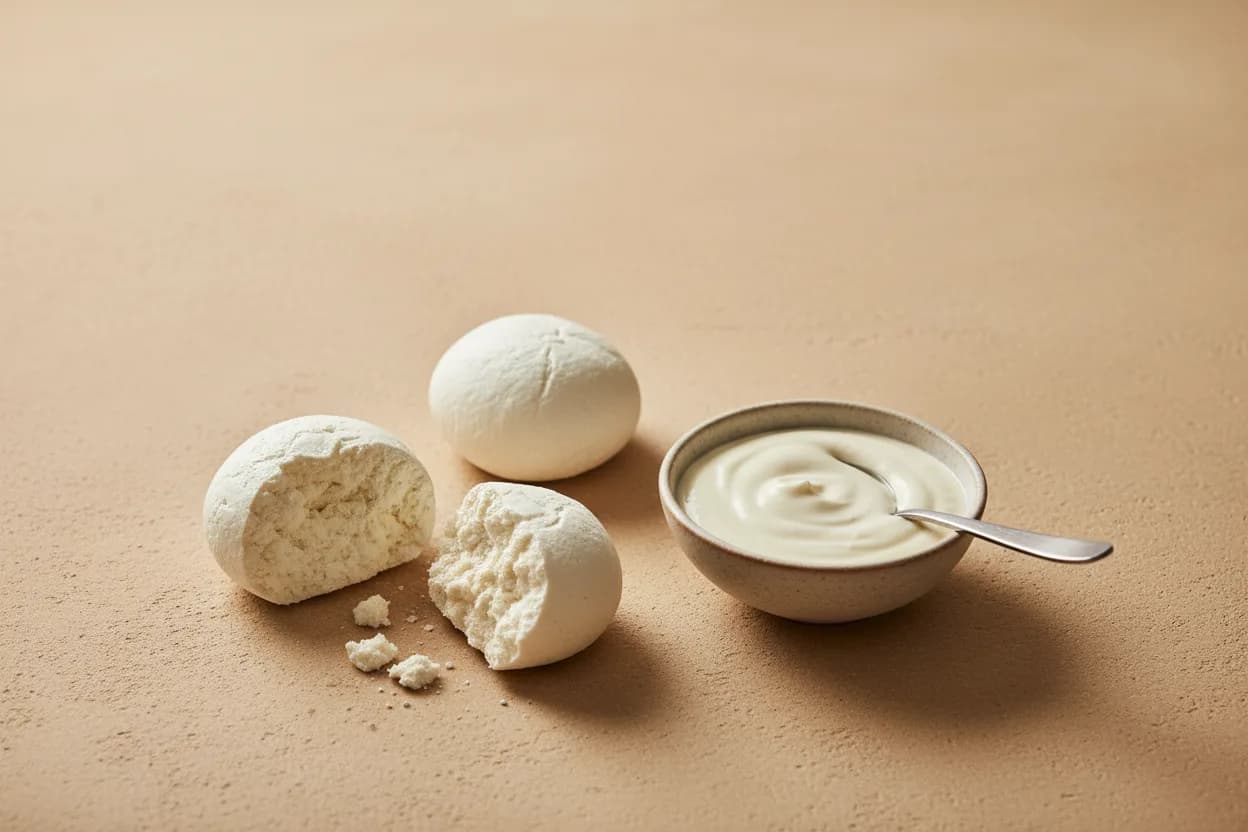
A ball of jameed weighs anything from fifty grams to the better part of a kilo, depending on the district, and it is white, chalk-dry and hard enough to need a mallet or a long soak. 1 It is what the sheep of Karak did in spring. Some 330,000 head there give about 8,500 tonnes of milk between January and June, the milking season runs two or three months for most flocks, and half the households process their own milk into jameed, butter and ghee rather than selling it. 1 19 Karak alone makes an estimated 1,230 tonnes of jameed a year, 95 per cent of it at home. 2 The ball on the shelf in September is the milk of March, made to keep until the next spring, and it can be kept for years at room temperature without spoiling. 1
How milk becomes stone
The sequence is the same in every account and the details differ by village. Fresh milk is set into laban with the two yogurt bacteria, Lactobacillus delbrueckii bulgaricus and Streptococcus thermophilus, plus whatever house culture the family carries from batch to batch. 3 The laban is churned, the butter taken off, and the buttermilk strained through cloth until the whey has drained and a thick white paste is left in the bag; the paste is salted by kneading, shaped by hand into balls, and dried, a day in the shade and then in direct sun for a fortnight or more, until it is stone-hard. 1 4 5 There is no rennet anywhere in that sequence. Older papers call the product jameed cheese, but it is a dried, salted, fermented milk, closer to a yogurt that has been taken as far from liquid as it will go. 6 1
The finished ball is mostly protein and salt. A 1988 analysis of sheep-and-goat jameed found 50 per cent protein, 20 per cent fat, 91 per cent total solids and 11 per cent salt, with a titratable acidity of 6.6 per cent. 6 A 2024 survey of 80 market samples from every governorate of Jordan found the spread a village product produces: total solids from 73 to 92 per cent, protein from 37 to 54 per cent of solids by region, salt averaging 15.7 per cent, with every district over the 12 per cent that Jordan's own standard prescribes, because producers use salt to hold the acidity down while the balls dry. 1 Karak's jameed had the lowest fat in the country, under 9 per cent against nearly 18 in Ajloun, and its consumers prefer it acidic and strong; the survey used Karak's as the reference the whole country recognises. 1 A storage trial that followed sheep-buttermilk jameed for six months watched the pH fall from 4.98 to 3.36 and the salt and protein concentrate as the water left. 5
Why it keeps
Nothing in a jameed ball is doing the preserving alone. Low moisture, low pH, a sixth of its weight in salt, and a resident population of lactic acid bacteria that crowd out anything pathogenic: the survey names all four, and it is the combination that lets the product sit for months at 15 to 30 degrees without deteriorating. 1 7 The record is good. In the 80 market samples there was no Brucella, no Chlamydia and no Q fever, the diseases a raw-milk product from a sheep economy would carry if the process failed. 1 A trial that introduced hazard-control points into home production found the home-made balls already low in coliforms and Staphylococcus, and brought both below detection with better hygiene at the straining and salting steps. 8 The one real safety finding in that survey was not the jameed's doing: antibiotic residues, carried over from mastitis treatment in the flocks, turned up in roughly half the samples. 1 Sun-drying, the slow traditional way, left a lower microbial load than freeze-drying in a side-by-side comparison, which is a rare case of the older method being the more conservative one. 4
Why the cook never stops stirring
Soaked, ground and strained back into a liquid, jameed is milk protein in a very acidic bath, and the rule every mansaf cook learns is to whisk it from cold to the boil and keep stirring through the simmer, often with an egg or a spoon of starch beaten in first. The dairy chemistry explains the nervousness. Casein floats in milk as micelles held apart by a hairy surface layer of kappa-casein and a negative charge; acid strips the charge, and heat strips the kappa-casein, and a 2018 study showed that micelles which have lost their kappa-casein to heat clump at an earlier stage of acidification than intact ones, because their surfaces are barer and more hydrophobic. 9 Fresh milk starts near pH 6.7; reconstituted jameed starts around 4, already past the point where cold milk would have curdled, so the pot begins where a custard ends. Constant stirring keeps any spot from overheating and breaks up protein flocs before they grow; starch or egg thickens the liquid between them and gets in their way. That last part is general food science applied to a sauce nobody has put in a rheometer. It is the best account of the rule, not a test of it.
Jameed has cousins the length of the old dry belt. Kishk, across the eastern Mediterranean, Egypt and the Levant, is the same idea with bulgur or another grain kneaded into the fermented milk before drying. 10 Kurut, in Kazakhstan and across Central Asia and western China, is the acid-coagulated, spontaneously fermented ball of yak, cow, sheep or goat milk; one Kazakh study's own formulations came out at pH 3.7 to 4.0 and a water activity of 0.91 to 0.93. 11 Mongolia's aaruul sits at the far end, and a survey of 543 lactic bacteria isolated from Mongolian dairy products found the same Lactobacillus delbrueckii bulgaricus among the dominant species. 12 Jordan's engineers have taken the ball into a spray dryer, working out in 2000 the feed solids and inlet temperature that turn fermented, salted curd into a powder that disperses faster than the sun-dried original. 13 The Karak farmers who still shape it by hand now compete with liquid jameed and with balls imported from Syria and Türkiye, and as of 2023 the product had no protected designation of its own, only a reputation. 19
How old is the dish it makes
In 2022 UNESCO inscribed al-mansaf on its list of the intangible heritage of humanity: chunks of sheep or goat meat boiled with spices in a yogurt sauce, served with rice or sometimes bulgur over a layer of thin bread, garnished with fried almonds, the platters carried to the reception hall by the host's relatives and eaten by five to seven people at a time, with the right hand, the left held behind the back. 14 The listing does not use the words jameed or shrak; it says yogurt sauce and thin bread, and it credits women with passing the recipes and the milking to their daughters. 14
The dish is older than the listing and younger than its legend. An ethnography of one northern village, Hartha, built on interviews in 2015 and 2016, reconstructs the local sequence: before 1945 mansaf was thin shrak bread soaked in meat broth with the meat piled on and clarified butter poured over, then bread with bulgur under the meat; rice arrived around 1945 and overtook bulgur in the early 1950s; the jameed sauce, the roasted almonds and the pine nuts came in the 1960s, when cooks also began cooking the meat in the sauce; the bread went out in the 1970s. The author is explicit that this is one village's memory and not the history of the dish everywhere. 15 Joseph Massad's argument in Colonial Effects is broader: that the mansaf presented to the Bedouin as their own timeless dish had been repackaged and reintroduced by the state, first under the Mandate and then under the Hashemites, in a form that differed substantially from what came before, and an informant of his own told him about Bedouin mansaf and about jamid as things that belonged together. 16 Two later studies make the same point in the language of their fields: mansaf as a feasting food that recruits allies and repays social debts, and mansaf as a national symbol that emerged from particular historical contingencies rather than an unchanged desert relic. 18 17 Massad's notes also cite a 1978 Baghdad folklore journal on mansaf in Palestinian popular tradition, a reminder that the dish's map is wider than one kingdom, and that the word laban itself meant yogurt to a villager and milk to a Bedouin. 16
Hartha's informants add the detail no listing carries. Seven or eight people to a tray, left arm behind the back so that more can fit and no one encroaches; a strict rule to eat only from the spot in front of you, enforced, if someone reaches, by an elder grabbing the hand and pushing it into the hot rice; eating with the hand as the mark of adulthood, with a young man reaching for a spoon gently told off. 15 The day before a wedding lunch the women soak the jameed in warm water and grind it by the handful in shifts, drinking tea and singing folk songs that set a rhythm for the grinding and, one informant said, distract the workers from how hard it is. 15 The recipe on this site skips the ball and builds the sauce from yogurt, ayran, an egg and a spoon of cornflour, which is the same stabilising instinct in a kitchen without a Karak spring behind it. Somebody, somewhere, is still grinding.
Questions this note answers
- What is jameed made of?
- Sheep or goat milk, set into yogurt, churned to take off the butter, strained through cloth, salted by kneading, shaped into balls and sun-dried for weeks until stone-hard. No rennet is used. The finished ball is roughly half protein, a sixth salt, and under a tenth water, with a pH near 4. 1 6 5
- Why does mansaf sauce curdle if you stop stirring?
- Reconstituted jameed is milk protein in an acidic liquid, already near the point where casein clumps. Heat strips kappa-casein from the micelles and makes them clump earlier in acidification, so an unstirred hot spot flocculates first. Stirring keeps the pot even and breaks flocs; the egg or starch many cooks add thickens the liquid between the proteins. The rule is well founded in dairy chemistry but has never been tested on the sauce itself. 9
- How long does jameed keep?
- Years at room temperature, in the field survey's words, and months at 15 to 30 degrees in a controlled trial. Low moisture, low pH, high salt and a resident lactic flora together stop spoilage; 80 market samples carried no Brucella, Chlamydia or Q fever. 1 7
- Why is Karak jameed particularly famous?
- Karak has the numbers behind it: some 330,000 sheep there produce about 8,500 tonnes of milk between January and June, and Karak alone turns out an estimated 1,230 tonnes of jameed annually, 95 per cent of it made at home. 1 2 19 Its jameed is also distinctive, the lowest in fat of any Jordanian governorate, under 9 per cent against nearly 18 in Ajloun, and consumers prefer it acidic and strong, so the national survey used Karak's jameed as the reference the whole country recognises. 1
Sources
Every numbered claim above points here. Links go to the paper, record, or authority itself.
- 1.
Hilali M, Rekik M, Hijazi J, Ababenah H. Nutritional and Food Safety Characteristics of Jameed, A Traditional Dairy Product of Drylands. Applied Sciences. 2024;14(2):678.
https://doi.org/10.3390/app14020678 - 2.
FAO and EBRD. Jordanian Jameed: Jameed connects present-day Jordanians to their ancestral roots. Rome: FAO; 2024.
https://openknowledge.fao.org/handle/20.500.14283/cd1078en - 3.
Haddad MA, Yamani MI, Jaradat D, Obeidat M, Abu-Romman SM, Parisi S. Dried Fermented Dairy Products in Jordan: Jameed and Traceability. In: Food Traceability in Jordan. Cham: Springer; 2021.
https://doi.org/10.1007/978-3-030-66820-4_4 - 4.
Al Omari A, Quasem JM, Mazahreh AS. Microbiological Analysis of Solar and Freeze-Dried Jameed Produced from Cow and Sheep Milk with the Addition of Carrageenan Mix to the Jameed Paste. Pakistan Journal of Nutrition. 2008;7(6):726-729.
https://doi.org/10.3923/pjn.2008.726.729 - 5.
Ismail MM. Impact of Innovative Forms on the Chemical Composition and Rheological Properties of Jameed. Journal of Nutritional Health & Food Engineering. 2017;6(1).
https://medcraveonline.com/JNHFE/impact-of-innovative-formson-the-chemical-composition-and-rheological-properties-of-jameednbsp.html - 6.
Abu-Lehia IH. The chemical composition of jameed cheese. Ecology of Food and Nutrition. 1988;20(3):231-239.
https://doi.org/10.1080/03670244.1988.9991003 - 7.
Angor MM. Physicochemical and sensory properties of jameed enriched with orange albedo and apple peel powders as dietary fibre sources. African Journal of Food, Agriculture, Nutrition and Development. 2023;23(2).
https://doi.org/10.18697/ajfand.117.22535 - 8.
Al-Saed AK, Al-Groum RM, Al-Dabbas MM. Implementation of hazard analysis critical control point in jameed production. Food Science and Technology International. 2012;18(3):229-239.
https://doi.org/10.1177/1082013211427783 - 9.
Oka D, Ono W, Ohara S, Noguchi T, Takano K. Effect of heat-induced κ-casein dissociation on acid coagulation of milk. Journal of Dairy Research. 2018;85(1):104-109.
https://doi.org/10.1017/s002202991700084x - 10.
Khedr S, Güran HŞ. A Traditional Fermented Product: Kishk. Dicle Üniversitesi Veteriner Fakültesi Dergisi. 2024;17(1):78-84.
http://dergipark.org.tr/en/doi/10.47027/duvetfd.1501236 - 11.
Ospanov A, Muslimov N, Tlevlessova D, et al. Production of kurut (kurt) using probiotic Lacticaseibacillus rhamnosus GG strain in Kazakhstan. Frontiers in Food Science and Technology. 2022;2:1045579.
https://doi.org/10.3389/frfst.2022.1045579 - 12.
Takeda S, Yamasaki K, Takeshita M, et al. The investigation of probiotic potential of lactic acid bacteria isolated from traditional Mongolian dairy products. Animal Science Journal. 2011;82(4):571-579.
https://doi.org/10.1111/j.1740-0929.2011.00874.x - 13.
Jumah RY, Tashtoush B, Shaker RR, Zraiy AF. Manufacturing Parameters and Quality Characteristics of Spray Dried Jameed. Drying Technology. 2000;18(4-5):967-984.
https://doi.org/10.1080/07373930008917747 - 14.
UNESCO. Al-Mansaf in Jordan, a festive banquet and its social and cultural meanings. Representative List of the Intangible Cultural Heritage of Humanity, element 01849; inscribed 2022.
https://ich.unesco.org/en/RL/al-mansaf-in-jordan-a-festive-banquet-and-its-social-and-cultural-meanings-01849 - 15.
Alobiedat AA. The Sociocultural and Economic Evolution of Mansaf in Hartha, Northern Jordan. Humanities. 2016;5(2):22.
https://doi.org/10.3390/h5020022 - 16.
Massad JA. Colonial Effects: The Making of National Identity in Jordan. New York: Columbia University Press; 2001. Notes to chapter 3, p. 316.
https://ciaotest.cc.columbia.edu/book/maj01/maj01_07.pdf - 17.
Wojnarowski F, Williams J. Making mansaf: the interplay of identity and political economy in Jordan's 'national dish'. Contemporary Levant. 2020;5(2):161-177.
https://doi.org/10.1080/20581831.2020.1767325 - 18.
Shunnaq M, Ramadan S, Young WC. National meal or tribal feasting dish? Jordan's mansaf in cross-cultural perspective. Food, Culture & Society. 2021;25(5):977-996.
https://doi.org/10.1080/15528014.2021.1948753 - 19.
Bdour MA, Zyadeen AF, Alkawalit NT. Estimating Economic Returns of Sheep and Goat Rearing in Karak Governorate. Jordan Journal of Agricultural Sciences. 2023;19(2):142-150.
https://doi.org/10.35516/jjas.v19i2.1428