Browning is not a reaction, it is a cascade
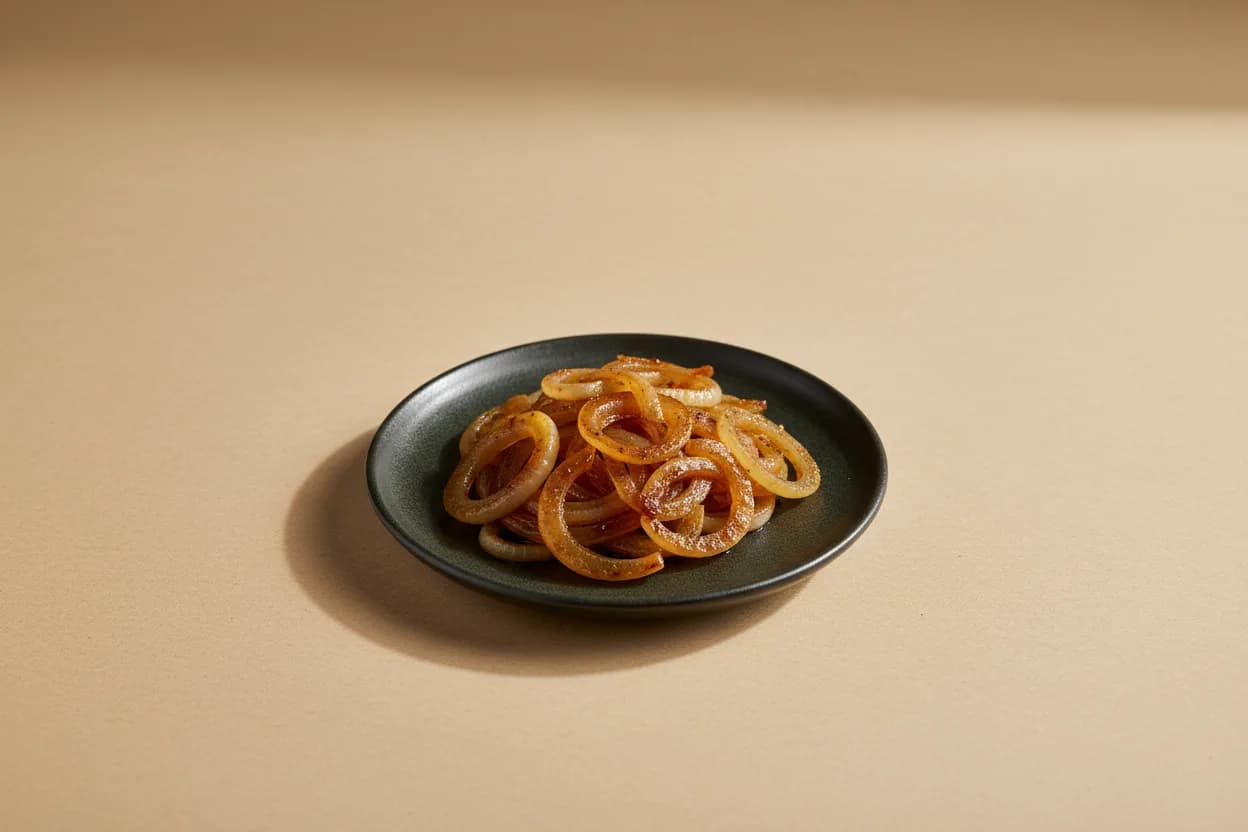
A physician studying protein chemistry in 1912 described the reaction that makes bread crust, seared beef, and fried onions taste the way they do. He was not thinking about food at all.
Contents
In 1912 Louis-Camille Maillard, a French physician and chemist, sent a two-page note to the Académie des sciences describing what happens when amino acids are heated with sugars. It ran to three pages of the Comptes Rendus and was not about cooking in any way. 1 He was working on protein chemistry and on the formation of the dark, complex substances he called melanoidins, and he followed it the next year with a memoir on the genesis of humic and proteic matter. Soil and physiology, not the kitchen.
It took four decades for food science to fully claim him. The scheme still taught today was set out by John Hodge in 1953, a sixteen-page paper in the very first volume of the Journal of Agricultural and Food Chemistry, which laid out the stages in an order that has survived essentially intact. 2 Most of what a cook believes about browning descends from those two documents.
Not one reaction
The single most useful correction is that the Maillard reaction is not a reaction. It is a cascade, and the stages do genuinely different chemistry. 4
It starts with a condensation: the carbonyl group of a reducing sugar meets a free amino group, usually on an amino acid or the exposed end of a protein, and they join, losing water, to form a glycosylamine. That rearranges into a ketosamine by the Amadori rearrangement. The ketosamine dehydrates and fragments into small, highly reactive dicarbonyl compounds, and those are the workhorses of everything that follows.
The dicarbonyls attack amino acids in the Strecker degradation, stripping off carbon dioxide and yielding an aldehyde that keeps the original amino acid's side chain. This is where a lot of specificity comes from: which amino acids are present determines which aldehydes you get, which is part of why browned lamb, browned onion, and browned bread do not smell alike despite running the same chemistry. Finally the reactive fragments cyclise into heterocycles, the pyrazines and furans and thiophenes and pyrroles that carry roasted aroma, and polymerise into the brown melanoidins that give crust its colour. 3
The temperature myth
You will read everywhere that the Maillard reaction happens at 140 to 165 degrees. That figure describes when browning becomes fast and visible in a dry system. It is not a switch.
The reaction runs, slowly, far below that. Reviews document measurable Maillard chemistry in food stored at four degrees, and advanced glycation products accumulating in meatballs held at minus eighteen. 3 It also runs at body temperature, continuously, in you. Haemoglobin A1c, the marker used to assess long-term blood sugar control, is an Amadori product: glucose condensing onto a protein and rearranging, at thirty-seven degrees, exactly as Maillard described. The clinical test and the crust on a loaf are the same chemistry at different speeds.
Caramelisation is a genuinely different process, and the distinction is not pedantry. Caramelisation is sugar alone, breaking down under heat with no amino group involved, and it generally needs higher temperatures: fructose goes at around 105 degrees, glucose near 150, sucrose around 160 to 170, maltose not until 180. That is a 75-degree spread inside a single word. When you cook an onion slowly to deep brown sweetness you are running both processes at once, and the result tastes like neither one alone.
Why a wet surface will not brown
The most practical consequence of all this is about water, and it comes from two directions.
The first is thermodynamic. As long as there is free water on the surface of a piece of food, evaporation holds that surface near the boiling point of water, around one hundred degrees, which is below the range where browning proceeds quickly. The surface cannot get hot enough until it has dried. This is why patting meat dry is not a chef's superstition, why a crowded pan steams instead of searing, and why anything you have just rinsed will sit there going pale and grey.
The second is kinetic and less intuitive: the reaction is not fastest in the absence of water either. Maillard browning peaks at a water activity of roughly 0.6 to 0.7. 3 Too much free water dilutes the reactants and caps the temperature; too little and the molecules cannot move to find each other. The reaction wants a surface that is damp, not wet and not bone dry, which is a decent description of a properly rested piece of meat going into a hot pan.
Pyrazines, plural
There is no molecule called pyrazine that makes things taste roasted. Pyrazines are a family of nitrogen-containing rings, and dozens of them form during browning, each with its own smell and its own potency.
Potency is where they get startling. A study of thirteen alkylpyrazines formed in Maillard reactions found odour detection thresholds spanning 4 to 490 parts per billion. 5 Parts per billion is the working unit. Better still, compare two isomers: 2-ethyl-3,5-dimethylpyrazine has a threshold around 0.04 micrograms per litre in water, while 2-ethyl-3,6-dimethylpyrazine, which differs only in the position of one methyl group, sits at 8.6. 6 Moving a single methyl around the ring changes detectability by more than two hundredfold.
One caution if you go looking at threshold tables. These numbers are medium-dependent; the same compound measured in a water-alcohol matrix rather than plain water can come out orders of magnitude different. A threshold is a measurement in a context, not a property of the molecule.
The cost side
Browning is not free. Acrylamide, which forms in starchy foods at high heat, is a Maillard product, and its mechanism was pinned down by two independent groups publishing back to back in the same 2002 issue of Nature. 7 It arises specifically from the amino acid asparagine reacting with reducing sugars, generally above about 120 degrees, which is why it concentrates in potatoes, crisps, bread, and coffee rather than in seared meat. Same cascade, but this particular product needs that particular amino acid.
The European Food Safety Authority's assessment flags neurotoxicity, carcinogenicity, and developmental toxicity as concerns based on animal data, while noting that human epidemiological studies have not shown a clear link to cancer. 8 The sensible reading is neither panic nor dismissal: brown your food to gold rather than dark brown, especially starches, and get on with your life.
The best part of all this is how ordinary the original observation was. A physician mixed sugars with amino acids, watched them go brown, and wrote three pages about it because he was curious what proteins do. He had no idea he had just described the taste of nearly every cooked thing anyone would eat for the next century.
Sources
Every numbered claim above points here. Links go to the paper, record, or authority itself.
- 1.
Kawamura S. Louis Camille Maillard (1878-1936) and the Amino-Carbonyl Reaction. Journal of the Agricultural Chemical Society of Japan. 1982;56(12):1199-1202. On Maillard's original 1912 note in Comptes Rendus de l'Académie des Sciences 154:66-68.
https://doi.org/10.1271/nogeikagaku1924.56.1199 - 2.
Hodge JE. Dehydrated Foods: Chemistry of Browning Reactions in Model Systems. Journal of Agricultural and Food Chemistry. 1953;1(15):928-943.
https://doi.org/10.1021/jf60015a004 - 3.
El Hosry L, Elias V, Chamoun V, et al. Maillard Reaction: Mechanism, Influencing Parameters, Advantages, Disadvantages, and Food Industrial Applications: A Review. Foods. 2025;14(11):1881.
https://doi.org/10.3390/foods14111881 - 4.
van Boekel MAJS. Formation of flavour compounds in the Maillard reaction. Biotechnology Advances. 2006;24(2):230-233.
https://doi.org/10.1016/j.biotechadv.2005.11.004 - 5.
Fors SM, Olofsson BK. Alkylpyrazines, volatiles formed in the Maillard reaction. I. Determination of odour detection thresholds and odour intensity functions by dynamic olfactometry. Chemical Senses. 1985;10(3):287-296.
https://doi.org/10.1093/chemse/10.3.287 - 6.
Buttery RG, Ling LC. 2-Ethyl-3,5-dimethylpyrazine and 2-ethyl-3,6-dimethylpyrazine: odor thresholds in water solution. LWT - Food Science and Technology. 1997;30(1):109-110.
https://doi.org/10.1006/fstl.1996.0139 - 7.
Mottram DS, Wedzicha BL, Dodson AT. Acrylamide is formed in the Maillard reaction. Nature. 2002;419:448-449.
https://doi.org/10.1038/419448a - 8.
EFSA Panel on Contaminants in the Food Chain (CONTAM). Scientific Opinion on acrylamide in food. EFSA Journal. 2015;13(6):4104.
https://doi.org/10.2903/j.efsa.2015.4104