Big Mike, Blue Java, Matooke: a Map of Every Banana Worth Knowing
A wild banana is mostly seeds. Everything edible descends from a few Southeast Asian wild populations, some still unidentified, sorted into an alphabet of genomes. Here is who begat whom, why the export banana has died once already, and what banana candy has to do with it.
Contents
Bite a wild banana and you break a tooth. The fruit of Musa acuminata is a slim green case packed with hard black seeds around a little pulp, and nothing about it suggests a fruit bowl. What turned it into food was an accident it carries in its genes: a tendency to set fruit without pollination, called parthenocarpy, which every so often produced a fruit with fewer seeds and more flesh. Somebody in New Guinea noticed, dug up the sucker, and planted it. Phytoliths in the garden mounds at Kuk Swamp, in the highlands, show bananas being cultivated intensively between 6,950 and 6,440 years ago. 11 1 2
Parthenocarpy on its own is not enough, because a parthenocarpic plant is still fertile and will set seed if something pollinates it. Seedlessness needed sterility too, which arrived when distant subspecies were crossed and their mismatched chromosomes wrecked meiosis. 10 The result is a plant that cannot breed and is multiplied only by digging up its shoots, so every Cavendish on earth is one clone. That fact sits under everything that follows. A banana variety has no genetic variation for a disease to stumble over, and a fungus that finds a way into one plant has found its way into all of them. 51
An alphabet instead of a Latin name
Linnaeus named the plantain Musa paradisiaca in 1753, after the forbidden fruit, and the dessert banana Musa sapientum in 1758, the banana of the wise. Both turned out to describe hybrids, and every Latin binomial coined for a cultivated banana since has been folded into Musa x paradisiaca. 8 Ernest Cheesman, working first in Trinidad and then at Kew, argued in 1948 that the wild species and the cultivated types could not be reconciled inside Linnaean naming at all. 9 His successors at the Trinidad banana station, Norman Simmonds and Kenneth Shepherd, replaced the binomials in 1955 with a score: fifteen characters that differ between the two wild parents, each marked one to five, so that a cultivar lands somewhere between 15, pure Musa acuminata, and 75, pure Musa balbisiana. 6 7 The letters A and B stand for those two species. A supermarket banana is AAA, a plantain AAB, a Thai or Philippine cooking banana ABB, and the number of letters is the number of chromosome sets, so most of the map below is triploid and sterile.
The A side is not one thing. Musa acuminata is a species of regional subspecies: banksii in New Guinea, malaccensis on the Malay Peninsula, zebrina in Java, errans in the Philippines, burmannica and its relatives on the mainland. 2 Domestication began with banksii, whose alleles turn up in nearly every edible diploid, and the plants moved west and picked up other subspecies as they went, so that a cultivar's chromosomes read as a mosaic of three, four, five ancestries. 2 3 Then the mosaics threw up a surprise. In 2020 a genome-ancestry study found a fifth ancestral group that exists only in cultivars, and said plainly that major wild banana ancestors have yet to be identified. By 2023 the count was eleven contributing gene pools, two of unknown origin, plus the New Guinean species Musa schizocarpa, whose introgressions are carried by cultivars far outside New Guinea. 3 4 5 The textbook line, acuminata crossed with balbisiana, is true and incomplete. Some of the banana's parents are still out there, or gone.
Big Mike
The banana the twentieth century ate was 'Gros Michel'. A French planter, Jean Pouyat, noticed it growing on Martinique in the 1830s; by the 1890s it lined the Caribbean coast of Central America, and by 1900 it was the bulk of what the United States imported. 25 Its virtues were the trade's virtues: a big bunch and a bruise-resistant peel, so tough that whole stems went from the field to the fruit stand with the fruit still hanging on them. 50 Minor Keith laid railway through Costa Rica from 1871 and planted bananas beside the track; the company he went on to co-found, United Fruit, gave the language the phrase banana republic. 50
The fungus was already waiting. Fusarium wilt of banana was first recorded in Australia in 1876, but it took its common name from the export plantations of Panama, where it was reported in 1890. 51 It moved through the soil of every Gros Michel monoculture in the hemisphere: 30,000 hectares lost in the Ulua Valley of Honduras between 1940 and 1960, 6,000 around Quepos in Costa Rica, losses put at 400 million dollars by 1960, over two billion in today's money. 50 Resistant cultivars had been identified as early as 1910, and the Governor of Jamaica wrote in 1933 that the final destruction of Gros Michel was a question of when, not if. 25 51 The trade still did not move until the late 1950s, when cheap Gros Michel from Ecuador's clean soils undercut the diseased plantations of Central America and the companies replanted them with Cavendish. 25 50
It did not go extinct. Gros Michel is still grown by smallholders and in backyards, and it answers to living names: Bogoya in Uganda, Kluai Hom Thong in Thailand, Pisang Embun in Malaysia, Guineo in Colombia. Two accessions sit in the international banana genebank. 25 27 What died was a supply chain.
The candy question
Everyone has heard that banana candy tastes wrong because it was modelled on Gros Michel. Half of that is chemistry and half is folklore. The chemistry: the smell of a banana is mostly one ester, isoamyl acetate, which sniffing panels pick out of banana essence more consistently than anything else in it. 58 The folklore is in the timeline. Amyl acetate reached the confectioner as a pear flavour; pear drops were a novelty at the Crystal Palace exhibition of 1851, and chemical catalogues sold the compound as pear oil into the 1880s. Yet a chemical dealer's 1854 catalogue lists the same compound as Banana Essence, Scientific American reported in 1853 that pineapple and banana were the exhibition's commonest flavours, and the earliest banana-essence formula the flavour historian Nadia Berenstein has found dates from 1859: amyl acetate with a little butyric ether, in alcohol. 59 That is four decades before Gros Michel came to dominate the American market. The synthetic flavour came first. In 1912 a flavour-house chemist named Clemens Kleber analysed ripe bananas in his New Jersey laboratory, almost certainly Gros Michel since that was the banana on sale, and found amyl acetate in them, which is the closest the two ever came to being modelled on each other. 59 A 2014 investigation found no source for the modelling story, and a synthetic chemist called it very, very unlikely. 60 What survives is the tasting note. People who grow Gros Michel describe it as a Cavendish amplified, sweeter and somehow artificial, and Berenstein allows there is some evidence it leans harder on that one ester. 60 61 Nobody has published the side-by-side chromatography that would settle it.
Cavendish, and the second act
The replacement was a half-sibling. Molecular work has shown that Cavendish and Gros Michel share one parent, an East African diploid of the Mlali subgroup that contributed both copies of its genome through an unreduced gamete, while the third genome copy in each came from a cultivar of the Thai Khai subgroup. 28 26 The name honours the Duke of Devonshire, whose family name is Cavendish and whose glasshouse grew the plant described as Musa cavendishii in 1837. 28 It resisted race 1, it yields up to 60 tonnes a hectare, and it now accounts for just under half of the 139 million tonnes of bananas grown in 2024 and for nearly all of the 19 million tonnes that crossed a border the year before; India alone grew 37 million. 62 63 65 64 66 The export clone is 'Grande Naine'; 'Williams' appeared as a tall mutant in an Australian Dwarf Cavendish plantation in 1910. 30 29
Its disease arrived on schedule. Cavendish plants in Taiwan showed Fusarium symptoms in 1967; the isolates were reclassified as race 4 in 1977; the tropical form reached Darwin in 1997, Jordan, Oman and Mozambique in 2013, Queensland in 2015, Colombia in 2019, Peru in 2021, Venezuela in 2023. 52 53 54 Two answers are in the ground. 'Formosana' is a tissue-culture sport that a Taiwanese farmer noticed surviving in an infected field; in Taiwanese trials it lost 4 per cent of its plants where the parent clone lost 25, though in the Northern Territory it proved as susceptible as Williams. 31 55 The other is QCAV-4, a Grande Naine carrying a resistance gene, RGA2, borrowed from the wild Malay subspecies malaccensis; Cavendish already has the gene and barely expresses it. Over three years on infected land, 67 to 100 per cent of the control plants died or sickened while the best transgenic lines showed no symptoms, and in February 2024 Australia licensed it as the first genetically modified banana approved for commercial production. There are no plans, yet, to sell it. 55 56
Beyond the fruit bowl
Most of the world's bananas are not eaten raw. The Plantain subgroup alone runs to more than a hundred cultivars, nearly all of them selected by farmers in West and Central Africa from what may have been a single introduced plant, and sorted by what happens to the male bud: French types keep it, Horn types pour everything into a few enormous fingers and never form one. 33 Plantain is the name of one subgroup, not a word for any banana you cook; the Pacific 'Maoli-Popoulu' and 'Iholena' are cooked, and are not plantains. 39 The ABB cooking bananas are a different family again. 'Saba' in the Philippines is deep-fried and rolled in caramel as banana cue and wrapped with jackfruit as turon, and its male bud is eaten as a vegetable; 'Pisang Awak' is seven bananas in ten grown in Thailand; 'Bluggoe' was wiped out by Moko disease in the Americas and replaced there by 'Pelipita'. 42 43 44 49 46 In the 1930s the Filipino food scientist Maria Orosa, faced with imported tomato ketchup nobody could afford, made ketchup from bananas instead; it is on Filipino tables still. 68
In Uganda the staple is matooke, from tooke, the Luganda word for banana: the East African highland bananas of the Mutika/Lujugira subgroup, grown nowhere else, steamed and mashed, or in their Mbidde forms brewed into beer from pulp too bitter to eat. 32 49 Consumption there ran to 243 kilograms per person in 1996 by the FAO's count and 191 by a more recent one from IITA, which is more than half a kilogram a day, averaged across the whole country. 62 67
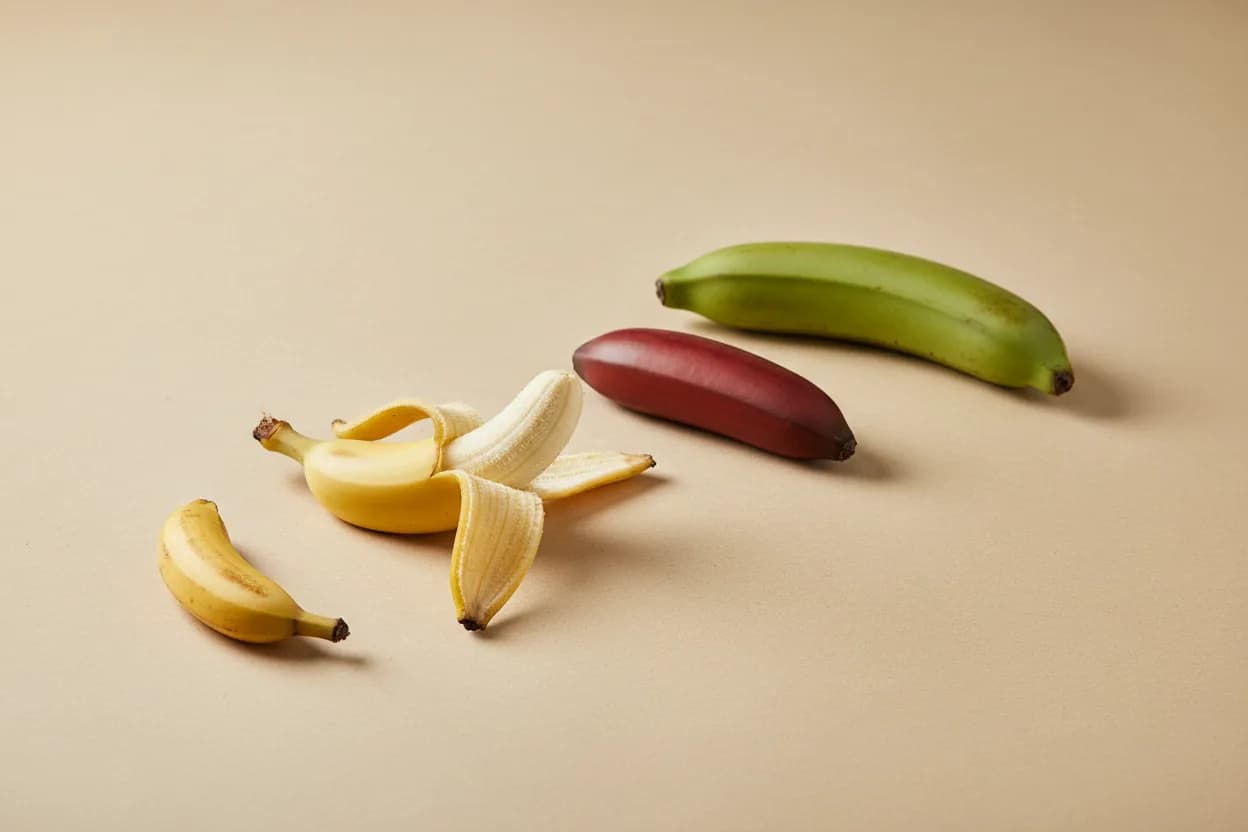
Then the strange ones. The Fe'i bananas of the Pacific do not descend from the A and B parents at all: their bunches stand straight up, their sap runs purple, and their flesh is orange. Lois Englberger, a nutritionist on Pohnpei, found that the Karat banana there was rich enough in carotenoids to answer the vitamin A deficiency appearing in the island's children, and in 2004 she told a symposium of banana scientists who had not known that orange-fleshed bananas existed. 17 18 19 The karat's genome, sequenced in 2022, shows why it ripens so slowly: an insertion upstream of a ripening gene blocks its ethylene, so it is one of the few non-climacteric bananas, taking about 215 days to fill a bunch. 20 The red banana's peel is coloured by anthocyanins, not by the carotenoids that colour its orange flesh, and red plants throw off green-skinned sports while the reverse has never been recorded. 69 49 'Blue Java', the Ice Cream banana of Hawai'i, is silver-green under a heavy coat of wax and earned its name because the fully ripe flesh is smooth enough to eat with a spoon; the vanilla flavour that nursery catalogues promise appears in no reference this note could find. 49 And Lady Finger, depending on where you are standing, names a Sucrier, a Ney Poovan, a Silk or a Pome, across three genome groups. 21 24 36 49
The banana is the largest herb on earth, its trunk nothing but rolled leaf sheaths, and Musa ingens of New Guinea hangs bunches of 300 fruit fifteen metres up. 70 71 Every tower of it grows from a shoot that somebody dug up and carried, and the map is a record of the carrying: out of New Guinea, across Southeast Asia, to Africa, to Martinique, to a Honduran valley that lost 30,000 hectares, and on to a garden in Uganda where a plant called Bogoya is still Big Mike.
Sources
Every numbered claim above points here. Links go to the paper, record, or authority itself.
- 1.
Denham, T. P., Haberle, S. G., Lentfer, C., Fullagar, R., Field, J., Therin, M., Porch, N. & Winsborough, B. 2003. Origins of agriculture at Kuk Swamp in the highlands of New Guinea. Science 301: 189-193.
https://doi.org/10.1126/science.1085255 - 2.
Perrier, X., De Langhe, E., Donohue, M., et al. 2011. Multidisciplinary perspectives on banana (Musa spp.) domestication. Proceedings of the National Academy of Sciences 108(28): 11311-11318.
https://doi.org/10.1073/pnas.1102001108 - 3.
Martin, G., Cardi, C., Sarah, G., et al. 2020. Genome ancestry mosaics reveal multiple and cryptic contributors to cultivated banana. The Plant Journal 102(5): 1008-1025.
https://doi.org/10.1111/tpj.14683 - 4.
Martin, G., Cottin, A., Baurens, F.-C., et al. 2023. Interspecific introgression patterns reveal the origins of worldwide cultivated bananas in New Guinea. The Plant Journal 113(4): 802-818.
https://doi.org/10.1111/tpj.16086 - 5.
Sardos, J., Breton, C., Perrier, X., et al. 2022. Hybridization, missing wild ancestors and the domestication of cultivated diploid bananas. Frontiers in Plant Science 13: 969220.
https://doi.org/10.3389/fpls.2022.969220 - 6.
Simmonds, N. W. & Shepherd, K. 1955. The taxonomy and origins of the cultivated bananas. Journal of the Linnean Society of London, Botany 55(359): 302-312.
https://doi.org/10.1111/j.1095-8339.1955.tb00015.x - 7.
ProMusa (Bioversity International). Nomenclature of cultivated bananas: the Simmonds and Shepherd genome-group system. Musapedia.
https://www.promusa.org/Nomenclature+of+cultivated+bananas - 8.
ProMusa. Musa x paradisiaca: the Linnaean names and why they are treated as hybrids. Musapedia.
https://www.promusa.org/Musa+paradisiaca - 9.
ProMusa. Ernest E. Cheesman (1898-1983), Musa Hall of Fame, with his 1948 Kew Bulletin classification papers. Musapedia.
https://www.promusa.org/Ernest+E.+Cheesman - 10.
ProMusa. GWAS and the parthenocarpic banana: parthenocarpy, sterility and the seedless fruit. Musapedia blog.
https://promusa.org/blogpost449-GWAS-and-the-parthenocarpic-banana - 11.
ProMusa. Domestication of the banana. Musapedia.
https://www.promusa.org/Domestication+of+the+banana - 12.
ProMusa. Musa acuminata ssp. banksii. Musapedia.
https://www.promusa.org/Musa+acuminata+ssp.+banksii - 13.
ProMusa. Musa acuminata ssp. malaccensis. Musapedia.
https://www.promusa.org/Musa+acuminata+ssp.+malaccensis - 14.
ProMusa. Musa acuminata ssp. zebrina. Musapedia.
https://www.promusa.org/Musa+acuminata+ssp.+zebrina - 15.
ProMusa. Musa schizocarpa: the self-peeling wild banana of Papua New Guinea. Musapedia.
https://www.promusa.org/Musa+schizocarpa - 16.
ProMusa. Musa balbisiana Colla. Musapedia.
https://www.promusa.org/Musa+balbisiana - 17.
ProMusa. Fei bananas: the erect-bunched, orange-fleshed bananas of the Pacific. Musapedia.
https://www.promusa.org/Fei+bananas - 18.
ProMusa. Lois Englberger (Musa Hall of Fame): carotenoid-rich Karat bananas and vitamin A deficiency on Pohnpei. Musapedia.
https://www.promusa.org/Lois+Englberger - 19.
Vezina, A. 2015. The bananas of Pohnpei. ProMusa blog, 7 August 2015.
https://www.promusa.org/blogpost404-The-bananas-of-Pohnpei - 20.
Wang, Z., et al. 2022. The Musa troglodytarum L. genome provides insights into the mechanism of non-climacteric behaviour and enrichment of carotenoids. BMC Biology (PubMed Central, PMC9400310).
https://pmc.ncbi.nlm.nih.gov/articles/PMC9400310/ - 21.
ProMusa. Sucrier (Pisang Mas, Kluai Khai) and its local names. Musapedia.
https://www.promusa.org/Sucrier - 22.
ProMusa. Lakatan, and the disputed AA versus AAA genome group. Musapedia.
https://www.promusa.org/Lakatan - 23.
ProMusa. Pisang Jari Buaya. Musapedia.
https://www.promusa.org/Pisang+Jari+Buaya - 24.
ProMusa. Ney Poovan (Safet Velchi), an AB cultivar. Musapedia.
https://www.promusa.org/Ney+Poovan - 25.
ProMusa. Gros Michel: history, local names, Fusarium wilt and survival, citing Soluri 2002. Musapedia.
https://www.promusa.org/Gros+Michel - 26.
ProMusa. Gros Michel subgroup: the Mlali 2n donor and Khai n donor after Hippolyte et al. 2012. Musapedia.
https://www.promusa.org/Gros+Michel+subgroup - 27.
ProMusa. Bogoya, the Ugandan name of Gros Michel. Musapedia.
https://www.promusa.org/Bogoya - 28.
ProMusa. Cavendish subgroup: name, half-sibling parentage with Gros Michel, disease profile. Musapedia.
https://www.promusa.org/Cavendish+subgroup - 29.
ProMusa. Williams (Cavendish subgroup). Musapedia.
https://www.promusa.org/Williams - 30.
ProMusa. Grande Naine (Cavendish subgroup). Musapedia.
https://www.promusa.org/Grande+Naine - 31.
ProMusa. GCTCV-218 (Formosana): the Taiwan Banana Research Institute somaclonal variant and its field trials. Musapedia.
https://www.promusa.org/GCTCV-218 - 32.
ProMusa. East African highland banana subgroup (Mutika/Lujugira): origins, clone sets, matooke. Musapedia.
https://www.promusa.org/East+African+highland+banana+subgroup - 33.
ProMusa. Plantain subgroup: French, French Horn, False Horn and Horn types, African diversification. Musapedia.
https://www.promusa.org/Plantain+subgroup - 34.
ProMusa. Silk subgroup. Musapedia.
https://www.promusa.org/Silk+subgroup - 35.
ProMusa. Latundan, named for Claude Letondal. Musapedia.
https://www.promusa.org/Latundan - 36.
ProMusa. Pome subgroup, including the Australian Lady Finger. Musapedia.
https://www.promusa.org/Pome+subgroup - 37.
ProMusa. Mysore (Poovan) and its local names. Musapedia.
https://www.promusa.org/Mysore - 38.
ProMusa. Pisang Raja. Musapedia.
https://www.promusa.org/Pisang+Raja - 39.
ProMusa. Maoli-Popoulu subgroup, and why 'Pacific plantain' perpetuates a confusion. Musapedia.
https://www.promusa.org/Maoli-Popoulu+subgroup - 40.
ProMusa. Iholena subgroup, after Kepler and Rust 2011. Musapedia.
https://www.promusa.org/Iholena+subgroup - 41.
ProMusa. Bluggoe subgroup. Musapedia.
https://www.promusa.org/Bluggoe+subgroup - 42.
ProMusa. Saba: the disputed ABB or BBB genome, uses and TR4 field observations. Musapedia.
https://promusa.org/Saba - 43.
ProMusa. Banana cue. Musapedia.
https://www.promusa.org/Banana+cue - 44.
ProMusa. Turon (lumpiyang saging). Musapedia.
https://www.promusa.org/Turon - 45.
ProMusa. Pisang Awak (Kluai Nam Wa, Ducasse). Musapedia.
https://www.promusa.org/Pisang+Awak - 46.
ProMusa. Pelipita. Musapedia.
https://www.promusa.org/Pelipita - 47.
ProMusa. FHIA-01 (Goldfinger, Maravilha): pedigree, resistance and distribution. Musapedia.
https://www.promusa.org/FHIA-01 - 48.
Rowe, P. R. & Rosales, F. E. 1994. Banana plant 'FHIA-01'. United States Plant Patent PP8,983 (parentage: 'Prata Ana' x SH-3142; SH-3142 from SH-1734 crossed onto Pisang Jari Buaya).
https://patents.google.com/patent/USPP8983P/en - 49.
Ploetz, R. C., Kepler, A. K., Daniells, J. & Nelson, S. C. 2007. Banana and plantain: an overview with emphasis on Pacific island cultivars. In: Elevitch, C. R. (ed.), Species Profiles for Pacific Island Agroforestry. Permanent Agriculture Resources, Holualoa, Hawai'i.
https://agroforestry.org/images/pdfs/Banana-plantain-overview.pdf - 50.
Ploetz, R. C. 2005. Panama disease: an old nemesis rears its ugly head. Part 1: the beginnings of the banana export trades. Plant Health Progress, APSnet Features.
https://doi.org/10.1094/PHP-2005-1221-01-RV - 51.
Ploetz, R. C. 2015. Fusarium wilt of banana. Phytopathology 105(12): 1512-1521.
https://doi.org/10.1094/PHYTO-04-15-0101-RVW - 52.
ProMusa. Tropical race 4 (TR4): history and spread of Fusarium oxysporum f. sp. cubense TR4. Musapedia.
https://www.promusa.org/Tropical+race+4+-+TR4 - 53.
Queensland Government, Business Queensland. Panama disease tropical race 4: detections near Darwin (1997) and in the Tully Valley (2015).
https://www.business.qld.gov.au/industries/farms-fishing-forestry/agriculture/biosecurity/plants/priority-pest-disease/panama-disease - 54.
Munhoz, A., et al. 2024. Fusarium Tropical Race 4 in Latin America and the Caribbean: status and global research advances towards disease management. Frontiers in Plant Science (PubMed Central, PMC11286425).
https://pmc.ncbi.nlm.nih.gov/articles/PMC11286425/ - 55.
Dale, J., James, A., Paul, J.-Y., et al. 2017. Transgenic Cavendish bananas with resistance to Fusarium wilt tropical race 4. Nature Communications 8: 1496.
https://doi.org/10.1038/s41467-017-01670-6 - 56.
Queensland University of Technology. 2024. Australian government approves release of QUT-developed GM Cavendish QCAV-4. QUT News, 16 February 2024.
https://www.qut.edu.au/news?id=192777 - 57.
Towards the integrated management of Fusarium wilt of banana. 2024 review (PubMed Central, PMC11508314), on the deployment of GCTCV-218 in Taiwan, the Philippines and Mozambique.
https://pmc.ncbi.nlm.nih.gov/articles/PMC11508314/ - 58.
Jordan, M. J., Tandon, K., Shaw, P. E. & Goodner, K. L. 2001. Aromatic profile of aqueous banana essence and banana fruit by gas chromatography-mass spectrometry (GC-MS) and gas chromatography-olfactometry (GC-O). Journal of Agricultural and Food Chemistry 49(10): 4813-4817.
https://doi.org/10.1021/jf010471k - 59.
Berenstein, N. 2016. Bananas! Flavor Added (blog), 15 February 2016: the nineteenth-century record of amyl acetate as pear and banana essence, and Kleber's 1912 analysis.
http://nadiaberenstein.com/blog/2016/2/15/bananas - 60.
Baraniuk, C. 2014. Debunking the myth of the fake banana flavor. Gizmodo, 2 September 2014.
https://gizmodo.com/debunking-the-myth-of-the-fake-banana-flavor-1629459201 - 61.
Science Friday. Why doesn't fake banana flavoring taste like real bananas? Interview with Nadia Berenstein.
https://www.sciencefriday.com/articles/why-dont-banana-candies-taste-like-real-bananas/ - 62.
FAO. 2003. The World Banana Economy 1985-2002, Chapter 1: Overview of world banana production and trade. Rome: FAO.
https://www.fao.org/4/y5102e/y5102e04.htm - 63.
FAO. Bananas: Markets and Trade, commodities overview (Cavendish share and export origins).
https://www.fao.org/markets-and-trade/commodities-overview/bananas-tropical-fruits/bananas/en - 64.
FAO. 2024. Banana Market Review 2023. Rome: FAO.
https://openknowledge.fao.org/server/api/core/bitstreams/1085e3ed-0f37-4e7d-848d-cdfe203be158/content - 65.
Our World in Data, from FAOSTAT. Banana production by country, 1961 to 2024.
https://ourworldindata.org/grapher/banana-production - 66.
ProMusa. Banana-producing countries portal: 135 producing countries; exports under 16 per cent of production. Musapedia.
https://www.promusa.org/Banana-producing+countries+portal - 67.
International Institute of Tropical Agriculture (IITA). Banana and plantain: crop overview, with Ugandan per-capita consumption.
https://www.iita.org/crops/banana-and-plantain/ - 68.
United States National Park Service. Maria Ylagan Orosa (1893-1945), biography.
https://www.nps.gov/articles/000/maria-ylagan-orosa.htm - 69.
Fu, X., Cheng, S., Liao, Y., et al. 2018. Comparative analysis of pigments in red and yellow banana fruit. Food Chemistry 239: 1009-1018.
https://doi.org/10.1016/j.foodchem.2017.07.046 - 70.
ProMusa. Morphology of the banana plant: the giant herb, the pseudostem, bunches, hands and fingers. Musapedia.
https://www.promusa.org/Morphology+of+banana+plant - 71.
Guinness World Records. Largest banana species: Musa ingens of New Guinea.
https://www.guinnessworldrecords.com/world-records/627895-largest-banana-species