Every lemon and every lime traces back to the same father
Ten wild citrus species exist. Almost nothing you buy is one of them. A map of what crossed with what, with the botanical names, the parentage, and what each hybrid ended up tasting and smelling like.
Contents
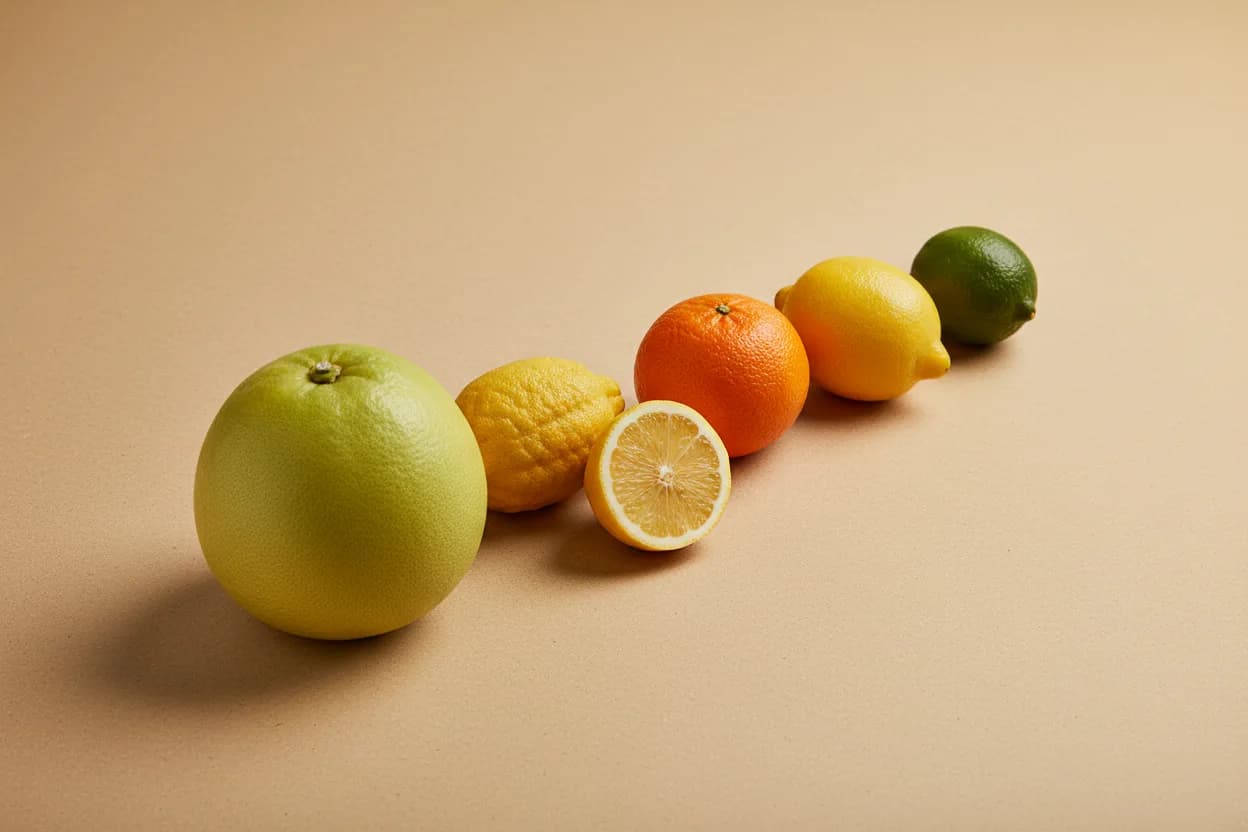
A supermarket citrus shelf looks like a display of separate species. Lemons, limes, oranges, grapefruit, mandarins, each with its own name and its own shape, arranged as though they were as distinct from each other as apples are from pears. Genomically it is closer to a family photograph. Nearly everything on that shelf is a hybrid, most of them are hybrids of the same small handful of ancestors, and several are hybrids of hybrids.
In 2018 a large international group sequenced 60 citrus accessions and described ten natural species in the genus. Their reconstruction has citrus radiating rapidly through southeast Asia during the late Miocene, in a burst that lines up with a marked weakening of the monsoons, and then a second radiation across the Wallace line in the early Pliocene that produced the Australian limes. 1 Ten wild species, then. Almost nothing in a fruit bowl is one of them.
Four of those ancestors do most of the work in the cultivated citrus we actually eat: the citron, Citrus medica; the pummelo, Citrus maxima; the mandarin, Citrus reticulata; and a papeda, Citrus micrantha. 3 Most of what follows is some arrangement of those four; the wilder edges of the family, from the Chinese papedas to the kumquat and Australia's finger lime, join at the map at the end.
The oranges came first, and they are not simple
The 2014 genome comparison sorted out the oranges. Cultivated pummelos are selections from a single progenitor species, C. maxima, so a pummelo is close to a real thing rather than a blend. Cultivated mandarins are not: they are introgressions of C. maxima into the ancestral mandarin, which is to say wild mandarin with pummelo bred into it. 2
That detail turns out to matter for flavour. The 2018 team found pummelo admixture widespread among mandarins and correlated with fruit size and acidity, and suggested pummelo introgression had a plausible role in the selection of palatable mandarins. 1 The sweet, large, low-acid mandarin is a wild sour one with pummelo bred into it until it became worth eating.
The two oranges then split cleanly. Sour orange is an F1 hybrid of pure C. maxima and pure C. reticulata parents, a first-generation cross between two clean species. Sweet orange is messier: the offspring of individuals that were already admixed. 2 The bitter orange in marmalade and the sweet one in juice are separated by one generation of tidiness.
The citron is in all of it
The lemons and limes are where the pattern gets startling. A 2016 study genotyped 133 citrus accessions with 123 markers, including 73 that diagnose which ancestral taxon a stretch of genome came from, and traced the maternal line separately through mitochondrial and chloroplast markers. 3
The group came out highly polymorphic, with diploid, triploid and tetraploid varieties arising from many independent reticulation events. Every lime and lemon accession was highly heterozygous, carrying admixture from two, three, and in some cases all four ancestral genomes. And running through all of it: Citrus medica contributed to all limes and lemons, and was the direct male parent for the main subgroups. 3
The citron is the thing almost nobody eats. It is mostly rind, it has little juice, and in Europe it survives as candied peel and as the etrog of Sukkot. It is also, on this evidence, the father of the entire lemon and lime family, crossed in turn with a papeda, with a mandarin, with a sour orange, and with a pummelo-mandarin hybrid, producing a different subgroup each time.
The triploids are stranger still. The Persian or Tahiti lime, the seedless one in most bars, comes from a haploid ovule of a lemon fertilised by a diploid gamete of a Mexican lime. 3 It has three sets of chromosomes because one parent contributed an unreduced one, and its seedlessness follows from that arithmetic.
Grapefruit, which is younger than the United States
Grapefruit is the newcomer, a pummelo crossed with a sweet orange, and its origin is recent enough to be a matter of historical record rather than genomic inference alone. 5 What happened afterwards is unusual: grapefruits diversified almost entirely by bud mutation and vegetative propagation rather than by sexual reproduction, so genetic variation between cultivars is negligible. 4 The pink one and the white one are close to the same plant with a somatic mutation between them.
Its oil is where the contrast with its parent shows. Grapefruit peel oil runs 86 to 98 per cent limonene, a narrow and consistent band. Pummelo peel oil is all over the place by comparison, from 46 to 54 per cent limonene in some cultivars up to 81 to 96 in others. 4 The hybrid is more uniform than either parent, which is what you would expect of a plant that stopped having sex.
Limonene is not what makes grapefruit smell of grapefruit, though. It is present in almost every citrus peel and smells generically of citrus. The character comes from nootkatone, which appears in grapefruit peel oil at 0.15 to 0.94 per cent 4 and was identified as the compound carrying the aroma of grapefruit oil and the flavour of the juice. 6 Under one per cent of the oil is doing the identifying.
The map
A few things fall out of the map that are hard to see in prose. The lemon and the limetta share a cross. So do the Meyer lemon and the sweet lime, one of them tasting like a lemon that has calmed down and the other barely reading as sour at all. The Rangpur lime and the rough lemon have the same two parents and ended up filed under different fruits, one called a lime and one called a lemon, which tells you how little those English words track the genetics. And Japan reruns the pattern one tier down: the yuzu, itself a papeda crossed with a mandarin, appears as a parent in ten of the crosses behind Japanese kitchen citrus, sudachi and kabosu among them. 8
It also explains a frustration anyone who has gone looking for this will recognise. There is no single authoritative list, because the naming is horticultural and the ancestry is genomic and the two systems were built for different purposes centuries apart. Tanaka's taxonomy split citrus into well over a hundred species; the genomes say ten. The names on the crates are trade names with Latin attached.
The other thing the map hides is how much of this happened without anyone deciding. Limes and lemons were propagated vegetatively, by cutting and grafting, so the differences between varieties inside a subgroup come from asexual variation rather than from breeding. 3 Somebody found a branch that had changed, and cut it off, and that became a variety.
Which leaves the citron, sitting at the root of half the shelf, being almost inedible. It has no commercial fruit to speak of and it is the male parent of every lemon and lime lineage in the study. Whatever it contributed, it was not the part you eat.
Sources
Every numbered claim above points here. Links go to the paper, record, or authority itself.
- 1.
Wu GA, Terol J, Ibanez V, Lopez-Garcia A, Perez-Roman E, Borreda C, Domingo C, Tadeo FR, et al. Genomics of the origin and evolution of Citrus. Nature, 2018, 554, 311-316.
https://doi.org/10.1038/nature25447 - 2.
Wu GA, Prochnik S, Jenkins J, Salse J, Hellsten U, Murat F, Perrier X, Ruiz M, et al. Sequencing of diverse mandarin, pummelo and orange genomes reveals complex history of admixture during citrus domestication. Nature Biotechnology, 2014, 32, 656-662.
https://doi.org/10.1038/nbt.2906 - 3.
Curk F, Ollitrault F, Garcia-Lor A, Luro F, Navarro L, Ollitrault P. Phylogenetic origin of limes and lemons revealed by cytoplasmic and nuclear markers. Annals of Botany, 2016, 117, 565-583.
https://doi.org/10.1093/aob/mcw005 - 4.
Luro F, Marchi E, Costantino G, Paoli M, Tomi F. Diversity of Pummelos (Citrus maxima (Burm.) Merr.) and Grapefruits (Citrus x aurantium var. paradisi) Inferred by Genetic Markers, Essential Oils Composition, and Phenotypical Fruit Traits. Plants, 2025, 14, 1824.
https://doi.org/10.3390/plants14121824 - 5.
Kumamoto J, Scora RW, Lawton HW, Clerx WA. Mystery of the forbidden fruit: Historical epilogue on the origin of the grapefruit, Citrus paradisi (Rutaceae). Economic Botany, 1987, 41, 97-107.
https://doi.org/10.1007/bf02859356 - 6.
Shaw PE, Wilson CW. Importance of nootkatone to the aroma of grapefruit oil and the flavor of grapefruit juice. Journal of Agricultural and Food Chemistry, 1981, 29, 677-679.
https://doi.org/10.1021/jf00105a063 - 7.
Curk F, Ancillo G, Ollitrault F, Perrier X, Jacquemoud-Collet JP, Garcia-Lor A, Navarro L, Ollitrault P. Nuclear Species-Diagnostic SNP Markers Mined from 454 Amplicon Sequencing Reveal Admixture Genomic Structure of Modern Citrus Varieties. PLOS ONE, 2015, 10, e0125628.
https://doi.org/10.1371/journal.pone.0125628 - 8.
Shimizu T, Kitajima A, Nonaka K, Yoshioka T, Ohta S, Goto S, Toyoda A, Fujiyama A, et al. Hybrid origins of citrus varieties inferred from DNA marker analysis of nuclear and organelle genomes. PLOS ONE, 2016, 11, e0166969.
https://journals.plos.org/plosone/article?id=10.1371/journal.pone.0166969 - 9.
Jeong H, Yun YB, Jeong SY, Cho Y, Kim S. Identification of putative parental species of yuzu (Citrus junos) by comparative analyses of variations in chloroplast genomes and nuclear single-copy genes of Citrus. Horticultural Science and Technology, 2022, 40, 420-431.
https://doi.org/10.7235/HORT.20220038 - 10.
Wu GA, Sugimoto C, Kinjo H, Azama C, Mitsube F, Talon M, Gmitter FG Jr, Rokhsar DS. Diversification of mandarin citrus by hybrid speciation and apomixis. Nature Communications, 2021, 12, 4377.
https://doi.org/10.1038/s41467-021-24653-0 - 11.
Carbonell-Caballero J, Alonso R, Ibanez V, Terol J, Talon M, Dopazo J. A phylogenetic analysis of 34 chloroplast genomes elucidates the relationships between wild and domestic species within the genus Citrus. Molecular Biology and Evolution, 2015, 32, 2015-2035.
https://pmc.ncbi.nlm.nih.gov/articles/PMC4833069/ - 12.
Peng Z, Bredeson JV, Wu GA, Shu S, Rawat N, Du D, et al. A chromosome-scale reference genome of trifoliate orange (Poncirus trifoliata) provides insights into disease resistance, cold tolerance and genome evolution in Citrus. The Plant Journal, 2020, 104, 1215-1232.
https://pmc.ncbi.nlm.nih.gov/articles/PMC7756384/ - 13.
Soost RK, Cameron JW. 'Oroblanco', a triploid pummelo-grapefruit hybrid. HortScience, 1980, 15, 667-669.
https://doi.org/10.21273/hortsci.15.5.667 - 14.
Hsu WJ, Berhow M, Robertson GH, Hasegawa S. Limonoids and flavonoids in juices of Oroblanco and Melogold grapefruit hybrids. Journal of Food Science, 1998, 63, 57-60.
https://doi.org/10.1111/j.1365-2621.1998.tb15675.x - 16.
Giuffre AM, Nobile R. Citrus bergamia, Risso: the peel, the juice and the seed oil of the bergamot fruit of Reggio Calabria (South Italy). Emirates Journal of Food and Agriculture, 2020, 32, 522-532.
https://doi.org/10.9755/ejfa.2020.v32.i7.2128 - 17.
Miyazawa N, Tomita N, Kurobayashi Y, Nakanishi A, Ohkubo Y, Maeda T, Fujita A. Novel character impact compounds in yuzu (Citrus junos Sieb. ex Tanaka) peel oil. Journal of Agricultural and Food Chemistry, 2009, 57, 1990-1996.
https://pubmed.ncbi.nlm.nih.gov/19203264/ - 18.
Buettner A, Mestres M, Fischer A, Guasch J, Schieberle P. Evaluation of the most odour-active compounds in the peel oil of clementines (Citrus reticulata Blanco cv. clementine). European Food Research and Technology, 2003, 216, 11-14.
https://doi.org/10.1007/s00217-002-0586-y - 19.
Cozzolino R, et al. Comparative volatilomic profile of three finger lime (Citrus australasica) cultivars based on chemometrics analysis of HS-SPME/GC-MS data. Molecules, 2022, 27, 7846.
https://pmc.ncbi.nlm.nih.gov/articles/PMC9697472/ - 20.
Nakandala U, et al. The genome of Citrus australasica reveals disease resistance and other species specific genes. BMC Plant Biology, 2024, 24, 260.
https://doi.org/10.1186/s12870-024-04988-8 - 21.
Baccati C, et al. Chemical variability of peel and leaf essential oils in the Citrus subgenus Papeda (Swingle) and few relatives. Plants, 2021, 10, 1117.
https://pmc.ncbi.nlm.nih.gov/articles/PMC8227882/ - 22.
Zhao Z, et al. Citrus hystrix: a review of phytochemistry, pharmacology and industrial applications research progress. Arabian Journal of Chemistry, 2023, 16, 105236.
https://arabjchem.org/citrus-hystrix-a-review-of-phytochemistry-pharmacology-and-industrial-applications-research-progress/ - 23.
The National, 17 June 2021. Waitrose to rename its kaffir lime leaves after complaints that name is linked to racial slur.
https://www.thenationalnews.com/lifestyle/food/waitrose-to-rename-its-kaffir-lime-leaves-after-complaints-that-name-is-linked-to-racial-slur-1.1243064 - 24.
Venkatachalam K, Charoenphun N, Srean P, et al. Phytochemicals, bioactive properties and commercial potential of calamondin (Citrofortunella microcarpa) fruits: a review. Molecules, 2023, 28, 3401.
https://pmc.ncbi.nlm.nih.gov/articles/PMC10146261/ - 25.
Andersen PC, Ferguson JJ, Shahid MA. The Satsuma Mandarin. UF/IFAS Extension, HS195, 2023 revision.
https://ask.ifas.ufl.edu/publication/CH116 - 26.
Unno K, Noda S, Nii H, Kawasaki Y, Iguchi K, Yamada H. Anti-stress effect of beta-cryptoxanthin in satsuma mandarin orange on females. Biological and Pharmaceutical Bulletin, 2019, 42, 1402-1408.
https://www.jstage.jst.go.jp/article/bpb/42/8/42_b19-00325/_html/-char/en - 27.
Mitani M, Minatogawa Y, Nakamoto A, et al. Sudachitin, polymethoxyflavone from Citrus sudachi, enhances antigen-specific cellular and humoral immune responses in BALB/c mice. Journal of Clinical Biochemistry and Nutrition, 2019, 64, 158-163.
https://pmc.ncbi.nlm.nih.gov/articles/PMC6436041/ - 28.
Kawase K, Iwagaki I, Takahara T, Ono S, Hirose K. Rootstock studies for citrus varieties in Japan. Japan Agricultural Research Quarterly, 1987, 20, 253-259.
https://www.jircas.go.jp/sites/default/files/publication/jarq/20-4-253-259_0.pdf - 29.
NC State Extension Gardener Plant Toolbox. Citrus trifoliata (hardy orange).
https://plants.ces.ncsu.edu/plants/poncirus-trifoliata/ - 30.
PROSEA (Plant Resources of South-East Asia). Citrus amblycarpa (Hassk.) Ochse.
https://prosea.prota4u.org/view.aspx?id=73 - 31.
Morton JF. Pummelo. In: Fruits of Warm Climates, Miami, 1987.
https://hort.purdue.edu/newcrop/morton/pummelo.html - 32.
Morton JF. Kumquat. In: Fruits of Warm Climates, Miami, 1987.
https://hort.purdue.edu/newcrop/morton/kumquat.html - 33.
Morton JF. Lemon. In: Fruits of Warm Climates, Miami, 1987.
https://www.hort.purdue.edu/newcrop/morton/lemon.html - 34.
Morton JF. Tahiti lime. In: Fruits of Warm Climates, Miami, 1987.
https://www.hort.purdue.edu/newcrop/morton/tahiti_lime.html - 35.
Citrus ID, USDA APHIS Identification Technology Program. Dancy fact sheet, quoting Hodgson RW, Horticultural Varieties of Citrus, The Citrus Industry Vol. 1, 1967.
https://idtools.org/citrus_id/index.cfm?packageID=1179&entityID=8462 - 36.
Citrus ID, USDA APHIS Identification Technology Program. Limequat fact sheet.
https://idtools.org/citrus_id/index.cfm?packageID=1179&entityID=8643 - 37.
Givaudan Citrus Variety Collection, University of California, Riverside. Etrog citron (CRC 3891).
https://citrusvariety.ucr.edu/crc3891 - 38.
Givaudan Citrus Variety Collection, University of California, Riverside. Ichang papeda (CRC 2327).
https://citrusvariety.ucr.edu/crc2327 - 39.
Givaudan Citrus Variety Collection, University of California, Riverside. Yuzu ichandrin (CRC 1216).
https://citrusvariety.ucr.edu/crc1216 - 40.
Givaudan Citrus Variety Collection, University of California, Riverside. Nagami kumquat (CRC 3877).
https://citrusvariety.ucr.edu/crc3877 - 41.
Givaudan Citrus Variety Collection, University of California, Riverside. Citrus hystrix (CRC 2454).
https://citrusvariety.ucr.edu/crc2454 - 42.
Givaudan Citrus Variety Collection, University of California, Riverside. Seville sour orange (CRC 3856).
https://citrusvariety.ucr.edu/crc3856 - 43.
Givaudan Citrus Variety Collection, University of California, Riverside. Chinotto sour orange (CRC 3857).
https://citrusvariety.ucr.edu/crc3857 - 44.
Givaudan Citrus Variety Collection, University of California, Riverside. Mexican lime (CRC 1710).
https://citrusvariety.ucr.edu/crc1710 - 45.
Givaudan Citrus Variety Collection, University of California, Riverside. Rangpur lime (CRC 2875).
https://citrusvariety.ucr.edu/crc2875 - 46.
Givaudan Citrus Variety Collection, University of California, Riverside. Florida rough lemon (CRC 400).
https://citrusvariety.ucr.edu/crc400 - 47.
Givaudan Citrus Variety Collection, University of California, Riverside. Nasnaran (CRC 2485).
https://citrusvariety.ucr.edu/crc2485 - 48.
Givaudan Citrus Variety Collection, University of California, Riverside. Alemow (CRC 2446).
https://citrusvariety.ucr.edu/crc2446 - 49.
Givaudan Citrus Variety Collection, University of California, Riverside. Excelsa (CRC 2316).
https://citrusvariety.ucr.edu/crc2316 - 50.
Givaudan Citrus Variety Collection, University of California, Riverside. Ponderosa lemon (CRC 294).
https://citrusvariety.ucr.edu/crc294 - 51.
Givaudan Citrus Variety Collection, University of California, Riverside. Dancy mandarin (CRC 3026).
https://citrusvariety.ucr.edu/crc3026 - 52.
Givaudan Citrus Variety Collection, University of California, Riverside. Frost Owari satsuma mandarin (CRC 3178).
https://citrusvariety.ucr.edu/crc3178 - 53.
Givaudan Citrus Variety Collection, University of California, Riverside. Sudachi ichandrin (CRC 3471).
https://citrusvariety.ucr.edu/crc3471 - 54.
Givaudan Citrus Variety Collection, University of California, Riverside. Kabosu papeda hybrid (CRC 3943).
https://citrusvariety.ucr.edu/crc3943 - 55.
Givaudan Citrus Variety Collection, University of California, Riverside. Hassaku (CRC 3907).
https://citrusvariety.ucr.edu/crc3907 - 56.
Givaudan Citrus Variety Collection, University of California, Riverside. Millsweet limetta (CRC 569).
https://citrusvariety.ucr.edu/crc569 - 57.
Givaudan Citrus Variety Collection, University of California, Riverside. Improved Meyer lemon (CRC 3737).
https://citrusvariety.ucr.edu/crc3737 - 58.
Givaudan Citrus Variety Collection, University of California, Riverside. Palestine sweet lime (CRC 1482).
https://citrusvariety.ucr.edu/crc1482 - 59.
Givaudan Citrus Variety Collection, University of California, Riverside. Calamondin (CRC 2592).
https://citrusvariety.ucr.edu/crc2592 - 60.
Givaudan Citrus Variety Collection, University of California, Riverside. Eustis limequat (CRC 3603).
https://citrusvariety.ucr.edu/crc3603 - 61.
Givaudan Citrus Variety Collection, University of California, Riverside. Algerian clementine (CRC 279).
https://citrusvariety.ucr.edu/crc0279 - 62.
Givaudan Citrus Variety Collection, University of California, Riverside. Temple tangor (CRC 2598).
https://citrusvariety.ucr.edu/crc2598 - 63.
Givaudan Citrus Variety Collection, University of California, Riverside. Ortanique tangor (CRC 3368).
https://citrusvariety.ucr.edu/crc3368 - 64.
Givaudan Citrus Variety Collection, University of California, Riverside. Minneola tangelo (CRC 3340).
https://citrusvariety.ucr.edu/crc3340 - 65.
Givaudan Citrus Variety Collection, University of California, Riverside. Ugli tangelo (CRC 2780).
https://citrusvariety.ucr.edu/crc2780 - 66.
Givaudan Citrus Variety Collection, University of California, Riverside. Troyer citrange (CRC 1459).
https://citrusvariety.ucr.edu/crc1459 - 67.
Givaudan Citrus Variety Collection, University of California, Riverside. Oroblanco grapefruit hybrid (CRC 3602).
https://citrusvariety.ucr.edu/crc3602 - 68.
Givaudan Citrus Variety Collection, University of California, Riverside. Melogold grapefruit hybrid (CRC 3764).
https://citrusvariety.ucr.edu/crc3764