Sumac is sour with apple acid, and red with a blackberry's pigment
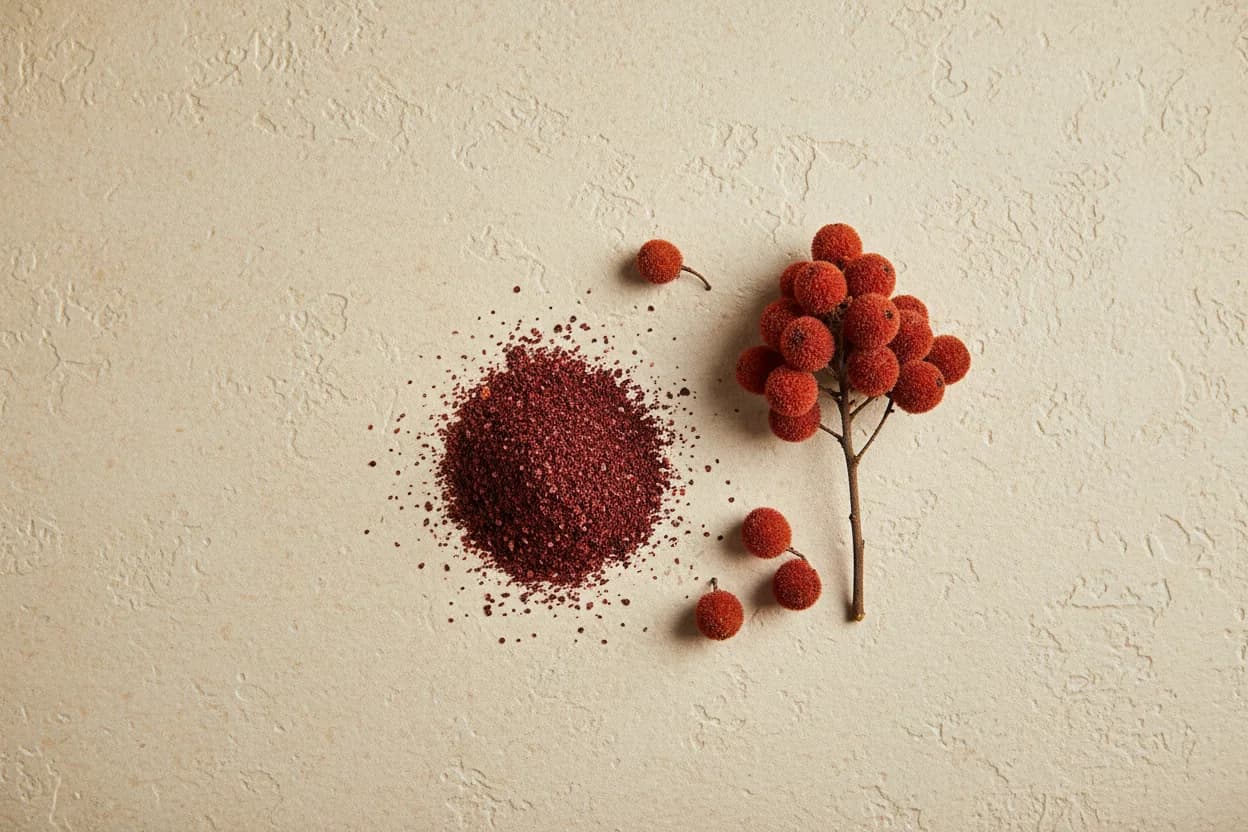
The red powder on the fattoush is a dried fruit ground with salt. Its tartness is malic acid, the acid of a green apple, and its colour is the anthocyanin of blackberries and red cabbage. What is in it, what Pliny sprinkled it on, why Sicily tanned leather with it, and which sumac you must never touch.
Contents
The dark red powder over a plate of fattoush is a fruit. Rhus coriaria is a shrub of the cashew family, three or four metres tall with pinnate leaves, and in late summer it carries dense cones of small fuzzy drupes that ripen to brick red. 7 Its native belt runs from the Canaries and North Africa through Sicily, Greece, Anatolia, Lebanon, Syria and Palestine into the Caucasus and Central Asia. 1 The drupes are dried and ground, traditionally with salt, and the result is sprinkled over fish, grilled meat, onions and salad. 2 The word came into English around 1300, by way of Old French and medieval Latin, from the Arabic summaq, and behind that from a Syriac word for red. 3 2
Apple acid
People reach for the word lemony, and the chemistry says apple. When Kossah and colleagues ran the organic acids of dried Syrian sumac fruit from Latakia through a chromatograph, malic acid came out at 1,568 milligrams per kilogram, citric at 57, fumaric at 3 and tartaric at 2. 2 Malic acid is the acid of an unripe apple, and citric, the acid of a lemon, is a minor player. The absolute amounts are modest, well under a per cent of the dried fruit. 2 4 That points to sumac's sourness working by contact: a coating of fine acidic powder on the tongue rather than a squeeze of juice. Nobody, as far as the literature I could reach goes, has published the pH of the fruit; the paper that probably did, from 2004, has no accessible text, and I would rather leave the gap than fill it.
The salt is real and variable. A 2022 study that profiled six sumac samples found 263 volatile compounds in the fruit, led by alpha-pinene, caryophyllene and limonene, and, in passing, confirmed by analysis that an Iranian commercial powder carried added sodium chloride as a preservative while a Mediterranean one did not. 5 Taste your sumac before you salt the dish.
The red, and the grip
The colour is anthocyanin, and the lead pigment is cyanidin-3-glucoside, the same molecule that colours blackberries and red cabbage. In five Sicilian accessions analysed in 2023 it reached 20,890 milligrams per kilogram of dried extract in the fruit from Giarratana. 6 The most abundant phenolic in those extracts was not a pigment at all but gallic acid, at nearly 200 grams per kilogram of extract, sitting alongside a family of gallotannins, ten of them identified, from mono- to deca-galloyl glycosides. 6 7 Those tannins are the astringency, the faint drying grip that follows the sourness, and they are also the reason the plant has a Latin name about leather.
Coriaria is from corium, hide. 8 Pliny, in the first century, already knew the Syrian sumac tree as something the tanners used, and noted its lentil-sized seed that reddens with the grapes. 9 Until the twentieth century sumac leaves, with oak bark, were among the most important tanning materials in Europe, prized in the Middle Ages for light-coloured, durable leather and used in Iberia to make cordovan from goatskin; Portuguese sumac fed the tanneries of France and Britain through the 1600s and 1700s before Spanish and Sicilian sumac overtook it. 10 The spice on your table and the leather of a medieval book share a chemistry.
That red has a modern footnote. In 2012 a cantonal food laboratory in Switzerland, screening a sumac sample for the illegal Sudan dyes, found a red it could not name. It turned out to be Basic Red 46, a textile and hair dye that had slipped past the standard test because it is a cation and behaves differently in the clean-up. It was the first report of that dye in any food. 11 Good sumac is dark, dull and slightly damp, and it does not look like paprika.
Pliny's salt substitute
The oldest cookery instruction for sumac is Roman. Pliny lists rhus erythros, red sumac, as the seed of the shrub, astringent and cooling, sprinkled on food as a salt substitute when the bowels are loose, and combined with silphium to improve the flavour of meat. 12 The Greeks had been importing it from Syria before that. 13 By the Abbasid period it was one of the emblematic spices of the Baghdad kitchen: the dried drupes and their husks were pounded or macerated and strained into a sour sumac juice that served as a marinade, a cooking liquid and a red dye for dishes, and the sumac stew, summaqiyya, is said to have been a favourite of the caliph Harun al-Rashid. 13 14 That is roughly the arc of the spice: a Roman condiment, a medieval sauce base, and now a finishing powder.
Three sumacs
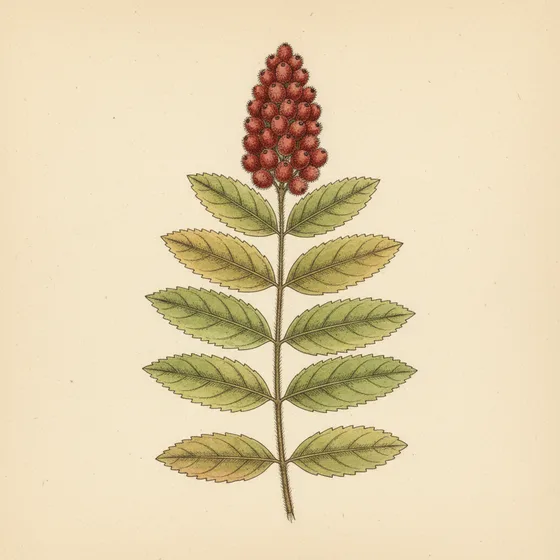
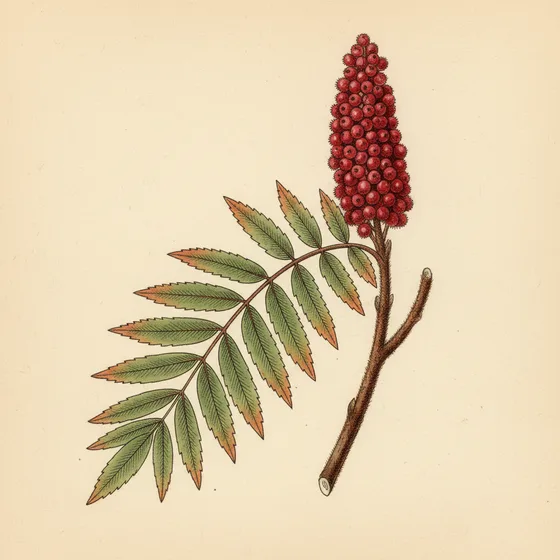
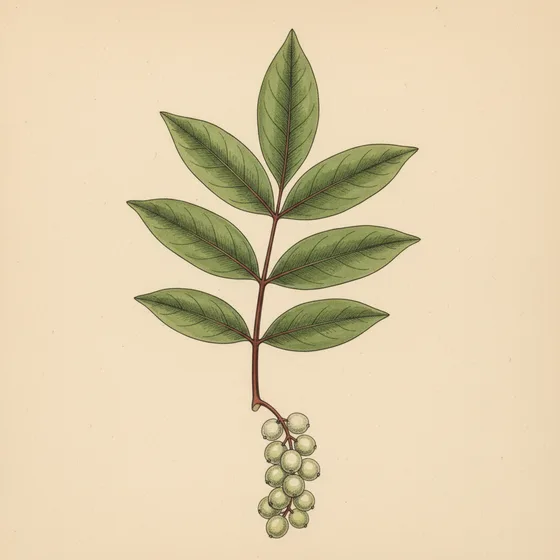
Staghorn sumac, Rhus typhina, grows wild across eastern North America, with velvety antler-like twigs and cones of hairy drupes that ripen bright red and darken through winter; the fruits are soaked in water to make a tart drink from the acid in the hairs that coat them, the sumac-ade or Indian lemonade of the field guides. 15 2 It is a weaker relative in the pot: the same analysis found its fruit carrying about a quarter of the Syrian sumac's malic acid. 2 Poison sumac, Toxicodendron vernix, is another genus. Its drupes hang in loose clusters, smooth and round, and ripen from green to a dull yellowish-white; every part of the plant carries urushiol, the sensitiser of poison ivy and poison oak. 16 Red, upright and fuzzy is food. White, drooping and smooth is a rash.
On the table
Sumac is the sour third of za'atar, with wild Levantine oregano, Origanum syriacum, and toasted sesame. 17 It is the whole point of musakhan, the national dish of Palestine, in which thickly sliced onions are cooked soft and pale gold with sumac and a great deal of olive oil, then spread with chicken over taboon bread; the dish was traditionally made at the olive pressing in October or November, to celebrate and to judge the new oil. 18 Around Ramallah, where the shrub grows on the hills, versions of it have been made for about 150 years. 19 Elsewhere in the region it dresses the onion salad beside a kebab, goes over yogurt and rice, and meets fish with olive oil and vinegar around the Mediterranean. 4
What the trials say
Sumac has a supplement literature, almost all of it Iranian, and a 2025 meta-analysis did the honest thing with it. Fifteen randomised trials, 917 participants, doses of 1 to 6 grams a day for four to twelve weeks: sumac lowered triglycerides on evidence the authors graded moderate, lowered fasting glucose and LDL on evidence graded low, and every claim about weight, waist, insulin resistance and inflammation rested on evidence graded very low, however tidy the individual P values looked. 20 A representative trial gave 47 adults with metabolic syndrome one gram a day for six weeks and saw systolic blood pressure fall by five millimetres of mercury, with no change in weight or diastolic pressure. 21 Nobody has run a trial longer than twelve weeks. The one safety note belongs to the family tree: sumac is Anacardiaceae, with cashew, pistachio and mango, and in a Dutch study of 56 children with suspected cashew allergy the antibodies of a fifth of the sensitised group cross-reacted with other members of the family sumac belongs to, though the authors themselves called the clinical relevance unknown. 22
A pinch of it, then, is a little malic acid, a little cyanidin, a lot of gallotannin and, sometimes, a little salt, delivered as a powder that clings. The Romans used it in place of salt and the caliphs used it in place of vinegar. On a plate of onions and hot bread it is still doing both jobs at once.
Questions this note answers
- Is sumac the spice related to poison sumac?
- Only distantly. Culinary sumac is Rhus coriaria, with fuzzy red drupes in upright cones; poison sumac is Toxicodendron vernix, a different genus, with smooth yellowish-white berries that hang in loose clusters, and every part of it carries urushiol, the rash-causing oil of poison ivy. The colour of the fruit tells them apart. 16 15
- Why does sumac taste sour?
- Malic acid, the acid of green apples. In dried Syrian sumac it outweighed citric acid roughly thirty to one, with only traces of tartaric and fumaric acid, and the tannins behind it add the dry, astringent grip. Some commercial sumac is also ground with salt, so taste it before seasoning. 2 5
- Does sumac lower blood sugar or cholesterol?
- The trials say a little, briefly. A 2025 meta-analysis of fifteen randomised trials found lower triglycerides on moderate-quality evidence, lower fasting glucose and LDL on low-quality evidence, and nothing reliable on weight or insulin resistance; no trial lasted more than twelve weeks and nearly all were run in Iran. 20
Sources
Every numbered claim above points here. Links go to the paper, record, or authority itself.
- 1.
Rhus coriaria L. World Flora Online, taxon wfo-0000402784; distribution data from the World Checklist of Vascular Plants (Kew).
https://www.worldfloraonline.org/taxon/wfo-0000402784 - 2.
Kossah R, Nsabimana C, Zhao J, et al. Comparative Study on the Chemical Composition of Syrian Sumac (Rhus coriaria L.) and Chinese Sumac (Rhus typhina L.) Fruits. Pakistan Journal of Nutrition. 2009;8(10):1570-1574.
https://pjnonline.org/pjn/article/view/1044 - 3.
Harper D. Sumac. Online Etymology Dictionary.
https://www.etymonline.com/word/sumac - 4.
Calabrò A, Accardi G, Aiello A, et al. The Nutraceutical Properties of Rhus coriaria Linn: Potential Application on Human Health and Aging Biomedicine. International Journal of Molecular Sciences. 2023;24(7):6206.
https://pmc.ncbi.nlm.nih.gov/articles/PMC10094520/ - 5.
Arena K, Trovato E, Cacciola F, et al. Phytochemical Characterization of Rhus coriaria L. Extracts by Headspace Solid-Phase Micro Extraction Gas Chromatography, Comprehensive Two-Dimensional Liquid Chromatography, and Antioxidant Activity Evaluation. Molecules. 2022;27(5):1727.
https://pmc.ncbi.nlm.nih.gov/articles/PMC8912007/ - 6.
Mazzara E, Caprodossi A, Mustafa AM, Maggi F, Caprioli G. Phytochemical Investigation of Sumac (Rhus coriaria L.) Fruits from Different Sicilian Accessions. Foods. 2023;12(23):4359.
https://pmc.ncbi.nlm.nih.gov/articles/PMC10706679/ - 7.
Alsamri H, Athamneh K, Pintus G, Eid AH, Iratni R. Pharmacological and Antioxidant Activities of Rhus coriaria L. (Sumac). Antioxidants. 2021;10(1):73.
https://pmc.ncbi.nlm.nih.gov/articles/PMC7828031/ - 8.
Lewis CT, Short C. A Latin Dictionary: corium. Perseus Digital Library, Tufts University.
https://www.perseus.tufts.edu/hopper/text?doc=Perseus%3Atext%3A1999.04.0059%3Aentry%3Dcorium - 9.
Pliny the Elder. Natural History, Book 13. Translated by H. Rackham, W.H.S. Jones and D.E. Eichholz. Wikisource.
https://en.wikisource.org/wiki/Natural_History_(Rackham,_Jones,_%26_Eichholz)/Book_13 - 10.
Falcão L, Araújo MEM. Vegetable Tannins Used in the Manufacture of Historic Leathers. Molecules. 2018;23(5):1081.
https://pmc.ncbi.nlm.nih.gov/articles/PMC6099987/ - 11.
Ruf J, Walter P, Kandler H, Kaufmann A. Discovery and structural elucidation of the illegal azo dye Basic Red 46 in sumac spice. Food Additives & Contaminants: Part A. 2012;29(6):897-907.
https://pubmed.ncbi.nlm.nih.gov/22455543/ - 12.
Pliny the Elder. Natural History, Book 24. Translated by H. Rackham, W.H.S. Jones and D.E. Eichholz. Wikisource.
https://en.wikisource.org/wiki/Natural_History_(Rackham,_Jones,_%26_Eichholz)/Book_24 - 13.
Newman D. Sumac. Eat Like a Sultan: the medieval Arab kitchen (Durham University Arabic Studies).
https://eatlikeasultan.com/2226-2/ - 14.
Newman D. Sumac stew (summaqiyya, سمّاقية). Eat Like a Sultan: the medieval Arab kitchen.
https://eatlikeasultan.com/sumac-stew-summaqiyya-%d8%b3%d9%85%d9%91%d8%a7%d9%82%d9%8a%d8%a9/ - 15.
Rhus typhina. North Carolina Extension Gardener Plant Toolbox, NC State University.
https://plants.ces.ncsu.edu/plants/rhus-typhina/ - 16.
Toxicodendron vernix. North Carolina Extension Gardener Plant Toolbox, NC State University.
https://plants.ces.ncsu.edu/plants/toxicodendron-vernix/ - 17.
Mesmar J, Abdallah R, Badran A, Maresca M, Baydoun E. Origanum syriacum Phytochemistry and Pharmacological Properties: A Comprehensive Review. Molecules. 2022;27(13):4272.
https://pmc.ncbi.nlm.nih.gov/articles/PMC9268277/ - 18.
Tamimi S, Wigley T. Chicken Musakhan. Another Pantry.
https://www.anotherpantry.co.uk/recipes/chicken-musakhan/ - 19.
Yassky-Weiss E. The Musakhan Queens of Ramallah. TASTE, 30 January 2018.
https://tastecooking.com/musakhan-queens-ramallah/ - 20.
Jafari A, ParsiNezhad B, AhmadianMoghaddam M, et al. Sumac (Rhus coriaria L.) and Human Metabolic Health: A Systematic Review and Meta-Analysis. Endocrinology, Diabetes & Metabolism. 2025;9(1):e70135.
https://pmc.ncbi.nlm.nih.gov/articles/PMC12671535/ - 21.
Mirenayat FS, Hajhashemy Z, Siavash M, Saneei P. Effects of sumac supplementation on metabolic markers in adults with metabolic syndrome: a triple-blinded randomized placebo-controlled cross-over clinical trial. Nutrition Journal. 2023;22:25.
https://pmc.ncbi.nlm.nih.gov/articles/PMC10183306/ - 22.
Bastiaan-Net S, Reitsma M, Cordewener JHG, et al. IgE Cross-Reactivity of Cashew Nut Allergens. International Archives of Allergy and Immunology. 2019;178(1):19-32.
https://pubmed.ncbi.nlm.nih.gov/30368491/