A pot-herb well known to the people of al-Sham
Modern ethnobotanical surveys of Syria and its neighbours record every wormwood in the region except this one. Yet a botanist who died in Damascus in 1248 calls tarragon ordinary there, and a Syrian cookbook from the same century pickles it twice. The herb did not fail to arrive.
Contents
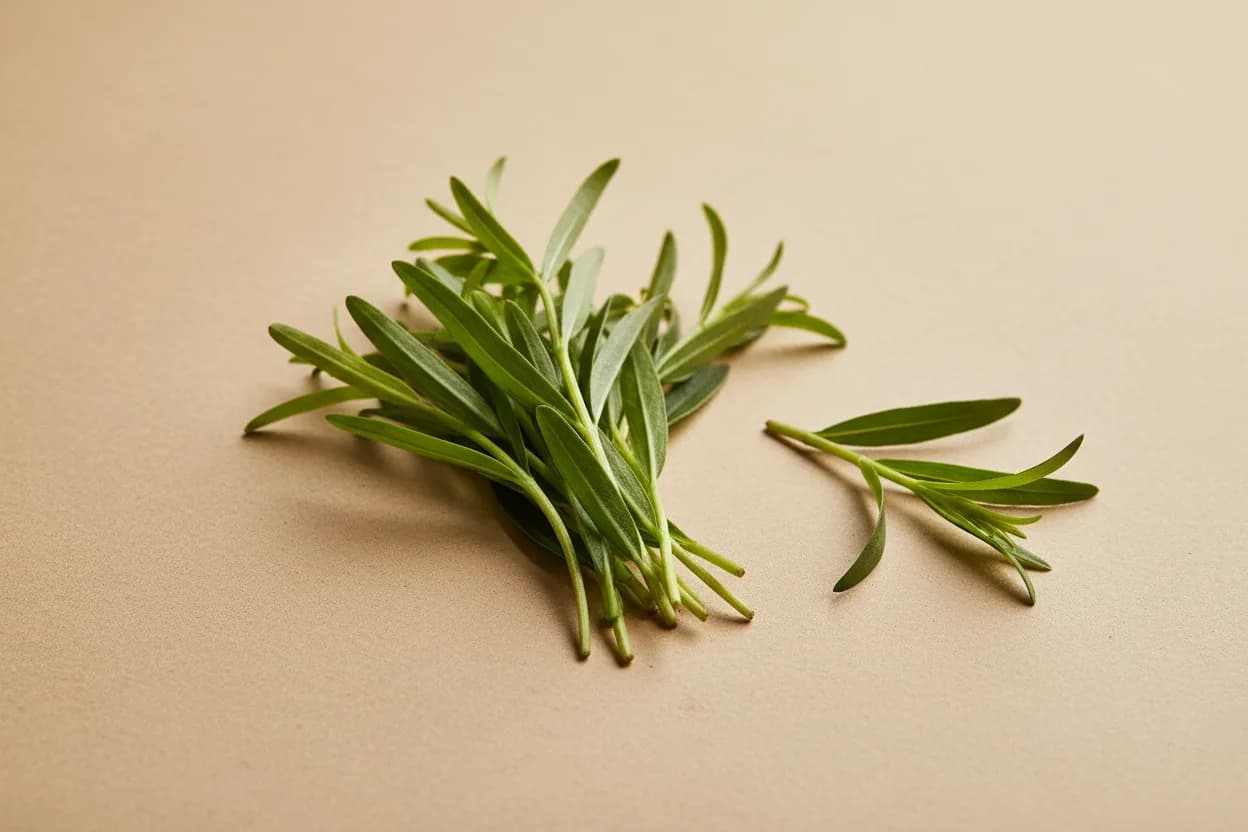
The entry begins by correcting two things people had wrong. Ibn al-Baytar, who died in Damascus in 1248, opens his article on tarkhun by noting that one authority alone had claimed the plant was pellitory, and it is not; and that some people say tarragon has no seed, and that is not the case either. 1 Then he says what it is: a pot-herb well known to the people of al-Sham, and of scarce occurrence in Egypt.
That is a Damascene writing about Syria, in a book of simples covering food as well as medicine, and the word he reaches for is baqla, a leafy green of the kitchen garden. What follows is not a prescription. Its tender tips, he writes, are served at the table with mint and other greens; they rouse the appetite and sweeten the breath, and if you drink water afterwards the water tastes better for it. 1 He files tarragon among the herbs of the table.
The authorities he quotes are more specific still. Ishaq ibn Imran says to choose the young tender growth and to eat it with celery, because celery checks the harm in it. Al-Razi, in his book on countering the harms of foods, says chewing it and holding it in the mouth a long while is good for mouth ulcers. And al-Tamimi describes something a cook would recognise: tarragon numbs the uvula and the tongue through a fine camphoraceous pungency, and in its taste there is something of the taste of pellitory, so that chewing it before a dose of foul boiled medicine numbs the mouth enough to get the medicine down without nausea. 1 Nobody in the entry compares tarragon to anise.
The cookbook agrees, without copying
A second thirteenth-century Syrian text has tarragon too, and it is a cookbook rather than a drug book. Kitab al-Wasla ila l-Habib is anonymous, sometimes attributed to the Aleppan historian Ibn al-Adim on the strength of one manuscript ascription. Its eighth chapter is on pickles and salted preserves, and tarragon appears there twice, which is every time it appears in the book. 2
The first is a cucumber pickle: small cucumbers soaked, drained, packed into a jar, covered with sharp wine vinegar, laid up with celery hearts and rue and heads of garlic. Then the line that dates the dish to a season rather than a shopping list. If it is tarragon season, some of its stalks are put in as well. It is good, and it does not keep long. 2 The second is green fennel: the tender hearts chopped as small as possible, salted and worked by hand until they wilt, left overnight in a bowl tilted so the water runs out, pressed hard, then dressed with sour milk, onion shredded fine and white part only, mint leaves, tarragon hearts and good olive oil. 2
Two texts, two genres, one century, one region. What makes them worth reading together is that they agree on the company tarragon keeps. The drug book has Ishaq ibn Imran pairing tarragon with celery, and the cookbook puts celery hearts in the cucumber pickle. The drug book has tarragon water going with green fennel water into a drink, and the cookbook builds a whole pickle out of green fennel dressed with tarragon. 1 2 Both reach for the same word for the good part of the plant: qulub, hearts, the tender tops. That is not one text copying another. That is a shared kitchen vocabulary, which is what a cuisine sounds like from the inside.
It also sits in a region that made its own materia medica rather than only importing one. A survey of the medieval and Ottoman al-Sham reconstructed 286 substances from roughly eleven hundred years of pharmacological literature, travelogues, dictionaries and archives, 234 of them plants, and concluded that al-Sham was an independent source of production and marketing. 3 Whether tarragon is on that particular list I could not check, and I am not going to pretend otherwise.
And then it goes missing
Look for tarragon in the modern Levantine record and it is not there. A sweep of the ethnobotanical survey literature on Syria, Lebanon, Jordan, Palestine and southeastern Turkey turns up fifteen papers whose species lists carry no Artemisia dracunculus, while Artemisia herba-alba, judaica, sieberi, monosperma, inculta, annua and absinthium all appear across them. Two of the Syrian ones I read in full. A survey of wild food plants in coastal Tartus does not mention the genus at all. 4 An ethnomedicinal survey of Hama and Homs, in central Syria, has Artemisia herba-alba and Artemisia annua and not this one. 5 No academic or food-history source I could reach names a modern Syrian or Aleppine tarragon dish. Where tarragon is unmistakably food today, the record is Georgian, Iranian and Armenian: Georgian fieldwork with over 380 participants logs 125 food use-mentions for it, against eight for wormwood and three for mugwort. 7
Before treating that as a verdict, look at what the instrument can see. The Georgian survey that recorded those 125 mentions lists tarragon among the herbs it calls widely cultivated, alongside parsley, coriander, dill and fennel. 7 A separate survey of the wild plants and fungi sold in the markets of Yerevan, 37 locations and 136 people and 163 species, records five Artemisia species and not tarragon, in Armenia, where tarragon is beyond argument a kitchen herb. 6 Wild-food surveys, medicinal-plant surveys and herbarium sheets are all nets with the same hole in them. They do not catch garden herbs. Ibn al-Baytar's own word for tarragon was baqla, a cultivated green, which is precisely the category nobody goes out to survey.
The occurrence data makes the point unkindly. Tarragon has 19,298 records in the Global Biodiversity Information Facility, and 1,331 of them are from France, a country Kew's own distribution lists as introduced. 8 9 Syria, Lebanon, Jordan, Palestine, Iraq and Egypt return zero between them, while Artemisia herba-alba, a genuinely wild Levantine wormwood nobody plants, returns nineteen for Syria alone. 8 Kew lists Lebanon-Syria among 101 native regions for tarragon; GBIF holds not one Levantine specimen. 9 8 Those two databases disagree and I cannot settle it, so the honest reading is that recording effort follows botanists rather than plants, and that a plant kept in gardens and eaten young is close to invisible to all of it.
France, which is the one place it is not from
Meanwhile the herb acquired a nationality. Western botanical writing does not register tarragon until 1536, when the French physician Jean Ruel mentions it inside a chapter on Dracunculus, a chapter that is really about arum. Dodoens gives it its first dedicated entry in 1554, filed between rocket and watercress among the edible plants, and reports it unknown except in some parts of France and in Antwerp, Brussels and Mechelen, where it had been introduced by Frenchmen. 11 That is roughly 290 years after a man in Damascus called it ordinary.
The word itself came the other way. English tarragon descends from New Latin tarchon, from Medieval Greek tarkhon, from Arabic tarkhun, and only then, with a dictionary's own qualifier of perhaps, from Greek drakon, a dragon. 12 The dragon in the species name dracunculus is a different dragon, arriving separately in the 1530s when Ruel filed the plant under the arums. 11 The two are routinely welded into one story about tarragon curing snakebite, and the historians of the Latin literature say plainly that those beliefs are not attested. 11
The credit is stranger than that. Search the International Plant Names Index for Artemisia dracunculus var. sativa, the name on essentially every seed packet and nursery label for culinary tarragon, and it returns nothing. Control searches in the identical form return five results for var. glauca and one for var. pamirica, so the zero is a real absence rather than a broken query. 10 Kew lists France among eighteen introduced regions. 9 French tarragon is a garden clone wearing botanical Latin, named for a country where the plant is a visitor.
The usual explanation for that clone is that it is sterile, which is where Ibn al-Baytar's thirteenth-century correction becomes funny rather than quaint. Karyotype work on nine Iranian accessions found a basic chromosome number of nine, with French tarragon tetraploid and Russian tarragon decaploid. 15 The freely seeding one carries more than twice the chromosome sets of the one that will not set seed, which leaves the tidy story about polyploidy and sterility with nothing to stand on. He was right that the species has seed. The horticulturalists are right that their plant does not give them any.
What it actually tastes of
Tarragon is an Artemisia, the wormwood and mugwort genus, and it tastes sweet and anise-like instead of bitter. The reason is one bond. Estragole, the compound that dominates tarragon oil, and anethole, the compound that makes anise taste of anise, are structural isomers: both C10H12O, both with an exact mass of 148.0888, both a methoxybenzene carrying a three-carbon tail. In anethole the double bond sits next to the ring; in estragole it sits at the far end of the tail. 17 An Artemisia tastes of anise because it makes the anise molecule with one double bond moved along by a single position. A commercial Iranian tarragon oil also carries real anethole, at 1.5 per cent. 13
What tarragon does not carry is the thing that makes its relatives bitter. In one paper's tables, the alpha- and beta-thujone rows for Artemisia dracunculus are blank, while wormwood in the same table shows beta-thujone at 44 per cent and mugwort shows alpha-thujone at 65.5. 13 The thujones are bicyclic monoterpene ketones and absinthin is a dimeric sesquiterpene lactone; estragole comes off the phenylpropanoid pathway. 17 Tarragon and wormwood are not two settings of the same instrument. They are running different chemistry in the same genus.
Here is where the folklore breaks, though. Estragole is 75 per cent of that Iranian oil and 84 per cent of the same paper's own distillate, and roughly 80 per cent of the oil from tetraploid French tarragon. 13 14 Then somebody measured what people actually smell. An aroma extract dilution analysis of tarragon found estragole the most abundant potent odorant, at 2,900 milligrams per kilogram of leaf, and ranked it third by odour activity: beta-ionone at 5,862, eugenol at 2,653, estragole at 460. The authors concluded that beta-ionone and eugenol made the greatest contribution and that estragole was of minor importance. 16 One sample, thresholds measured in starch and cellulose, and an odour activity of 460 is still far above threshold, so this complicates the story rather than ending it. But the dominant compound by mass is not the dominant smell, and al-Tamimi, reaching for a comparison nine hundred years ago, said pellitory rather than anise.
Nor is there one tarragon flavour to be faithful to. Of 63 wild diploid North American plants, the dominant compound was ocimene in 22, methyl eugenol in 15, methyl chavicol in only 10, and terpinolene in 5. 14 The taste that European cooking treats as definitive belongs to one clone out of a species that does several quite different things.
So the herb did not fail to take in Syria. It was there, in the garden and on the table, and the record of it is a drug book and a pickle recipe that agree with each other about celery and green fennel and the word for the tender tops. What happened afterwards is not documented anywhere I can reach, and the surveys that report its absence are not built to find a plant somebody grows by the kitchen door. Ibn al-Baytar's last observation about it is the one no chemist has bothered with: eat the young tips, and the water you drink after them tastes better than it did.
Sources
Every numbered claim above points here. Links go to the paper, record, or authority itself.
- 1.
Ibn al-Baytar (Abd Allah ibn Ahmad al-Malaqi, d. 646 AH / 1248 CE, Damascus). Al-Jami li-mufradat al-adwiya wa-l-aghdhiya, entry tarkhun, in the ta section. Read in Arabic in volume 3 of the four-volume Arabic printing digitised by the Internet Archive (item title al-Jami li-mufradat al-adwiya wa-l-aghdhiya, Ibn al-Baytar). The entry sits between the entries tarashina and tarthuth, and the volume yields thirteen occurrences of the word tarkhun. Source for the descriptions of tarragon as a pot-herb known to the people of al-Sham and scarce in Egypt, as one of the herbs of the table served with mint, for the refutations of the claims that it is pellitory and that it sets no seed, for the two kinds reported from the agricultural literature, for Ibn Masawayh's Galenic grade, for al-Razi on chewing it for mouth ulcers, for Ishaq ibn Imran on eating it with celery, and for al-Tamimi on its numbing of the uvula and tongue and its taste of pellitory.
https://archive.org/details/1_20210320_20210320_0857 - 2.
Anonymous, 13th century, Syria. Kitab al-Wasla ila l-Habib fi Wasf al-Tayyibat wa-l-Tib, chapter 8, on pickles and salted preserves. Published in translation as Perry C (ed. and trans.), Scents and Flavors: A Syrian Cookbook, Library of Arabic Literature 47, New York University Press, 2017. The link is to the Library of Arabic Literature's page for that edition; the Arabic was read in the Internet Archive scan of the Arabic-only text (item perry-scents-and-flavors-arabic-only-1), which yields two occurrences of tarkhun, both in chapter 8: tarragon stalks added to a cucumber pickle in sharp wine vinegar with celery hearts, rue and garlic, and tarragon hearts dressed with sour milk, onion and mint over salted green fennel hearts. Authorship is anonymous; an attribution to the Aleppan historian Ibn al-Adim rests on a single manuscript ascription and is not asserted here.
https://www.libraryofarabicliterature.org/books/scents-and-flavors/ - 3.
Lev E. Reconstructed materia medica of the medieval and Ottoman al-Sham. Journal of Ethnopharmacology. 2002;80(2-3):167-179. Source for al-Sham having been an independent source of production and marketing of medicinal substances in the medieval and Ottoman periods, and for the 286 substances identified across roughly 1,100 years of sources, of which 234 (81.8 per cent) are plant species. Whether Artemisia dracunculus is among those 234 could not be checked, and no claim either way is made here.
https://doi.org/10.1016/S0378-8741(02)00029-6 - 4.
Sulaiman N, Pieroni A, Soukand R, Polesny Z. Food behavior in emergency time: wild plant use for human nutrition during the conflict in Syria. Foods. 2022;11(2):177. An ethnobotanical survey of wild food plants in Tartus, coastal Syria. Full text read at PMC8775266: the genus Artemisia does not appear in it at all.
https://doi.org/10.3390/foods11020177 - 5.
Khatib C, Nattouf A, Hasan Agha MI. Traditional medicines and their common uses in central region of Syria: Hama and Homs, an ethnomedicinal survey. Pharmaceutical Biology. 2021;59(1):776-786. Full text read at PMC8231352: Artemisia herba-alba and Artemisia annua appear, and Artemisia dracunculus does not.
https://doi.org/10.1080/13880209.2021.1936078 - 6.
Nanagulyan S, Zakaryan N, Kartashyan N, Piwowarczyk R, Luczaj L. Wild plants and fungi sold in the markets of Yerevan (Armenia). Journal of Ethnobiology and Ethnomedicine. 2020;16:26. A survey of 37 market locations, 136 people and 163 species. It records Artemisia absinthium, austriaca, fragrans, tournefortiana and vulgaris, and not Artemisia dracunculus, in a country where tarragon is a well-established culinary herb. Cited here as evidence that surveys of wild plants cannot see cultivated garden herbs.
https://doi.org/10.1186/s13002-020-00375-3 - 7.
Bussmann RW, Paniagua Zambrana NY, Ur Rahman IU, Kikvidze Z, Sikharulidze S, Kikodze D, Tchelidze D, Khutsishvili M, Batsatsashvili K. Unity in diversity, food plants and fungi of Sakartvelo (Republic of Georgia), Caucasus. Journal of Ethnobiology and Ethnomedicine. 2021;17:72. Fieldwork 2013 to 2019 with over 380 participants and more than 19,800 mentions of food plants. Source for Artemisia dracunculus carrying 125 food use-mentions, against eight for Artemisia absinthium and three for Artemisia vulgaris, and for tarragon being named, among parsley, coriander, savory, garden cress, dill, fennel and celery, as herbs that are widely cultivated and popular ingredients of local cuisine.
https://doi.org/10.1186/s13002-021-00490-9 - 8.
Global Biodiversity Information Facility, occurrence search API, queried 17 August 2026 by taxon key. The linked query returns the global record count; the per-country figures below were obtained from the same endpoint with a country parameter added, gbif.org's own species pages returning HTTP 403 to automated requests. Artemisia dracunculus L. (taxon key 3121581) returns 19,298 occurrence records globally, of which 1,331 are from France and zero from each of Syria, Lebanon, Jordan, Palestine, Israel, Iraq and Egypt; Georgia returns 3, Armenia 5 and Iran 4. For comparison, Artemisia herba-alba Asso (taxon key 3120848) returns 19 records for Syria, 24 for Jordan, 18 for Iraq and 65 for Egypt.
https://api.gbif.org/v1/occurrence/search?taxonKey=3121581&limit=0 - 9.
Royal Botanic Gardens Kew. Artemisia dracunculus L., Kew Backbone Distributions, in Plants of the World Online (taxon urn:lsid:ipni.org:names:307848-2), read via the Kew-run ColPlantA portal serving the same backbone, powo.science.kew.org having returned HTTP 403. Source for the native range statement, for 101 named native regions including Lebanon-Syria, Palestine, Iran, Iraq, Turkiye, the Transcaucasus, Mongolia and West Siberia, and for the 18 introduced regions, which include France, Great Britain, Germany and Italy.
https://colplanta.org/taxon/urn:lsid:ipni.org:names:307848-2 - 10.
International Plant Names Index, API search, queried 17 August 2026. The queries Artemisia dracunculus var. sativa and Artemisia dracunculus sativa each return totalResults 0, while control queries in the identical form return 5 for Artemisia dracunculus glauca, 1 for Artemisia dracunculus pamirica and 9 for Artemisia dracunculoides. Cited as evidence that the absence is a real absence from the index rather than a failed query.
https://www.ipni.org/ - 11.
Touwaide A, Appetiti E. Herbs in history: tarragon. American Herbal Products Association, August 2024. Source for tarragon being absent from Hippocratic-era therapeutics and from the cuisine of the ancient world, for Jean Ruel (1474-1537) first mentioning it in De natura stirpium libri tres (Paris, 1536) inside a chapter on Dracunculus, meaning arum, for Dodoens' Cruijdeboeck (1554) giving it its first dedicated entry between rocket and watercress among the edible plants and reporting it known only in some parts of France and in Antwerp, Brussels and Mechelen where it had been introduced by Frenchmen, for Gerard's Herball (1597) grading it hot and dry in the third degree, and for the dragon and snakebite beliefs attached to tarragon not being attested in the literature.
https://www.ahpa.org/herbs_in_history_tarragon - 12.
American Heritage Dictionary of the English Language, entry tarragon. Gives the etymology as New Latin tarchon, from Medieval Greek tarkhon, from Arabic tarkhun, perhaps from Greek drakon, dragon. The Arabic to Medieval Greek to New Latin chain is stated flatly; the Greek origin of the Arabic carries the qualifier perhaps.
https://www.ahdictionary.com/word/search.html?q=tarragon - 13.
Obistioiu D, Cristina RT, Schmerold I, Chizzola R, Stolze K, Nichita I, Chiurciu V. Chemical characterization by GC-MS and in vitro activity against Candida albicans of volatile fractions prepared from Artemisia dracunculus, Artemisia abrotanum, Artemisia absinthium and Artemisia vulgaris. Chemistry Central Journal. 2014;8(1):6. Source for the composition of a commercial Iranian tarragon oil in Table 2 (estragole 75 per cent, Z-beta-ocimene 8.3, E-beta-ocimene 7.8, limonene 4, anethole 1.5) and of the authors' own distilled oil in Table 1 (estragole 84.1 per cent), and for the alpha- and beta-thujone cells being blank for Artemisia dracunculus in the same tables in which Artemisia absinthium shows beta-thujone at 44 per cent and alpha-thujone at 13, and Artemisia vulgaris shows alpha-thujone at 65.5 per cent. The paper's prose and tables differ slightly, giving approximately 80 per cent estragole in the prose against 84.1 in Table 1.
https://doi.org/10.1186/1752-153X-8-6 - 14.
Eisenman SW, Juliani HR, Struwe L, Simon JE. Essential oil diversity in North American wild tarragon (Artemisia dracunculus L.) with comparisons to French and Kyrgyz tarragon. Industrial Crops and Products. 2013;49:220-232. Source for tetraploid French tarragon oil containing approximately 80 per cent methyl chavicol (estragole), and for the 63 diploid North American individuals showing dominant components of (Z)-beta-ocimene in 22 samples, methyl eugenol in 15, methyl chavicol in only 10 and alpha-terpinolene in 5.
https://doi.org/10.1016/j.indcrop.2013.04.037 - 15.
Jelvehgar N, Mohammadi A, Kashi A, Miri SM. First karyomorphological analysis of French and Russian tarragon (Artemisia dracunculus L.). Biologia. 2024;79(11):3227-3238. Source for the basic chromosome number x = 9 and for two ploidy levels across nine Iranian accessions, 4x in the French accessions and 10x in the Russian ones.
https://doi.org/10.1007/s11756-024-01768-5 - 16.
Zeller A, Rychlik M. Impact of estragole and other odorants on the flavour of anise and tarragon. Flavour and Fragrance Journal. 2007;22(2):105-113. Aroma extract dilution analysis followed by quantitation and odour activity values. Source for estragole and 7-methoxycoumarin being the most abundant potent odorants in tarragon leaves at 2,900 and 220 mg/kg, for odour activity values of 5,862 for beta-ionone, 2,653 for eugenol and 460 for estragole, for the thresholds having been taken in starch or cellulose as the main constituents of the leaves, and for the authors' conclusion that beta-ionone and eugenol made the greatest contribution to the overall flavour of tarragon whereas estragole and the other odorants were of minor importance. The abstract does not state whether the leaf was fresh or dried.
https://doi.org/10.1002/ffj.1765 - 17.
PubChem, US National Library of Medicine, compound records retrieved via PUG REST. Estragole, CID 8815, molecular formula C10H12O, exact mass 148.088815, IUPAC name 1-methoxy-4-prop-2-enylbenzene. trans-Anethole, CID 637563, molecular formula C10H12O, exact mass 148.088815, IUPAC name 1-methoxy-4-[(E)-prop-1-enyl]benzene. Alpha-thujone, CID 261491, and beta-thujone, CID 91456, both C10H16O bicyclic monoterpene ketones; absinthin, CID 442138, C30H40O6.
https://pubchem.ncbi.nlm.nih.gov/compound/8815