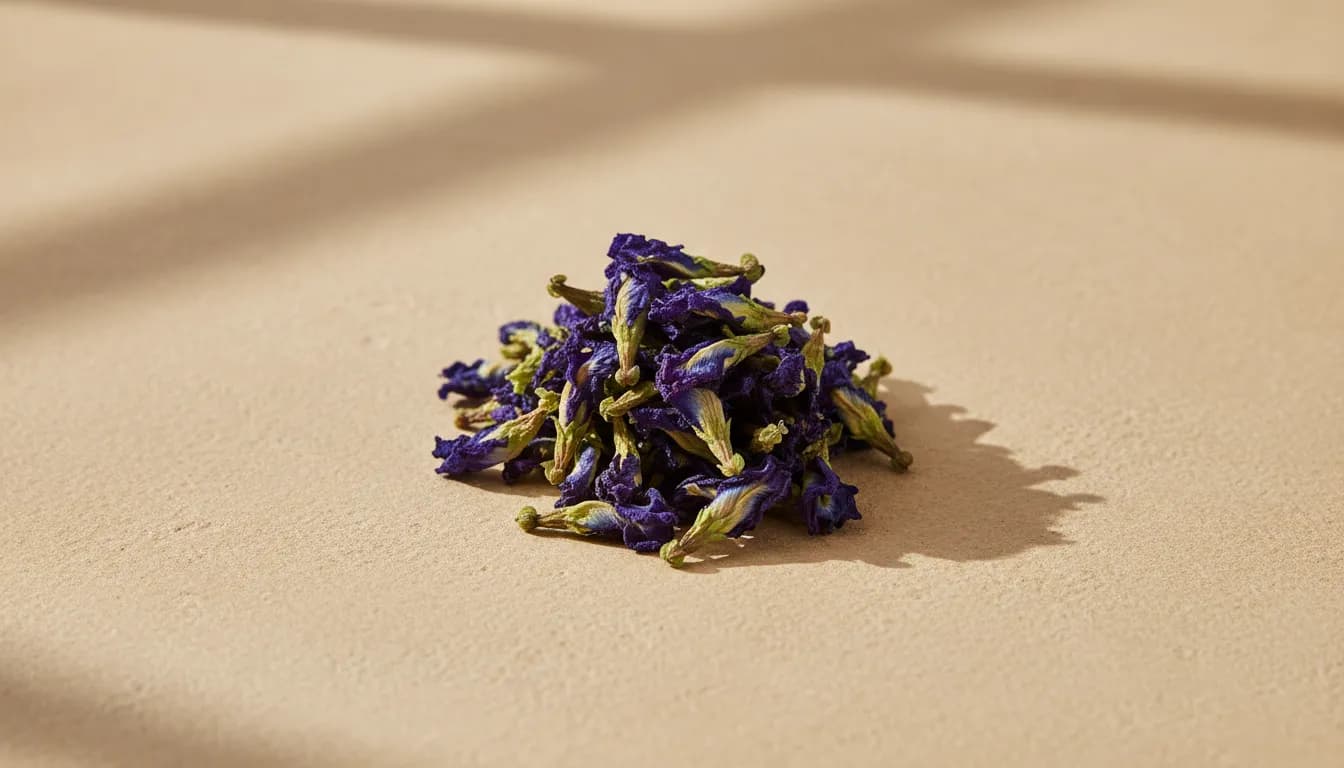
butterfly pea petals
Clitoria ternatea
IN ARABIC بتلات زهرة البازلاء الفراشية
Petals that steep an electric indigo.
ABOUT
Clitoria ternatea's dried petals appear in three teas here, always at the same 0.4 grams: added straight into a warmed cup for blue euphoric tea, steeped four minutes in just-boiled water for blue silk throat soother, and stirred in only after the pot is off the heat for the chamomile, butterfly pea and ginger cup. All three are chasing the same thing: a saturated, singular indigo, not a background tint.
That colour holds because of an unusually well-engineered pigment. Most anthocyanins fade within minutes in warm, near-neutral water because water attacks a specific carbon on the molecule and switches it to a form that no longer absorbs light. Butterfly pea's pigments, ternatins, are built on the same delphinidin core as any other anthocyanin, but they carry long chains of alternating glucose and p-coumaric acid off two positions on the ring, and those chains fold back and stack over the flat core, physically shielding the vulnerable carbon the way DNA's bases stack on each other. A Japanese research group mapped fifteen of these ternatins through the 1990s and demonstrated the stacking directly. The pH trick, indigo turning magenta under lemon, runs on the same equilibrium as red cabbage: the flavylium cation is red in strong acid, the quinoidal base blue to purple near neutral, and a neutral infusion here sits blue until an acid pushes it back toward red.
What that blue does once it is swallowed is far less settled than what it does in the cup. The plant has a long Ayurvedic reputation as a memory tonic and calming herb, but the most thorough review of it says plainly that the human evidence is preliminary, built on animal studies and cell assays, and that nobody has cleanly established which of the flower's compounds, anthocyanins, flavonols or its separate cyclotide peptides, would even be responsible. Regulators disagree on how comfortable they are with the plant itself rather than its effects: the US FDA cleared butterfly pea extract as a colour additive in 2025, while an EU application to sell the dried flowers as food closed without approval over unresolved questions about those cyclotides, a different class of molecule entirely from the pigment doing the colouring. So the recipes here are honest about what they are for: colour and a floral note, not a nootropic.
CHEMISTRY
1The characteristic compounds documented in this ingredient, plus any the library traces to it in a recipe. Not an exhaustive phytochemistry.
USED IN
3Blue Euphoric Tea
0.4 g · dried; ≈ 1/4 tsp loose
STEP 1 Add the butterfly pea petals, lavender, star anise, and sliced ginger to a warmed cup.
Chamomile, Butterfly Pea & Ginger
0.4 g · dried
STEP 2 Take off the heat, then add the chamomile and butterfly pea petals.
Blue Silk Throat Soother
0.4 g · dried
STEP 1 Steep the butterfly pea and crushed anise seeds in just-boiled water.