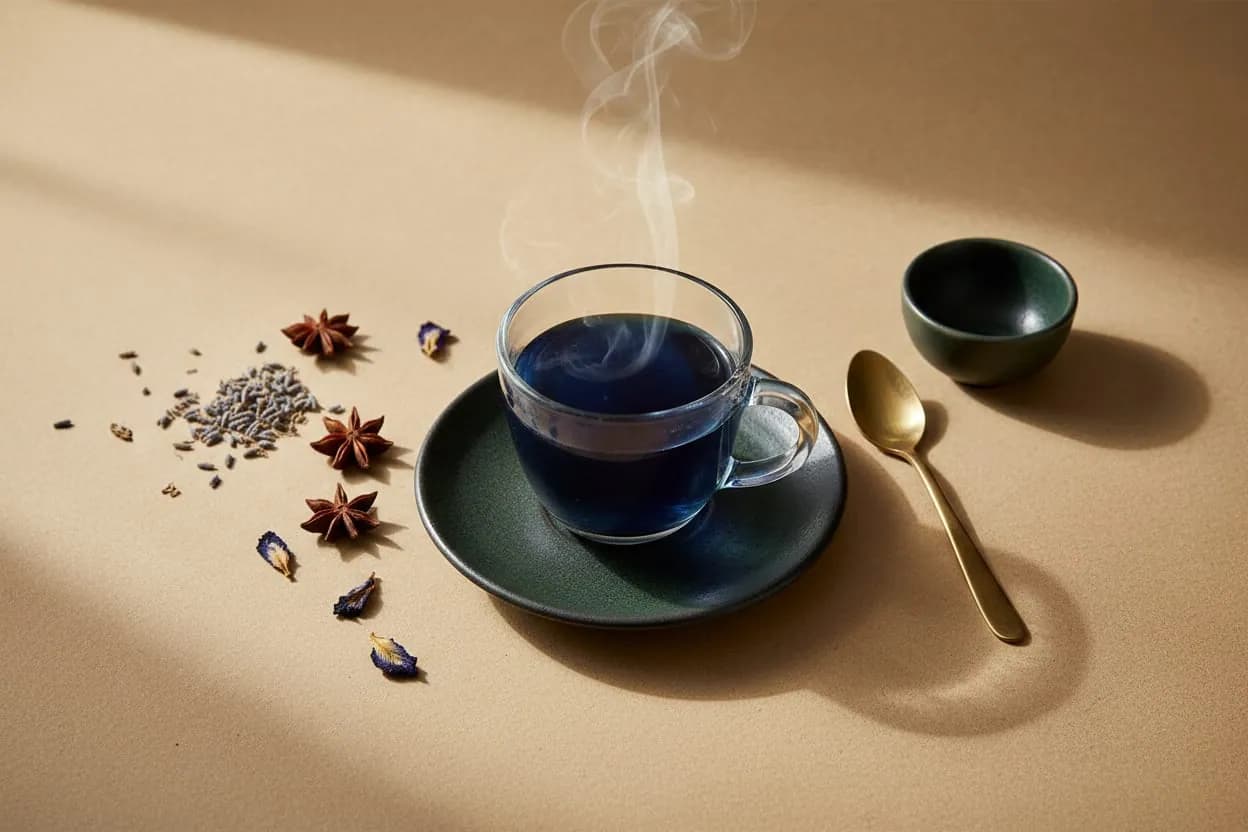
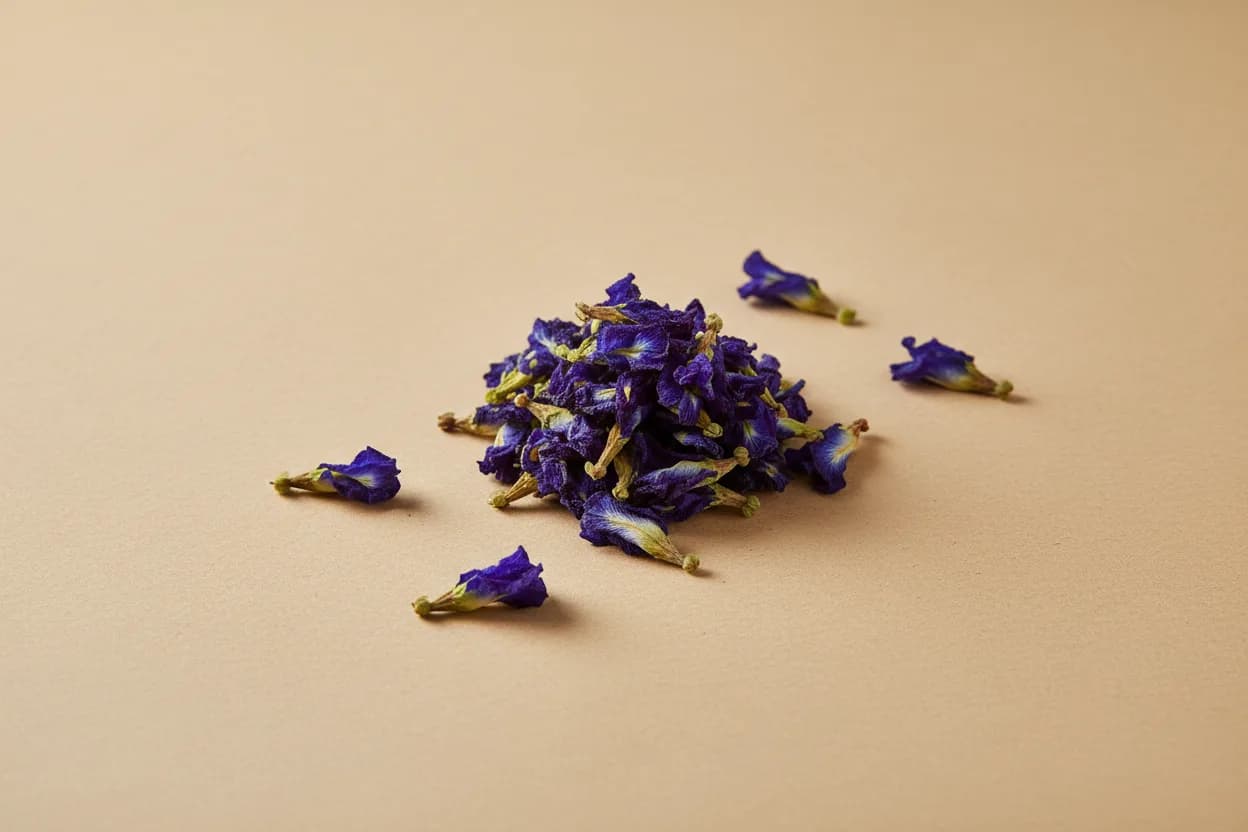
No staged steep this time, just one pour: butterfly pea petals, lavender, a pinch of star anise, and a thin ginger slice go into a warmed cup, then hot water, about ninety degrees, turns it indigo in five to six minutes before a strain finishes it. Butterfly pea's pigments sit blue in neutral water; lemon swings the color violet. Star anise, barely a pinch at 0.05, tastes sweet because its anethole fits the tongue's sweet receptor, confirmed in 2025 for the human version, not the mouse. What's in the cup is floral, licorice-edged, and a ginger bite that wakes rather than warms the mouth; nothing here is cooked, only steeped.
Calm and focus don't rest on equal evidence. Lavender's strongest result belongs to Silexan, a capsule licensed as a medicine in Germany: a meta-analysis of five trials and 1,213 patients found it beat placebo on an anxiety scale with a number needed to treat of five, but every trial, and the analysis, was funded by the pill's maker: a capsule's result, not buds in a cup. Star anise contributes flavor here, not medicine: its shikimic acid, from Illicium verum, was Tamiflu's raw material in the mid-2000s, yet has no antiviral action itself, just a scaffold rebuilt through synthetic steps. Ginger's warmth wakes the tongue through the same heat receptor as capsaicin, roughly two hundred fifty times gentler, a real feeling, not sharpened attention. Butterfly pea's part is less settled still: no review has established which compound, if any, drives any cognitive effect.
Drink it as suggested, adding lemon partway through to watch the color turn. The one real caution concerns buying star anise at all: a nearly identical toxic look-alike, Japanese star anise, isn't reliably told apart by eye and carries anisatin, blocking the brain's calming receptor and risking seizures. Case reports read the same each time: an infant given the tea for colic. Buy it from a supplier who knows the species, and never make this tea, or any star anise tea, for a baby. The pinch here, 0.05 against the butterfly pea's 0.4, is too small to worry about twice.