The blue that survives the kettle
Most blue in nature is unstable, and most anthocyanins go colourless in warm water. Butterfly pea holds its blue by folding its own molecule over itself like a sandwich.
Contents
Blue is rare in food for a chemical reason, not an aesthetic one. The pigments that make plants red and purple are anthocyanins, and anthocyanins are unstable in exactly the conditions a kitchen provides. Put most of them in warm water at neutral pH and they lose their colour within minutes, because water attacks the pigment at a specific carbon and converts it into a form that simply does not absorb visible light.
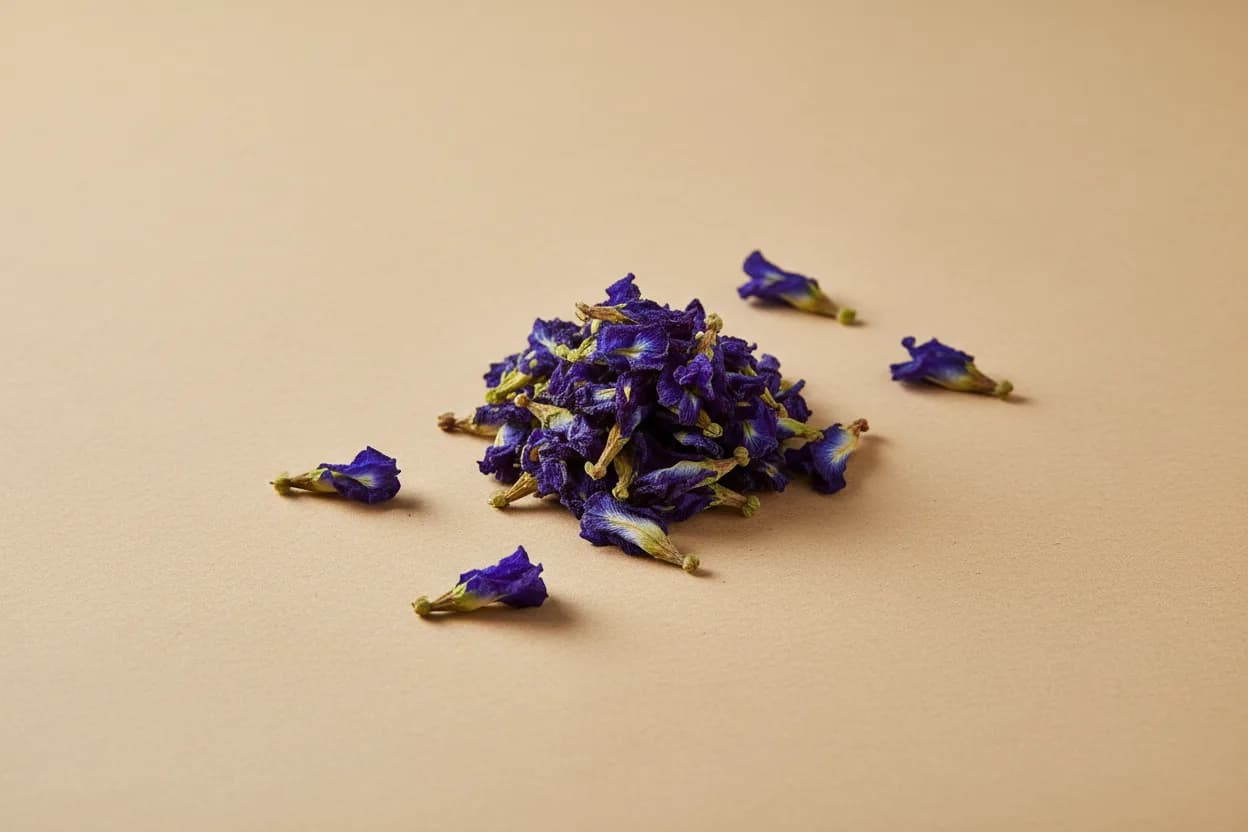
Butterfly pea does not do this. Steep the dried flowers of Clitoria ternatea and you get a blue that is deep, immediate, and stubborn. The reason is a piece of molecular architecture that is genuinely elegant, and it was worked out by one Japanese research group across roughly a decade.
Fifteen molecules with the same spine
The pigments are called ternatins, and they are built on delphinidin, one of the standard anthocyanidin cores, glycosylated at three positions to give a delphinidin 3,3',5'-triglucoside chassis. What makes them unusual is what hangs off the 3' and 5' positions: chains alternating glucose and p-coumaric acid, of varying lengths and symmetry. 1
Norihiko Terahara and colleagues mapped fifteen of them, named A1 through D3, in a run of papers through the 1990s. 2 3 Same core molecule, fifteen different arrangements of increasingly elaborate arms. It reads like a catalogue until you understand what the arms are for.
The sandwich
The acyl arms do not stick out. They fold back over the flat aromatic core and stack on top of it, held there by the same sort of interaction that stacks the bases in DNA. The pigment is wrapped in its own side chains. This is intramolecular copigmentation, and the general theory of how molecular stacking stabilises flower colour was laid out by Goto and Kondo. 4 Terahara's group demonstrated the stacking specifically in ternatins in solution. 2
The consequence is physical shielding. Water bleaches an ordinary anthocyanin by attacking the C2 position of the flavylium core; if that position is covered by a folded-over aromatic arm, the attack is much harder to land. The pigment stays in a coloured form where a naked anthocyanin would have gone to a colourless hemiketal. 6 The flower is not using better chemistry than a blueberry. It is using the same chemistry with a lid on.
Why lemon turns it pink
The party trick everyone knows is real chemistry and not a novelty. Anthocyanins exist as a set of interconverting species whose balance depends on pH: the flavylium cation, which is red, dominates in strong acid; deprotonate it and you get the quinoidal base, which is purple to blue; let water in at C2 and you get the colourless hemiketal, which can open further to a pale yellow chalcone. 5
A butterfly pea infusion made with ordinary water sits near neutral, so it is blue. Squeeze in lemon and you drop the pH into flavylium territory, and the colour swings toward purple and magenta. Broadly: red below about pH 3, violet through the middle, blue around neutral, and drifting green as it becomes strongly alkaline. 6 Nothing exotic is happening. It is the same equilibrium that governs red cabbage and red wine, made visible because the starting colour is so saturated.
The stability has limits, and you want to know them before you build a drink around it. Heat is handled well: at mildly acidic pH the pigment held its absorbance over six hours at sixty to seventy degrees. Light is handled badly, with only about a third of the colour surviving light exposure in one test. 6 Keep the jar dark. A sunny windowsill is a worse enemy than the kettle.
The name, and the honest caveats
The species epithet honours Ternate, an island in the Maluku, because that is where the specimens Linnaeus worked from came from, which is not the same as where the plant is from. Its actual native range is genuinely unsettled: Kew lists a broad range across Africa and the Arabian Peninsula, while phylogenetic reviews argue for an origin in or around the Indian Ocean. 7 Anyone who tells you confidently where butterfly pea is from is ahead of the evidence.
The genus name is a separate story. It comes from a 1678 description by the Polish naturalist Jakób Breyne, who called it the Ternatean flower of the clitoris, for the obvious reason, and Linnaeus kept it.
On health claims, restraint is required. The plant has a long Ayurvedic reputation as Aparajita, a memory tonic and calming herb. The modern evidence is animal studies and cell assays, and the most thorough review of the plant notes that the work is preliminary and that nobody has cleanly established which compound would even be responsible, since the flower contains flavonols and cyclotides alongside the anthocyanins. 7 Blue tea is a lovely thing. It is not a nootropic yet.
Regulators have landed in interestingly different places. In May 2025 the US FDA listed butterfly pea flower extract as a colour additive exempt from certification, cleared for drinks, ice cream, confectionery, and coffee creamers. 8 The EU has not authorised it: a bid to sell the dried flowers as a traditional food was closed out without approval, over unresolved questions about cyclotides, the cyclic peptides the plant also makes. Note that this is a question about a completely different class of molecule from the pigment. Nobody is worried about the ternatins. They are just the part you can see.
Sources
Every numbered claim above points here. Links go to the paper, record, or authority itself.
- 1.
Terahara N, Saito N, Honda T, Toki K, Osajima Y. Acylated anthocyanins of Clitoria ternatea flowers and their acyl moieties. Phytochemistry. 1990;29(3):949-953.
https://doi.org/10.1016/0031-9422(90)80053-J - 2.
Terahara N, Oda M, Matsui T, et al. Five new anthocyanins, ternatins A3, B4, B3, B2, and D2, from Clitoria ternatea flowers. Journal of Natural Products. 1996;59(2):139-144.
https://doi.org/10.1021/np960050a - 3.
Terahara N, Toki K, Saito N, et al. Eight new anthocyanins, ternatins C1-C5 and D3 and preternatins A3 and C4 from young Clitoria ternatea flowers. Journal of Natural Products. 1998;61(11):1361-1367.
https://doi.org/10.1021/np980160c - 4.
Goto T, Kondo T. Structure and molecular stacking of anthocyanins: flower colour variation. Angewandte Chemie International Edition in English. 1991;30(1):17-33.
https://doi.org/10.1002/anie.199100171 - 5.
Pina F, Oliveira J, de Freitas V, et al. Evolution of flavylium-based colour systems in plants: what physical chemistry can tell us. International Journal of Molecular Sciences. 2021;22(8):3833.
https://doi.org/10.3390/ijms22083833 - 6.
Vidana Gamage GC, Lim YY, Choo WS. Anthocyanins from Clitoria ternatea flower: biosynthesis, extraction, stability, antioxidant activity, and applications. Frontiers in Plant Science. 2021;12:792303.
https://doi.org/10.3389/fpls.2021.792303 - 7.
Oguis GK, Gilding EK, Jackson MA, Craik DJ. Butterfly pea (Clitoria ternatea), a cyclotide-bearing plant with applications in agriculture and medicine. Frontiers in Plant Science. 2019;10:645.
https://doi.org/10.3389/fpls.2019.00645 - 8.
US Food and Drug Administration. Listing of Color Additives Exempt From Certification; Butterfly Pea Flower Extract. Federal Register, 12 May 2025; codified at 21 CFR 73.69.
https://www.federalregister.gov/documents/2025/05/12/2025-08248/listing-of-color-additives-exempt-from-certification-butterfly-pea-flower-extract