How far a grating of nutmeg is from a dose
A woman in the Netherlands put about two teaspoons of nutmeg into a dish of asparagus and woke at four in the morning confused, with a heart rate of 120 and a dry mouth that took 36 hours to go. The spice rack sits one to two orders of magnitude below that. The mechanism everybody cites for it has never been demonstrated in a person.
Contents
She was 37, she was cooking asparagus, and she was generous with the nutmeg. Roughly two teaspoons went in, which is around ten grams. She ate her dinner and went to bed. At four in the morning she woke confused, speaking incoherently, drowsy, dizzy, with a very dry mouth and the sense that she could not empty her bladder. Her heart was running at 120. The confusion cleared inside ten hours. The dry mouth and the urinary retention took 36.1
Nothing about that evening was recreational. It is in the literature as an unintentional autointoxication, and it is the most useful case in the whole nutmeg file, because it establishes the one thing people assume cannot happen: you can reach a toxic dose of nutmeg from a spice jar, in food, by accident.
The arithmetic, which is reassuring right up until it isn't
A teaspoon of ground nutmeg weighs 2.2 grams and a tablespoon weighs 7.0.2 A grating over a bowl of something is a small fraction of a teaspoon, so call it a few tenths of a gram. Now line up the doses that have actually put people in the medical literature: about 10 grams in the asparagus,1 14 grams for two American college students in 1963,3 15 to 24 grams for a 13-year-old girl over three hours,5 18.3 grams for a woman in Virginia in 1959,4 25 grams for a 16-year-old reported to the Illinois Poison Center.6
So the gap between seasoning a dish and joining that list is somewhere between twenty-fold and a hundred-fold. Two tablespoons is the dose. Nobody seasons with two tablespoons.
The reassurance stops there, because there is no threshold underneath the arithmetic. The National Toxicology Program, reviewing the human reports, gives a range for the onset of intoxication that spans an order of magnitude on its own: as little as one and a half seeds, and up to nineteen.14 And the Erfurt poison information centre recorded seven poisonings between 1996 and 1998 in which doses of 20 to 80 grams of powder were swallowed and, in the authors' words, a life-threatening situation was never observed.8 Ten grams hospitalised the woman with the asparagus. Eighty grams did not put somebody else in danger. Whatever governs that difference has not been identified.
What it is actually like
The best clinical description is sixty years old and was written by a resident physician at North Carolina Memorial Hospital about two students, aged 19 and 20, who each took two tablespoonfuls of powdered nutmeg suspended in milk. Onset came about five hours later, heralded by what Payne called a leaden feeling in the extremities and a detached mental state the students described as unreal or dreamlike. Their hearts raced. Both complained of dry mouth and thirst. Onlookers reported that one became hyperactive and talked incoherently, and that the faces of both were, in the phrase recorded, as red as beets.34
Two details from that case have never been improved on. The first is what one of them said about the experience: a sense of impending doom, as if he were breaking up inside. The second is the tail. Extreme drowsiness arrived about seven hours after symptoms began and ran for another 24, and both patients stated emphatically that a sense of unreality persisted for 48 to 60 hours from a single oral dose.34
A modern case reads much the same with better instruments. A 19-year-old man who deliberately swallowed a large quantity of powdered nutmeg arrived calm and then deteriorated into verbal and physical aggression, with widely dilated pupils responding sluggishly, nystagmus, dry skin, a fever, a heart rate of 129, a lactate of 6 and a completely unremarkable toxicology screen. He needed intramuscular haloperidol, three doses of lorazepam and eventually intubation purely to control his behaviour, and was discharged after a day of observation.10 Dilated pupils, dry skin, fever, tachycardia and agitation is a picture emergency physicians know, and the standing advice reflects it: nutmeg can mimic in part an anticholinergic hyperstimulation.11 Mimic is the operative word, and it was chosen carefully.
The mechanism everybody cites has never been found in a person
Search for why nutmeg does this and you will be told, quickly and confidently, that myristicin is metabolised in the body into MMDA, an amphetamine relative. It is in review articles. It is in case reports. It is in almost every popular account.
It began as a suggestion. In 1966 Alexander Shulgin published a paper in Nature titled Possible Implication of Myristicin as a Psychotropic Substance,12 and the hedge in that title is the whole story. The idea was structural: myristicin looks like something that could be aminated into an amphetamine, so perhaps the body does it.
In 2006 Beyer, Ehlers and Maurer went looking. They ran gas chromatography and mass spectrometry on urine from a suspected case of nutmeg abuse and on urine from dosed rats, and reported that in both, neither the amphetamine derivatives nor the main nutmeg ingredients could be detected.13 What they found instead were ordinary metabolic products: O-demethyl elemicin, demethylenyl myristicin, dihydroxy myristicin, demethylenyl safrole. Side chains hydroxylated, methyl groups removed. No amphetamine skeleton anywhere.
The National Toxicology Program's 2019 review puts it flatly: one study proposed the biotransformation in perfused rat liver, and no other studies have identified amphetamine derivatives of myristicin.14 A poison centre had already said the same thing in 2000, six years before anyone checked the urine, in a sentence worth keeping: the central nervous system activity of nutmeg is often postulated to result from biotransformation of its components to amphetamine-like compounds, but this has not been proven.5
It has still not been proven, and the papers repeating it as fact are not blogs. The 2014 Illinois series and the 2015 Dutch case report both state the MMDA conversion as settled, in journals with peer review.61 A hypothesis published under the word Possible has spent sixty years hardening into a mechanism, and the correction has been available since 2006.
The other mechanism you will see cited holds up slightly better and is still weaker than advertised. In 1963 Truitt and colleagues argued for monoamine oxidase inhibition by myristicin, but from indirect evidence: it lowered the convulsive dose of intravenous tryptamine in mice, raised rat brain serotonin, and antagonised reserpine-induced drooping eyelids. The optimum oral dose in mice was 500 milligrams per kilogram, myristicin was less potent than the real inhibitors they compared it against, and the authors closed by recommending further study for more direct evidence.17 Sixty years later that direct evidence in humans has not arrived. This is not a reason to worry about your cheese sauce and tyramine.
One death, in 1908
The folklore has a lethal dose in it. Some number of nutmegs, sometimes two, sometimes more, will supposedly kill you. No source establishes any lethal dose of nutmeg in a human being, and the poison-centre record runs hard the other way. California logged 119 single-substance nutmeg exposures between 1997 and 2008 and reported no major effects and no deaths in either the intentional or the accidental group.7 Illinois logged 32 over eleven years: no major outcomes, no deaths.6 Erfurt saw its seven cases at 20 to 80 grams with nobody in danger.8
There is exactly one fatality attributed to the spice alone, and it is very old. In 1908 Cushny reported to the Royal Society of Medicine the case of an eight-year-old boy who ate two whole nutmegs, became comatose and died in under 24 hours.94 The frequently cited second death, a 55-year-old woman in whom myristicin was measured postmortem in 2001, is not a nutmeg death: flunitrazepam was in her serum too, and the authors of the report attributed her death to the combined toxic effect of both substances.8
Who was actually being poisoned
The current pattern of misuse is adolescent and male. In the Illinois series, 13 of the 15 intentional exposures were male and ten of them were teenagers.6 In California, intentional users were overwhelmingly aged 13 to 20 and far likelier to need medical assessment than the accidental cases.7
That is a recent arrangement. Andrew Weil, who wrote the definitive survey of nutmeg's history as an intoxicant in 1965, found that by far the greatest number of people ever poisoned by the spice were women, mostly English and American, in the late nineteenth and early twentieth centuries, who took it to bring on a late period or to end a pregnancy. He describes an apparent epidemic of nutmeg poisoning around the turn of the century that subsided after the First World War.4 The Virginia woman who ate 18.3 grams of finely ground nutmeg in 1959 did so because her menses were two days late. Weil notes the irony without pressing it: many early commentators had praised nutmeg for its ability to prevent miscarriage.
Mace is stronger, and nobody regulates either
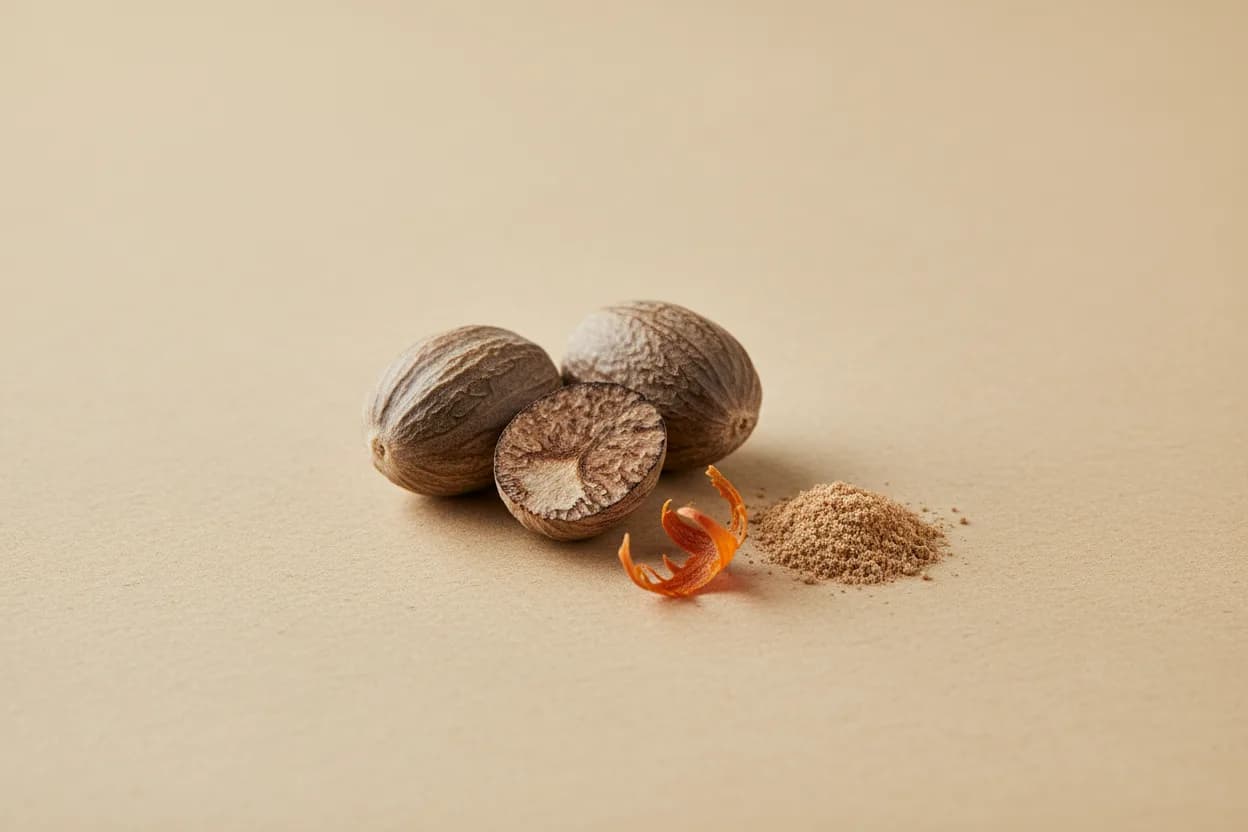
Myristicin is not evenly distributed through the fruit. The NTP figures put it at 0.25 to 3.28 per cent in the nutmeg seed against 0.25 to 5.92 per cent in mace, the lacy red aril that grows around it; in powdered form, 1.14 to 2.54 per cent against 2.59 to 7.55.14 Mace runs roughly two to three times higher. In the essential oil the numbers climb again, with myristicin between 0.5 and 12.4 per cent, elemicin from 0.3 to 4.6 and safrole from 0.1 to 3.2, varying sharply by where the tree grew.15
Given all that, the regulatory position is odd mostly for what is missing from it. European law does set maximum levels for safrole in finished foods, 15 milligrams per kilogram in meat and fish products, 25 in soups and sauces, 1 in non-alcoholic drinks.16 Myristicin and elemicin appear nowhere in that table. The European authorities regulate one of nutmeg's three alkenylbenzenes and are silent on the one responsible for the intoxication, and a German federal risk assessment notes that the two were never assessed by international expert bodies in a comparable manner.15 No authority anywhere has set an intake limit for nutmeg itself, and the United States treats it as generally recognised as safe.14
There is a further gap that most people would not guess. Those European limits carry a derogation: they do not apply where a compound food contains no added flavourings and the only flavouring ingredients are fresh, dried or frozen herbs and spices.16 Grating nutmeg into your own cooking falls outside the regulation entirely. The law governs manufactured flavour, not the spice rack.
The seven spice mix in this index calls for a nutmeg cracked open with the others, and after all of the above it is worth saying clearly that this is fine, and that the arithmetic is the reason. What actually protects everybody is not a regulation and not a warning label. It is that nutmeg at ten grams tastes appalling. The spice defends its own dose, and the people who get past that defence are almost always trying to.
Sources
Every numbered claim above points here. Links go to the paper, record, or authority itself.
- 1.
Roeters van Lennep JE, Schuit SCE, van Bruchem-Visser RL, Ozcan B. Unintentional nutmeg autointoxication. Netherlands Journal of Medicine. 2015;73(1):46. Open access. The 37-year-old woman, roughly two teaspoons of nutmeg in asparagus, onset about three hours, tachycardia at 120, confusion resolved within ten hours, dry mouth and urinary retention lasting 36. Cited for the case only; the paper also repeats the MMDA claim, which is why it appears in this note as an example of that error.
https://www.njmonline.nl/article_ft.php?a=1536&d=1013&i=179 - 2.
United States Department of Agriculture, FoodData Central. Spices, nutmeg, ground. FDC ID 171326, SR Legacy, last updated 1 April 2019. The linked record gives the portion weights used here: 1 tsp = 2.2 g and 1 tbsp = 7.0 g. The per-grating figure in this note is arithmetic from those weights, not a measured value.
https://fdc.nal.usda.gov/portal-data/external/171326 - 3.
Payne RB. Nutmeg intoxication. New England Journal of Medicine. 1963;269(1):36-38. Two students aged 19 and 20, two tablespoonfuls each in milk, onset at five hours, the leaden extremities, the dreamlike state, the racing hearts and dry mouth, the impending doom, and the sense of unreality persisting 48 to 60 hours. The full text is paywalled; the passages used here are quoted verbatim and at length in Weil 1965, which was read in full.
https://doi.org/10.1056/NEJM196307042690108 - 4.
Weil AT. Nutmeg as a narcotic. Economic Botany. 1965;19(3):194-217. The standard historical survey, originally a 1964 Harvard honours thesis. Source of the Cushny fatality as reported, the quotation of Payne 1963, the abortifacient history and the turn-of-the-century poisoning epidemic among English and American women, and the 1959 Virginia case of 18.3 grams.
https://doi.org/10.1007/BF02914307 - 5.
Sangalli BC, Chiang W. Toxicology of nutmeg abuse. Journal of Toxicology: Clinical Toxicology. 2000;38(6):671-678. Hudson Valley Regional Poison Center. The 13-year-old who took 15 to 24 grams over three hours and recovered over two days, and the sentence that the amphetamine biotransformation has not been proven.
https://doi.org/10.1081/CLT-100102020 - 6.
Ehrenpreis JE, DesLauriers C, Lank P, Armstrong PK, Leikin JB. Nutmeg poisonings: a retrospective review of 10 years experience from the Illinois Poison Center, 2001-2011. Journal of Medical Toxicology. 2014;10(2):148-151. Thirty-two exposures, ages 2 to 30, 17 unintentional and 15 intentional, of which 13 were male and ten aged 13 to 19; the 16-year-old who reported 25 grams; no major outcomes and no deaths. Cited for epidemiology only; the paper states the MMDA conversion as fact.
https://doi.org/10.1007/s13181-013-0379-7 - 7.
Carstairs SD, Cantrell FL. The spice of life: an analysis of nutmeg exposures in California. Clinical Toxicology. 2011;49(3):177-180. One hundred and nineteen single-substance exposures, 1997 to 2008, 72.3 per cent intentional; intentional users concentrated at ages 13 to 20 and likelier to require evaluation; no major effects and no deaths reported in either group.
https://doi.org/10.3109/15563650.2011.561210 - 8.
Stein U, Greyer H, Hentschel H. Nutmeg (myristicin) poisoning: report on a fatal case and a series of cases recorded by a poison information centre. Forensic Science International. 2001;118(1):87-90. Seven Erfurt cases 1996 to 1998 in which 20 to 80 grams of powder produced no life-threatening situation, and the 55-year-old woman in whom myristicin and flunitrazepam were both found postmortem, death attributed by the authors to the combination.
https://doi.org/10.1016/S0379-0738(00)00369-8 - 9.
Cushny AR. Nutmeg poisoning. Proceedings of the Royal Society of Medicine. 1908;1(Therapeutics and Pharmacology Section):39-44. The eight-year-old boy who ate two whole nutmegs, became comatose and died in under 24 hours: still the only fatality attributed to nutmeg alone. Full text paywalled; the clinical content is carried by Weil 1965 and independently by the NTP 2019 report, both read in full.
https://doi.org/10.1177/003591570800101313 - 10.
Casale MJ, MacDonald LQL, Mitra A. Nutmeg intoxication: a case report. Cureus. 2023;15(9):e46286. The 19-year-old man, sluggish mydriasis, nystagmus, dry skin, fever, heart rate 129, lactate 6, unremarkable toxicology screen, haloperidol and lorazepam and intubation for behavioural control, discharged after 24 hours.
https://doi.org/10.7759/cureus.46286 - 11.
Demetriades AK, Wallman PD, McGuiness A, Gavalas MC. Low cost, high risk: accidental nutmeg intoxication. Emergency Medicine Journal. 2005;22(3):223-225. Source of the framing that nutmeg poisoning may mimic in part an anticholinergic hyperstimulation, and of the observation that it is rare but probably underreported.
https://doi.org/10.1136/emj.2002.004168 - 12.
Shulgin AT. Possible implication of myristicin as a psychotropic substance. Nature. 1966;210(5034):380-384. The origin of the MMDA hypothesis, published as a structural suggestion. Cited here as the source of the idea, never as a demonstration of it.
https://doi.org/10.1038/210380a0 - 13.
Beyer J, Ehlers D, Maurer HH. Abuse of nutmeg (Myristica fragrans Houtt.): studies on the metabolism and the toxicologic detection of its ingredients elemicin, myristicin, and safrole in rat and human urine using gas chromatography/mass spectrometry. Therapeutic Drug Monitoring. 2006;28(4):568-575. Neither amphetamine derivatives nor the parent compounds were detectable in human or rat urine; the metabolites found were O-demethyl and demethylenyl products.
https://doi.org/10.1097/00007691-200608000-00013 - 14.
National Toxicology Program. NTP technical report on the toxicity studies of myristicin (CASRN 607-91-0) administered by gavage to F344/NTac rats and B6C3F1/N mice. NTP Toxicity Report 95. Research Triangle Park, NC: National Toxicology Program, 2019. Source of the myristicin content ranges for seed and mace, the one and a half to nineteen seeds range for intoxication onset, the statement that no other studies have identified amphetamine derivatives of myristicin, and the absence of any FDA limit.
https://www.ncbi.nlm.nih.gov/books/NBK556998/ - 15.
Gotz ME, Sachse B, Schafer B, Eisenreich A. Myristicin and elemicin: potentially toxic alkenylbenzenes in food. Foods. 2022;11(13):1988. German Federal Institute for Risk Assessment. Nutmeg essential oil composition, and the finding that myristicin and elemicin have no maximum level under EU flavouring law and were not assessed by international expert bodies in a comparable manner.
https://pmc.ncbi.nlm.nih.gov/articles/PMC9265716/ - 16.
Regulation (EC) No 1334/2008 of the European Parliament and of the Council of 16 December 2008 on flavourings and certain food ingredients with flavouring properties for use in and on foods, Annex III Part B. The safrole maximum levels quoted here, the absence of myristicin and elemicin from the table, and the derogation exempting compound foods flavoured only with fresh, dried or frozen herbs and spices.
https://www.legislation.gov.uk/eur/2008/1334/annex/III/part/B - 17.
Truitt EB Jr, Duritz G, Ebersberger EM. Evidence of monoamine oxidase inhibition by myristicin and nutmeg. Proceedings of the Society for Experimental Biology and Medicine. 1963;112:647-650. Indirect assays in mice and rats at an optimum oral dose of 500 mg/kg; myristicin less potent than tranylcypromine and iproniazid; the authors recommend further study for more direct evidence.
https://doi.org/10.3181/00379727-112-28128