The freezer is a drying method
Salt, sugar, sun and ice look like four different ideas about how to keep food. They are four ways of doing one thing to the water. Peanut butter holds fifteen per cent water and powdered milk holds eight, and both sit at exactly the same reading on the scale that decides what can live in them.
Contents
In a table at the back of an FDA inspection guide written in 1984, two foods sit on adjacent lines. Peanut butter, fifteen per cent water. Dry milk, eight per cent water. Nearly twice the water in one as the other, and both are listed at exactly the same figure: 0.70.1
The figure is water activity, and it is the number that actually governs whether food keeps. It measures how much of a food's water is free to do anything, which turns out to have remarkably little to do with how much of it there is.
Once you have it, the four great preservation methods stop looking like four separate inventions. Drying, salting and sugaring, fermenting, freezing: they are four ways of getting at the same variable, and the one everybody assumes is the odd one out turns out to be the most extreme drying method of all.
The number
Water activity is a ratio. Take the vapour pressure of the water sitting above the food, divide it by the vapour pressure of pure water at the same temperature, and you get a figure between 0 and 1. Pure water is 1. It is the same thing as the equilibrium relative humidity of the air in a sealed jar, divided by a hundred, which is a useful way to picture it: a food at 0.70 is a food that has come to terms with air at seventy per cent humidity.
What it measures is availability. Water bound up in solvation around dissolved sugar, or held in a protein's hydration shell, is present in the food and unavailable to a microorganism, which has to pull water across its own membrane against whatever the food is doing to hold on to it. The regulator's own guide puts the mechanism in one line: the vapour pressure of a salt or sugar solution is reduced in comparison to that of pure water, and water activity is usually controlled by the use of salt or sugar.1
The thresholds are specific enough to tabulate. The FDA's seafood hazards guidance carries a table of limiting conditions for pathogen growth, and it is a bracing document to read. Proteolytic Clostridium botulinum stops at water activity 0.935 and pH 4.6. Salmonella stops at 0.94, Listeria monocytogenes at 0.92. The most stubborn organism on the list by a distance is Staphylococcus aureus, which will grow down to 0.83 and tolerates twenty per cent salt in the water phase, twice what anything else on the table can manage.2
That last number is why the legal line sits where it does. United States regulations define low-acid foods as those above pH 4.6 and above water activity 0.85, and a food brought below 0.85 falls outside the low-acid canned food rules entirely.3 The 0.85 marks where S. aureus stops being able to make its enterotoxin, which the same FDA table lists one row below the growth minimum, at 0.85 against 0.83.2 The line was drawn around an organism rather than rounded off for tidiness.
Half the water, the same shelf life
The peanut butter and the dry milk are the cleanest demonstration that water content tells you very little on its own, and the FDA says so in plain words elsewhere. Discussing which products need controlling, its preventive-controls guidance notes that some unique products like soy sauce appear to be a high moisture product, but actually are in the intermediate-moisture category because salt, sugars or other ingredients bind the moisture.4
Honey is the extreme case, and it has been measured properly. A 2025 study of Greek monofloral honeys reports cotton honey at 15.85 per cent moisture and water activity 0.53, thyme honey at 14.60 per cent and 0.53, heather at 18.10 per cent and 0.60.5 Set the cotton honey beside the peanut butter: essentially the same water, and a water activity lower by nearly two tenths. That gap is the difference between a food that moulds will eventually find and one that almost nothing in the ordinary spoilage flora can touch.
The water has not gone anywhere. It is simply spoken for.
The same guidance runs the trick in reverse, and its example is the loaf on your counter. Bread sits at water activity 0.95, up with lettuce and apples and milk. The FDA's own comment is worth reading as written: the big surprise here is probably the bread, most of us tend to think it is a dry, shelf-stable product, and it is safe because of the multiple barriers of pH, water activity, and preferential growth by mold rather than pathogens. In other words, the bread spoils before it becomes hazardous.4 A food can be wet and safe. It can also be dry and, given the right specialist, perfectly habitable.
Drying, and what it costs
Drying is the oldest of the four and the one with the simplest theory: take the water out and the activity follows it down. What is less obvious is how much of the flavour leaves with it, and here the measurements are unkind to a rule almost every cook uses.
In 2022 a group led by Lucia Caputo dried oregano six different ways and distilled each batch. The headline in their table is not the composition, it is the yield. Fresh oregano, still about seventy per cent water, gave 0.2 per cent essential oil by weight of the material that went into the still. The batch dried in a high-power microwave came out at 8.6 per cent water, almost pure solids, and gave 0.1 per cent.18
Removing nearly all the water should have concentrated the oil several times over per gram. Instead the yield halved. The drying boiled the aroma off faster than it concentrated it. Shade drying over five days did far better, at 0.7 per cent, which is the useful practical finding buried in the same table.
The composition moves too, and in a consistent direction. Caputo's group found that the percentages of p-cymene, gamma-terpinene and alpha-pinene decreased significantly in the dried sample compared with the fresh sample, while carvacrol, isoborneol and linalool increased.18 The light monoterpene hydrocarbons, which carry the green and resinous top of the smell, are the first to leave. The heavier phenol stays and comes to dominate what remains.
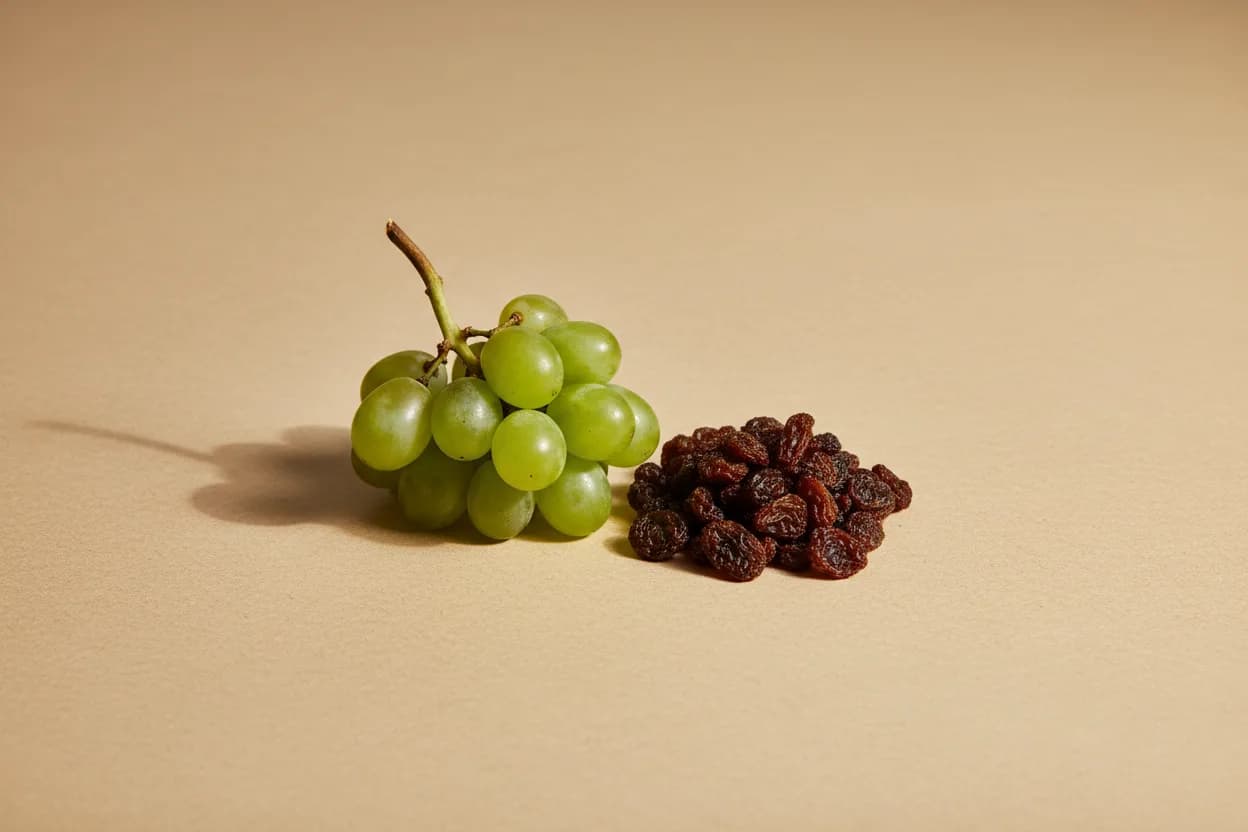
So what sits in the jar of dried oregano is a differently shaped oil from the one in the living plant: weighted towards the base, stripped of the top, and about as much a concentrate of the fresh leaf as a raisin is a concentrate of a grape.
The three-to-one rule sits on top of all this. Every recipe writer knows it: dried herbs are stronger, so use a third as much. I went looking for where it comes from and found recipe blogs, retailer pages and content farms citing one another. No measurement, no study, no original authority. That absence is not proof the ratio is bad advice, but the premise underneath it does not survive Caputo's table, where the dried material gave less oil per gram than the wet leaf. And no single number could be right across herbs anyway, since how much aroma survives depends on how the plant was dried, which is information the cook does not have and the jar does not print.
Method matters more than most kitchens assume. A 2024 study of purple basil found methyl cinnamate, the signature ester, at 43.21 per cent of the oil in the fresh leaf, 57.66 per cent after freeze-drying, and 32.69 per cent after sun-drying.19 Sunlight took the thing that makes it smell like basil. In mint, shade drying gave a higher oil yield than sun, 1.59 per cent against 1.38.20 Though the same paper is a caution against turning that into a slogan: for thyme, sun and shade were level on yield, and the sun-dried and oven-dried material carried more carvacrol than the shade-dried.20 Better depends on which molecule you are chasing.
Drying also builds things. Hold a fruit warm and damp for long enough and the Maillard reaction gets going in the fruit itself: a study of dried longan aged at 60 degrees found the pulp moving from light brown to black over thirty days, with browning attributed to non-enzymatic browning between polysaccharides and protein.21 The dark, faintly caramel taste of a well-dried fruit is manufactured during the drying, not revealed by it.
Sugar, which packs as well as it dries
Candying gets at the same variable from the other side. Rather than removing water, you add so much dissolved solute that the water present is spoken for. The effect is colligative, meaning it depends on how many particles are dissolved rather than what they are. Honey does so well because it is mostly invert sugar, glucose and fructose at a molecular weight of 180, rather than sucrose at 342. Per gram of sugar that is roughly twice as many particles holding water down.
That sugar alone can reach shelf stability is not a theoretical claim. The honey measurements settle it: sixteen per cent water, water activity 0.53, comfortably under the 0.85 line without salt, heat or acid.5
What happens in a candying pan is a two-way traffic that food engineers name precisely: water loss out of the tissue and solid gain into it. Studies of osmotic dehydration report both numbers, because both are happening.22 The fruit dries and candies in the same operation.
And the sugar going in does something to the aroma that plain drying does not. A 2025 study on persimmon compared fruit that was osmotically dehydrated in sucrose before freeze-drying against a freeze-dried control, and found the treated fruit held roughly twice as much 6-methyl-5-hepten-2-one, 1,065.92 micrograms per kilogram against 535.40.23 Their summary is that the osmotic process gave better results for all identified classes of volatile with the exception of alcohols. Sugar builds a dense matrix around the aroma molecules and they leave more slowly. Candying is aroma packaging as much as it is water removal.
There is a chemistry to the syrup as well. Boil fruit in sugar with acid present, from lemon or from the fruit itself, and some of the sucrose splits into glucose and fructose. That inverted syrup is sweeter than sucrose and does not show the crystallization problems of its precursor in highly concentrated solutions.24 It is the reason good candied peel stays supple for months instead of going sandy in the tin.
Fermentation, which is playing a different game
Fermentation is the one of the four that does not primarily work on water at all. Its lever is acid, and a population. Lactic acid bacteria take the available sugar, drop the pH, and occupy the niche before anything else can. The regulatory line here is not 0.85 but 4.6: proteolytic C. botulinum will not grow below pH 4.6, and the whole legal category of acidified foods is built on getting under it.23
But the reason to ferment, for a cook, is that it is the only one of the four that reliably makes the food taste of more than it did.
Take the buttery smell of cultured dairy. That is diacetyl, and its route is stranger than it is usually told. Lactococcus lactis biovar diacetylactis pulls citrate into the cell through a permease, and the transport system is switched on by acid stress, meaning the culture souring itself is what opens the aroma pathway.25 The citrate is worked down to alpha-acetolactate. And then the bacterium stops. Diacetyl arises from the chemical oxidative decarboxylation of alpha-acetolactate, a spontaneous reaction with oxygen, while a competing bacterial enzyme diverts the same molecule to the blander acetoin.26 No enzyme makes the smell of butter. A microbe builds the precursor and the air finishes it.
Proteolysis does the heavier work. Fermentation breaks proteins into peptides and free amino acids, and free glutamate is savouriness itself. In an inoculated soy-sauce moromi, glutamate content rose from 215.9 to 509.4 milligrams per hundred millilitres across ten days.27 In hard Italian cheese the accumulation is so orderly that it functions as a clock: pyroglutamic acid, the cyclised form of glutamic acid, reaches about half a gram per hundred grams in Grana Padano and Parmigiano Reggiano, and its concentration is linearly correlated, R squared of 0.94, with the age of the wheel.28 You can read a cheese's age off a chromatogram.
The purest example of the principle is not a ferment at all but a cure, and it happens to be the one this library already keeps a note on. A fresh green vanilla pod is 11.38 per cent glucovanillin and 0.21 per cent vanillin.29 The flavour is already there, bound to a sugar and smelling of nothing. The enzyme that would release it, a beta-glucosidase, sits in a different tissue of the same pod, so the reaction cannot happen while the pod is intact.29 Curing is the deliberate demolition of that separation: killing and sweating rupture the cells, enzyme meets substrate, and the smell appears. Classical curing then delivers 1.1 to 1.8 grams of vanillin per hundred grams of dry pod, well under half of what the glucoside theoretically holds.30
Preservation here is not the storage of a flavour. It is the manufacture of one.
And then the freezer
Which leaves the method everyone treats as the exception. Freezing feels like a different category: not drying, not chemistry, just cold holding everything still.
It is drying. When water crystallises it leaves the solution, because ice is a separate phase, and everything dissolved is pushed into a shrinking pocket of unfrozen liquid that gets steadily more concentrated. Osato Miyawaki, reviewing the physical chemistry in 2018, puts the consequence starkly: the water activity of the frozen system is solely determined by temperature. And then the number. Freezing at minus 20 degrees corresponds to a water activity of 0.82 and an osmotic pressure of 26.8 megapascals, which he notes means a substantial reduction in water activity and an increase in osmotic pressure are expected in freezing, even at the temperature of a home freezer. Then he draws the conclusion outright: this explains why freezing is the most effective among various methods for the preservation of food.6
The 0.82 sits below the 0.85 legal line and below the growth minimum of every pathogen in the FDA's table.2 But the phrase that does the real damage to intuition is solely determined by temperature. Once a food is frozen, its water activity no longer depends on what the food is made of. A freezer is a water-activity dial calibrated in degrees, and everything inside it reads the same.
So the freezer is the driest place in the kitchen, and nothing in it is dead.
That second half is where the popular understanding goes wrong, and you can watch the confusion being manufactured in a single government paragraph. The USDA's food safety page says freezing to 0 degrees Fahrenheit inactivates any microbes present in food, which reads to most people as kills. The very next sentence corrects it: once thawed, however, these microbes can again become active, multiplying under the right conditions to levels that can lead to foodborne illness.7 The page also states that freezing keeps food safe by causing microbes to enter a dormant stage, and dormant is the operative word.
The survival numbers make it concrete. In a 2025 study, Listeria monocytogenes held in mutton juice at minus 20 degrees for sixty days fell from 7.56 to 4.45 log colony-forming units per millilitre.8 That is a three-log reduction, and it leaves roughly twenty-eight thousand viable cells in every millilitre. For scale, the FDA's own table gives the time for a six-log kill of the same organism by heat: two minutes at 70 degrees.2 Two months in a freezer does a fraction of what two minutes in a pan does. Freezing's lethality is incidental and wildly inconsistent, which the same study shows by getting a six-log drop in dilute beef juice and three in mutton.
What the cold does not stop
The chemistry keeps going too, and there is a cruel symmetry in why. The freeze-concentration that lowers water activity and shuts down the microbes also crowds the enzymes and their substrates together in that shrinking unfrozen pocket. A 2026 modelling paper on blanching green beans states the consequence directly: without inactivation, enzyme reactions will continue during freezing, and they will even be amplified by the freeze-concentration effect.9 The same physics that saves the food speeds up its spoiling.
This is what blanching is for, and it comes with a piece of industrial folklore worth correcting. The enzyme everyone measures is peroxidase, which the same paper describes as an industrial indicator of blanching effectiveness and a practical time-temperature integrator. But peroxidase is the convenient proxy, not the culprit. The enzyme that actually ruins frozen peas is lipoxygenase, and the authors say plainly that incomplete lipoxygenase inactivation can result in lipid oxidation, leading to the development of off-flavors during frozen storage, and that it may be a more sensitive indicator of overall quality.9 A review of frozen vegetables puts the prescription at 85 to 90 degrees for two to three minutes for ninety per cent lipoxygenase inactivation.10
What lipoxygenase makes from the fatty acids that ice damage has just released is a family of six- and nine-carbon aldehydes that read as grassy, green and eventually rancid.10 Hexanal is the one you would recognise. The case is about as well proven as food chemistry gets: one group mapped the off-odours of peas to the lipoxygenase pathway,12 another deleted the genes with CRISPR and watched hexanal, 2-hexenal, heptanal and the rest fall significantly.13
None of this is fast, but none of it is stationary either. Volatiles from lipid oxidation climb steadily in meat held at minus 18 degrees across eighteen weeks, with correlations to storage time running from 0.75 to 0.99 and some following zero-order kinetics, which is to say a steady accumulation with no plateau in sight.14 Kiwifruit pulp at minus 20 loses its fruity esters and gains fatty and fermented notes, and the authors give a point of no return: flavor deterioration became irreversible after 9 months.15
Freezer burn is the same story told through physics rather than enzymes. Ice at the surface sublimes straight to vapour without passing through liquid, and the surface layers are left dried out and discolored.16 The pale patch on a forgotten chicken breast is a small desert, produced by exactly the mechanism the whole freezer runs on, just allowed to happen locally and without a wrapper to stop it.
And the texture. Slow freezing grows large crystals that puncture the cellular structure, so the cell bleeds when it thaws, which is where drip loss and mushiness come from.11 Fast freezing makes small crystals and does less damage. This is the one place freezing offers something back, and it is the same damage read as a virtue: beef frozen at minus 26 for thirty days came out measurably more tender than fresh, 27.4 against 33.0 on shear force at two days of ageing.17 Ice wrecks the myofibrils. In a vegetable that is ruin, and in a steak it is tenderising.
One lever is never enough
Real preserved food almost never relies on a single barrier, and the person who made that observation into a discipline was Lothar Leistner at the Federal Centre for Meat Research in Kulmbach. He tells the story himself in a 1994 paper: in earlier research, we studied the influence of water activity on the stability and safety of meats, it became obvious that in addition to water activity other factors, hurdles, determine the microbial stability of foods, from this understanding the hurdle effect was conceived, and later hurdle technology was derived.31 Writing in 2000 he dates the principled application of it to about twenty years earlier, which puts the formalisation around 1980.32
The hurdles he names are the whole of this essay in one list: temperature, pH, water activity, redox potential, and competitive flora.32 Salami is all five at once. So is jameed, the sun-dried fermented yogurt that a traditional mansaf is built on, which stacks acidification, salt and drying into a stone that keeps for a year. So, on a smaller scale, is a five-day salt cure on lamb, where the salt does the water activity and the cold does the rest.
Leistner's later idea is subtler than barriers adding up. Because the hurdles hit different cellular targets, an organism cannot mount one adaptive response to all of them at once. A cell burning energy to hold its internal pH against acid has less to spend holding its turgor against osmotic stress. He called the goal multitarget preservation, and framed it in terms of homeostasis, metabolic exhaustion and stress reactions.32 The aim is a wall that cannot be climbed in several directions at once, rather than simply a taller one.
The organism that lives on the far side
In 1968 John Pitt and John Christian, working at the CSIRO food laboratories in Australia, went looking at spoiled prunes. Prune flesh runs acid, around pH 3.8, and it is sugary enough that nothing much should be able to live there. They found two fungi that could. Chrysosporium fastidium grew down to water activity 0.686. Xeromyces bisporus grew down to 0.605.33
That figure has stood for over fifty years as roughly the driest conditions in which anything is known to grow.34 Later work pushed at it: Aspergillus penicillioides has been recorded dividing at 0.585.35 But the number has barely moved, and there is a reason to think it is close to a real physical floor rather than a gap in our sampling.
Pitt and Christian also noticed something quieter in the same experiments, and it is the detail I keep returning to. Germination was always followed by growth, but the water activity needed to make spores was usually higher than the water activity needed to germinate, and sexual reproduction needed more still.33 At the dry edge of life, an organism can carry on living but cannot make another generation. It is holding on rather than getting anywhere.
That is a fair description of what all four methods are actually doing. None of them sterilises anything. They make the place difficult enough that whatever is in there, and something always is, spends its whole existence too busy staying alive to spoil your dinner.
The jar of honey in the cupboard still holds a sixth of its weight in water, and whatever drifted into it on the way. It is a standoff, and it has been holding since long before anyone knew there was anything to hold off.
Sources
Every numbered claim above points here. Links go to the paper, record, or authority itself.
- 1.
US Food and Drug Administration. Inspection Technical Guide 39: Water Activity (aw) in Foods. 1984. Includes the table "Water Activity (aw) of Some Common Foods", listing peanut butter at 15% total moisture and dry milk at 8% total moisture, both at aw 0.70.
https://www.fda.gov/inspections-compliance-enforcement-and-criminal-investigations/inspection-technical-guides/water-activity-aw-foods - 2.
US Food and Drug Administration. Fish and Fishery Products Hazards and Controls Guidance, Appendix 4: Bacterial Pathogen Growth and Inactivation. Table A-1, "Limiting Conditions for Pathogen Growth", and Table A-3, "Inactivation of Listeria monocytogenes".
https://www.fda.gov/media/80390/download - 3.
US Code of Federal Regulations, Title 21, Part 113.3(n) (Thermally Processed Low-Acid Foods Packaged in Hermetically Sealed Containers): definition of low-acid foods as those above pH 4.6 and water activity 0.85. The parallel definition appears at 21 CFR 114.3(d).
https://www.ecfr.gov/current/title-21/chapter-I/subchapter-B/part-113/subpart-A/section-113.3 - 4.
US Food and Drug Administration. Draft Guidance for Industry: Hazard Analysis and Risk-Based Preventive Controls for Human Food, Chapter 4 (Preventive Controls). Includes Tables 4-12 and 4-13 and the discussion of soy sauce and bread.
https://www.fda.gov/files/food/published/Draft-Guidance-for-Industry--Hazard-Analysis-and-Risk-Based-Preventive-Controls-for-Human-Food---Preventive-Controls-(Chapter-4)-Download.pdf - 5.
Polatidou K, Nouska C, Tananaki C, Biliaderis CG, Lazaridou A. Physicochemical and rheological characteristics of monofloral honeys: kinetics of creaming-crystallization. Foods. 2025;14(10):1835.
https://doi.org/10.3390/foods14101835 - 6.
Miyawaki O. Water and freezing in food. Food Science and Technology Research. 2018;24(1):1-21.
https://doi.org/10.3136/fstr.24.1 - 7.
US Department of Agriculture, Food Safety and Inspection Service. Freezing and Food Safety. Food Safety Basics.
https://www.fsis.usda.gov/food-safety/safe-food-handling-and-preparation/food-safety-basics/freezing-and-food-safety - 8.
Kaboudari A, Aliakbarlu J. Effects of freezing period and meat juice model type on the survival, hydrophobicity, and acid resistance of Listeria monocytogenes and Salmonella Typhimurium. BMC Microbiology. 2025;25:321.
https://doi.org/10.1186/s12866-025-04039-8 - 9.
van der Sman RGM, Delbaere SM, Timmermans RAH. Modeling of enzyme inactivation and quality changes during blanching of green beans. Current Research in Food Science. 2026;12:101424.
https://doi.org/10.1016/j.crfs.2026.101424 - 10.
Mahmud MM, Mia MS, Nabi MHB, Arnab AH, Zzaman W. Mechanistic insights into color and texture stability of frozen tropical vegetables: processing, modeling, and preservation strategies. Food Science & Nutrition. 2026;14(6):e71895.
https://doi.org/10.1002/fsn3.71895 - 11.
Perez-Bermudez I, Castillo-Suero A, Cortes-Inostroza A, Jeldrez C, Dantas A, Hernandez E, Orellana-Palma P, Petzold G. Observation and measurement of ice morphology in foods: a review. Foods. 2023;12(21):3987.
https://doi.org/10.3390/foods12213987 - 12.
Zhang C, Hua Y, Li X, Kong X, Chen Y. Key volatile off-flavor compounds in peas (Pisum sativum L.) and their relations with the endogenous precursors and enzymes using soybean (Glycine max) as a reference. Food Chemistry. 2020;333:127469.
https://doi.org/10.1016/j.foodchem.2020.127469 - 13.
Bhowmik P, Yan W, Hodgins C, Polley B, Warkentin T, Nickerson M, Ro DK, Marsolais F, Domoney C, Shariati-Ievari S, Aliani M. CRISPR/Cas9-mediated lipoxygenase gene-editing in yellow pea leads to major changes in fatty acid and flavor profiles. Frontiers in Plant Science. 2023;14:1246905.
https://doi.org/10.3389/fpls.2023.1246905 - 14.
Yu L, Pang Y, Shen G, Bai B, Yang Y, Zeng M. Identification and selection of volatile compounds derived from lipid oxidation as indicators for quality deterioration of frozen white meat and red meat using HS-SPME-GC-MS combined with OPLS-DA. Food Chemistry. 2025;463(Pt 1):141112.
https://doi.org/10.1016/j.foodchem.2024.141112 - 15.
Zhao C, Niu J, Wang W, Wang Y, Cheng L, Meng Y, Guo Y, Song S. Deterioration in the quality of 'Xuxiang' kiwifruit pulp caused by frozen storage: an integrated analysis based on phenotype, color, antioxidant activity, and flavor compounds. Foods. 2025;14(13):2322.
https://doi.org/10.3390/foods14132322 - 16.
Geiger M. Freezer burn and food safety. AnswerLine, Iowa State University Extension and Outreach. 19 March 2024.
https://blogs.extension.iastate.edu/answerline/2024/03/19/freezer-burn-and-food-safety/ - 17.
Grayson AL, King DA, Shackelford SD, Koohmaraie M, Wheeler TL. Freezing and thawing or freezing, thawing, and aging effects on beef tenderness. Journal of Animal Science. 2014;92(6):2735-2740.
https://doi.org/10.2527/jas.2014-7613 - 18.
Caputo L, Amato G, de Bartolomeis P, De Martino L, Manna F, Nazzaro F, De Feo V, Barba AA. Impact of drying methods on the yield and chemistry of Origanum vulgare L. essential oil. Scientific Reports. 2022;12(1):3845.
https://doi.org/10.1038/s41598-022-07841-w - 19.
Altay K, Dirim SN, Hayaloglu AA. Effects of different drying processes on the quality changes in Arapgir purple basil (Ocimum basilicum L.) leaves and drying-induced changes in bioactive and volatile compounds and essential oils. Journal of Food Science. 2024.
https://doi.org/10.1111/1750-3841.17515 - 20.
Xylia P, Chrysargyris A, Tomou EM, Goumenos C, Skaltsa H, Tzortzakis N. Quality characteristics and essential oil properties of Thymus capitatus, Mentha piperita, and Sideritis cypria dried under different conditions. Plants (Basel). 2024;13(22):3150.
https://doi.org/10.3390/plants13223150 - 21.
Somjai C, Siriwoharn T, Kulprachakarn K, Chaipoot S, Phongphisutthinant R, Wiriyacharee P. Utilization of Maillard reaction in moist-dry-heating system to enhance physicochemical and antioxidative properties of dried whole longan fruit. Heliyon. 2021;7(5):e07094.
https://doi.org/10.1016/j.heliyon.2021.e07094 - 22.
de Jesus Junqueira JR, Rangel TF, Campos RP, Balbinotti TCV, Miyagusku L, Gomes Correa JL. Integrated analysis of osmotic dehydration of bocaiuva (Acrocomia aculeata) slices. Open Life Sciences. 2026;21:20251271.
https://doi.org/10.1515/biol-2025-1271 - 23.
Matos CMS, de Jesus MS, da Silva ADS, et al. Effect of osmotic dehydration on physico-chemical characteristics, bioactive compounds and volatiles profile of Diospyros kaki subjected to different drying methods. Foods. 2025;14(10):1727.
https://doi.org/10.3390/foods14101727 - 24.
Martinez D, Menendez C, Echemendia FM, Perez ER, Trujillo LE, Sobrino A, Ramirez R, Quintero Y, Hernandez L. Complete sucrose hydrolysis by heat-killed recombinant Pichia pastoris cells entrapped in calcium alginate. Microbial Cell Factories. 2014;13:87.
https://doi.org/10.1186/1475-2859-13-87 - 25.
Garcia-Quintans N, Magni C, de Mendoza D, Lopez P. The citrate transport system of Lactococcus lactis subsp. lactis biovar diacetylactis is induced by acid stress. Applied and Environmental Microbiology. 1998;64(3):850-857.
https://doi.org/10.1128/aem.64.3.850-857.1998 - 26.
Monnet C, Aymes F, Corrieu G. Diacetyl and alpha-acetolactate overproduction by Lactococcus lactis subsp. lactis biovar diacetylactis mutants that are deficient in alpha-acetolactate decarboxylase and have a low lactate dehydrogenase activity. Applied and Environmental Microbiology. 2000;66(12):5518-5520.
https://doi.org/10.1128/aem.66.12.5518-5520.2000 - 27.
Wang LH, Qu WH, Xu YN, Xia SG, Xue QQ, Jiang XM, Liu HY, Xue CH, Wen YQ. Developing a high-umami, low-salt soy sauce through accelerated moromi fermentation with Corynebacterium and Lactiplantibacillus strains. Foods. 2024;13(9):1386.
https://doi.org/10.3390/foods13091386 - 28.
Mucchetti G, Locci F, Gatti M, Neviani E, Addeo F, Dossena A, Marchelli R. Pyroglutamic acid in cheese: presence, origin, and correlation with ripening time of Grana Padano cheese. Journal of Dairy Science. 2000;83(4):659-665.
https://doi.org/10.3168/jds.S0022-0302(00)74926-5 - 29.
Zhang Y, Mo L, Chen F, Lu M, Dong W, Wang Q, Xu F, Gu F. Optimized production of vanillin from green vanilla pods by enzyme-assisted extraction combined with pre-freezing and thawing. Molecules. 2014;19(2):2181-2198.
https://doi.org/10.3390/molecules19022181 - 30.
Ruiz-Teran F, Perez-Amador I, Lopez-Munguia A. Enzymatic extraction and transformation of glucovanillin to vanillin from vanilla green pods. Journal of Agricultural and Food Chemistry. 2001;49(11):5207-5209.
https://doi.org/10.1021/jf010723h - 31.
Leistner L. Further developments in the utilization of hurdle technology for food preservation. Journal of Food Engineering. 1994;22(1-4):421-432.
https://doi.org/10.1016/0260-8774(94)90044-2 - 32.
Leistner L. Basic aspects of food preservation by hurdle technology. International Journal of Food Microbiology. 2000;55(1-3):181-186.
https://doi.org/10.1016/S0168-1605(00)00161-6 - 33.
Pitt JI, Christian JH. Water relations of xerophilic fungi isolated from prunes. Applied Microbiology. 1968;16(12):1853-1858.
https://doi.org/10.1128/am.16.12.1853-1858.1968 - 34.
Grant WD. Life at low water activity. Philosophical Transactions of the Royal Society B: Biological Sciences. 2004;359(1448):1249-1267.
https://doi.org/10.1098/rstb.2004.1502 - 35.
Stevenson A, Hamill PG, O'Kane CJ, Kminek G, Rummel JD, Voytek MA, Dijksterhuis J, Hallsworth JE. Aspergillus penicillioides differentiation and cell division at 0.585 water activity. Environmental Microbiology. 2017;19(2):687-697.
https://doi.org/10.1111/1462-2920.13597