sage
Salvia fruticosa
IN ARABIC مريمية
Savory, resinous, faintly medicinal.
ABOUT
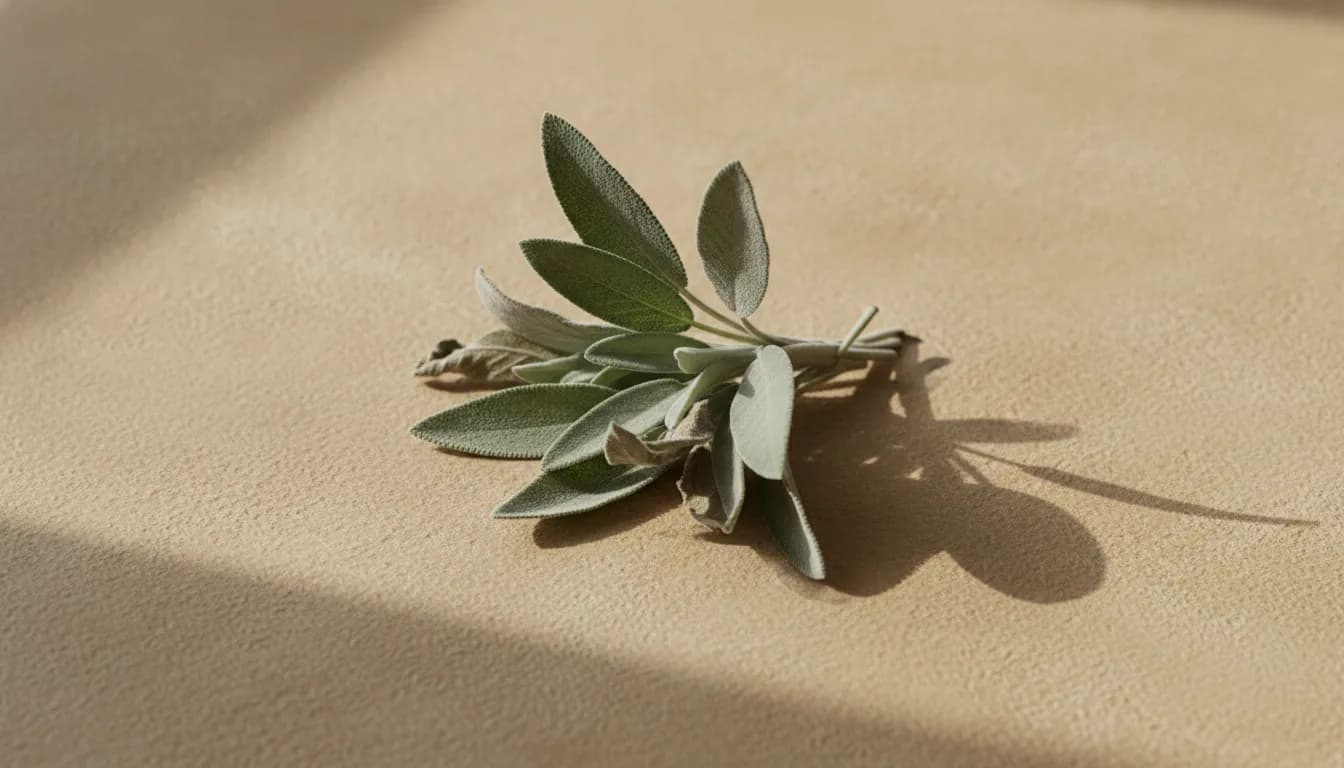
Sage here is Salvia fruticosa, not the common culinary Salvia officinalis of European kitchens. Officinalis is native to southwest Germany and southern Europe and only introduced to the Levant; fruticosa is the species that actually grows here and the one sold and drunk as maramiyya. The library uses it dried and always as leaf, across four teas at a tenth to four tenths of a gram: sage and black tea and smoke recovery tea simmer it for three to five minutes to pull out its savory oils, focus tea steeps it two minutes off a full boil, and desert recovery night tea adds it only once the heat is off.
The two compounds this library tracks are thujone and rosmarinic acid, and which one dominates depends on which sage you are holding. Salvia fruticosa oil runs 40 to 67 percent 1,8-cineole and 2 to 25 percent camphor, with the two thujones together under 5 percent; Salvia officinalis, the species most safety warnings are actually written about, runs the other way, 10 to 60 percent alpha-thujone and 4 to 36 percent beta-thujone, with cineole down at 1 to 15. The honest caveat is that fruticosa is not uniformly thujone-free: material grown in Turkey has measured close to 30 percent alpha-thujone, so provenance matters more than the species name on the packet. Rosmarinic acid is the steadier of the two, the polyphenol behind the tea's dry, resinous, faintly bitter finish.
What a cup actually carries is a small fraction of the thujone that worries regulators. Dried sage leaf holds under one and a half grams of thujone per kilogram, and per cup that works out to somewhere between 0.03 and 4.56 milligrams. Water is also a poor solvent for thujone, pulling out roughly a third of it against three-fifths in alcohol, and the extraction plateaus after about five minutes, so steeping longer doesn't add more; the researchers who measured this concluded three to six cups a day pose no toxicological risk from a traditional tea. Every documented seizure linked to sage involves the concentrated essential oil, never an infusion, which is the form nobody brewing a pot of maramiyya has ever been drinking.
CHEMISTRY
2The characteristic compounds documented in this ingredient, plus any the library traces to it in a recipe. Not an exhaustive phytochemistry.
green, savory
camphor, herbaceous
USED IN
4Smoke Recovery Tea
0.4 g · dried
STEP 1 Simmer the sage, thyme, and ginger in the water to build a clearing base.