Skip to content
MORTAR & KETTLE
Apothecary of Flavor
HERBAL TEA · №011

Sage & Black Tea

a brisk, savory brew

A savory, garden-green infusion where sage's warm herbaceousness meets the tannic backbone of black tea. It reads clear and awake, a brisk cup built to sharpen attention rather than lull it.

Easy5 minForgiving
HerbaceousBitterFocusEnergizing
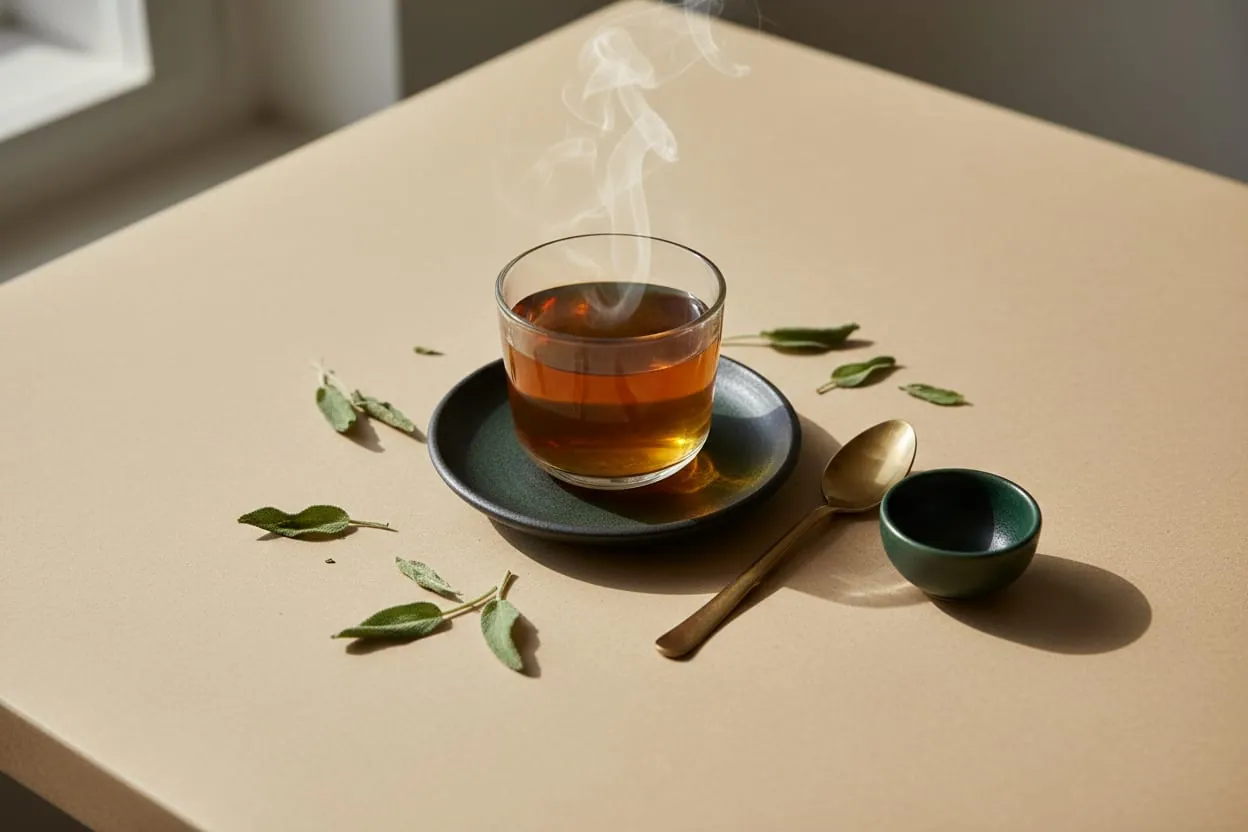
Sage & Black Tea · finished

Method

Check off each step as you go. Your progress is saved. Amounts below already match your batch size.

Simmer the sage in the water to release its savory oils.
0.3 gsage250 mlfiltered water
3 min
Turn off the heat and stir in the black tea.
0.5 gblack tea
Steep briefly so it stays brisk, strain, and sweeten to taste.
4 graw sugar
2 min
A good steep is chemistry with the kettle on. Mind the minutes.
THE MORTAR & KETTLE METHOD

The chemistry

SKELETAL STRUCTURES

4 compounds carry this recipe. Here is what each one does and, where we have it, what it actually looks like.

C₁₀H₁₆O
thujone
C₁₀H₁₆O

The sharp, savory principle drawn from the simmered sage; it gives the brew its green, slightly medicinal edge and lends a stimulating clarity in the cup.

HerbaceousFocus
C₁₈H₁₆O₈
rosmarinic acid
C₁₈H₁₆O₈

A polyphenol that pulls from the sage leaf, adding a faint bitterness and antioxidant depth beneath the tea's own tannins.

BitterHerbaceous
C₈H₁₀N₄O₂
caffeine
C₈H₁₀N₄O₂

Released from the black tea in the brief steep, it drives the cup's briskness and does most of the work of keeping you alert.

EnergizingBitter
C₇H₁₄N₂O₃
l-theanine
C₇H₁₄N₂O₃

The tea's amino acid that softens caffeine's jolt into steadier attention, pairing with the sage to keep the energy clean and pointed.

FocusEnergizing

On the table together

THE INDEX, LINKED

This recipe is part of a set: follow the thread through the blends it uses and what it's served with.
FROM THE JOURNAL

The reading behind this recipe

A third of people taste something when you warm the tongue
№38Senses

A third of people taste something when you warm the tongue

Put nothing in the mouth. Warm the tip of the tongue from 20 degrees to 35 and a good fraction of people report sweetness, from plain deionised water. In 2020 the effect was switched off with a compound that blocks the sweet receptor, which means temperature is opening the same door sugar opens.

14 August 2026·12 min read·14 SOURCES
Numb the taste nerve and the tea still dries your mouth
№33Senses

Numb the taste nerve and the tea still dries your mouth

Strong tea, young red wine and an unripe persimmon all do the same thing: they pull the inside of your mouth tight. That sensation is not one of the tastes, and the experiment that proves it involved anaesthetising people's nerves one at a time until the feeling went away.

12 August 2026·10 min read·11 SOURCES
The film on the tea was never limescale
№27Chemistry

The film on the tea was never limescale

Water is the most-used ingredient in this index, in twenty-nine of thirty-nine recipes and in every single tea, and it is the one nobody writes down. In the 1990s a chemist at Imperial College spent four papers on the film it leaves on the surface of a cup, and almost everything people assume about that film turned out to be wrong.

9 August 2026·7 min read·13 SOURCES