turmeric
Curcuma longa
IN ARABIC كركم
Golden rhizome, earthy and faintly bitter.
ABOUT
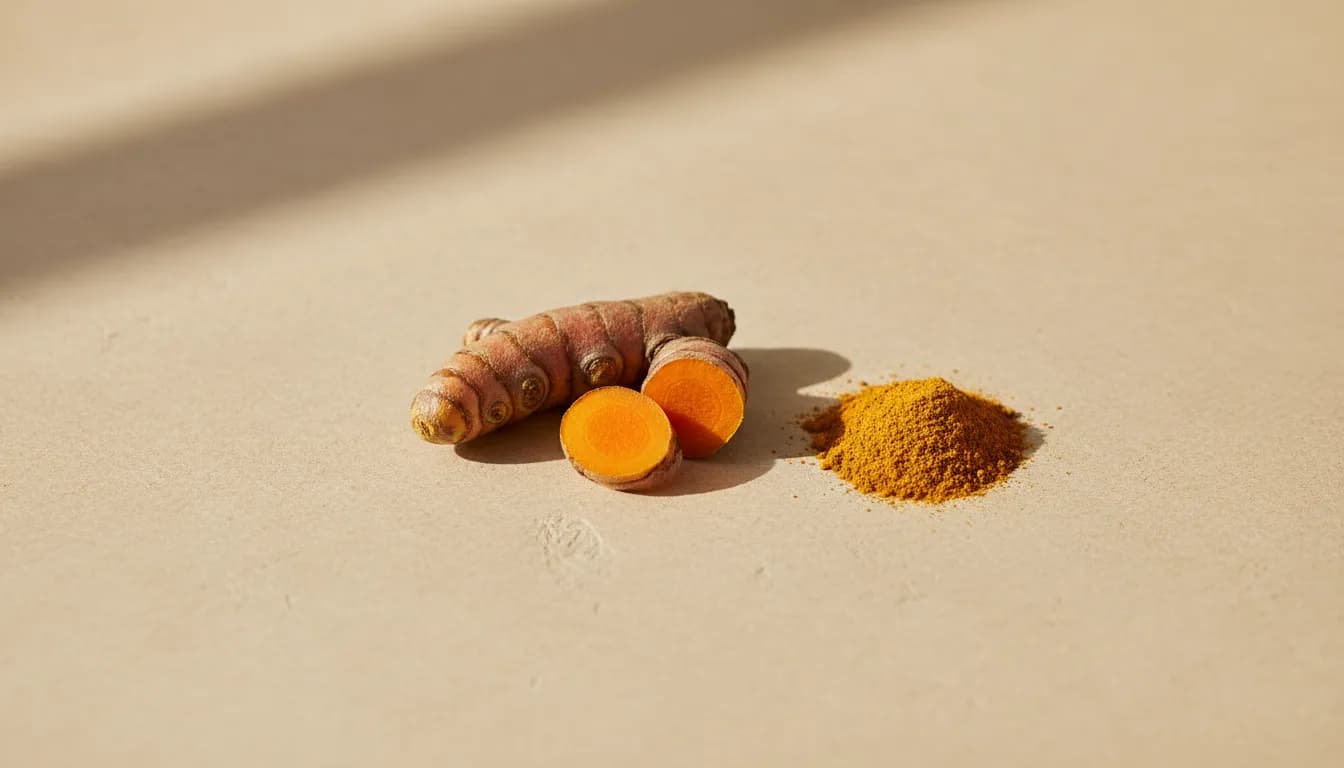
Curcuma longa's rhizome, dried and ground, does three different jobs here. A quarter teaspoon, about 0.7 grams, is bloomed in hot ghee for a few seconds before the rice goes into the jameed-free mansaf pot, and the same 0.7 grams goes in raw, off the heat, at the end of the fish spice mix. The Japanese curry powder uses 8 grams, a full tablespoon: turmeric, ground ginger and pomelo peel go in only after the toasted seeds have cooled, because, as the recipe notes, the three powders scorch in seconds if they see the pan. In all three, the pigment does more of the work than the flavour: turmeric supplies a dish's colour far more than its taste.
The colour is curcumin, C₂₁H₂₀O₆, the main member of a small curcuminoid family that also includes demethoxycurcumin and bisdemethoxycurcumin, siblings missing one or both of curcumin's methoxy groups. It is a genuine acid-base indicator: dip a strip of turmeric-dyed paper in soap or ammonia and the egg-yolk yellow flips to red as curcumin loses a proton, the same shift that turns an alkaline stain on a curry pot orange rather than yellow, somewhere past pH 7.5 to 8.5. And it is a minority ingredient inside a minority ingredient: assays of retail turmeric powder put curcumin at an average of about 3.1 per cent by weight, well under the 5 per cent ceiling the plant can reach, so the pigment tinting the mansaf's rice or the curry powder's tablespoon is a small fraction of an already small spice.
What curcumin does once it is swallowed is a smaller claim than the supplement aisle makes, and the Journal's note on turmeric and curcumin sets it out in full. A 2017 review in the Journal of Medicinal Chemistry, one of the more cited pieces of scepticism in the field, calls curcumin unstable, reactive and not bioavailable, and reports that no double-blinded, placebo-controlled trial of it has succeeded across more than 120 registered attempts. The same paper flags curcumin as a PAINS and IMPS compound, the kind that fools laboratory assays by fluorescing, chelating metals and disrupting membranes rather than by doing the biology being tested. The fix everyone repeats, a pinch of black pepper for its piperine, traces to a single 1998 study, one of whose co-authoring institutions sells a piperine extract commercially, and its twenty-fold bioavailability gain in humans starts from almost nothing. The best-supported use is narrower still: a pooled analysis of eleven randomised trials in about a thousand knee osteoarthritis patients found curcuminoids performing comparably to NSAIDs for pain, though the same reviewers call their own evidence too small and too low quality to act on. The mansaf's quarter teaspoon and the curry powder's tablespoon are doing exactly what the recipes say: colouring the pot gold, nothing a supplement shelf would recognise as a dose.
CHEMISTRY
1The characteristic compounds documented in this ingredient, plus any the library traces to it in a recipe. Not an exhaustive phytochemistry.
USED IN
4Jameed-Free Mansaf
0.7 g · ≈ 1/4 tsp
STEP 8 Rice: Melt the ghee, bloom the turmeric for a few seconds, then toast the rice for a minute or two.
Japanese Curry Powder
8 g · ground; 1 tbsp
STEP 4 Grind fine, then stir in the turmeric, ground ginger, and pomelo peel. The three powders never go in the pan: they scorch in seconds, and a scorched blend cannot be rescued. Sift out the husks.
Palestinian Maqluba
1 g · about 1/4 tsp, for the rice
STEP 8 Rice: Toss the drained rice with the turmeric and a spoon of the Levantine 7-Spice Mix.