How curry rice became Japan's weekday dinner
Japan's first written mention of curry is an entry in an 1860 phrasebook; the first Japanese man on record to meet it called it filthy. A century and a half later the country eats it more than once a week. The path runs through a British spice tin, a navy cookbook and a bar of roux.
Contents
In 1863 a member of the shogunate's mission to Europe, Miyake Shū, met curry for the first time and wrote in his diary that it was an utterly filthy thing. 1 Japan today eats curry 72.6 times a year per person, which is more than once a week counting home, takeaway and restaurant. 2 The navy alone gets through about 45 tonnes of curry roux a year, roughly two and a quarter million servings. 1 Something happened between the diary and the roux, and it is a better story than the usual one about a British admiral.
A British tin
The curry that reached Japan was already a translation. Hannah Glasse's The Art of Cookery Made Plain and Easy, first printed in London in 1747, has a recipe headed To make a Currey the Indian Way, and what made it Indian, to an English reader, was an ounce of turmeric and a large spoonful of ginger and beaten pepper. 3 4 Within a generation, that idea had become a product. British merchants were selling spice blends as curry powder by 1784, and the historian Lizzie Collingham's phrase for the whole category is that curry was something the Europeans imposed on India's food culture, lumping rogan josh, dopiaza and korma together under one word. Madhur Jaffrey put it more sharply in 1974: to her, the word curry was as degrading to India's cuisine as chop suey was to China's, and no Indian cook used curry powder. 5
The tin that mattered was Crosse & Blackwell's. The firm was founded in Soho in 1830 when Edmund Crosse and Thomas Blackwell bought the pickle and sauce house West and Wyatt, and curry powder became one of its standard lines. 6 By the time a Japanese company first made curry powder at home, in 1905, the phrase curry powder in Japan meant, almost exclusively, the expensive imported C&B product. 7 What Japan adopted was a British pantry item, not an Indian kitchen.
The word before the dish
The Japanese navy's own history page keeps a tidy timeline. In 1860 Fukuzawa Yukichi, the great popularizer of Western learning, listed the English word curry with a katakana rendering in his English-Chinese-Japanese phrasebook, the first appearance of the word in Japanese. Miyake's diary came three years later. In 1871 Yamakawa Kenjirō, a former Aizu cadet who would end up president of Tokyo Imperial University, became the first Japanese person on record to eat curry, aboard the ship taking him to study in the United States. In 1872 two Japanese cookbooks on Western food printed the first curry recipes in the language. 1 The Meiji government had lifted the ban on eating meat only the year before. 7
The institutions took it up fast. In 1873 the Army Cadet School set Saturday as curry day. In 1876 William Clark arrived at the new Sapporo Agricultural College and had his students eat rice curry every other day, which is where the legend that Clark named the dish comes from; House Foods' own historians point out that curry was on the cadet school's menu before Clark reached Japan. 7
The navy, and what it actually fixed
The popular version credits the navy surgeon Takaki Kanehiro with curing beriberi by feeding sailors curry. The medical history is stronger than that and does not contain the word. Takaki worked out, thirty years before thiamine was isolated, that beriberi tracked the ratio of nitrogen to carbon in the ration, and in 1884 he won approval to raise the protein in navy food and cut barley into the rice. His proof was two training voyages on the same route. The Ryūjō, on the old diet, sailed from December 1882 to October 1883 and 169 of her 376 crew came down with beriberi, 25 of them fatally. The Tsukuba, on the new diet, sailed in 1884 and 14 of 333 fell ill, none died. 8 Curry entered the navy through a different door: its cook-training regulations of 1889 and, above all, the Kaigun Kappōjutsu Sankōsho of 1908, a naval cookery reference compiled at the Maizuru training division with over a hundred Western dishes in it, curry, beef stew and chicken rice among them, which spread the dish through the fleet. 1 9 10 The British navy's curry habit and the beriberi reform belong to the same decade of borrowing, and they got tangled in the retelling.
The Friday curry that the Maritime Self-Defense Force serves today is the other tangle. The story that sailors eat curry on Fridays so as not to lose track of the day at sea is, by the force's own account, an explanation invented after the habit was already fixed; the day moved from Saturday to Friday only when the post-war force adopted a two-day weekend. 1 Yokosuka Kaigun Curry, the branded dish sold in the port town with its regulation salad and glass of milk, dates from 1999, a city revitalisation project with its own certification scheme. 11
Making it at home
Two companies claim to have made Japan's first domestic curry powder, and neither mentions the other. Hachi Foods, an Osaka herb wholesaler founded in 1845, launched Hachi Curry in 1905; its second-generation owner had noticed that the warehouse, full of medicinal turmeric, already smelled of curry, and named the brand for a bee he saw lit by the morning sun through the window while he was blending. 12 S&B's centenary site says without qualification that its founder Yamazaki Minejirō produced Japan's first homegrown curry powder in 1923. 13 Its Red Can, launched in 1950 and still made to the same recipe, is what a Japanese cook means by curry powder today. 14
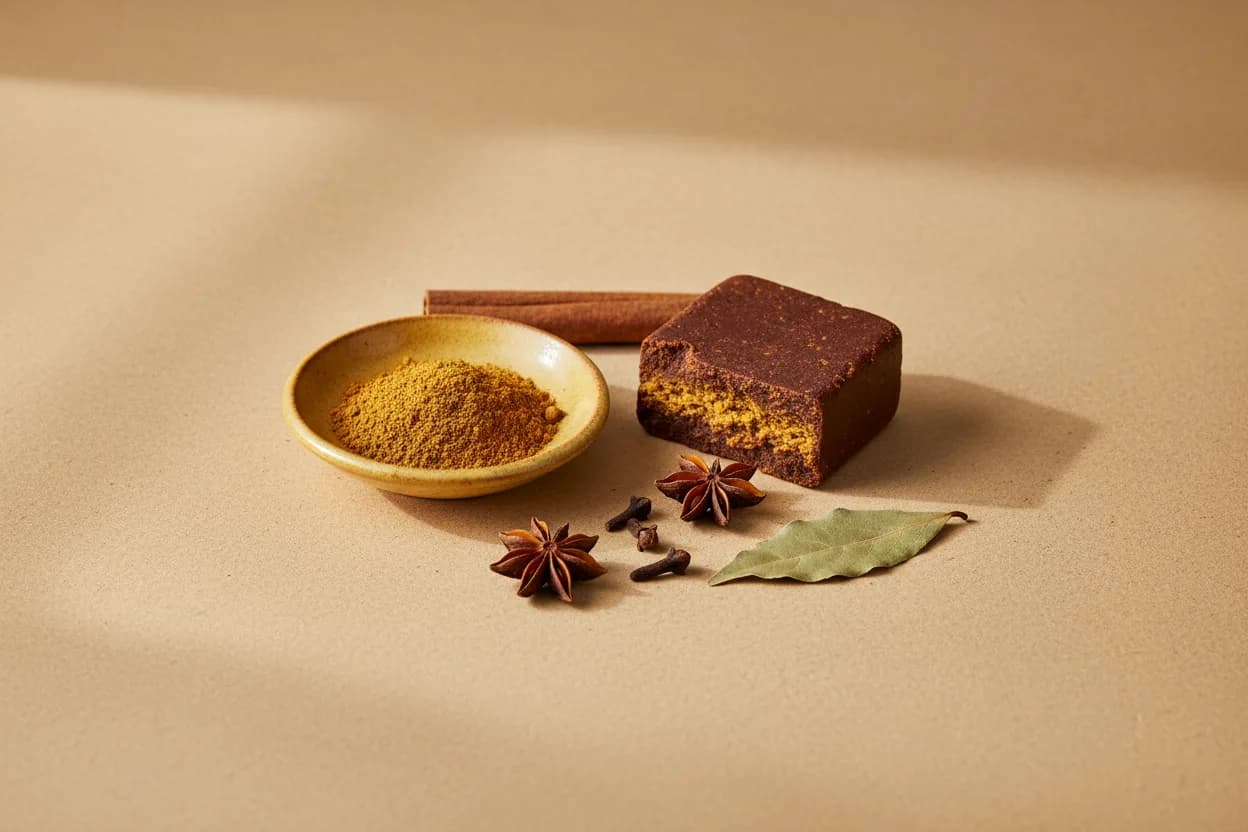
Powder needs a cook. The dish went national through school lunches, which began serving curry across the country in 1948, and through a piece of packaging. In 1950 a board-shaped block of solidified roux went on sale, a set of flour, fat, curry spice and salt that dissolves into a stew and thickens it in one step. Bell Foods dates its own block roux to April 1950 and adds, honestly, that there are various theories about who was first. 7 15 In 1963 House Foods launched Vermont Curry, sweetened with apple and honey so that children could eat it; retailers refused to stock it at first, on the grounds that a sweet curry could never sell, and it became a runaway hit within months. 7 S&B answered with Golden Curry in 1966. 14
Then Otsuka, a pharmaceutical group, put curry in a pouch. Bon Curry, launched in February 1968 in the Osaka region, was the world's first retail food in a retort pouch, a sterilisation idea the head of Otsuka Pharmaceutical Factory had picked up from an American army packaging article. The first pouches were two layers of plastic and let in enough light and oxygen that the curry went off in months; the three-layer pouch with an aluminium foil core fixed that, and Bon Curry went nationwide in May 1969 at 80 yen a pack, against 100 yen for a plate of curry rice in a cafeteria. Five years later it was selling 100 million packs a year. 16 CoCo Ichibanya opened its first shop in a Nagoya suburb in January 1978. 17 In 1982 the school nutritionists' association declared 22 January Curry Day. 7 The industry now makes on the order of 100,000 tonnes of roux a year. 18 Even the katsu curry has an origin dispute: the popular story puts it at a Ginza restaurant in 1948, at a baseball player's request, but a 2020 investigation by the magazine dancyu traces it to a working-class food stall in Asakusa in 1918, and S&B's own historians agree. 19
What makes it Japanese
Strip the history away and three things separate a Japanese curry from the Indian dishes the word was borrowed from. The first is the roux, a French technique: flour cooked in fat. When Krasnow, Hirson and Shoemaker cooked roux from three wheat flours and from cornstarch to six temperatures in 2011, only the wheat-flour roux browned, which places the colour in the Maillard reaction between the flour's protein and its sugars rather than in caramel, and they found that thickening power rose with gentle heating and then fell sharply as the roux darkened. 22 A blond roux thickens more per gram than a brown one, and the dark, sweet-savoury body of a Japanese curry is built on that trade.
The second is the powder. S&B prints seventeen ingredients on its tin: turmeric, coriander, fenugreek, cumin, black pepper, chilli, cinnamon, fennel, ginger, star anise, thyme, bay leaves, cloves, nutmeg, sage, cardamom and savory. 20 Turmeric does the colour and almost nothing else; fenugreek, a minor ingredient by weight, does the smell. Its character-impact compound is sotolone, which registers in air at 0.02 nanograms per litre, and it is the reason the aroma of curry powder as a category smells of fenugreek rather than of the turmeric that dominates the mix. 21 The third is sweetness: the apple, honey and long-cooked onion that Vermont Curry made standard. 7
One aside for anyone who has scrubbed a curry pot. Curcumin, turmeric's pigment, is a weak acid that turns from yellow to red as the pH rises past about 7.5 to 8.5, so the stain that goes orange under alkaline soap is not drying darker; it is changing shape. 23 Rinse with something mildly acidic first.
A phrasebook entry, a diary insult, a spice tin, a naval cookbook, a bar of roux, a pouch: none of it was Indian by the time it reached the plate, and the plate does not mind. Kare raisu is what Japan made out of what it was handed, and the recipe on this site is the version a stovetop can manage in an evening.
Sources
Every numbered claim above points here. Links go to the paper, record, or authority itself.
- 1.
Japan Maritime Self-Defense Force. 海上自衛隊 カレーの秘密 (The secret of the JMSDF's curry). Ministry of Defense, Japan.
https://www.mod.go.jp/msdf/kanmeshi/tip2.html - 2.
S&B Foods Inc. Japanese Curry Culture. S&B Foods Global.
https://www.sbfoods-worldwide.com/curry/culture/ - 3.
Glasse H. The Art of Cookery Made Plain and Easy, 1758 edition, p. 101: To make a Currey the Indian Way. Scan on Wikimedia Commons.
https://commons.wikimedia.org/wiki/File:Hannah_Glasse_To_make_a_Currey_the_Indian_Way_1758_edition.jpg - 4.
Batsha N. Curry Before Columbus. Contingent Magazine, 25 June 2020.
https://contingentmagazine.org/2020/06/25/curry-before-columbus/ - 5.
Chaki R. The Subversive, Surprising History of Curry Powder. Atlas Obscura, 9 April 2019.
https://www.atlasobscura.com/articles/what-is-curry-powder - 6.
Crosse and Blackwell. Grace's Guide to British Industrial History.
https://www.gracesguide.co.uk/Crosse_and_Blackwell - 7.
House Foods Corporation. 日本のカレー: カレーが国民食になるまでの歩み (Japan's curry: the road to a national dish). Archived 26 October 2023.
https://web.archive.org/web/20231026113713/https://housefoods.jp/data/curryhouse/know/trends01.html - 8.
Sugiyama Y, Seita A. Kanehiro Takaki and the control of beriberi in the Japanese Navy. Journal of the Royal Society of Medicine. 2013;106(8):332-334.
https://pmc.ncbi.nlm.nih.gov/articles/PMC3725862/ - 9.
Agency for Cultural Affairs, Japan. 海軍割烹術参考書及び海軍厨業管理教科書 (Naval cookery reference book and naval galley management textbook). Japan Heritage portal.
https://japan-heritage.bunka.go.jp/ja/culturalproperties/result/2489/ - 10.
Kikkoman Corporation. Yokosuka Kaigun Curry. Food Forum, Tasty Travel 32-3.
https://www.kikkoman.com/en/culture/foodforum/tasty-travel/32-3.html - 11.
Ministry of Agriculture, Forestry and Fisheries, Japan. よこすか海軍カレー (Yokosuka navy curry), Kanagawa. うちの郷土料理 (Our local cuisine) catalogue.
https://www.maff.go.jp/j/keikaku/syokubunka/k_ryouri/search_menu/menu/35_5_kanagawa.html - 12.
Hachi Foods Co., Ltd. 会社沿革 (Company history).
https://www.hachi-shokuhin.co.jp/company/history/ - 13.
S&B Foods Inc. Origin: 100th Anniversary. S&B Foods Global.
https://www.sbfoods-worldwide.com/100th/origin/ - 14.
S&B Foods Inc. History: 100th Anniversary. S&B Foods Global.
https://www.sbfoods-worldwide.com/100th/history/ - 15.
Bell Foods Co., Ltd. 会社概要・沿革 (Company profile and history).
https://www.bellsyokuhin.co.jp/company/ - 16.
Otsuka Holdings. For Life, Stories 06: Bon Curry. Otsuka corporate history.
https://www.otsuka.com/en/company/history/detaile/story_06.html - 17.
Ichibanya Co., Ltd. 沿革 (Company history). Curry House CoCo Ichibanya.
https://www.ichibanya.co.jp/comp/info/history/ - 18.
All Japan Curry Manufacturers Association. カレーの生産量 (Curry production statistics).
http://www.curry.or.jp/reference/production.html - 19.
dancyu. 102年の歴史を持つカツカレー丼 (The katsu curry bowl with a 102-year history). President Inc., 2020.
https://dancyu.jp/read/2020_00002825.html - 20.
S&B Foods Inc. Original Curry Powder, 85 g: ingredients. S&B Foods Global.
https://www.sbfoods-worldwide.com/products/search/023.html - 21.
Blank I, Lin J, Devaud S, Fumeaux R, Fay LB. The Principal Flavor Components of Fenugreek (Trigonella foenum-graecum L.). In: Spices: Flavor Chemistry and Antioxidant Properties. ACS Symposium Series 660; 1997:12-28.
https://doi.org/10.1021/bk-1997-0660.ch003 - 22.
Krasnow MN, Hirson GD, Shoemaker CF. Effects of Cooking Temperatures and Starch Source on the Gelatinization and Thickening Power of Roux. Journal of Culinary Science & Technology. 2011;9(4):218-228.
https://doi.org/10.1080/15428052.2011.627251 - 23.
Priyadarsini KI. The Chemistry of Curcumin: From Extraction to Therapeutic Agent. Molecules. 2014;19(12):20091-20112.
https://pmc.ncbi.nlm.nih.gov/articles/PMC6270789/