The molecule that keeps fooling the instruments
Curcumin has more than a hundred clinical trials behind it and no approved drug in front of it. Chemists now teach it as the textbook case of a compound that lies to laboratory equipment.
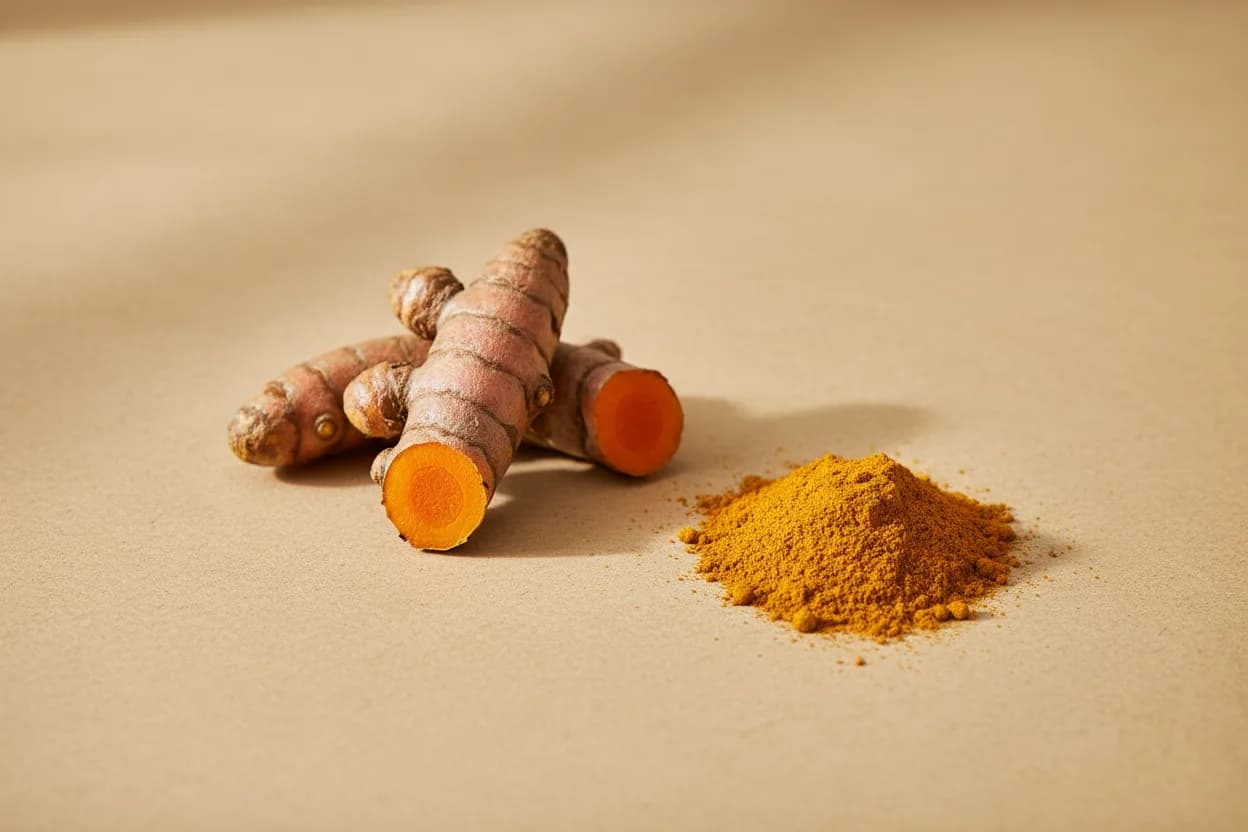
Turmeric is the most confident colour in the spice drawer. Nothing else stains a wooden spoon that permanently or turns a pot of rice that particular saturated gold. It is also, at the moment, the most oversold ingredient in the world, and the gap between what the jar does in a pan and what the supplement aisle claims it does in a body is one of the more instructive stories in modern food chemistry.
The plant itself is a quiet oddity. Curcuma longa is effectively sterile in cultivation, a triploid carrying an awkward chromosome count that makes reliable seed almost impossible, so every crop is propagated by splitting and replanting rhizomes. 3 The turmeric in your kitchen is not the descendant of a plant someone grew. It is a piece of it.
A dated fingerprint, not a round number
You will read everywhere that turmeric has been used for five thousand years. That figure has no traceable source, which is a shame, because the real evidence is better and more specific than the slogan.
Archaeologists working at Farmana, in Haryana, recovered starch grains from residue inside a Harappan cooking pot and identified turmeric alongside ginger and eggplant, in a layer dated between 2600 and 2200 BC. 1 That is not a folk memory. That is somebody's dinner, still in the pot, identified grain by grain under a microscope.
The second piece is stranger and, for this site, closer to home. Researchers analysing dental calculus, the hardened plaque on teeth from Bronze Age burials at Megiddo and Tel Erani in the southern Levant, found molecular traces of turmeric, banana, and soy. 2 People in the eastern Mediterranean were eating South Asian food in the second millennium BC. The spice route is usually told as a Roman story. It was already old by then, and the evidence sat in the teeth of the people who walked it.
Only a few per cent of it
The yellow comes from curcuminoids, of which curcumin, C₂₁H₂₀O₆, is the principal one. 4 It travels with two close siblings, demethoxycurcumin and bisdemethoxycurcumin, the same molecular backbone with one or both methoxy groups stripped off.
Here is the number that reframes everything after it. Curcumin makes up at most around five per cent of dried turmeric by weight, and when researchers actually ran the assay across retail products, pure turmeric powder averaged about 3.1 per cent. 7 5 The spice is overwhelmingly not the molecule people are excited about. A teaspoon of turmeric is roughly two and a half grams of powder carrying something like eighty milligrams of the compound, and only a small fraction of that will ever reach your bloodstream.
You can watch the chemistry work without a laboratory. Dip a strip of paper in turmeric, dry it, then touch it with soap or ammonia and the egg-yolk yellow flips to red. Turmeric paper has been a standard classroom acid-base indicator for decades. 6 The colour shift comes from the same extended conjugated system that makes curcumin yellow in the first place, rearranging as it loses a proton. It is a genuinely good indicator and a genuinely beautiful molecule. Neither of those facts is a medical claim.
The compound that lies to the equipment
In 2017 a group of medicinal chemists published a paper in the Journal of Medicinal Chemistry that has become one of the most cited pieces of chemical scepticism of the last decade. Its argument is not that curcumin is useless. It is that curcumin is a compound uniquely well designed to produce false positives in the assays scientists use to decide whether a compound is useful. 7
Curcumin is classed as a PAINS compound, a pan-assay interference compound, and as an IMPS, an invalid metabolic panacea. Those categories exist because some molecules trip laboratory readouts by mechanisms that have nothing to do with the biology being measured. Curcumin fluoresces, so it can register as a signal in fluorescence assays. It chelates metals, cycles redox, disrupts membranes, and aggregates in solution. Any one of those can make a screen light up. Put a promiscuous molecule like that into thousands of assays across thousands of laboratories and it will appear to do almost everything, because the instruments, not the cells, are responding.
No double-blinded, placebo controlled clinical trial of curcumin has been successful.
That sentence is doing a lot of work, so read it precisely. It does not say curcumin does nothing. It says that after more than a hundred and twenty registered clinical trials, the one design that can actually establish a drug effect has not produced a success. 7 The paper's blunt summary is that curcumin is unstable, reactive, and not bioavailable, which makes it a highly improbable drug lead. That is an unusual thing for chemists to say in print about a compound their own field has spent decades chasing.
The instability is not a technicality either. Curcumin degrades quickly in neutral and alkaline conditions, which describes your small intestine. Whatever survives the cooking, and then the stomach, then has to survive that.
The pepper trick, in its actual size
This is where the black pepper advice comes from, and it deserves an honest accounting because it is the single most repeated piece of kitchen science on the internet. A 1998 study gave curcumin with and without twenty milligrams of piperine, black pepper's pungent alkaloid, and reported a 154 per cent increase in bioavailability in rats and roughly a twenty-fold increase in human volunteers. 8
The finding is real and the mechanism is plausible. What gets lost is the scale: it is one small study, nearly thirty years old, and one of its co-authoring institutions manufactures a commercial piperine extract sold for this exact purpose. A twenty-fold increase on a starting point of almost nothing is still not very much. Grinding pepper into your turmeric is good cooking regardless. It is not a delivery system.
What the trials actually support
The most defensible case for turmeric is the narrowest one, and it is joint pain. A meta-analysis pooling eleven randomised trials across about a thousand patients with knee osteoarthritis found curcuminoids performed comparably to non-steroidal anti-inflammatories for pain, with fewer gastrointestinal side effects. 9 That sounds like a headline until you read the authors' own verdict, which is that the trials were mostly small and of low quality, and that the evidence is not adequate in size or quality to support any meaningful clinical recommendation.
So: a real signal, in one condition, from a body of evidence its own reviewers describe as too weak to act on. That is a fair and unglamorous summary, and it is a very long way from the claims printed on the bottles.
The yellow that is not turmeric
There is one turmeric health risk that is thoroughly documented, and it is not the spice. It is what has been added to it.
Because buyers pay for colour, processors in parts of South Asia have for decades polished turmeric roots with lead chromate, an industrial pigment that is a brilliant yellow and roughly two to ten per cent lead by weight. Investigators who traced the practice across Bangladesh found adulteration in seven of the nine major turmeric-producing districts, market powder testing as high as 1,152 micrograms of lead per gram, and soil at polishing yards higher still. 10
The part that closes the argument is isotopic. Lead from different sources carries different isotope ratios, so it can be fingerprinted. When researchers matched the lead in rural Bangladeshi villagers' blood against candidate sources, it matched turmeric more closely than paint, soldered cans, or soil. 11 The spice was not a suspected route. It was the route.
This is not a solved historical problem. A 2024 survey of 356 market samples from India, Pakistan, Sri Lanka, and Nepal, together the source of most of the world's turmeric, found about fourteen per cent above the lead screening threshold, with the worst samples from Patna, Karachi, and Peshawar exceeding a thousand micrograms per gram. 12 There is no safe level of lead for a developing brain, which makes this the rare food story where the boring regulatory detail is the part that actually matters to a child.
The practical advice is dull and worth following: buy turmeric from a supplier who tests for heavy metals, and treat suspiciously vivid powder with suspicion. Colour is the thing being counterfeited.
None of this should make you use less turmeric. It should make you use it for the right reason. It is earthy and slightly bitter, it turns fat gold, and it has been doing that in cooking pots since the Harappans. The molecule inside it is a fascinating chemical object and a cautionary tale about how easily good instruments can be fooled. Those are two separate pleasures, and the spice was never obliged to be medicine to earn its place on the shelf.
Sources
Every numbered claim above points here. Links go to the paper, record, or authority itself.
- 1.
Kashyap A, Weber SA. Harappan plant use revealed by starch grains from Farmana, India. Antiquity Project Gallery. 2010;84(326).
https://doi.org/10.15184/S2978855200902191 - 2.
Scott A, Power RC, Altmann-Wendling V, et al. Exotic foods reveal contact between South Asia and the Near East during the second millennium BCE. Proceedings of the National Academy of Sciences. 2021;118(2):e2014956117.
https://doi.org/10.1073/pnas.2014956117 - 3.
Nair RR, Sasikumar B. Chromosome number variation among germplasm collections and seedling progenies in turmeric, Curcuma longa L. Cytologia. 2009;74(2):153-157.
https://doi.org/10.1508/cytologia.74.153 - 4.
PubChem Compound Summary CID 969516, Curcumin. National Center for Biotechnology Information.
https://pubchem.ncbi.nlm.nih.gov/compound/969516 - 5.
Tayyem RF, Heath DD, Al-Delaimy WK, Rock CL. Curcumin content of turmeric and curry powders. Nutrition and Cancer. 2006;55(2):126-131.
https://doi.org/10.1207/s15327914nc5502_2 - 6.
Breedlove CH. Turmeric as an acid-base indicator. Journal of Chemical Education. 1995;72(6):540.
https://doi.org/10.1021/ed072p540 - 7.
Nelson KM, Dahlin JL, Bisson J, Graham J, Pauli GF, Walters MA. The Essential Medicinal Chemistry of Curcumin. Journal of Medicinal Chemistry. 2017;60(5):1620-1637.
https://doi.org/10.1021/acs.jmedchem.6b00975 - 8.
Shoba G, Joy D, Joseph T, Majeed M, Rajendran R, Srinivas PSSR. Influence of piperine on the pharmacokinetics of curcumin in animals and human volunteers. Planta Medica. 1998;64(4):353-356.
https://doi.org/10.1055/s-2006-957450 - 9.
Bannuru RR, Osani MC, Al-Eid F, Wang C. Efficacy of curcumin and Boswellia for knee osteoarthritis: systematic review and meta-analysis. Seminars in Arthritis and Rheumatism. 2018;48(3):416-429.
https://doi.org/10.1016/j.semarthrit.2018.03.001 - 10.
Forsyth JE, Nurunnahar S, Islam SS, et al. Turmeric means yellow in Bengali: lead chromate pigments added to turmeric threaten public health across Bangladesh. Environmental Research. 2019;179(Pt A):108722.
https://doi.org/10.1016/j.envres.2019.108722 - 11.
Forsyth JE, Weaver KL, Maher K, et al. Sources of blood lead exposure in rural Bangladesh. Environmental Science & Technology. 2019;53(19):11429-11436.
https://doi.org/10.1021/acs.est.9b00744 - 12.
Forsyth JE, Mistree D, Nash E, Angrish M, Luby SP. Evidence of turmeric adulteration with lead chromate across South Asia. Science of The Total Environment. 2024;949:175003.
https://doi.org/10.1016/j.scitotenv.2024.175003