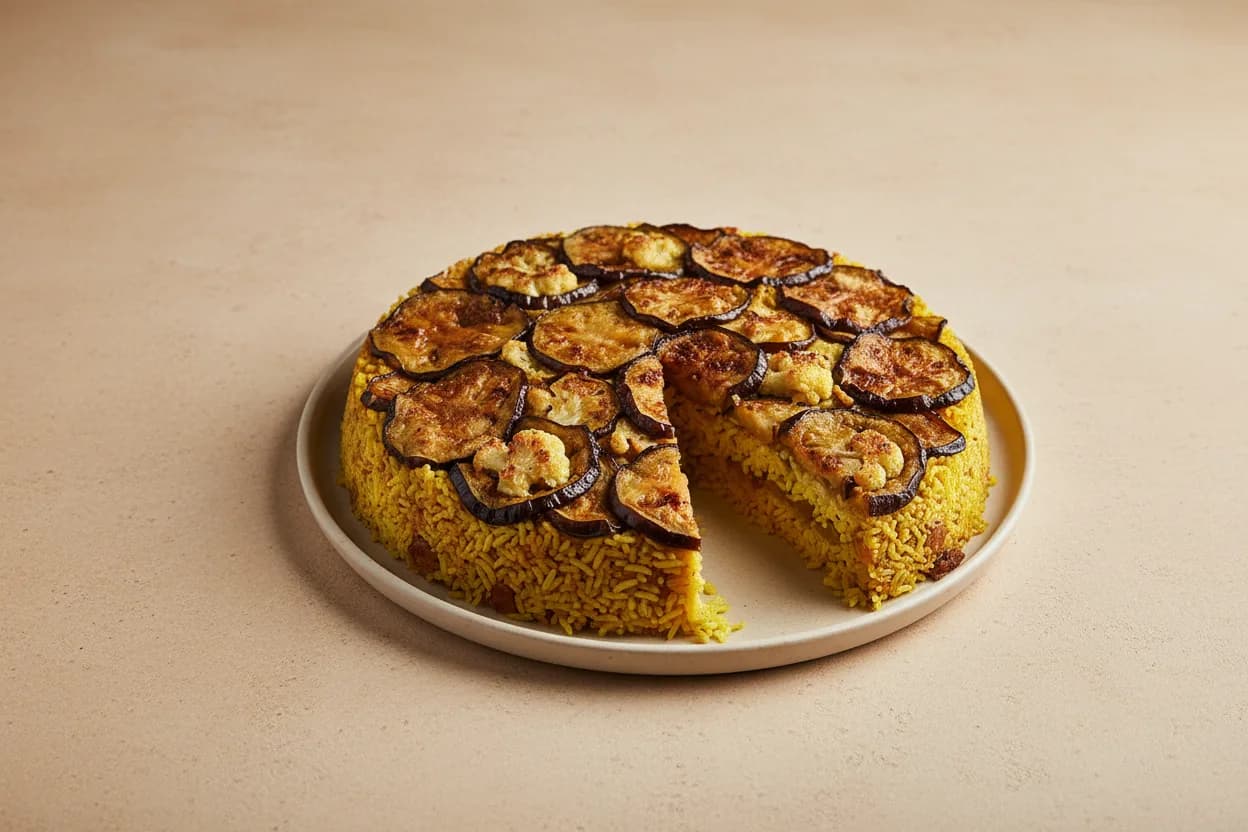
Maqluba means turned over, and the pot has to prove it
An American ethnographer watching Palestinian villagers in 1921 wrote down the dish and the reason for its name in one sentence. What the record actually holds before that, what is folklore, and the starch, oil and browning that let a pot of rice stand up on a platter.
Contents
In 1921 an American orientalist named Elihu Grant published his account of village life in Palestine, and in the pages on what the peasantry ate he set down one sentence that does the work of a whole etymology: a preparation of rice and eggplant, cooked in a deep dish and, when served, turned out upside down, whence the name, which means turned over. 1 The Arabic root is q-l-b, to turn, the same root as the word for heart, and maqluba is its passive participle. The dish is named for the last thing that happens to it.
What the record holds, and what it does not
The book usually named as the earliest home of the word is the Kitab al-Tabikh, the Book of Dishes, written in Baghdad in 1226 by a scribe we call al-Baghdadi, translated by Arberry in 1939 and again by Charles Perry in 2005, its one manuscript now in the Süleymaniye Library in Istanbul. 2 The maqluba in it is said to be an egg dish rather than a rice one. I could not get Perry's text in front of me to check that passage, so it stays here as a claim I have seen repeated and not one I have read. The other story, that Saladin was served a layered aubergine dish on retaking Jerusalem in 1187 and named it on the spot, is told as folklore by everyone who tells it carefully, and the details of what he was served drift from one telling to the next, which is what a folk etymology does. 3 The earliest description I can put my hand on is Grant's, and it already has the rice, the eggplant, the deep pot and the flip. 1
The dish today is Palestinian first and Levantine generally: chicken or lamb, cauliflower or eggplant or carrots, a layer of rice, and it is eaten across Syria, Jordan, Lebanon and Iraq and into Turkish and Kurdish kitchens. 4 Turned out, its top two layers are typically sliced tomato and aubergine, which were the bottom of the pot a moment before. 5 The flip is the point. One of the two LAist reporters touring Anaheim's Little Arabia, listing memories of Palestinian food in friends' homes, puts it first: the dance to flip the maqluba, then the mansaf, then the grape leaves stolen before dinner. 6 In Jerusalem families cook it in Ramadan at al-Aqsa, and one magazine reads the inversion as a statement about a city under erasure: history may be overturned, but so is resistance. 3 Everything below is about why the pot lets them do it.
Why the eggplant drinks oil
The vegetable layer is fried first, and eggplant fries like nothing else. A 2021 study that cooked eggplant with avocado oil measured fat at 0.02 per cent of the raw flesh, 6.4 per cent after boiling in an oil-and-water mix, and 37.8 per cent after deep-frying at 180 degrees, more than a third of the finished weight, and attributed the uptake to the high affinity of the pulp's carbohydrate structure for oil, so pronounced that eggplant pulp has been studied as a natural emulsifier. 7 A second study that fried plain eggplant rings found uncoated slices reaching 63 per cent oil under some conditions, and cut that by about half with a gel barrier coating on the surface. 8 The kitchen habit of salting slices to draw water and limit the oil has cousins in the literature, where moisture removal before frying reduces uptake in other vegetables, but I found no study that measured it in eggplant, so the folk number that usually follows the claim is not one I can give.
Why the cauliflower goes sweet
Raw cauliflower is a brassica, and its sulfur note is held in reserve as glucosinolates that only break down when tissue is cut or chewed and the enzyme myrosinase gets at them; dimethyl sulfide, one product, is the compound trained tasters actually describe with the word cauliflower, and boiling promotes exactly those sulfides, the smell of overcooked cabbage. 10 Frying takes the florets somewhere else. The brown edges are the Maillard reaction, first described by Louis Maillard in 1912, in which reducing sugars and amino acids at the dry, hot surface run through a network of reactions that yields both colour and a family of toasted, nutty aroma compounds. 9 It is not caramelisation, which needs sugar alone at higher temperatures, and the distinction matters for the taste: a fried floret has lost water, so its sugars are concentrated rather than leached into a pot, and its surface has made new flavours rather than releasing old ones.
Why the rice holds
A rice grain becomes part of a structure when its starch gelatinises: the granules lose their crystalline order, take on water and swell, and amylose leaches out of them and coats the outside of every grain. 11 How much amylose a rice carries decides what kind of structure it makes. In a 2025 profiling of Egyptian cultivars, amylose ran from about 18 to 23 per cent, and it predicted cooking time almost perfectly, with a correlation of 0.93. 12 Low-amylose rices swell more and cook up soft and cohesive; high-amylose rices set firmer, because linear amylose chains readily form stable double helices as the rice cools, which is the same retrogradation that makes yesterday's rice hard. 13 A short or medium grain of the Egyptian kind is what maqluba cooks reach for, and the chemistry says why: enough leached amylose to glue the mass, and on cooling, enough retrograded structure to carry it. The instruction to let the pot stand off the heat before inverting it is, on this reading, an instruction to let that network set. No one has tested the resting step as a variable; the starch science is the best account of it.
The stock the rice cooks in
Under the vegetables sits the meat, and the rice is cooked in the meat's own broth. That broth carries gelatin, because collagen begins to denature between 53 and 63 degrees and converts to gelatin above that, the change that turns a tough cut tender over a long simmer. 14 It carries the spices too. Allspice, the backbone of the Levantine seven-spice, is two-thirds eugenol by volatile content, the clove molecule, with methyl eugenol behind it; cinnamon bark oil is led by cinnamaldehyde at about 41 per cent with linalool and a little eugenol of its own, so the two spices overlap rather than merely stack. 15 16 The rice takes all of it up as it gelatinises, so maqluba rice tastes built rather than boiled, and the platter, once the pot is lifted, is already seasoned from the bottom up.
Grant watched it in a village a century ago and wrote down the name and the reason in one breath. The pot goes on the table upside down, somebody counts, somebody lifts, and the layers stand there proving the word.
Questions this note answers
- What does maqluba mean?
- Turned over. The name is the passive participle of the Arabic root q-l-b, to turn, and it describes the last step: the pot is inverted onto a platter and lifted away. An ethnography of Palestinian village life published in 1921 gives the dish, rice and eggplant cooked in a deep dish and turned out, and that gloss for the name. 1
- Why does the eggplant in maqluba absorb so much oil?
- Its pulp has an unusual affinity for oil; measured fat in eggplant rose from 0.02 per cent raw to 37.8 per cent after deep-frying in one study, and uncoated fried rings reached 63 per cent in another. Barrier coatings roughly halve the uptake; salting is a kitchen habit with no eggplant-specific measurement behind it. 7 8
- Why let maqluba rest before flipping?
- So the starch can set. Cooking leaches amylose out of the rice grains and coats them; as the pot cools, that amylose re-associates into a firmer network, the retrogradation that also hardens leftover rice, and the mass holds its shape when the pot comes off. The step has not been tested as a variable, but the starch science accounts for it. 11 13
- Did Saladin name the maqluba?
- No, not as far as the record shows. The Saladin story, that he was served a layered eggplant dish on retaking Jerusalem in 1187 and named it on the spot, is retold as folklore, with its details shifting from telling to telling. 3 The earliest description anyone can actually verify is an American ethnographer's 1921 account of Palestinian village life, which already has the rice, the eggplant, the deep pot and the flip; a possible earlier mention, as an egg dish, appears in a 1226 Baghdad cookbook, but that claim is unverified. 1 2
Sources
Every numbered claim above points here. Links go to the paper, record, or authority itself.
- 1.
Grant E. The People of Palestine: An Enlarged Edition of "The Peasantry of Palestine, Life, Manners and Customs of the Village". Philadelphia: J.B. Lippincott; 1921. Scan, University of Toronto Libraries, Internet Archive.
https://archive.org/details/peopleofpalestin00granuoft - 2.
Perry C, translator. A Baghdad Cookery Book: the Book of Dishes (Kitab al-Tabikh) by Muhammad b. al-Hasan b. Muhammad b. al-Karim, the scribe of Baghdad. Prospect Books; 2005. Publisher's page.
https://prospectbooks.co.uk/products-page/current-titles/a-baghdad-cookery-book/ - 3.
Ghanem K. Palestinian Dishes and the Stories Behind Them. MILLE World, 8 October 2025.
https://www.milleworld.com/popular-palestinian-dishes-stories/ - 4.
Shaheen B. Maqluba, The Paella of Palestine. Arab America, 29 January 2020.
https://www.arabamerica.com/maqluba-the-paella-of-palestine/ - 5.
Whitaker B. Food and recipes: Palestine. al-bab.com.
https://al-bab.com/special-topics/food-and-recipes - 6.
Farzan Y, Chabrán G. Come with us on a tasting tour of Anaheim's Little Arabia. LAist, 2 August 2024.
https://laist.com/news/food/come-with-us-on-a-tasting-tour-of-anaheims-little-arabia - 7.
Samaniego-Sánchez C, Martín-del-Campo ST, Castañeda-Saucedo MC, Blanca-Herrera RM, Quesada-Granados JJ, Ramírez-Anaya JDP. Migration of Avocado Virgin Oil Functional Compounds during Domestic Cooking of Eggplant. Foods. 2021;10(8):1790.
https://pmc.ncbi.nlm.nih.gov/articles/PMC8391506/ - 8.
Varidi M, Ahmadzadeh-Hashemi S, Nooshkam M. Changes in fat uptake, color, texture, and sensory properties of Aloe vera gel-coated eggplant rings during deep-fat frying process. Food Science & Nutrition. 2023;11(4):2027-2035.
https://pmc.ncbi.nlm.nih.gov/articles/PMC10084974/ - 9.
Barham P, Skibsted LH, Bredie WLP, et al. Molecular Gastronomy: A New Emerging Scientific Discipline. Chemical Reviews. 2010;110(4):2313-2365.
https://pmc.ncbi.nlm.nih.gov/articles/PMC2855180/ - 10.
Marcinkowska MA, Jeleń HH. Role of Sulfur Compounds in Vegetable and Mushroom Aroma. Molecules. 2022;27(18):6116.
https://pmc.ncbi.nlm.nih.gov/articles/PMC9502545/ - 11.
Xu H, Wei G, Chen B, et al. Application of Pulsed Ohmic Heating for Rapid Cooking of Indica Rice: Quality Enhancement and Mechanistic Insights. Foods. 2026;15(15):2742.
https://pmc.ncbi.nlm.nih.gov/articles/PMC13463885/ - 12.
Abdelsalam KMH, Shaalan AM, AbouEl-Soud GM, et al. Comprehensive quality profiling and multivariate analysis of rice (Oryza sativa L.) cultivars: integrating physical, cooking, nutritional, and micronutrient characteristics for enhanced varietal selection. BMC Plant Biology. 2025;25:492.
https://pmc.ncbi.nlm.nih.gov/articles/PMC12004827/ - 13.
Usenbekov B, Meldebekova A, Sartbayeva I, et al. Amylose content in rice: integrating genetics, grain filling physiology, and breeding strategies. Frontiers in Plant Science. 2026;17:1891006.
https://pmc.ncbi.nlm.nih.gov/articles/PMC13528215/ - 14.
Latoch A, Głuchowski A, Czarniecka-Skubina E. Sous-Vide as an Alternative Method of Cooking to Improve the Quality of Meat: A Review. Foods. 2023;12(16):3110.
https://pmc.ncbi.nlm.nih.gov/articles/PMC10453940/ - 15.
Narayanankutty A, Kuttithodi AM, Alfarhan A, Rajagopal R, Barceló D. Chemical Composition, Insecticidal and Mosquito Larvicidal Activities of Allspice (Pimenta dioica) Essential Oil. Molecules. 2021;26(21):6698.
https://pmc.ncbi.nlm.nih.gov/articles/PMC8588154/ - 16.
Gębarowska E, Budek K, Gębarowska M, Kmieć A, Szumny A. Cinnamon Bark Essential Oil as a Natural Plant Protection Agent: Chemical Profile, Antimicrobial Activity, and Defence Induction. Molecules. 2026;31(6):1036.
https://pmc.ncbi.nlm.nih.gov/articles/PMC13028868/