Why the bay leaf comes out of the pot
Laurus nobilis is on the FDA's safe list and in nearly every stock pot on earth. The leaf still comes out before serving, for a reason that has nothing to do with poison, and the poisonous plant people are thinking of is a different tree.
Contents
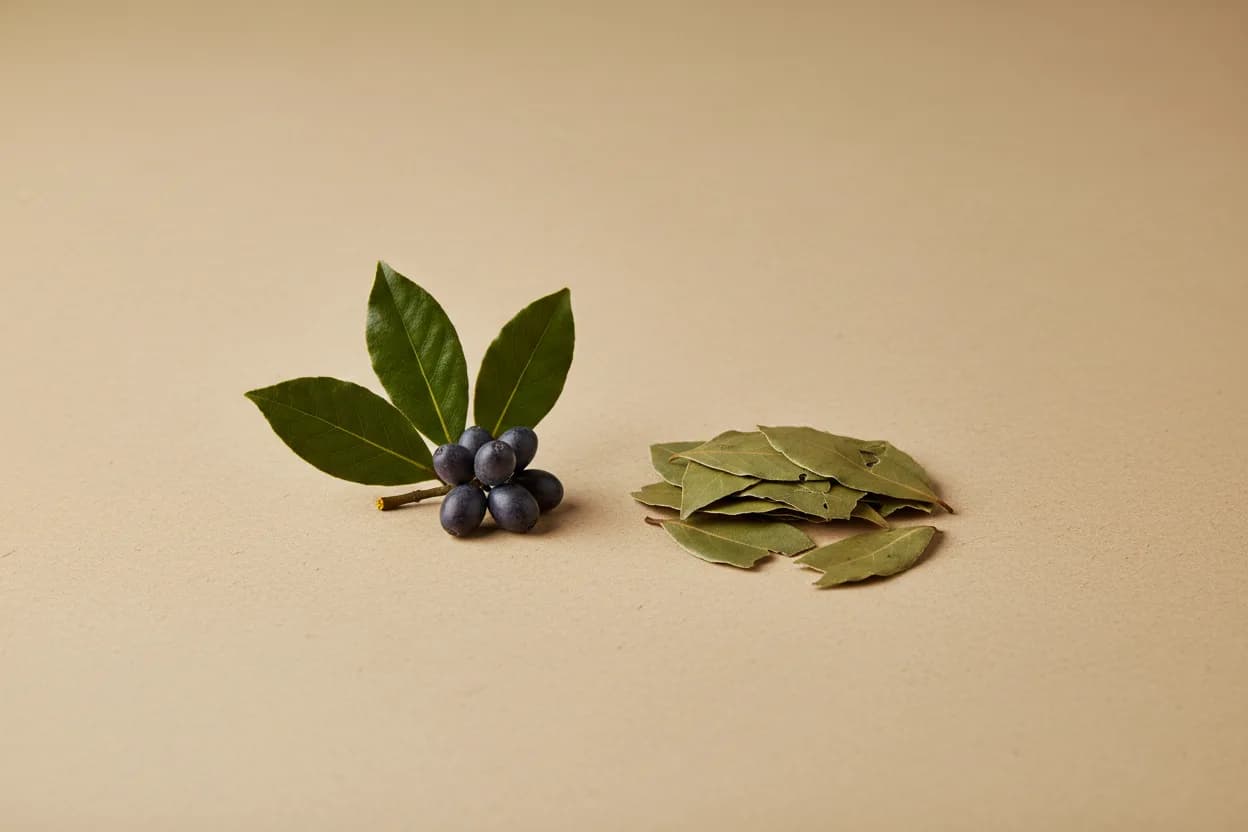
Every cook knows the bay leaf comes out before the dish goes to the table, and most have been told why: it is poisonous. It is not. Laurus nobilis is named, by its Latin binomial, in the United States food code's list of spices generally recognised as safe, alongside basil and black pepper. 1 The real reason the leaf comes out is mechanical. A dried bay leaf does not soften in a stew the way a herb does, and it does not break down in the gut either. The medical literature holds a small, consistent set of case reports of whole leaves lodging in the throat and oesophagus, blocking the duodenum, and in one case perforating a pouch of the small intestine. 2 3 4 A leaf with a stiff midrib and a sharp edge is a hazard to swallow. That is the whole of it.
The poison story is not invented from nothing, though. It belongs to a different plant with a similar leaf and an overlapping name, and this note gets to it. First, the tree itself.
One tree, mostly from one country
Kew gives the native range of Laurus nobilis as the Mediterranean, from Morocco and Algeria round through Türkiye, Lebanon and Palestine to the Balkans and the big islands. 5 It is an evergreen tree of the laurel family, the same family as cinnamon and avocado, and it will grow far outside that range, but the trade does not. Almost 97 per cent of the world's bay leaf production comes from Türkiye. 6
The leaf's aroma is an essential oil, and there is more of it than you might guess. A study in Montenegro that harvested the same trees through a year found dried leaves yielding 2.12 per cent oil by weight in summer and 1.26 per cent in winter. 8 The oil's headline compound is 1,8-cineole, the same molecule that gives eucalyptus its smell, and its share swings with geography: 31.9 per cent in leaves from southern Italy, 46 to 72 per cent in Turkish leaves, 57 to 66 per cent in Lebanese ones. 7 6 PubChem's reference descriptions of cineole read like a bay leaf: a camphor-like odour and a pungent, cooling, spicy taste. 9 Behind it sit sabinene, linalool, alpha-pinene and alpha-terpinyl acetate, and then the clove pair, eugenol and methyl eugenol, at a few per cent each in the Italian sample. 7 The warm, faintly sweet edge under the camphor is those two.
Fresh, dried, and why dried wins
Bay is one of the few leaves that improves in the drying. In 2002 a group in Spain dried bay four ways and ran the volatiles on each: air-drying at room temperature and oven-drying at 45 degrees caused hardly any loss compared with the fresh leaf, while freezing and freeze-drying lost a substantial share of the aroma and, oddly, raised the concentration of eugenol and a few heavier compounds. 10 Cold, in other words, is the treatment to avoid. The reference the spice trade leans on adds the part the chemistry does not measure: fresh leaves are strongly aromatic but quite bitter, and a proper drying reduces the bitterness and can improve the flavour, and the dried leaf can then sit in a pot for hours without the aroma collapsing. 11 That last claim is culinary experience rather than a measured time course; nobody appears to have published the extraction kinetics of a bay leaf in broth.
Four leaves called bay
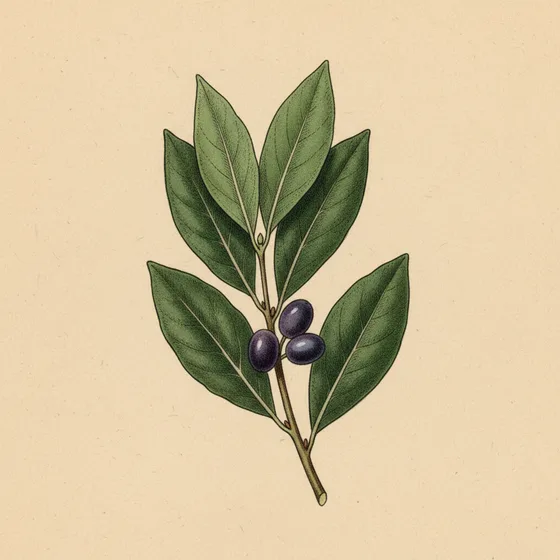
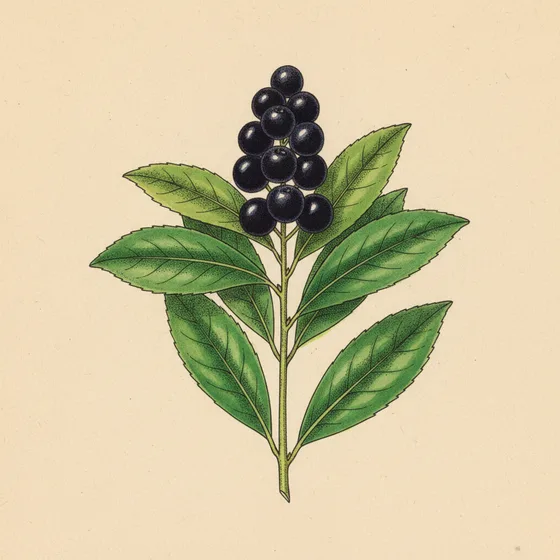
California bay, Umbellularia californica, is the Pacific coast's own laurel and is sold, occasionally, as a bay substitute. Its major volatile is umbellulone, a reactive ketone that the leaf of the true bay does not make, and in 2012 a team in Florence showed why the tree is known locally as the headache tree: umbellulone switches on the TRPA1 receptor on nerve endings in the face and sets off the same pathway that migraine drugs target. 12 The spice trade rarely handles it, and says so, because of the health question. 11 Used in small amounts it is a legitimate leaf, just a far stronger one, and any ratio you read for swapping it into a recipe is kitchen lore rather than a measured figure.
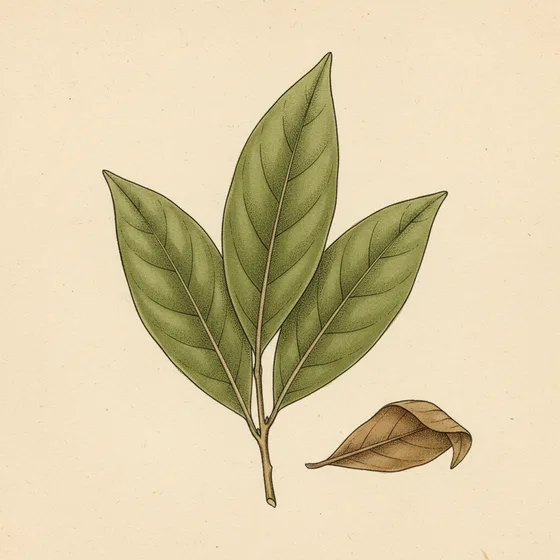
Indian bay leaf, tej patta, is Cinnamomum tamala, a cinnamon tree, and you can tell it at a glance by the three parallel veins running the length of the leaf. Its oil is not a cineole oil at all: linalool at 47 per cent, eugenol at 18, cinnamaldehyde at 16, which is a clove-and-cinnamon aroma with nothing of eucalyptus in it. 13 A recipe from the subcontinent that calls for bay leaf usually means this leaf, and the Mediterranean one is a poor stand-in for it, and vice versa.
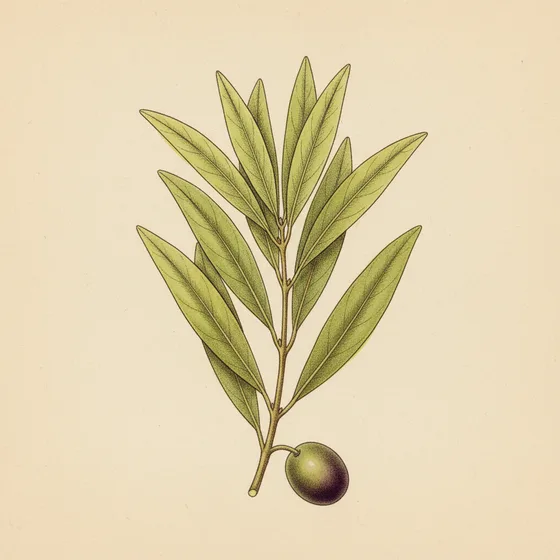
Then there is cherry laurel, Prunus laurocerasus, a hedge shrub across Europe with thick glossy leaves close enough to bay's that inexperienced foragers confuse them. Its leaves carry 1 to 2.5 per cent of a cyanogenic glycoside called prulaurasin, and crushed, they smell of bitter almond, the tell of released hydrogen cyanide, where true bay smells of camphor. Italian poison centres logged over a hundred laurel-confusion cases in the years between 1995 and 2007, and a public park in Scotland once lost 31 grazing sheep to the leaves. 14 This is the poisoning people half-remember when they take the bay leaf out of the pot. It is a real one. It is simply a different tree.
The crown
No other kitchen leaf carries this much history on its back. In Ovid, when Daphne becomes a laurel to escape Apollo, the god claims the tree in one speech: it will crown his hair and his lyre, it will be borne by Roman generals in triumph up the Capitol, and it will stand guard at the gates of Augustus. 16 Pliny adds the folk beliefs of his own day: that holding out a laurel branch between two armies is a sign of truce, and that of all the trees people plant, the laurel alone is never struck by lightning. 17 Suetonius gives the human note. Julius Caesar was embarrassed by his baldness, combed his thinning hair forward to hide it, and of all the honours the Senate voted him, none pleased him more than the right to wear a laurel wreath at all times. 18 The English word laureate comes straight from that crown. The word baccalaureate does not, despite the story; the dictionaries call the laurel-berry derivation a folk etymology grafted onto an older medieval word. 19
The Romans cooked with it as readily as they crowned with it. The first book of Apicius opens with a spiced wine that takes laurel leaves and saffron by the drachm, includes a remedy for spoiled fish sauce that involves fumigating it with laurel and cypress smoke, and keeps oysters under a sprinkling of laurel berries. 20 Fifteen centuries on, Escoffier's bouquet garni is parsley stalks, thyme, bay leaf and celery tied in a bundle, and it is still the base of a French stock. 21 In Arabic the leaf is waraq al-ghar, the leaf of the ghar tree, a plant name the language borrowed from Aramaic. 22 It goes into the broth for mansaf and under the rice for mandi, and it is one of the seventeen ingredients printed on a tin of S&B curry powder in Tokyo. 23
The one caveat
None of this makes the leaf harmless in any quantity. In 2026 physicians in Romania reported a 55-year-old woman with toxic hepatitis, her liver enzymes several times normal, whose only identified exposure was a habit of drinking bay-leaf infusions; a biopsy pointed to a toxic cause and the standard causality score for herb-induced liver injury came out at probable. 15 It is one case, and it concerns a daily tea made from the leaves, which is a different exposure from one leaf simmered in a pot of stock and lifted out. The kitchen use is the one the safety lists cover. A cupful of the leaves every day is something else, and nobody has studied it.
So the leaf goes in early, stays through the long simmer, gives the pot its camphor-and-clove undertone, and comes out at the end for the same reason you would take out a twig. Then someone at the table asks whether it is poisonous, and you get to tell them about the sheep.
Questions this note answers
- Are bay leaves poisonous?
- No. Laurus nobilis is listed by name among the spices the US food code recognises as safe. The leaf is removed because it stays rigid and can lodge in the throat or gut; the documented poisonings involve cherry laurel, Prunus laurocerasus, a look-alike hedge plant whose leaves carry cyanogenic glycosides. 1 2 14
- Why do you take the bay leaf out before serving?
- Because it does not soften or digest. Case reports describe whole bay leaves impacted in the oesophagus, blocking the duodenum, and perforating a Meckel's diverticulum. The flavour has already gone into the pot; the leaf itself is a stiff, sharp-edged object. 2 3 4
- Can I use California bay instead of regular bay leaf?
- You can, cautiously. Umbellularia californica is a different tree whose main volatile, umbellulone, activates the TRPA1 pain receptor and gives the tree its name of headache tree, so the leaf is far more pungent; the spice trade rarely handles it. Use less and taste as you go; no published source gives a fixed substitution ratio. 12 11
Sources
Every numbered claim above points here. Links go to the paper, record, or authority itself.
- 1.
Code of Federal Regulations, Title 21, §182.10: Spices and other natural seasonings and flavorings. US Government Publishing Office, 2022 edition.
https://www.govinfo.gov/content/pkg/CFR-2022-title21-vol3/xml/CFR-2022-title21-vol3-sec182-10.xml - 2.
Buto SK, Tsang TK, Sielaff GW, Gutstein LL, Meiselman MS. Bay leaf impaction in the esophagus and hypopharynx. Annals of Internal Medicine. 1990;113(1):82-83.
https://pubmed.ncbi.nlm.nih.gov/2350114/ - 3.
Tsang TK, Flais MJ, Hsin G. Duodenal obstruction secondary to bay leaf impaction. Annals of Internal Medicine. 1999;130(8):701-702.
https://pubmed.ncbi.nlm.nih.gov/10215575/ - 4.
Bell CD, Mustard RA. Bay leaf perforation of Meckel's diverticulum. Canadian Journal of Surgery. 1997;40(2):146-147.
https://pubmed.ncbi.nlm.nih.gov/9126131/ - 5.
Laurus nobilis L. Plants of the World Online. Royal Botanic Gardens, Kew.
https://powo.science.kew.org/taxon/urn:lsid:ipni.org:names:465049-1 - 6.
Paparella A, Nawade B, Shaltiel-Harpaz L, Ibdah M. A Review of the Botany, Volatile Composition, Biochemical and Molecular Aspects, and Traditional Uses of Laurus nobilis. Plants. 2022;11(9):1209.
https://pmc.ncbi.nlm.nih.gov/articles/PMC9100900/ - 7.
Caputo L, Nazzaro F, Souza LF, et al. Laurus nobilis: Composition of Essential Oil and Its Biological Activities. Molecules. 2017;22(6):930.
https://pmc.ncbi.nlm.nih.gov/articles/PMC6152719/ - 8.
Ilić ZS, Stanojević L, Milenković L, et al. Seasonal Variation of Essential Oil Quantity and Quality in Bay Laurel (Laurus nobilis L.) Leaves from Montenegro. Plants. 2026;15(6):923.
https://doi.org/10.3390/plants15060923 - 9.
PubChem Compound Summary CID 2758, Eucalyptol (1,8-cineole). National Center for Biotechnology Information.
https://pubchem.ncbi.nlm.nih.gov/compound/2758 - 10.
Díaz-Maroto MC, Pérez-Coello MS, Cabezudo MD. Effect of drying method on the volatiles in bay leaf (Laurus nobilis L.). Journal of Agricultural and Food Chemistry. 2002;50(16):4520-4524.
https://pubmed.ncbi.nlm.nih.gov/12137470/ - 11.
Katzer G. Laurel (Laurus nobilis L.). Gernot Katzer's Spice Pages.
https://gernot-katzers-spice-pages.com/engl/Laur_nob.html - 12.
Nassini R, Materazzi S, Vriens J, et al. The 'headache tree' via umbellulone and TRPA1 activates the trigeminovascular system. Brain. 2012;135(2):376-390.
https://pubmed.ncbi.nlm.nih.gov/22036959/ - 13.
Jon PH, Shourove JH, Ali MK, Rahman O, Thakur MU, Islam GMR. Optimizing sonication-assisted hydrodistillation of Cinnamomum tamala essential oil using response surface methodology and artificial neural network modeling. Scientific Reports. 2026;16:14107.
https://pmc.ncbi.nlm.nih.gov/articles/PMC13136388/ - 14.
Malaspina P, Betuzzi F, Ingegneri M, Smeriglio A, Cornara L, Trombetta D. Risk of Poisoning from Garden Plants: Misidentification between Laurel and Cherry Laurel. Toxins. 2022;14(11):726.
https://pmc.ncbi.nlm.nih.gov/articles/PMC9697506/ - 15.
Soare M, Călugăr-Solea SF, Brisc C, et al. Herb-Induced Liver Injury by Laurus nobilis: A Case Assessed for Causality Using the Updated RUCAM. Life. 2026;16(1):180.
https://pmc.ncbi.nlm.nih.gov/articles/PMC12842737/ - 16.
Ovid. Metamorphoses, Book 1, lines 452-567 (Apollo and Daphne). Translated by Brookes More. Theoi Classical Texts Library.
https://www.theoi.com/Text/OvidMetamorphoses1.html - 17.
Pliny the Elder. Natural History, Book 15. Translated by H. Rackham, W.H.S. Jones and D.E. Eichholz. Wikisource.
https://en.wikisource.org/wiki/Natural_History_(Rackham,_Jones,_%26_Eichholz)/Book_15 - 18.
Suetonius. The Life of the Deified Julius, 45. Translated by J.C. Rolfe (Loeb Classical Library, 1913). LacusCurtius, University of Chicago.
https://penelope.uchicago.edu/Thayer/E/Roman/Texts/Suetonius/12Caesars/Julius*.html - 19.
Harper D. Baccalaureate. Online Etymology Dictionary.
https://www.etymonline.com/word/baccalaureate - 20.
Apicius. De Re Coquinaria, Book I (Epimeles). Translated by Joseph Dommers Vehling (1936). LacusCurtius, University of Chicago.
https://penelope.uchicago.edu/Thayer/E/Roman/Texts/Apicius/1*.html - 21.
Escoffier A. Le Guide Culinaire: Bouquet garni. ckbk reference edition.
https://app.ckbk.com/reference/esco04831b01s001e008/bouquet-garni - 22.
غار (ghār). Wiktionary, the free dictionary: Arabic, etymology 3 (bay laurel).
https://en.wiktionary.org/wiki/%D8%BA%D8%A7%D8%B1 - 23.
S&B Foods Inc. Original Curry Powder, 85 g: ingredients. S&B Foods Global.
https://www.sbfoods-worldwide.com/products/search/023.html