A clove dulls touch and makes hot things hurt more
Press a whole clove against a tooth that aches and the burning comes first. Ten minutes later the burning has gone, the numbness has not, and the same patch of mouth now reads a warm cup as hotter than it is. The remedy is much older than the evidence for it, and the evidence is one small trial from 2006.
Contents
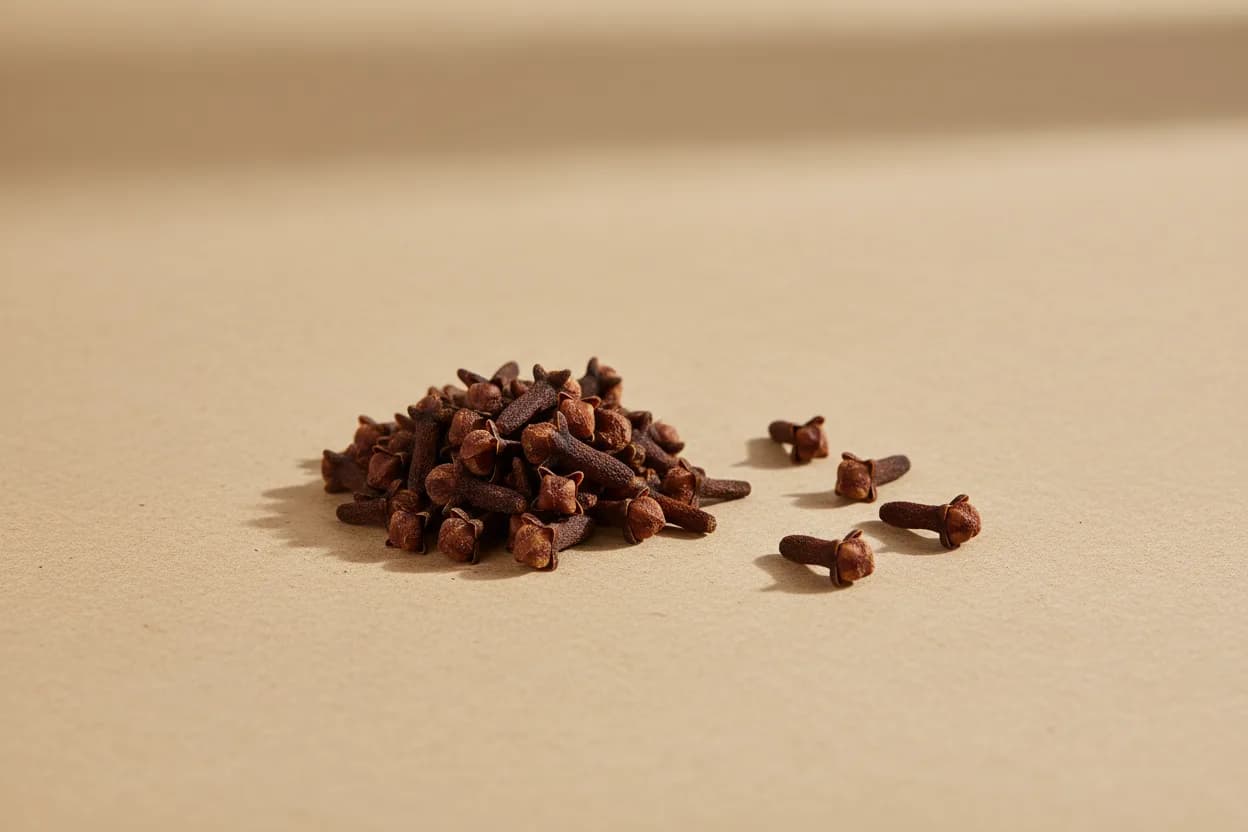
The instruction has been passed around kitchens and waiting rooms for as long as anyone can remember. Take one whole clove, press it against the tooth that hurts, bite down gently, and wait. What happens next arrives in stages, and the stages are more interesting than the folklore.
First it burns. Then it stings, and the sting goes. Then the patch of gum and tongue around the clove turns thick and slightly dead, and that part outlasts everything else. Drink something warm ten minutes later and it will feel hotter than it is.
Half a tongue at a time
That sequence has been measured on people, one half-tongue at a time. In 2013 Amanda Klein, Mirela Carstens and Earl Carstens painted eugenol, the molecule that makes a clove smell of clove, onto one side of a subject's tongue and the vehicle alone onto the other, so each person served as their own control.1 The solution was 600 millimolar eugenol in four per cent ethanol: strong, and nothing you would meet in a kitchen.
Asked to break the sensation into its parts, subjects reported burning and stinging immediately, and both faded quickly. What they were left with was numbness, named by 63.1 per cent of them, well ahead of tingling at 27.2 per cent and warming at 23.7 per cent.1 Apply eugenol again a minute later and the irritation comes back weaker, an effect that holds for at least ten minutes.
Two other results in that paper are stranger than the numbness. Eugenol raised the perceived warmth of an innocuous 44 degree stimulus for more than ten minutes, and briefly made a 49 degree stimulus hurt more, while doing nothing whatever to cool or to cold pain.1 And on the treated side of the tongue, people became measurably worse at detecting a fine 0.08 millinewton filament pressed against it.
So the folk anaesthetic is dulling touch, sharpening heat and quieting pain, in the same patch of tissue, at the same time. Whatever it is doing, it is doing several things at once.
One molecule, a great many channels
A clove is roughly a tenth eugenol by weight: measurements of fresh clove give 9,381 to 14,650 milligrams per 100 grams of plant material.2 The figure usually quoted, that cloves are eighty-five to ninety per cent eugenol, is a different measurement wearing the same clothes. That is eugenol's share of the essential oil, and the oil is only about a tenth to a fifth of the bud.2 One part in ten is still an extraordinary amount of a single compound to find in a plant part.
Eugenol activates TRPV1, the receptor that reports capsaicin and burning heat,3 and TRPA1, the one that reports mustard and cinnamon, at a half-maximal concentration of 261.5 micromolar.4 That is the burn. It is the same doorbell chilli rings.
The numbness is separate business, and the evidence for it is unusually clean. Working in the rat trigeminal system, Chul-Kyu Park's group sorted sensory neurons by type and then ran single-cell RT-PCR on the very neurons they had just recorded from.5 One group, their Type IV, came back negative for TRPV1. Eugenol silenced those too, blocking their action potentials and their voltage-gated sodium currents.
Eugenol does not need the capsaicin receptor to quiet a nerve. It goes at the sodium channels directly, and at a good deal else besides: T-type calcium channels, several potassium channels, and, most sensitively of all, the HCN channels, which it shuts down at 157 micromolar, a lower concentration than the one that stops sodium.6
The oldest careful measurement is still among the best. In 1984 Pal Brodin and Aksel Roed dripped eugenol onto an isolated rat phrenic nerve and watched the compound action potential fall away, reversibly, between 0.065 and 0.97 millimolar. Above 2.44 millimolar the block stopped reversing.7 They called it a membrane-stabilising drug at low concentrations, which is the technical way of saying local anaesthetic, and they said it two decades before the channels in the paragraph above had names.
Hold those numbers next to the syringe. Eugenol half-blocks sodium currents at around 2.2 millimolar and lidocaine at 1.4, while the two per cent lidocaine solution a dentist actually injects is roughly 85 millimolar.8 Clinical anaesthesia is not a subtle dose.
The filling is not inert
This is also why a temporary filling smells the way it does. Zinc oxide mixed with eugenol is one of dentistry's standard cements. In 1983 Brodin and Dag Orstavik laid the set cement against an isolated nerve and found it abolished conduction completely within half a minute to five minutes, reversibly when the nerve had kept its surrounding fatty tissue.9 The plug a dentist puts in a tooth is doing pharmacology, not merely filling a hole.
Dentine is what keeps that from being a disaster. In a review still worth reading thirty years on, Kenneth Markowitz and colleagues set out the two faces of the molecule: small quantities diffusing through dentine to the pulp are anti-inflammatory and locally anaesthetic, while high concentrations are cytotoxic, and direct application of eugenol to pulp tissue may result in extensive tissue damage.10 The tooth's own architecture is the dose regulator. Take the dentine away and the remedy is a caustic.
The evidence, all of it
For a remedy this famous, the human trial evidence is a single study. In 2006 Athbi Alqareer, Asma Alyahya and Lars Andersson at Kuwait University tested four preparations on the gum above a canine in 73 volunteers: a homemade clove gel, twenty per cent benzocaine, and a placebo matched to each.11 After five minutes every subject took two needle sticks and marked the pain on a 100 millimetre line.
Clove and benzocaine both beat their placebos at p equals 0.005, and were statistically indistinguishable from one another.11 The authors' own conclusion is carefully hedged: clove gel "might possess a potential" to replace benzocaine before needle insertion.
Read the design again, though. Nobody in that trial had a toothache. It measured a needle passing through healthy gum, the gel was homemade at an unstated strength, and only the subjects were blinded. A small study of a different kind of pain is what the entire reputation rests on.
The regulator noticed. In September 1991 the United States Food and Drug Administration wrote that it "does not find sufficient evidence to exist to establish general recognition of the effectiveness of eugenol as a toothache remedy", that controlled clinical investigations were needed, and that it was therefore "reclassifying eugenol as an agent for the relief of toothache from Category I to Category III".12
Category III means the data are insufficient, which is a different verdict from having been shown not to work. The reasoning is the interesting part: the original favourable rating had rested on the published opinions of experts in endodontics, and the agency said plainly that it did not agree with them.12 Then nothing happened. The rule was a proposal and was never finalised,13 and eugenol appears nowhere in the monograph governing over-the-counter oral health products today, whose eight permitted anaesthetics run from benzocaine to salicyl alcohol without it.14
You can still buy eugenol toothache drops. One label gives its marketing category as "OTC monograph not final" and its application number as "part356", the unfinished 1991 rulemaking, alongside the standard notice that the agency "has not evaluated whether this product complies".15 A bottle on a pharmacy shelf, citing a rule nobody ever wrote, as its licence to be there.
The harm is real at the doses people reach for. A three month old girl who swallowed less than eight millilitres of clove oil went into fulminant hepatic failure and was treated on the protocol used for paracetamol poisoning.16 She recovered completely. Eight millilitres is a teaspoon and a half.
What the old books actually say
The line that cloves have soothed toothache for thousands of years is worth chasing, because the chase does not end where anyone expects. John Gerard gave the clove tree a full chapter in his Herball of 1597, and he knew the plant: he describes the flowers darkening and hardening, "which flowers are the very Cloues when they are growen hard", and separates the true bud from the overripe "Fusses" that lose "the quicke taste".17 His list of virtues takes in the stomach, the liver, the heart, the eyes and the act of generation. There is not a tooth in it.
Nicholas Culpeper's English Physitian of 1652 mentions the tooth forty times and cloves not once,18 though in fairness he had excluded them on principle, having promised his readers only "the Vulgar Herbs of this Nation".
The Arabic medical tradition knew cloves far better than either Englishman, and it does not make the connection either. Ibn Sina's entry for qaranful in the Canon of Medicine allows the spice two jobs: it sweetens the breath, and it strengthens the stomach and the liver.19 Follow him into the chapters on the mouth and the teeth, sixty-six pages of them, and clove turns up only under foul breath. What he actually reaches for against toothache is opium, pellitory, castoreum and galbanum. Al-Razi is the same: no clove anywhere in the dental section of the Hawi, and its own entry for qaranful files the spice among the remedies that sharpen the sight.20
The prescription does exist, though. It is Chinese, and it is early. In the Beiji qianjin yaofang, the formulary Sun Simiao assembled around 652, the chapter on diseases of the teeth carries a recipe headed simply "a formula to treat tooth pain".21 Clove is the last of its seven drugs and the smallest dose in it, one liang. The seven are boiled in five sheng of water down to two and a half, strained, held in the mouth, and spat out.
That is a real answer, and a smaller one than the folklore wants. Clove is one ingredient of seven in a mouthwash, sharing the pot with asarum and long pepper, both of them classical Chinese toothache drugs in their own right. Nobody in that text is pressing a bud against a molar. The gesture we actually inherited surfaces later and more quietly, in the Zhenglei bencao of 1108, which quotes an earlier pharmacopoeia to the effect that the bark of the tree can also treat tooth pain.22
Further west the job stayed smell. In the South Asian record traced by Thomas Zumbroich, clove arrives as a luxury addition to the betel quid and a perfume for the breath, and its medical uses cluster around bad breath, mouth sores and loose teeth rather than pain.23
The smell you were taught
Which brings it back to the nose, where it began. Eugenol is what a dental surgery smells of, and in 1998 a group in Lyon put that to the test, exposing people to eugenol, menthol and methyl methacrylate and measuring autonomic responses rather than asking for opinions.24 Eugenol was the only one of the three that separated the subjects into two groups.
People without a fear of dentistry found it pleasant. People with one found it unpleasant. In the follow-up the same team mapped the autonomic patterns onto basic emotions, and eugenol evoked happiness and surprise in the unafraid, fear and anger and disgust in the afraid.25 Vanillin and propionic acid, the pleasant and unpleasant controls, did no such thing. The authors propose the association is learned, built by the fact that eugenol cements get used in the restorative work that hurts.
So the jar of cloves in a spice drawer is a quiet test of your dental history. Same molecule, same receptors, same nose. For some people it is mulled wine and rice pudding, for others it is the waiting room, and nothing in the smell itself will tell you which one you are about to get.
Sources
Every numbered claim above points here. Links go to the paper, record, or authority itself.
- 1.
Klein AH, Carstens MI, Carstens E. Eugenol and carvacrol induce temporally desensitizing patterns of oral irritation and enhance innocuous warmth and noxious heat sensation on the tongue. Pain. 2013;154(10):2078-2087. Source of the half-tongue design, the subquality percentages, the thermal enhancement and the tactile result.
https://doi.org/10.1016/j.pain.2013.06.025 - 2.
Cortes-Rojas DF, de Souza CRF, Oliveira WP. Clove (Syzygium aromaticum): a precious spice. Asian Pacific Journal of Tropical Biomedicine. 2014;4(2):90-96. Source of the eugenol content per 100 g of fresh plant material and of the essential-oil yield.
https://doi.org/10.1016/S2221-1691(14)60215-X - 3.
Yang BH, Piao ZG, Kim YB, et al. Activation of vanilloid receptor 1 (VR1) by eugenol. Journal of Dental Research. 2003;82(10):781-785.
https://doi.org/10.1177/154405910308201004 - 4.
Chung G, Im ST, Kim YH, Jung SJ, Rhyu MR, Oh SB. Activation of transient receptor potential ankyrin 1 by eugenol. Neuroscience. 2014;261:153-160. Source of the TRPA1 half-maximal concentration.
https://doi.org/10.1016/j.neuroscience.2013.12.047 - 5.
Park CK, Kim K, Jung SJ, et al. Molecular mechanism for local anesthetic action of eugenol in the rat trigeminal system. Pain. 2009;144(1-2):84-94. The Type IV neurons were characterised by single-cell RT-PCR following whole-cell recording.
https://doi.org/10.1016/j.pain.2009.03.016 - 6.
Yeon KY, Chung G, Kim YH, et al. Eugenol reverses mechanical allodynia after peripheral nerve injury by inhibiting hyperpolarization-activated cyclic nucleotide-gated (HCN) channels. Pain. 2011;152(9):2108-2116. Source of the 157 micromolar figure and of the comparison with the sodium-channel dose.
https://doi.org/10.1016/j.pain.2011.05.018 - 7.
Brodin P, Roed A. Effects of eugenol on rat phrenic nerve and phrenic nerve-diaphragm preparations. Archives of Oral Biology. 1984;29(8):611-615. Source of the reversible and irreversible block concentrations.
https://doi.org/10.1016/0003-9969(84)90130-4 - 8.
Moreira-Junior L, Leal-Cardoso JH, Cassola AC, Carvalho-de-Souza JL. Eugenol and lidocaine inhibit voltage-gated Na+ channels from dorsal root ganglion neurons with different mechanisms. Frontiers in Pharmacology. 2024;15:1354737. Open access. The eugenol and lidocaine half-blocking concentrations, and the 85 millimolar figure for a 2 per cent clinical lidocaine solution, are from this paper.
https://doi.org/10.3389/fphar.2024.1354737 - 9.
Brodin P, Orstavik D. Effects of therapeutic and pulp protecting materials on nerve transmission in vitro. Scandinavian Journal of Dental Research. 1983;91:46-50. Published under the journal's earlier name; the DOI resolves through its successor title.
https://doi.org/10.1111/j.1600-0722.1983.tb00774.x - 10.
Markowitz K, Moynihan M, Liu M, Kim S. Biologic properties of eugenol and zinc oxide-eugenol. A clinically oriented review. Oral Surgery, Oral Medicine, and Oral Pathology. 1992;73(6):729-737.
https://doi.org/10.1016/0030-4220(92)90020-Q - 11.
Alqareer A, Alyahya A, Andersson L. The effect of clove and benzocaine versus placebo as topical anesthetics. Journal of Dentistry. 2006;34(10):747-750. Note that a different DOI is widely circulated for this paper and resolves to an unrelated study.
https://doi.org/10.1016/j.jdent.2006.01.009 - 12.
United States Food and Drug Administration. Oral Health Care Drug Products for Over-the-Counter Human Use; proposed rule. Docket No. 80N-0228. Federal Register. 24 September 1991;56:48302. The eugenol reclassification and the quoted sentences are at 56 FR 48308.
https://www.govinfo.gov/link/fr/56/48302 - 13.
United States Food and Drug Administration. Rulemaking History for OTC Oral Healthcare Drug Products. The toothache relief table lists an advance notice of proposed rulemaking and a proposed rule, and no final rule.
https://www.fda.gov/drugs/historical-status-otc-rulemakings/rulemaking-history-otc-oral-healthcare-drug-products - 14.
United States Food and Drug Administration. OTC Monograph M022: Oral Healthcare Drug Products for Over-the-Counter Human Use. The permitted anaesthetic and analgesic active ingredients are listed at section M022.12; eugenol is not among them.
https://www.accessdata.fda.gov/drugsatfda_docs/omuf/monographs/OTC%20Monograph_M022-Oral%20Healthcare%20Products%20for%20OTC%20human%20Use%2010.14.2022.pdf - 15.
DailyMed, United States National Library of Medicine. Eugenol Toothache Medication (eugenol liquid), labeler Team Technologies Inc. Marketing category: OTC monograph not final. Application number: part356.
https://dailymed.nlm.nih.gov/dailymed/drugInfo.cfm?setid=3afd5a15-02ee-27d3-e054-00144ff88e88 - 16.
Eisen JS, Koren G, Juurlink DN, Ng VL. N-acetylcysteine for the treatment of clove oil induced fulminant hepatic failure: case report and review of the literature. Journal of Toxicology: Clinical Toxicology. 2004;42:89-92.
https://doi.org/10.1081/clt-120028751 - 17.
Gerard J. The Herball, or Generall Historie of Plantes. London: John Norton; 1597. Book 3, chapter 144, Of the Cloue tree, pages 1351-1353. The chapter lists no dental use.
https://archive.org/details/bim_early-english-books-1475-1640_the-herball-_gerard-john_1597 - 18.
Culpeper N. The English Physitian: or an Astrologo-Physical Discourse of the Vulgar Herbs of this Nation. London; 1652. Wellcome Collection digitisation. A full-text count of the volume returns forty occurrences of tooth and none of clove.
https://archive.org/details/b30335310 - 19.
Ibn Sina. al-Qanun fi al-Tibb. The entry for qaranful is in book II, volume 1 page 642 of this digitisation; the chapters on the mouth and the teeth run from volume 2 page 241 to page 306, where qaranful appears only under foul breath. al-Maktaba al-Shamela, book 10706.
https://shamela.ws/book/10706/632 - 20.
al-Razi. al-Hawi fi al-Tibb. The section on diseases of the teeth begins at volume 1 page 408 and contains no clove; the entry for qaranful is at volume 6 page 313. al-Maktaba al-Shamela, book 10704.
https://shamela.ws/book/10704/384 - 21.
Sun Simiao. Beiji qianjin yaofang, chapter 6, diseases of the teeth, under the heading hanshu tang. The formula is headed zhi chi tong fang and lists duhuo, huangqin, chuanxiong, xixin, bibo, danggui and dingxiang (clove) at one liang. Compiled c. 652. Chinese Wikisource.
https://zh.wikisource.org/wiki/備急千金要方/第六 - 22.
Tang Shenwei. Zhenglei bencao, juan 12. 1108. The clause that the bark of the tree can also treat tooth pain is quoted here from the earlier Haiyao bencao; the page is set in simplified characters. Chinese Wikisource.
https://zh.wikisource.org/wiki/證類本草/12 - 23.
Zumbroich TJ. From mouth fresheners to erotic perfumes: the evolving socio-cultural significance of nutmeg, mace and cloves in South Asia. eJournal of Indian Medicine. 2012;5(2):37-97.
https://indianmedicine.nl/article/view/24743 - 24.
Robin O, Alaoui-Ismaili O, Dittmar A, Vernet-Maury E. Emotional responses evoked by dental odors: an evaluation from autonomic parameters. Journal of Dental Research. 1998;77(8):1638-1646.
https://doi.org/10.1177/00220345980770081201 - 25.
Robin O, Alaoui-Ismaili O, Dittmar A, Vernet-Maury E. Basic emotions evoked by eugenol odor differ according to the dental experience. A neurovegetative analysis. Chemical Senses. 1999;24(3):327-335.
https://doi.org/10.1093/chemse/24.3.327