The mustard order has a tropical fruit in it
Papaya seeds taste of radish and cress because papaya is filed with the mustards, and the seed carries as much of the relevant chemistry as the hottest daikon. Roasting them is the part nobody thinks through.
Contents
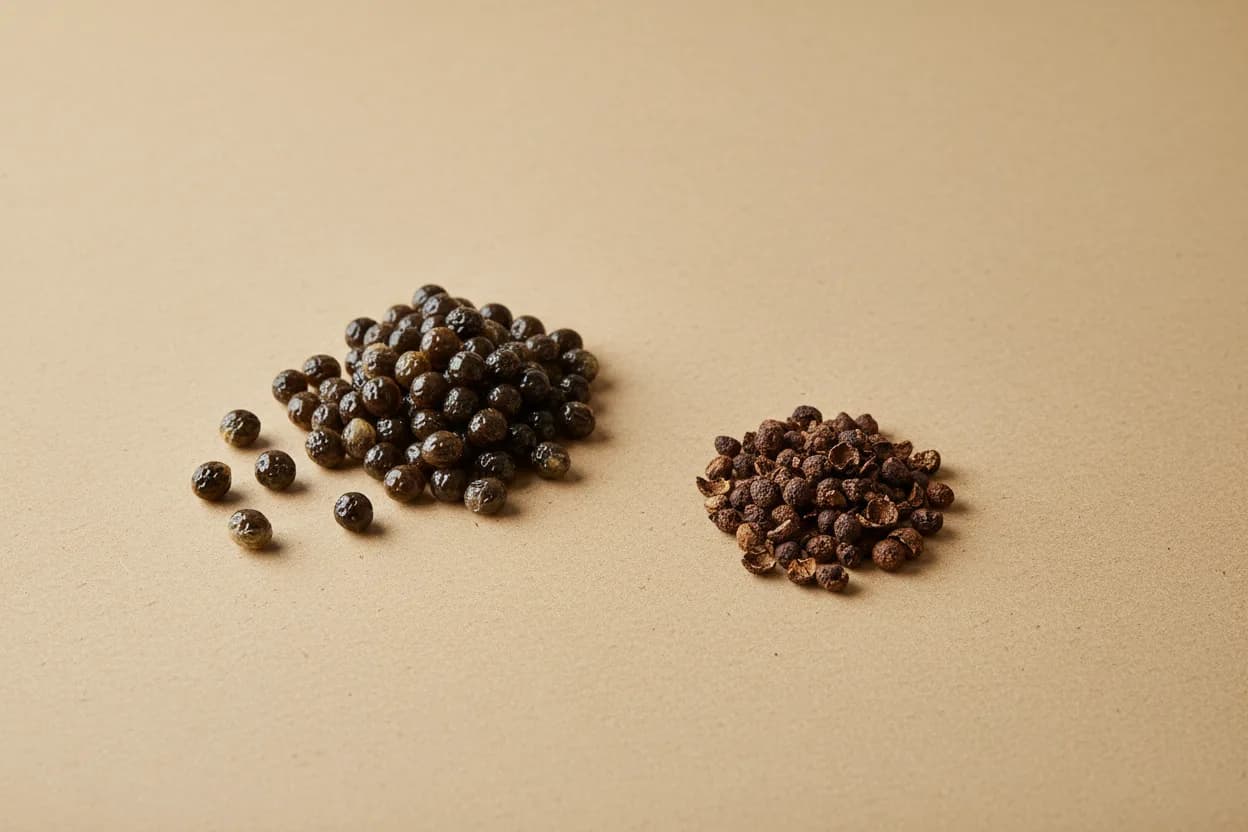
Scrape the seeds out of a papaya, rinse the orange jelly off them, and bite one. Nothing about it reads as fruit. It lands nearer to radish, or watercress, or the back end of a spoonful of wasabi: a clean bitter heat that goes up behind the nose rather than sitting on the tongue. People who try this usually assume they have found a curiosity. They have found a family resemblance.
Papaya belongs to the Caricaceae, and the Caricaceae sit inside the Brassicales, the order that also holds mustard, cabbage, horseradish, watercress, capers, moringa and nasturtium. Its lineages have been diversifying for something on the order of a hundred and three million years. 4 What holds the order together is a shared piece of chemistry: the glucosinolates, the sulphur compounds that give every one of those plants its particular sharpness. 3 The heat in a papaya seed is not a coincidence or a quirk of the tropics. It is the ordinary equipment of the mustard family, showing up in a fruit that looks nothing like a mustard.
Papaya carries one glucosinolate rather than a spread of them: glucotropaeolin. 3 The name comes from Tropaeolum, the nasturtium genus, which runs on the same compound. And papaya concentrates it in a very specific place. When a Japanese group separated papaya seed from papaya pulp and measured both, the seed came in at more than one millimole of benzyl glucosinolate per hundred grams, a level they put alongside Karami daikon, the hottest Japanese white radish, or cress. The pulp, the part everybody actually eats, contained an undetectable amount and showed no meaningful enzyme activity at all. 1 A later survey of peel, pulp and seed through development and ripening found the same gradient, with the seeds well ahead of everything else. 2
So the breakfast fruit and the spoonful of seeds you scrape into the bin are, chemically, two different ingredients that happen to be packed in the same skin.
What roasting actually does
Glucosinolates on their own are not pungent. They need myrosinase, the enzyme stored separately in the plant and brought into contact with them when the tissue is crushed. Papaya seed has plenty of it: the same measurement that found the glucosinolate found very high myrosinase activity in the seed, and seed measured with that enzyme left active yielded 460 micromoles of benzyl isothiocyanate per hundred grams. 1 That isothiocyanate is the heat.
Myrosinase is also fragile. In broccoli it inactivates across a range of roughly 30 to 60 degrees, and the authors of that kinetic study noted it is thermolabile compared with the other enzymes food scientists usually worry about, polyphenol oxidase and peroxidase among them. 5 Put a dry pan under papaya seeds and you are heating past that range within a minute or two.
This is where the popular version of the advice quietly inverts itself. Roasting is recommended as the civilised way to eat papaya seeds, and it does make them pleasant: nuttier, less aggressive, easier to grind into something you would actually put on a salad. It achieves that by destroying the enzyme that makes the compound everybody is recommending them for.
It is not a clean switch, though. When a Dutch group varied the water content of broccoli from 10 to 90 per cent and heated it between 40 and 70 degrees, myrosinase inactivated more slowly in the driest samples at every temperature tested. 6 A dry seed is a better shelter for its own enzyme than a wet floret is. A short toast in a dry pan is a gentler treatment than the numbers alone suggest.
And a denatured enzyme is not the end of the story either. Work on cooked brassicas shows that when plant myrosinase is gone, intact glucosinolates travel down to the colon and the resident microflora hydrolyse them there instead. The site of release moves from the upper gut to the lower. Human feeding trials found that hydrolysis and isothiocyanate absorption were greater from raw vegetables with their enzyme intact than from cooked ones without it. 7 Less, then, but not none, and arriving somewhere else.
The practical version: crack them raw or barely warmed if you want the pepperiness, since that is where the enzyme still works. Toast them properly if you want a mild nutty grind that behaves itself in a dressing. Either is a legitimate ingredient. They are simply not the same ingredient, and the milder one is milder because there is less of the active compound in it.
The health warning, which is real but specific
Benzyl isothiocyanate has a research history that has nothing to do with cooking. In 1999 a group in Rajasthan gave adult male rabbits a benzene fraction of a chloroform extract of papaya seed at 50 milligrams per animal per day for 150 days. The animals were azoospermic within 15 days and stayed that way for the full period. Their fertility rate was zero. Haematology and serum chemistry showed no appreciable change, libido was normal, and everything returned to baseline 60 days after the treatment stopped. 8
Read that carefully before deciding what it means for a teaspoon. It is a solvent-extracted fraction, not a seed; a rabbit, not a person; a daily dose sustained for five months. Nobody has shown that seasoning food with papaya seeds does anything of the kind. What the study does establish is that the compound has real reproductive activity in a mammal at sustained exposure, which is a reasonable thing to know if you are trying to conceive and have started eating them by the spoonful because the internet suggested it.
There is a second finding that deserves more attention than it gets. Papaya contains low levels of cyanogenic glycosides, the class of compounds that release hydrogen cyanide when the plant is damaged. That combination was thought not to occur: glucosinolates and cyanogenic glycosides were assumed to be mutually exclusive, two different chemical strategies a plant would not run at once, and papaya runs both. 3 The levels are low and the fruit is eaten worldwide without incident. It is still an argument for treating the seeds as a seasoning with a dose rather than a health food to be eaten by the handful.
For pregnancy the evidence points at the fruit rather than the seed, and it is more specific than the folklore. Rats fed ripe papaya through gestation showed no difference in implantation sites or viable fetuses and no maternal or fetal toxicity, and ripe juice did nothing to isolated uterine muscle. Crude papaya latex, the milky sap of the unripe fruit, was another matter: it produced spasmodic contraction comparable to oxytocin and prostaglandin, and in the late-pregnancy uterus the response was tetanic. 9 The authors were careful to say this is a rat model and that the human risk is not established. Ripe papaya looks fine. Unripe papaya, the latex and the seeds are the ones to leave alone while pregnant.
None of that makes papaya seeds exotic or dangerous in the way a headline would want. It makes them a pungent brassica-order seed with a dose response, which is the same sentence you could write about horseradish, or mustard oil, or a large quantity of watercress.
The part I keep coming back to is the packaging. A papaya puts its entire chemical defence into the seeds and leaves the flesh completely disarmed, so the animal that eats the fruit carries the seeds somewhere useful and gets nothing but sugar for the trouble. We have spent a long time eating the half that was meant for us and throwing away the half that was meant to survive us. It turns out the discarded half tastes like the mustard shelf, because that is what the family does.
Sources
Every numbered claim above points here. Links go to the paper, record, or authority itself.
- 1.
Nakamura Y, Yoshimoto M, Murata Y, Shimoishi Y, Asai Y, Park EY, Sato K, Nakamura Y. Papaya seed represents a rich source of biologically active isothiocyanate. Journal of Agricultural and Food Chemistry, 2007, 55, 4407-4413.
https://doi.org/10.1021/jf070159w - 2.
Rossetto MRM, Oliveira do Nascimento JR, Purgatto E, Fabi JP, Lajolo FM, Cordenunsi BR. Benzylglucosinolate, benzylisothiocyanate, and myrosinase activity in papaya fruit during development and ripening. Journal of Agricultural and Food Chemistry, 2008, 56, 9592-9599.
https://doi.org/10.1021/jf801934x - 3.
Williams DJ, Pun S, Chaliha M, Scheelings P, O'Hare T. An unusual combination in papaya (Carica papaya): The good (glucosinolates) and the bad (cyanogenic glycosides). Journal of Food Composition and Analysis, 2013, 29, 82-86.
https://doi.org/10.1016/j.jfca.2012.06.007 - 4.
Cardinal-McTeague WM, Sytsma KJ, Hall JC. Biogeography and diversification of Brassicales: A 103 million year tale. Molecular Phylogenetics and Evolution, 2016, 99, 204-224.
https://doi.org/10.1016/j.ympev.2016.02.021 - 5.
Ludikhuyze L, Ooms V, Weemaes C, Hendrickx M. Kinetic study of the irreversible thermal and pressure inactivation of myrosinase from broccoli (Brassica oleracea L. cv. Italica). Journal of Agricultural and Food Chemistry, 1999, 47, 1794-1800.
https://doi.org/10.1021/jf980964y - 6.
Oliviero T, Verkerk R, Van Boekel MAJS, Dekker M. Effect of water content and temperature on inactivation kinetics of myrosinase in broccoli (Brassica oleracea var. italica). Food Chemistry, 2014, 163, 197-201.
https://doi.org/10.1016/j.foodchem.2014.04.099 - 7.
Rungapamestry V, Duncan AJ, Fuller Z, Ratcliffe B. Effect of cooking brassica vegetables on the subsequent hydrolysis and metabolic fate of glucosinolates. Proceedings of the Nutrition Society, 2007, 66, 69-81.
https://doi.org/10.1017/s0029665107005319 - 8.
Lohiya NK, Mishra PK, Pathak N, Manivannan B, Jain SC. Reversible azoospermia by oral administration of the benzene chromatographic fraction of the chloroform extract of the seeds of Carica papaya in rabbits. Advances in Contraception, 1999, 15, 141-161.
https://doi.org/10.1023/a:1006701826831 - 9.
Adebiyi A, Adaikan PG, Prasad RN. Papaya (Carica papaya) consumption is unsafe in pregnancy: fact or fable? Scientific evaluation of a common belief in some parts of Asia using a rat model. British Journal of Nutrition, 2002, 88, 199-203.
https://doi.org/10.1079/bjnbjn2002598