The orchid that needed a thumb
Vanilla is the second most expensive spice on earth because every flower is pollinated by hand, in a window of a few hours, by a method worked out by an enslaved twelve-year-old.
Contents
Vanilla is an orchid, which is the first surprising thing about it, and a climbing vine native to Mesoamerica, which is the second. The Totonac of what is now Veracruz cultivated it first; the Aztecs, having subjugated them, took it up for flavouring cacao. It reached Europe with the Spanish in the sixteenth century, and then a very specific problem appeared. The vines grew perfectly well in European greenhouses and colonial plantations across two oceans. They flowered. They would not fruit.
The missing bee that probably was not the problem
The explanation everyone repeats is that vanilla is pollinated by a single species of Melipona bee that lives only in Mexico, so transplanted vines had no partner. It is a lovely story and the evidence for it is thin to the point of collapse.
A historical review traced the claim to an 1884 account whose description of the insects, pale green, striped yellow, chestnut, brown, black and even blue, and one to seven centimetres long, does not describe any actual Melipona bee. It was copied forward for a century and hardened into fact along the way. 1 In 2024 a field study put an introduced Melipona beecheii colony beside flowering vanilla in the Yucatán and watched: the bees were not attracted to the flowers, and no legitimate pollination visits were recorded from them or from orchid bees. 2
The likelier truth is less tidy and more interesting. Vanilla is a nectarless, deceptive flower that offers pollinators nothing, and its natural fruit set is somewhere between one in a hundred and one in a thousand flowers even in its native range. 1 So the honest framing is not that we broke a working pollination system by moving the plant, but that vanilla never had a working one. Human hands do at scale what the flower almost never manages on its own.
Edmond
Edmond was born in 1829 in Sainte-Suzanne on Bourbon, now Réunion, to an enslaved mother who died in childbirth. He was enslaved himself, on the plantation of Féréol Bellier-Beaumont, who took an interest in the boy and taught him some botany.
At around twelve he solved it. The vanilla flower keeps its male anther and female stigma separated by a membranous flap called the rostellum, which is what prevents the flower from simply pollinating itself. Edmond lifted the flap with a thin sliver of bamboo and pressed the two parts together with his thumb. That is the entire technique, and it is still, essentially unchanged, how every vanilla bean in the world is produced.
Two corrections the record deserves. The date is conventionally given as 1841, but Bellier-Beaumont, writing later, admitted he had neglected to date his own account and could not say the year with precision; the earliest solid documentary trace of the method being described publicly is 1843. 1 And Edmond did not invent hand pollination in the absolute sense: Charles Morren had already fruited vanilla artificially in a Belgian greenhouse in 1836 or 1837. What Edmond produced was the fast, simple, teachable version that a plantation could actually run on, which is a different and more consequential thing. When a botanist later claimed to have taught him the method years earlier, Bellier-Beaumont pointed out that this would have required teaching it to an eight-year-old.
The method spread through the colony's plantations within a few years, and Réunion turned into a serious vanilla producer on the strength of it. Edmond was freed in 1848 when France abolished slavery in its colonies, took the surname Albius from the Latin for white, after the flower, worked afterwards as a servant and labourer, spent time in prison following a theft conviction, and died in poverty in 1880, aged about fifty-one. 1 The industry he made possible was, by then, enormous.
Why it costs what it costs
A vanilla flower opens for roughly one day. The practical pollination window is the morning, about six until one, and although the stigma stays receptive for up to a day, the work is done early or not at all. A trained worker can pollinate one to two thousand flowers in a day, and hand pollination alone accounts for around a third of the labour cost of growing vanilla. 3 There is no machine for this, and there is unlikely ever to be one.
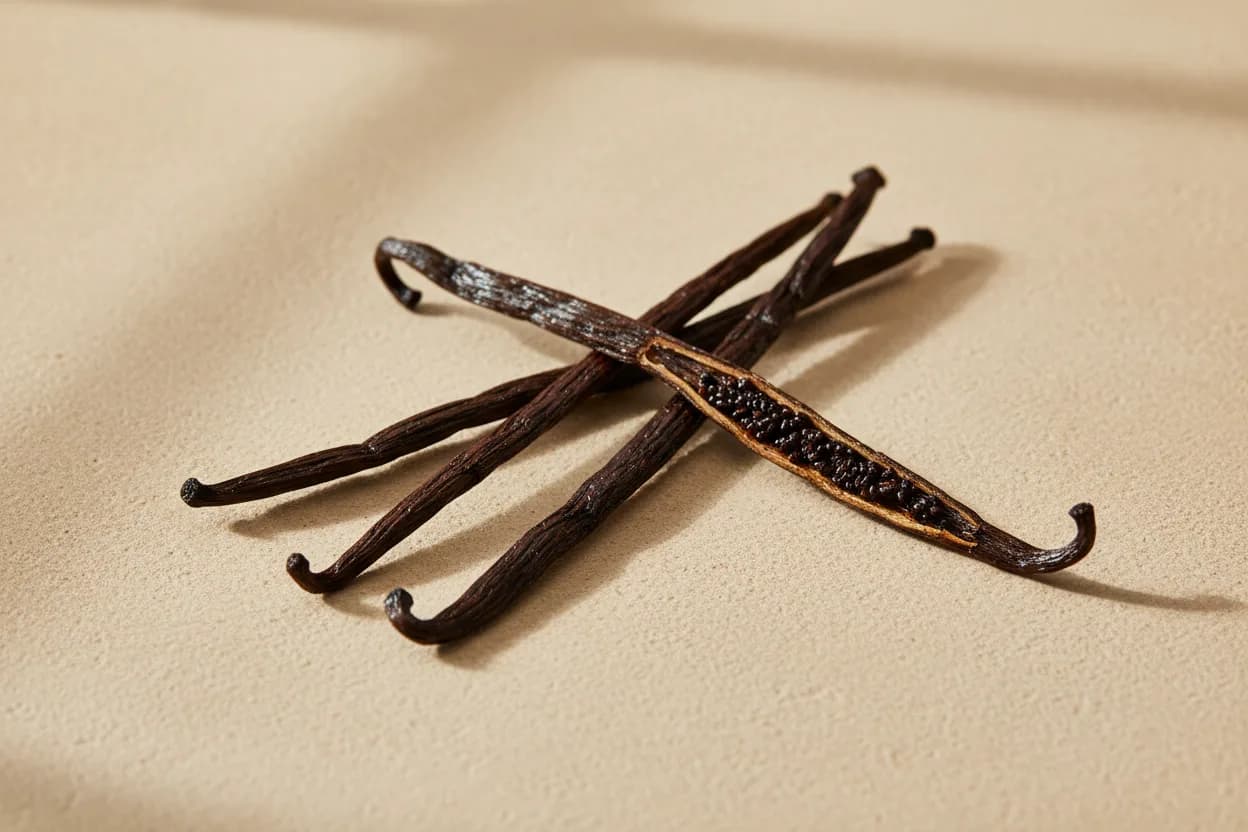
Then the bean has to be cured, which takes months and is not merely drying. A green vanilla pod has essentially no smell. Curing runs in four stages: killing, usually a brief hot-water scald or a freeze; sweating, held hot and humid; drying, alternating sun and shade over weeks; and conditioning in closed boxes for months afterward. 7 Three to six months from green pod to something you would recognise.
What curing is actually for
The chemistry explains why you cannot skip it. In the living pod, vanillin is not present as vanillin at all: it is stored as glucovanillin, an inactive glucoside, kept physically separated from the enzyme beta-D-glucosidase that would cleave it. Different compartments, same tissue, no contact.
The killing step exists precisely to break that separation. Rupture the compartmentalisation and the enzyme finally reaches its substrate and starts liberating free vanillin. 4 The parallel with garlic is exact, and both are worth holding in mind as a general principle: a great deal of what we call flavour is not stored in a plant, it is manufactured at the moment the plant's internal architecture fails.
Vanillin itself is small and unglamorous: 4-hydroxy-3-methoxybenzaldehyde, C₈H₈O₃, 152 grams per mole. 5 A cured bean carries it alongside a couple of hundred other aroma compounds, and several of those, guaiacol and acetovanillone among them, register nearly as intensely to the nose despite being present at a fraction of the concentration. That is the actual chemical reason a real bean and a bottle of pure vanillin are not the same experience, and it has nothing to do with romance. It is that one of them is a mixture.
Most vanillin in the world has never been near an orchid. In 2001, world demand ran to twelve thousand tonnes, of which about eighteen hundred, fifteen per cent, was natural. Today most of it is made from guaiacol, with a minority route from lignin, a by-product of paper pulping. 6 There is a fact from that older lignin era worth keeping: by 1981 a single sulfite pulp mill in Thorold, Ontario, was supplying around sixty per cent of the world's synthetic vanillin, turning waste liquor from paper-making into the smell of dessert.
So when you split a bean, remember the arithmetic. One flower, one morning, one thumb, and then a hundred days of somebody turning pods in and out of the sun. The price is not a market failure so much as a fairly honest accounting of the work.
Sources
Every numbered claim above points here. Links go to the paper, record, or authority itself.
- 1.
Karremans AP. A Historical Review of the Artificial Pollination of Vanilla planifolia: The Importance of Collaborative Research in a Changing World. Plants. 2024;13(22):3203.
https://doi.org/10.3390/plants13223203 - 2.
Quezada-Euán JJG, Guerrero-Herrera RO, González-Ramírez RM, MacFarlane DW. Frequency and behavior of Melipona stingless bees and orchid bees in relation to floral characteristics of vanilla in the Yucatán region of Mexico. PLOS ONE. 2024;19(7):e0306808.
https://doi.org/10.1371/journal.pone.0306808 - 3.
Van Dyk S, McGlasson WB, Williams M, Spooner-Hart R, Holford P. Vanilla planifolia: Artificial and Insect Pollination, Floral Guides and Volatiles. Plants. 2024;13(21):2977.
https://doi.org/10.3390/plants13212977 - 4.
Odoux E, Escoute J, Verdeil JL. The relation between glucovanillin, beta-D-glucosidase activity and cellular compartmentation during the senescence, freezing and traditional curing of vanilla beans. Annals of Applied Biology. 2006;149(1):43-52.
https://doi.org/10.1111/j.1744-7348.2006.00071.x - 5.
PubChem Compound Summary CID 1183, Vanillin (4-hydroxy-3-methoxybenzaldehyde). National Center for Biotechnology Information.
https://pubchem.ncbi.nlm.nih.gov/compound/1183 - 6.
Fache M, Boutevin B, Caillol S. Vanillin Production from Lignin and Its Use as a Renewable Chemical. ACS Sustainable Chemistry & Engineering. 2016;4(1):35-46.
https://doi.org/10.1021/acssuschemeng.5b01344 - 7.
Cuan-Escobar TA, et al. Effect of different killing methods during curing on the phytochemical and bacterial composition of Vanilla planifolia using multi-omic approaches. Food Chemistry: X. 2025;26:102269.
https://doi.org/10.1016/j.fochx.2025.102269