dried lavender
Lavandula angustifolia
IN ARABIC خُزامى مجفّفة
Fragrant buds for calm and sleep.
ABOUT
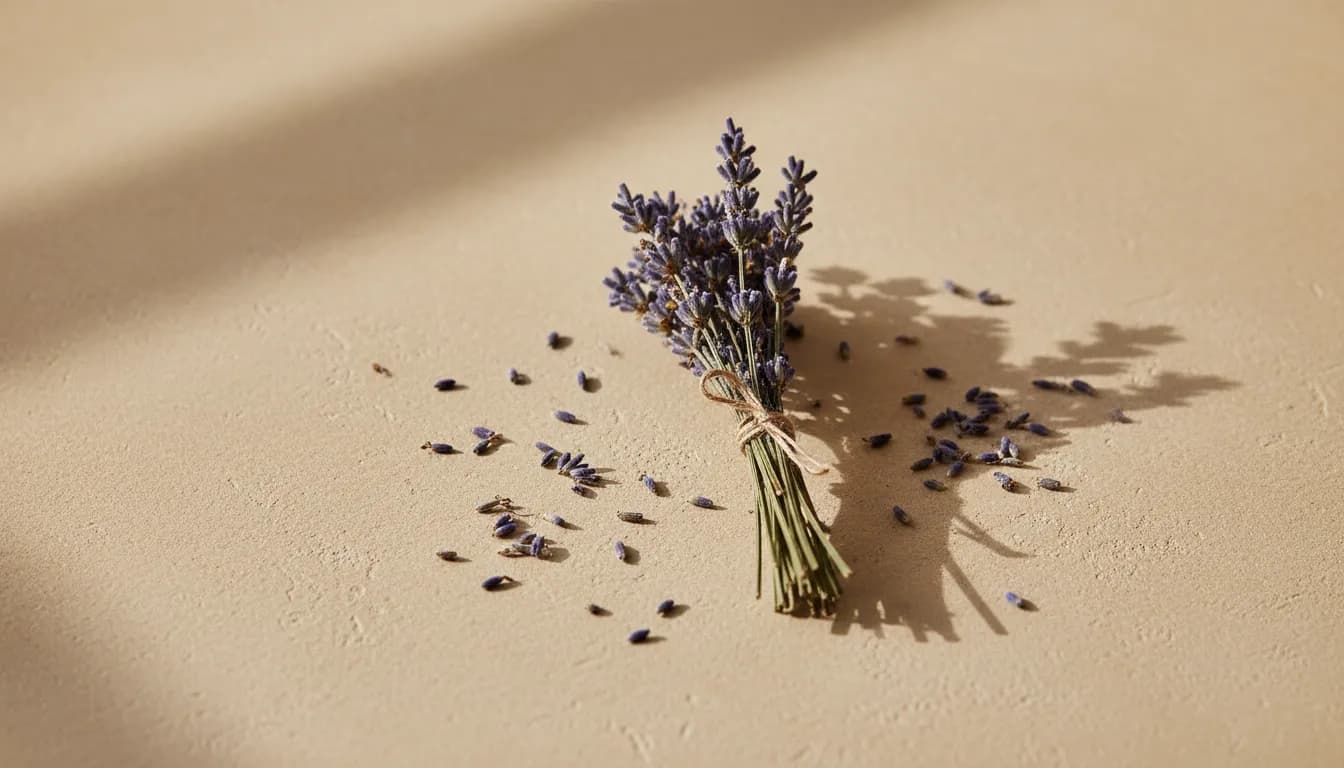
Lavender here means the dried flower buds of Lavandula angustifolia. All eight of its recipes use tiny amounts: about 0.03 grams, six to eight buds, in jasmine and lavender, up to a tenth of a gram, roughly an eighth of a teaspoon, in blue euphoric tea and lavender, star anise and jujube; smoke recovery tea lists the buds as optional. Three recipes, deep sleep tea, smoke recovery tea and velvet ember tea, add them only once the heat is off, while the rest steep them straight into a warmed pot or cup rather than a boil, keeping the buds away from a long simmer either way.
The two compounds this library tracks, linalool at 33.6 to 46.1 percent of the flower oil and linalyl acetate at 24.7 to 32.7 percent, are lavender's own quality markers: together they make up most of what a grower calls good lavender oil, and the ester is specifically what keeps the scent reading sweet rather than sharp. Both are volatile terpenes, the same fragility that keeps every recipe here from boiling the buds: heat does not break them apart so much as carry them off into the steam before they ever reach the cup.
What lavender does once swallowed has its best evidence in a form nothing here serves: Silexan, a standardised oral lavender-oil capsule licensed as a medicine in Germany. Pooled across five trials and 1,213 patients, it beat placebo by 2.9 points on a standard anxiety scale, a small but real effect, though one of the five trials was flatly negative and every trial in the pool was run and funded by the company that sells the product. A cup steeped from an eighth of a teaspoon of buds is a different dose of a different preparation, and nobody has tested it against anything.
CHEMISTRY
2The characteristic compounds documented in this ingredient, plus any the library traces to it in a recipe. Not an exhaustive phytochemistry.
33.6 to 46.1% of the flower oil, and with linalyl acetate one of the two quality markers for lavender.
24.7 to 32.7% of the flower oil, the ester that makes lavender read sweet rather than sharp.
USED IN
8Lavender, Star Anise & Jujube
0.1 g · ≈ 1/8 tsp buds
STEP 1 Slice the jujube to open its sweetness and add it to the pot with the lavender and broken star anise.
Blue Euphoric Tea
0.1 g · ≈ 1/8 tsp buds
STEP 1 Add the butterfly pea petals, lavender, star anise, and sliced ginger to a warmed cup.
Spikenard, Lavender & Star Anise
0.05 g · ≈ 1/16 tsp buds
STEP 1 Combine the spikenard, lavender, and star anise in a small pot.
Chamomile, Lavender & Star Anise
0.08 g · ≈ 1/16–1/8 tsp buds
STEP 1 Combine the chamomile, lavender, and star anise in a warmed pot.
Smoke Recovery Tea
0.03 g · optional
STEP 2 Off the heat, add the chamomile, mint, and lavender.
Deep Sleep Tea
0.09 g
STEP 2 Turn off the heat and add the chamomile, lavender, valerian, and mint.