black tea
Camellia sinensis
IN ARABIC شاي أسود
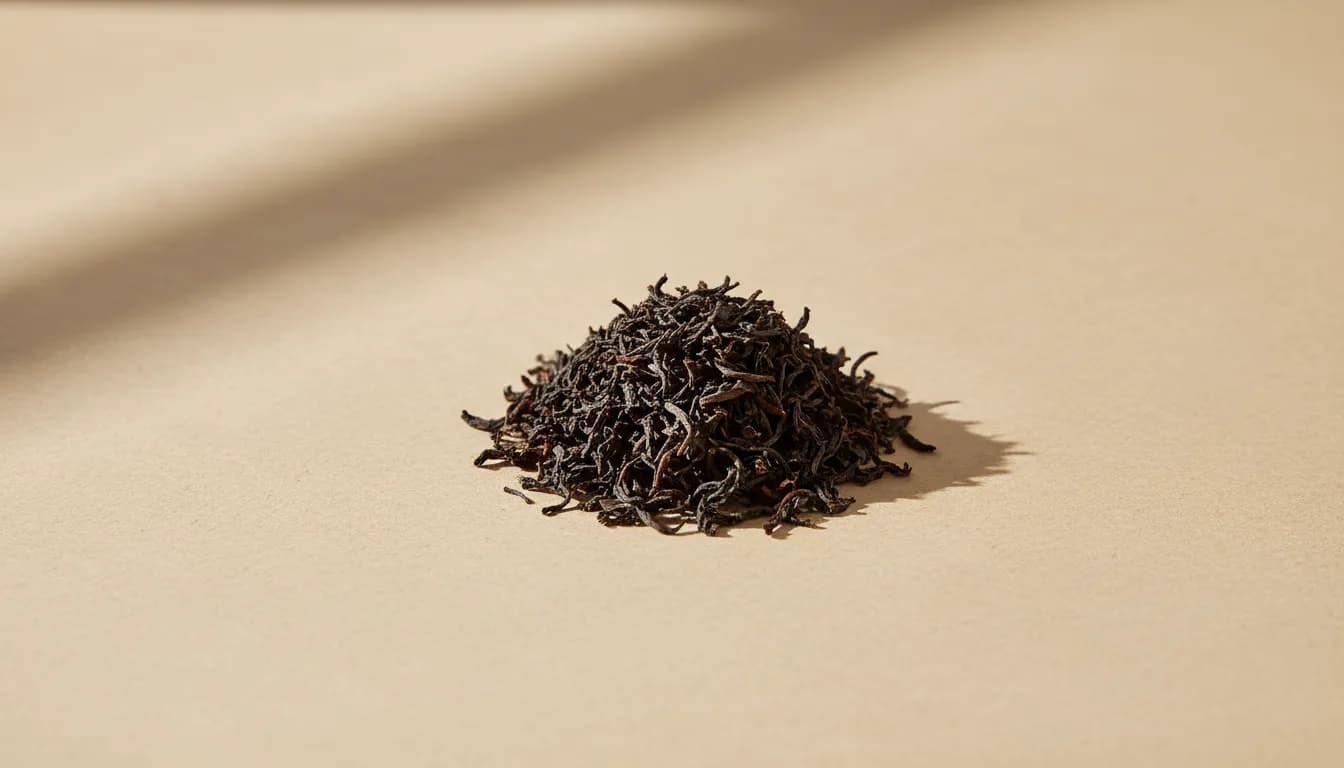
Fully oxidized leaf, brisk and caffeinated.
ABOUT
Camellia sinensis, the oxidised leaf, and in this library it never carries a cup by itself: seven recipes use it, all teas, at doses from half a gram to a gram and a half. In five of them the pattern repeats. Other botanicals, jujube and ginger, sage, ginger and cardamom, get their simmer first, and the tea goes in only after, off the heat or near it, steeping for no more than a minute or two so the tannin does not take over the cup. Three of those five are milk teas, where the brief steep also keeps the tea from fighting the fresh, evaporated and condensed milk stirred in last. Grape mint wine breaks the pattern outright: its gram of leaf, about half a teaspoon, is cold-brewed for two to four hours instead, which keeps it smooth rather than bitter.
The three compounds in the leaf do different jobs on the tongue. Catechins, EGCG chief among them, are what dries the mouth: work published in 2014 anaesthetised the front-of-tongue taste nerve and found the pucker stayed, then blocked the trigeminal nerve as well and it vanished, so astringency turns out to ride on the touch system rather than taste. What the catechins are actually doing is precipitating the proline-rich proteins that make up about seventy per cent of saliva's protein, stripping the mouth's lubricating film rather than triggering a taste receptor. Two odd findings sit on top of that. Milk cuts the astringency of a strong cup while making the oral lubrication measurably worse, which the 2009 study that found it could not fully explain. And caffeine, the tea's other compound, quietly weakens EGCG's own astringency by getting between it and the salivary protein before the tannin can bind, an interaction modelled in 2024 with real saliva. The third compound, l-theanine, does something gentler: it is the amino acid these recipes credit with taking caffeine's edge off, sweet and savoury rather than bitter. The Journal's note on astringency walks through the rest of the mechanism.
What actually reaches you is smaller than either compound's reputation. Black tea runs about 47 milligrams of caffeine to an eight-ounce cup, USDA's own figure, and what it does once it is in you was only worked out in 1981: caffeine is shaped closely enough to adenosine to occupy its receptors without triggering them, blocking the signal that reports how long you have been awake rather than adding any stimulus of its own. Whether that translates into feeling more alert depends on who is drinking it. A 2010 trial of 379 people found no net alertness benefit over placebo in non-habitual drinkers, while a 2005 crossover in 24 people who were not caffeine users found real gains in reaction time and working memory, so the honest read is that for a daily drinker much of the lift is simply restoring what the last cup wore off. L-theanine fares worse against its own trials. Under the brewing conditions researchers actually measured, one gram of leaf in a hundred millilitres at eighty degrees for three minutes, black tea gives up about 5.13 milligrams of theanine per gram of leaf, so a normal two-gram serving carries somewhere around ten to thirteen milligrams. The trials behind theanine's calming reputation use 200 milligrams, fifteen to twenty cups drunk at once, brewed stronger and steeped longer than any recipe in this library asks for. The cup still does something; it just is not the dose in the study. The Journal's note on herbal tea and stress evidence has the rest of the arithmetic.
CHEMISTRY
3The characteristic compounds documented in this ingredient, plus any the library traces to it in a recipe. Not an exhaustive phytochemistry.
grippy tannin
calm, sweet-savory
USED IN
7Wine-Style Grape & Mint
1 g · ≈ 1/2 tsp, cold-brewed
STEP 2 Tea: Steep the black tea in 150 ml cold water in the fridge, then strain; cold-brewing keeps it smooth, not bitter.
STEP 3 Mix: Combine the grape juice, mint infusion, cold-brew tea, and the lemon juice.