The film on the tea was never limescale
Water is the most-used ingredient in this index, in twenty-nine of thirty-nine recipes and in every single tea, and it is the one nobody writes down. In the 1990s a chemist at Imperial College spent four papers on the film it leaves on the surface of a cup, and almost everything people assume about that film turned out to be wrong.
Contents
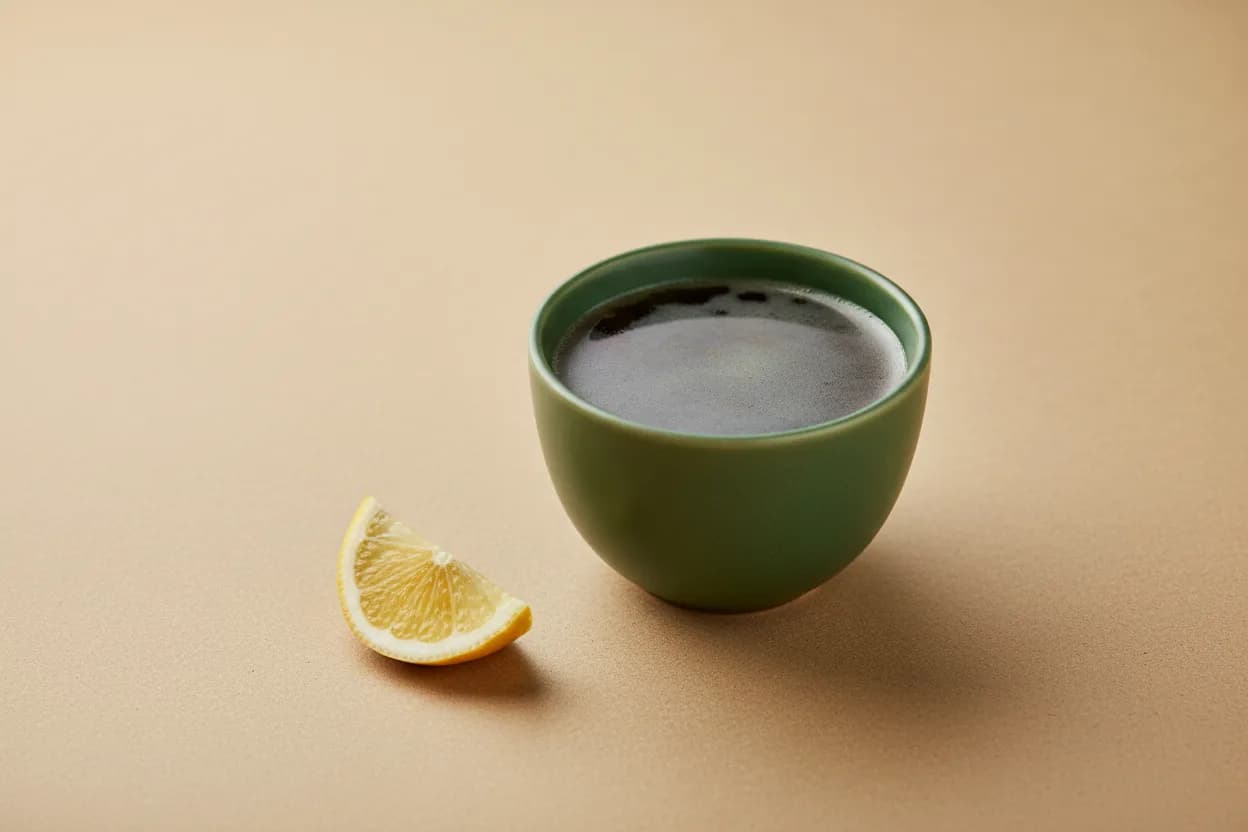
Make a mug of black tea in a hard-water town, leave it a few minutes, and tilt it towards the light. There is a film on the surface. It slides about in one piece, catches the light like oil, and sticks to the side of the cup as the level drops.
Nearly everyone who notices it blames the kettle. Limescale, flaking off the element and floating up. It is a good theory, and in 1993 a chemist at Imperial College put the question to Nature under exactly that title, What causes scum on tea, and then spent the rest of the decade answering it properly.1
Michael Spiro and Deogratius Jaganyi got a different answer. The film is not limescale, and the experiment that proves it is the best thing in the literature.
What the film is made of
They collected it, which is harder than it sounds, and put it through powder diffractometry. Limescale is calcite: crystalline, with a diffraction pattern like a fingerprint. The scum came back amorphous. No pattern at all.2
Under the electron microscope there was calcium carbonate on the film, but sitting on it as islands, and dilute hydrochloric acid washed those away while the film underneath survived. Chemical microanalysis put the calcium at 3 per cent by weight, rising to 7 as the film aged.2 The other ninety-odd per cent is an organic polymer that came out of the tea. The empirical formula of that matrix runs to around forty-five carbon atoms.2
Then the clean kill. In a later paper they blew a film of calcium carbonate onto the surface of a tea infusion, which is roughly the limescale theory staged on purpose, and it did not reproduce the effect. What did produce scum was calcium and bicarbonate present as ions in the water. Their conclusion is that it is the ions, and not the calcium carbonate they go on to form, that mediate the film.4
What it does need
The kinetics paper is a small masterpiece of patience. Black tea, hard London mains water, 80 degrees, and a long list of things they tried.
The film needs both ions. Take the calcium or magnesium out with a complexing agent and no film forms. Take the bicarbonate out by lowering the pH and no film forms either.3 Hardness alone will not do it and alkalinity alone will not do it, which matters more than it sounds, because those two are constantly mistaken for each other.
It also needs air. They passed nitrogen over the surface of a cup of tea and the scum was inhibited. They passed oxygen over it and the scum increased.3 Their mechanism, in their words, is that scum is produced by oxidation of tea solubles mediated by calcium carbonate formation.
And it is a surface, not a sediment. The amount that formed depended on the exposed surface area and not on the volume of the brew.3 A wide mug scums more than a tall one holding exactly the same tea. Stirring made no difference at all, and the activation energy came out at 34 kilojoules per mole, high enough to say the slow step is a chemical reaction rather than anything diffusing anywhere.3
Three findings in that paper are the sort a person repeats at a table. Decaffeinated tea scums just as much as ordinary black tea, so caffeine has nothing to do with it. Green Chun Mee makes about eighty per cent as much. And the more tea leaf they used, the less scum they got, which they attribute to the drop in pH that comes with a stronger brew.3 Boiling the water first reduced the scum without eliminating it, so the folk remedy half works, and now we know by how much.
A slice of lemon greatly decreases it, by two routes at once: the pH falls, and citric acid ties up the calcium. Two cubes of sugar significantly reduce it too, and here the authors are honest in a way I like. The effect is far more than could be accounted for by the increase in solution viscosity, and they leave it there, unexplained.4
Thirty years on, a group at ETH Zurich put the film on an interfacial rheometer and measured it. It is about twenty nanometres thick, and going from soft to hard water made it roughly thirty-five times stiffer.5 They describe it as high molecular weight organic material with islands of calcium carbonate, which is Spiro's answer, confirmed with better instruments.5
The two numbers everyone confuses
Hardness counts the dissolved calcium and magnesium.6 Alkalinity counts the buffering capacity, the water's ability to neutralise acids and bases and hold a stable pH, and it comes mostly from bicarbonates and carbonates.7 Cations in one, anions in the other. Both are reported in milligrams per litre as calcium carbonate, the same unit for two different quantities, which is exactly how they came to be treated as one thing. The US Geological Survey calls water soft below 60 and very hard above 180.6
The distinction earns its keep the moment you ask which one spoils a cup. A 2021 study brewed green tea across five hardness levels and found that as hardness rose the total catechin yield fell, mostly through the oxidation of epigallocatechin and its gallate, and that the infusions browned. The driver was the alkaline condition, and the paper's warning is aimed squarely at the bicarbonate: high levels of alkaline sodium bicarbonate found in hard water can render some tap waters unsuitable for green tea preparation.8 The calcium takes the blame; the bicarbonate does the damage.
The people who actually measured it
Coffee got there first, and with better funding. In 2014 the Journal of Agricultural and Food Chemistry published a paper on how dissolved cations pull flavour compounds out of coffee. Two of its three authors are credited to a street address: Colonna and Small's, 6 Chapel Row, Bath.10 A café, in the affiliation block, next to the Department of Chemistry.
It found magnesium the strongest binder of the three ions tested and told readers plainly that sodium rich water is of no benefit to the consumer.10 It is also, and this rarely survives the retelling, a computational study. No brewing, no tasting, no panel. The shift it reports between desirable and undesirable acids in going from calcium to magnesium is around five per cent, and bicarbonate is named in the paper as outside its scope.10
Ten years later a group in Sweden tested the idea in an actual brewer, adding salts before and after extraction and comparing the results by mass spectrometry and NMR. The two matched, which should not happen if the ions were doing their work in the coffee bed. Their finding is that whatever interactions take place are more likely to occur in the final cup, and they say so directly: the findings contradict previously suggested mechanisms for the role of calcium and magnesium in extraction of acids.11
The trade standards sit oddly beside that argument, because they were never in doubt about the direction. The Specialty Coffee Association of America's 2009 water standard names a target of 150 parts per million total dissolved solids, 68 of calcium hardness and 40 of alkalinity.12 The current standard widens it to a band: calcium hardness of 50 to 175, alkalinity of 40 to 70, pH between 6 and 8.13 The numbers moved. The floor did not. Neither document has ever permitted zero.
That floor is the part that catches people out, because the intuition runs the other way. Purer should be cleaner. But a 2019 study of green tea found that purified water gave the capability to double the EGCG content of the infusion,9 and EGCG is among the more bitter and astringent things in the leaf. Strip the minerals and you do not get a cleaner cup. You get a harsher one.
There is a line at the top of that 2021 green tea paper that I keep thinking about. In scientific studies, green tea is often prepared with deionized water, it says, while casual consumers simply use their local tap water, which differs in alkalinity and mineral content depending on the region.8 The laboratory takes the water out of the experiment in order to see the tea clearly, and in doing so brews a cup that nobody anywhere actually drinks.
Twenty-nine of the thirty-nine recipes in this index list water as an ingredient, and every one of the twenty-three teas does. Each of them calls it filtered, which describes what has been taken out and says nothing about what is left. That was fine as long as I thought water was the neutral part. It is the only thing in the cup that came out of the ground under your own town, and on a hard-water morning it is the one leaving a mark you can see.
Sources
Every numbered claim above points here. Links go to the paper, record, or authority itself.
- 1.
Spiro M, Jaganyi D. What causes scum on tea? Nature. 1993;364(6438):581. Cited here for the question and its authorship; the body of the note is paywalled and the findings quoted in this piece are taken from the Food Chemistry papers below.
https://doi.org/10.1038/364581a0 - 2.
Spiro M, Jaganyi D. Kinetics and equilibria of tea infusion. Part 10: The composition and structure of tea scum. Food Chemistry. 1994;49(4):351-357.
https://doi.org/10.1016/0308-8146(94)90004-3 - 3.
Spiro M, Jaganyi D. Kinetics and equilibria of tea infusion. Part 11: The kinetics of the formation of tea scum. Food Chemistry. 1994;49(4):359-365.
https://doi.org/10.1016/0308-8146(94)90005-1 - 4.
Spiro M, Chong YY, Jaganyi D. Kinetics and equilibria of tea infusion. Part 13: Further studies on tea scum: the effects of calcium carbonate, lemon juice and sugar. Food Chemistry. 1996;57(2):295-298.
https://doi.org/10.1016/0308-8146(95)00236-7 - 5.
Giacomin CE, Chen RY, Hack E, Fischer P. Tea film formation in artificial tap water. Soft Matter. 2023;19(31):5967-5977.
https://doi.org/10.1039/d3sm00169e - 6.
US Geological Survey. Hardness of Water. USGS Water Science School. Includes the classification bands in mg/L as calcium carbonate.
https://www.usgs.gov/special-topics/water-science-school/science/hardness-water - 7.
US Geological Survey. Alkalinity and Water. USGS Water Science School.
https://www.usgs.gov/special-topics/water-science-school/science/alkalinity-and-water - 8.
Cabrera M, Taher F, Llantada A, Do Q, Sapp T, Sommerhalter M. Effect of water hardness on catechin and caffeine content in green tea infusions. Molecules. 2021;26(12):3485.
https://doi.org/10.3390/molecules26123485 - 9.
Franks M, Lawrence P, Abbaspourrad A, Dando R. The influence of water composition on flavor and nutrient extraction in green and black tea. Nutrients. 2019;11(1):80.
https://doi.org/10.3390/nu11010080 - 10.
Hendon CH, Colonna-Dashwood L, Colonna-Dashwood M. The role of dissolved cations in coffee extraction. Journal of Agricultural and Food Chemistry. 2014;62(21):4947-4950. A density functional theory study; it contains no brewing experiment and no sensory panel.
https://doi.org/10.1021/jf501687c - 11.
Bratthall T, Figueira J, Nording ML. Influence of divalent cations on the extraction of organic acids in coffee determined by GC-MS and NMR. Heliyon. 2024;10(5):e26625.
https://doi.org/10.1016/j.heliyon.2024.e26625 - 12.
Specialty Coffee Association of America. SCAA Standard: Water for Brewing Specialty Coffee, revised 21 November 2009. Read from the Internet Archive capture of the SCAA's own PDF, the document having since been retired from the association's site.
https://web.archive.org/web/20100216181407/http://scaa.org/PDF/ST%20-%20WATER%20STANDARD%20V.21NOV2009A.pdf - 13.
Specialty Coffee Association. SCA Standard 310-2021, Home Coffee Brewers: Specifications and Test Methods, clause 7.1.4 Water. The standard permits reproduction with attribution; the clause was read from a publicly hosted copy of the PDF, linked here, and its figures are independently reproduced in the peer-reviewed literature by Bratthall et al. 2024.
https://coffeegeek.com/wp-content/uploads/2023/10/SCAGoldCupStandard.pdf