Numb the taste nerve and the tea still dries your mouth
Strong tea, young red wine and an unripe persimmon all do the same thing: they pull the inside of your mouth tight. That sensation is not one of the tastes, and the experiment that proves it involved anaesthetising people's nerves one at a time until the feeling went away.
Contents
Leave a black tea too long and it stops being bitter and starts being something else. The bitterness you can locate: it is a flavour, it has a place on the tongue. The other thing is harder to point at. Your cheeks feel drawn in, the inside of your mouth feels suddenly rougher against itself, and the sensation arrives late and outstays the sip.
That is astringency, and it is not one of the tastes. The way that was established is unusually direct: a group in Germany anaesthetised people's nerves, one route at a time, and watched for the sensation to disappear.
The nerve block
The chorda tympani is the nerve that carries taste from the front of the tongue. In work published in 2014, with Hanns Hatt, Thomas Hofmann and Linda Bartoshuk among the authors, subjects who had either a lesion of that nerve or lidocaine anaesthesia of it showed no impairment of astringency perception at all.1 Take away their taste and the pucker was still there.
It went away only when the experimenters blocked the trigeminal supply as well, by anaesthetising the inferior alveolar nerve alongside the lingual taste innervation.1 The trigeminal is the nerve of touch, temperature and irritation in the face: the one that handles chilli and menthol and the cold of a metal spoon.
So the signal is riding on the somatosensory system rather than the gustatory one. Whatever astringency is, your mouth is reporting it the way it reports texture.
What the tannins actually do to your spit
Saliva is not mostly water in the way that matters here. About seventy per cent of its total protein is a family called the proline-rich proteins,2 which are floppy, open molecules with an unusual amino acid composition and no obvious job.
Their job appears to be this one. Polyphenols bind them and precipitate them out of solution, and the precipitation is selective in a way that has been measured. Work from Sheffield in 1997 ranked the affinities: procyanidin dimer B-2 binds most strongly, then pentagalloylglucose, then trigalloylglucose, and then a long way behind, the monomer epicatechin sitting at roughly the level of propyl gallate.3 Size and the number of galloyl groups decide how hard a polyphenol grips.
There is a lovely detail in the same literature about how seriously animals take this. Feeding tannins to rats and mice mimics the effects of isoproterenol on the parotid glands,2 which is to say the glands enlarge and change their output. The defence is inducible. An animal eating tannin-rich forage grows a better answer to it.
The friction story, and why it is not enough
The obvious next step is mechanical. Strip the proteins out of saliva and you strip out its lubrication, the mouth surfaces stop sliding, and the increased friction is the feeling. Tribology, the study of rubbing surfaces, has been applied to exactly this, and the correlation between oral friction and astringency is real.
I was ready to write that as the answer. The literature will not have it. The most-cited tribology paper in the area carries the finding in its title: astringency is more than an oral lubrication tactile percept.4
The evidence that breaks the simple version comes from one 2009 study that managed a double dissociation in a single set of experiments. EGCG, the big galloylated catechin of green tea, raised friction and tasted astringent, which fits. Epicatechin tasted astringent and did not measurably alter the salivary film at all. And milk reduced the astringency while making the lubrication considerably worse.5
Friction without astringency, astringency without friction, both in the same paper. Notice too that epicatechin is precisely the weak binder at the bottom of the Sheffield affinity ranking, so two labs two decades apart are pointing at the same odd compound: the one that barely touches saliva and puckers you anyway.
It also stands out among trigeminal sensations for having no identified receptor. Menthol has TRPM8, chilli has TRPV1, the sting of fresh olive oil has TRPA1. For astringency, a 2021 review of the field is still asking what the exact chemosensory mechanism of its detection is and what the nature of the receptors involved might be.10 A sensation this old and this universal, and nobody can yet name the thing that receives it.
It builds across a meal
Anyone who has drunk a young tannic wine through a meal knows that it accumulates. This has been measured properly. In work published in 1986, repeated sips produced growth in the sensation across the series, in duration in one experiment and in intensity in another.6 Sitting still and sipping made it stronger, not weaker.
The mechanism follows from the chemistry. Each sip takes protein out of your saliva, and saliva takes time to be replaced. You are drinking faster than you can rebuild the film, so the fourth glass meets a mouth less defended than the first.
The persimmon, which proves it another way
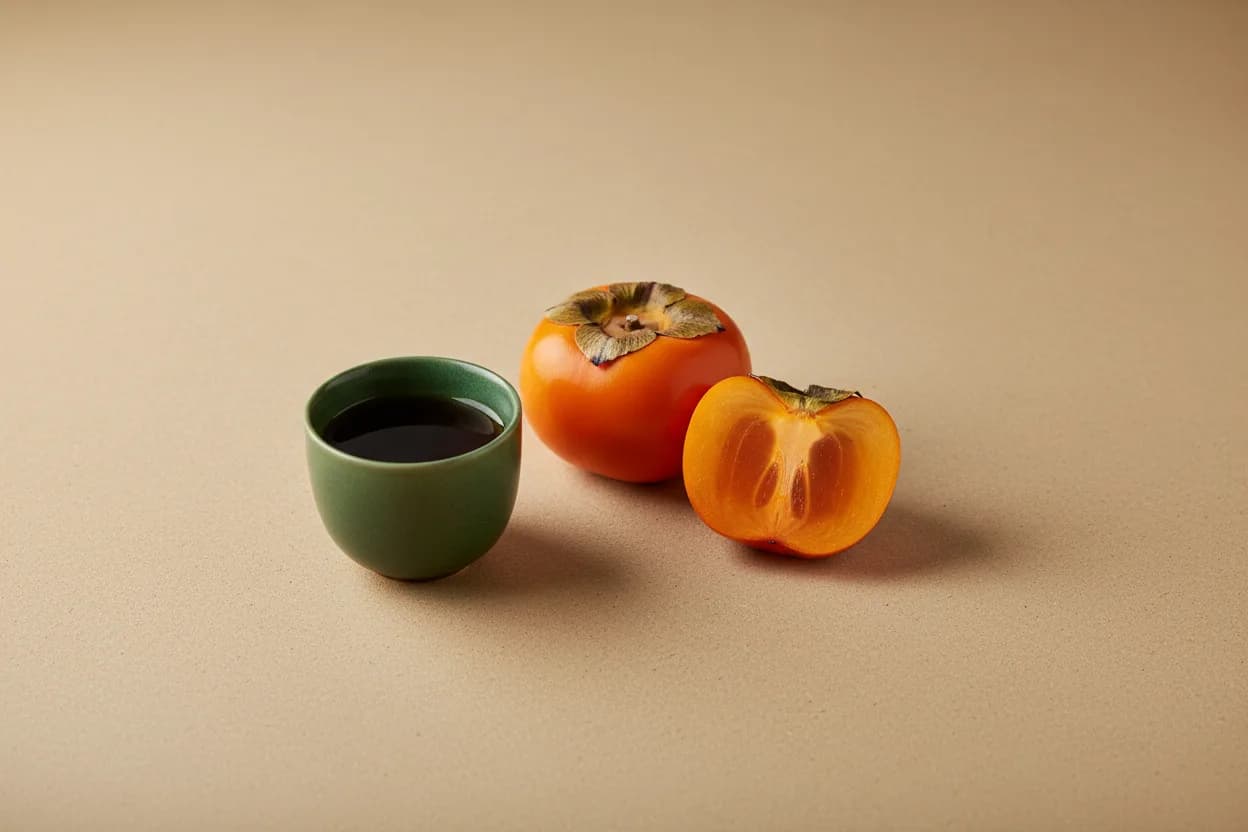
An unripe persimmon is the most violent astringency most people will ever meet. What happens to it is the cleanest demonstration in the whole subject that this is a physical event rather than a chemical message.
Commercial de-astringency treatment holds the fruit under about 95 per cent carbon dioxide, which pushes it into anaerobic metabolism. In the words of one study of the process, that increases the concentrations of ethanol and acetaldehyde by glycolysis, and precipitates the soluble tannin.7
The tannin does not leave the fruit. Not one molecule of it is removed. It is simply locked into an insoluble form that cannot reach your salivary proteins, and the sensation stops. No taste behaves like that. A sweet thing does not stop being sweet because the sugar became insoluble, because sweetness is a receptor reading a molecule. Astringency needs the molecule to be free to go and do something to you.
Milk in tea, which works for the wrong reason
The oldest piece of practical advice in this area is to put milk in strong tea. It works. Everybody knows why: the milk proteins bind the tannins first, sparing your saliva.
The 2009 experiment says otherwise, or at least says the story is incomplete. Milk did cut the astringency, and it made the lubrication of the oral surfaces considerably worse while doing it.5 If the whole mechanism were protecting the salivary film, the film should have been better off, not worse. Something else is happening, and the honest position is that we have a reliable technique and a shaky explanation of it.
Why you have this sense at all
The best proposal for what astringency is for came from Prinz and Lucas in 2000, and it is about teeth. Tannins strip the lubricating protein film off your oral surfaces, and a mouth that chews without that film is a mouth grinding enamel against enamel with the padding removed. On this reading the sensation is a wear alarm, a warning that continuing to chew is now expensive.8
Twelve years later that idea acquired support from an unexpected direction. Astringency and fattiness, it turns out, oppose each other perceptually on an oral rheological spectrum.9 The mouth appears to run a single axis from slippery to draggy, with fat at one end and tannin at the other.
Which means that pairing a tannic red with fatty meat, the most repeated rule in wine, is not a matter of flavours complementing one another. The two are cancelling on a scale of how your mouth slides.
Back in the cup
One more finding worth having if you make tea. In 2024 a group modelled the mouth with EGCG, caffeine and real saliva, and found that caffeine weakens the astringency of EGCG by getting in the way of its binding to salivary proteins.11 The bitterest thing in the cup is quietly taking the edge off the driest thing in the cup, and it is doing so upstream, at the protein, rather than anywhere in your nervous system.
So when the sage and black tea in this index says five minutes, the number is doing more work than it looks. Bitterness and astringency come out of the leaf together and are read by two different nerves, and only one of them will still be with you three sips later, quietly taking the lining off your mouth.
Sources
Every numbered claim above points here. Links go to the paper, record, or authority itself.
- 1.
Schobel N, Radtke D, Kyereme J, et al. Astringency is a trigeminal sensation that involves the activation of G protein-coupled signaling by phenolic compounds. Chemical Senses. 2014;39(6):471-487. The nerve-block result quoted here is from this paper.
https://doi.org/10.1093/chemse/bju014 - 2.
Carlson DM. Salivary proline-rich proteins: biochemistry, molecular biology, and regulation of expression. Critical Reviews in Oral Biology and Medicine. 1993;4(3-4):495-502. Source of the 70 per cent figure and of the isoproterenol comparison.
https://doi.org/10.1177/10454411930040033401 - 3.
Baxter NJ, Lilley TH, Haslam E, Williamson MP. Multiple interactions between polyphenols and a salivary proline-rich protein repeat result in complexation and precipitation. Biochemistry. 1997;36(18):5566-5577.
https://doi.org/10.1021/bi9700328 - 4.
Laguna L, Sarkar A. Oral tribology: update on the relevance to study astringency in wines. Tribology - Materials, Surfaces and Interfaces. 2017;11(2):116-123. Open access.
https://doi.org/10.1080/17515831.2017.1347736 - 5.
Rossetti D, Bongaerts JHH, Wantling E, Stokes JR, Williamson AM. Astringency of tea catechins: more than an oral lubrication tactile percept. Food Hydrocolloids. 2009;23(7):1984-1992.
https://doi.org/10.1016/j.foodhyd.2009.03.001 - 6.
Guinard JX, Pangborn RM, Lewis MJ. The time course of astringency in wine upon repeated ingestion. American Journal of Enology and Viticulture. 1986;37(3):184-189. Two experiments, one finding growth in duration and one in intensity across repeated sips.
https://doi.org/10.5344/ajev.1986.37.3.184 - 7.
Zhu Q, Zhang Z, Rao J, et al. Involvement of DkTGA1 transcription factor in anaerobic response leading to persimmon fruit postharvest de-astringency. PLOS ONE. 2016;11(5):e0155916. Open access.
https://doi.org/10.1371/journal.pone.0155916 - 8.
Prinz JF, Lucas PW. Saliva tannin interactions. Journal of Oral Rehabilitation. 2000;27(11):991-994. Proposes astringency as a signal of compromised oral lubrication and consequent tooth wear.
https://doi.org/10.1046/j.1365-2842.2000.00578.x - 9.
des Gachons CP, Mura E, Speziale C, Favreau CJ, Dubreuil GF, Breslin PAS. Opponency of astringency and fat sensations. Current Biology. 2012;22(19):R829-R830.
https://doi.org/10.1016/j.cub.2012.08.017 - 10.
Canon F, Belloir C, Bourillot E, et al. Perspectives on astringency sensation: an alternative hypothesis on the molecular origin of astringency. Journal of Agricultural and Food Chemistry. 2021;69(13):3822-3826.
https://doi.org/10.1021/acs.jafc.0c07474 - 11.
Zhou Z, Ou M, Shen W, Jin W, Yang G, Huang W, Guo C. Caffeine weakens the astringency of epigallocatechin gallate by inhibiting its interaction with salivary proteins. Food Chemistry. 2024;458:140753.
https://doi.org/10.1016/j.foodchem.2024.140753