cinnamon stick
Cinnamomum aromaticum
IN ARABIC عود قرفة
Sweet, warming bark.
ABOUT
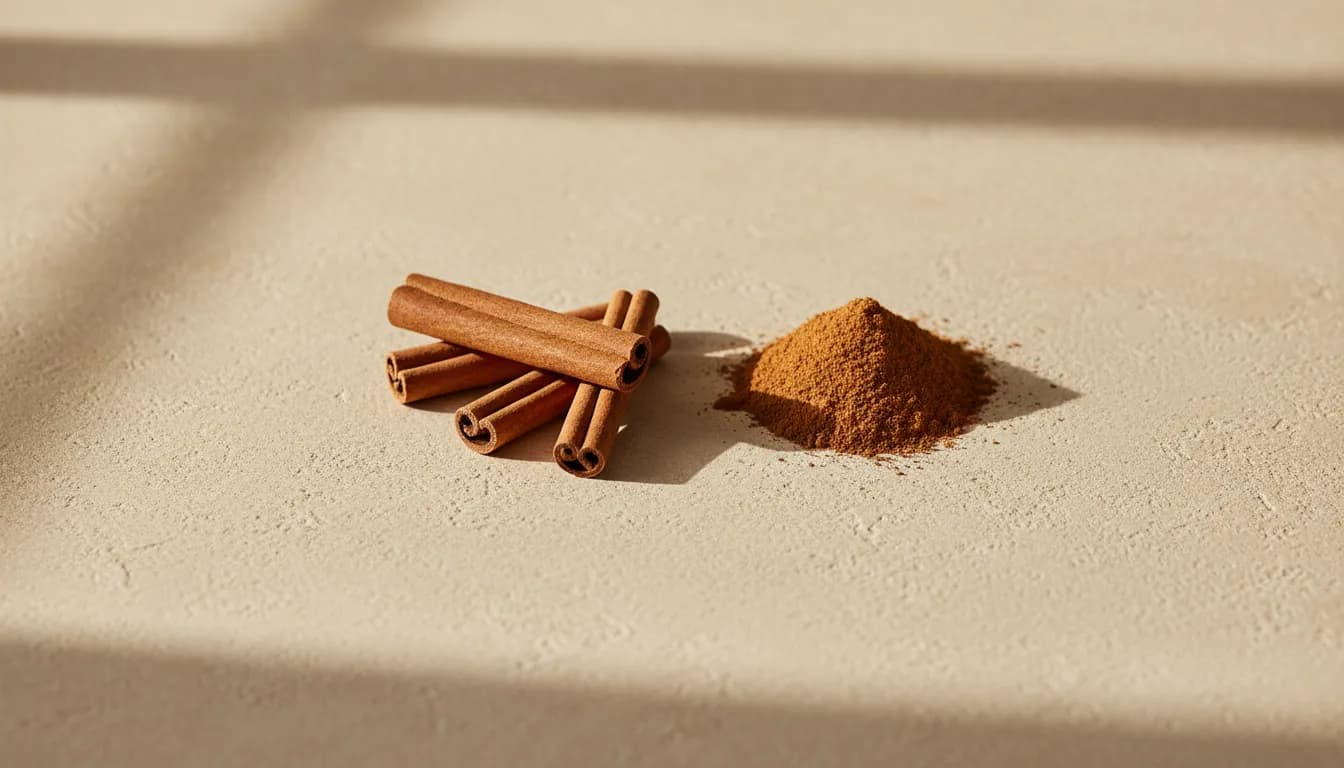
The stick in this library's jar is cassia, not true cinnamon: it curls from the bark's full thickness into a single hard tube that resists a grinder, the way cassia is built and sold as cinnamon across nearly the whole world, unlike true Ceylon cinnamon's many paper-thin, crumbling layers. It goes into six recipes here: three spice mixes, two dishes, and a smoothie. Whole sticks, broken or left small, go into three spice mixes: two short sticks, about eight grams, in the seven-spice mix; a five-centimeter piece in the curry powder; and one small stick toasted whole then ground in the rice blend. Jameed-Free Mansaf simmers four broken sticks loose in the lamb broth. Ground cinnamon appears only pinch-scale elsewhere: about half a teaspoon in the protein oat waffles and half a gram in the strawberry-banana smoothie.
Cinnamaldehyde, C₉H₈O, is effectively what cinnamon tastes of: it dominates the bark oil of every commercial species and makes up 77.93 percent of it here. What separates cassia from true Ceylon cinnamon is everything the cinnamaldehyde figure hides: Ceylon carries eugenol and benzyl benzoate alongside it and almost no coumarin, while cassia carries little eugenol and a great deal of coumarin, and this entity, being cassia, is the second kind.
That distinction matters once cinnamon is swallowed rather than smelled. Cassia measured across surveys runs from 700 to 12,200 milligrams of coumarin per kilogram, with official German monitoring of cinnamon powder, effectively all cassia, at 2,300 to 3,300; Ceylon, by contrast, tops out around 190. The European Food Safety Authority's tolerable daily intake is 0.1 milligrams of coumarin per kilogram of body weight, which gives a sixty-kilogram adult about six milligrams a day, an allowance that roughly two grams of ordinary cassia, under a level teaspoon, uses up entirely. The recipes here stay well under that: even the seven-spice mix's two broken sticks divide across a whole batch, and the pinch in the waffles or the smoothie is a fraction of a gram. Coumarin is hepatotoxic in a small, idiosyncratic minority of people, most of the documented cases in those taking cassia capsules daily for blood sugar at doses that can run three times the tolerable intake; a Cochrane review of ten trials and 577 participants found no significant effect on the marker that actually reflects long-term glucose control, and no clear liver injury has been tied to ordinary dietary cinnamon at all.
CHEMISTRY
1The characteristic compounds documented in this ingredient, plus any the library traces to it in a recipe. Not an exhaustive phytochemistry.
USED IN
7Rice Spice Mix
1 piece · small stick
STEP 1 Toast the cumin, coriander, peppercorns, cinnamon, and cardamom in a dry pan until fragrant.
STEP 2 Cool, then grind to a fine powder.
Levantine 7-Spice Mix
8 g · ≈ 2 short sticks, broken; 2 parts
STEP 2 Add the broken cinnamon and the whole cloves for the last stretch, just long enough to wake their oils, not brown them.
Jameed-Free Mansaf
4 · sticks, broken
STEP 1 Lamb: Working in batches that fit your cooker, add the shanks with quartered onion, cardamom, bay, a piece of cinnamon, and salt, and water to cover.
Protein Oat Waffles
1.3 g · ≈ 1/2 tsp
STEP 2 Dry: Whisk the flour, oat flour, whey, baking powder, sugar, monk fruit, cinnamon, cardamom, and salt together in a bowl.
Japanese Curry Powder
1 stick · 5 cm, broken up
STEP 1 Toast the whole spices: set a dry skillet over medium-low heat and toast the coriander, cumin, fenugreek, fennel, peppercorns, cardamom, cloves, cinnamon, bay, and chilies until they are fragrant and a shade darker, shaking the pan so nothing scorches.
Palestinian Maqluba
1 · one stick, for the stock
STEP 1 Stock: Place the lamb in a pressure cooker with the cardamom, bay leaves, cinnamon stick, and salt, and add water to cover.