Nobody is actually counting the seven spices
The practice is genuinely old and the blend is genuinely documented, in a thirteenth-century Aleppan cookbook that lists twelve ingredients including spikenard and rosebuds. The name is Ottoman, the number is a convention, and one spice in the modern jar could not have reached the Levant before 1492.
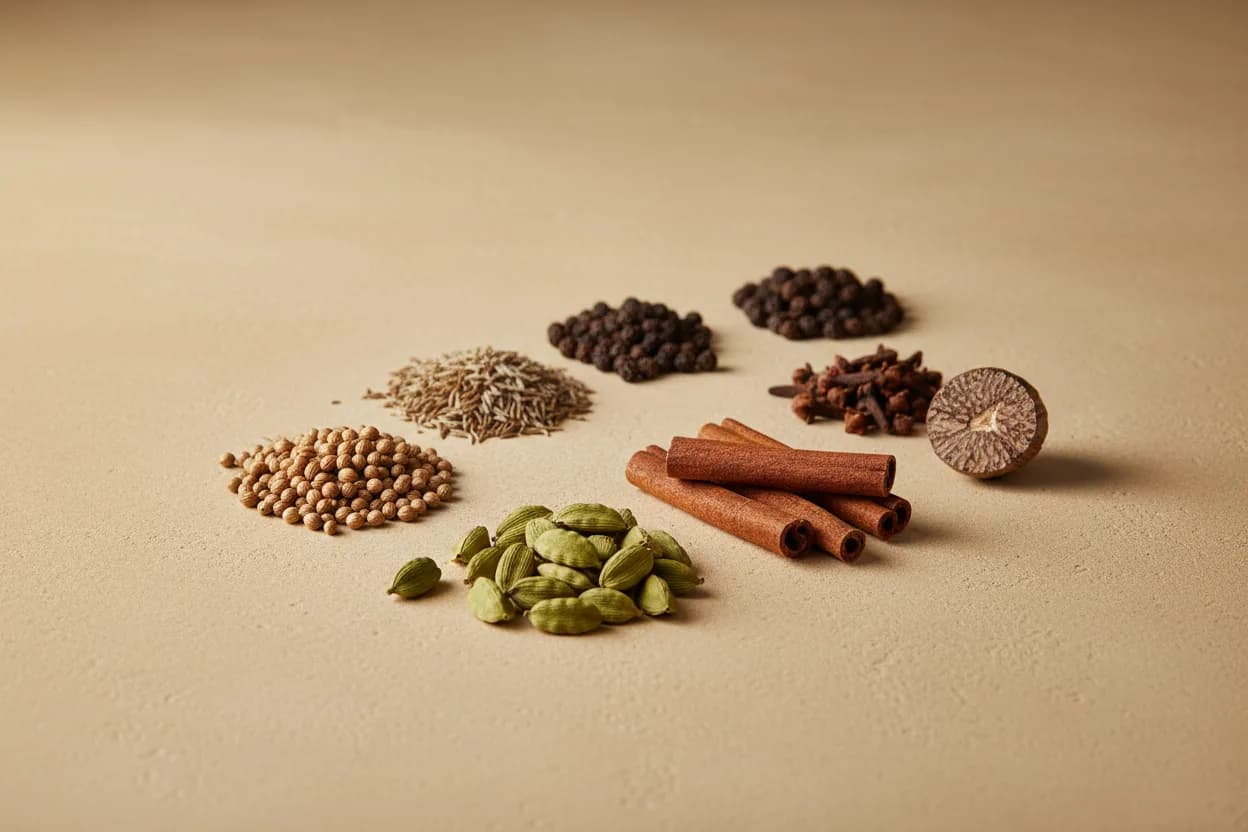
The oldest properly documented compound spice blend in Levantine cooking is written down in a thirteenth-century Aleppan cookbook, and here is what goes in it: spikenard, betel leaf, bay leaves, nutmeg, mace, green cardamom, cloves, rose buds, seeds of the elm tree, long pepper, ginger and black pepper. All ground separately, then mixed. 1
That is twelve things, and four of them are not in any kitchen I know. There is no cumin in it, no coriander seed, no cinnamon, and nothing called allspice. It is not seven of anything, and it is not called baharat either: its name is aṭrāf al-ṭīb, the sides of scent.
The book is Kitāb al-Wuṣla ilā al-Ḥabīb, 635 recipes from Ayyubid Syria, translated by Charles Perry for the Library of Arabic Literature. 2 It is the single most Levantine thing in the medieval Arabic culinary record, and it tells you that people here were grinding a dozen spices together eight hundred years ago. What it does not tell you is that they were making seven-spice.
The word is younger than the practice
Start with the name, because it turns out not to mean what everyone says it means. Bahārāt is the plural of bahār, and you will read everywhere that bahār is simply Persian for spice. Open a Persian dictionary and it is not there. Steingass gives bahār as spring, the beginning of summer, a blossom, orange flower, camomile, and a species of odoriferous herb, buphthalmum, the ox-eye. 3 A flower. Not a spice.
The other candidate is more interesting and comes from the trade rather than the garden. Hobson-Jobson records bahār as a unit of weight, from Sanskrit bhāra by way of Malayalam bhāram, meaning a load: roughly four hundred pounds, naturalised by the Arabs and used across the Indian Ocean for bulk transactions. It quotes Varthema in 1510 saying that if the merchandise is spices, they deal by the bahār. 4 In other words, the word that now means spice may once have meant the quantity you bought pepper in.
The most rigorous etymological dictionary of Turkish agrees with the flower, not the spice. Nişanyan derives Turkish bahar from Arabic bahār, root b-h-r, glossed as a sweet-smelling plant, buphthalmum, and as the general name for plants that bloom in the desert after rain. On the Persian derivation it is unusually blunt: it may be borrowed from Persian bahār meaning spring, however this is not certain. 5
And it dates the culinary sense. The earliest attestation Nişanyan gives for bahar meaning something added to food for flavour is from before 1600, and it is not a recipe but a customs schedule: a camel-load of bahār and of textiles is taxed seven gold pieces of duty. 5 The first datable evidence that this word meant spice comes from a tax office, and the unit being taxed is a load, which is exactly what the Sanskrit meant.
Nawal Nasrallah, who is the serious scholar on this, puts the shift in the same place. In all probability, she writes, at some point during the Ottoman era the name bihar or bahar started to designate spice mix. Before that, spice mixes in the Arab world were called aṭrāf al-ṭīb, afwāh al-ṭīb, and nawāfiḥ al-ṭīb. 1 The category is old. The word for it is not.
One more piece, from the language that borrowed it. Baharat is a proper headword in the official dictionary of the Turkish state, defined as substances such as cinnamon, clove, ginger and black pepper used to give pleasant aroma and taste, and its etymology is given as Arabic. Ask the same dictionary for yedi baharat, seven spices, and it returns no result at all. 6 The Turkish term you will see on jars is a product name, not a word the language recognises.
A plant that could not have been there
Now the part that settles the antiquity question without needing any argument from silence. Most modern seven-spice formulations contain allspice. Allspice is Pimenta dioica, a member of the myrtle family, and its native range is southern Mexico, Central America and the Caribbean: the Gulf and southern states of Mexico, Belize, Guatemala, Honduras, Nicaragua, Costa Rica, and the islands from Cuba and Jamaica across to the Bahamas and the Caymans. 7 There is no Old World entry anywhere in that native range. Not Syria, not Lebanon, not Turkey, not Egypt, not anywhere in the Mediterranean. Where the tree grows outside the Americas at all, somebody carried it there.
So a spice blend containing allspice cannot be Phoenician, cannot be Abbasid, and cannot be medieval. It cannot predate 1492. This is not an inference from missing documents, it is botany, and it is not arguable. The same goes for any version carrying paprika or chili, since Capsicum annuum was domesticated in central-east Mexico. 8
It is worth adding that even the deeper antiquity claims in this area are shakier than they sound. The much-repeated finding that Phoenician flasks carried cinnamon from South East Asia in the Iron Age rests on detecting cinnamaldehyde, and Stephen Haw's 2017 review takes it apart: some of the flasks were broken, others were handled with metal tools and stored in plastic, microbial action was not considered, and, decisively, cinnamaldehyde is not unique to cinnamon. Myrrh contains it too. His principle is one worth carrying around: a single chemical compound cannot provide an adequate basis for identifying any particular plant. 9
Nobody counts to seven
Here is where it gets funny. I went looking for the authoritative seven, and what I found is that the published record cannot agree on what the seven are, or that there are seven.
The Lebanese Cookbook, written by a Lebanese chef and published in London in 2006, says this: Lebanese seven spice, or sabaa baharat, is a combination of cloves, cumin, nutmeg, coriander, cinnamon and pepper, with paprika often added. 10 Count them. That is six, with a seventh described as optional. A book defining seven-spice names six spices and then shrugs.
Three other published books carry an identical formulation, and it has eight: paprika, pepper, cumin, cassia, cloves, coriander, cardamom and nutmeg. 11 Set the two lists side by side and only five spices appear in both: pepper, cumin, cloves, coriander, nutmeg. Neither list contains allspice, which is the ingredient the internet is most confident about.
No standards body fixes a count either. The Gulf standard covering mixed spices, which is the closest thing to a regulatory definition in the region, defines the product as a mixture of the ground powders of two or more kinds of spices. That is the entire compositional requirement. The rest of the document governs moisture, capped at ten per cent by weight, freedom from insect parts and rodent filth, and a flat prohibition on adding colouring matter or food additives to the mixture. 12 Two or more. The word seven does not appear.
And the only peer-reviewed study I could find on baharat does not model it as seven either. A 2025 paper in Food Bioscience describes the blend as built from a small set of main components, cloves, black pepper, cinnamon and allspice, then supplemented with further spices drawn from a pool including cumin, ginger, red pepper, garlic, mint, turmeric and black dried lime. The researchers built four regional formulations from that pool and tested them. 13 Four in the core, a variable tail. A structure, not a number.
I want to be careful about how far this goes. The book record I searched is overwhelmingly in English, and a formulation printed in Arabic in a Beirut or Damascus household cookbook would be invisible to it. So the honest claim is not that seven is a fiction, but that nobody in the citable record is actually counting to seven, and that the number behaves like a convention rather than a specification.
That fits the wider scholarship on how this cuisine got written down. The editors of Making Levantine Cuisine argue that the region's modern food culture took shape as the Levant was drawn into a global capitalist system across the nineteenth and twentieth centuries, and their opening chapter deliberately historicises Lebanon's supposedly authentic and unchanging foodways, anchoring the bourgeois Beiruti repertoire in a printed cookbook of 1885. 14 A named, counted, jarred house blend is exactly the kind of object that era produces.
Why the substitutions work anyway
Which raises the obvious question. If the lists disagree this much, why does every version still smell recognisably like the same thing? Part of the answer is a single molecule.
Clove bud oil is 68 to 82 per cent eugenol. 17 Allspice berry oil, compiled across growing regions, runs from about 64 to 86 per cent eugenol: Jamaica at 86.4, Brazil at 77.0, Guatemala at 65.9, India at 68.4. 18 Two plants from opposite sides of the world, a flower bud from the Moluccas and a berry from the Caribbean, whose oils are dominated by the same compound in overlapping proportions. They are both Myrtaceae, so the convergence is not random, but the practical consequence is that a cook swapping one for the other is making a much smaller change than the ingredient list suggests.
The rest of the blend is similarly load-bearing in single compounds. Cinnamon is the odd one out in its volatile chemistry, dominated by carbonyl compounds at 63.7 per cent with cinnamaldehyde the largest single peak, where nearly every other spice is dominated by terpenoids. Cumin is 55.5 per cent cuminaldehyde. Black pepper's aroma is mostly sesquiterpenoids, with a caryophyllene isomer the biggest peak. 19 Note that piperine, the thing that makes pepper hot, is not volatile at all and contributes nothing to the smell. Heat and aroma are separate deliveries from the same seed.
Cardamom seed oil is characterised by regulators as terpineol acetate above 35 per cent and 1,8-cineole above 20. 20 Coriander fruit oil is specified at 65 to 78 per cent linalool and measures around 71.7. 21 Nutmeg seed oil ranges from 9.1 to 52.8 per cent sabinene with myristicin at 10.6 to 20.3. 22 Seven jars, and the character of each is carried by one or two molecules.
On the nutmeg, since somebody always asks. Intoxication is documented from around five grams of ground nutmeg. A German poison centre reviewing its cases reported that even where higher doses of twenty to eighty grams of powder had been ingested, a life-threatening situation was never observed, and the one fatality in that series involved a benzodiazepine taken alongside. 23 Nutmeg is a minority component of a blend used a teaspoon at a time. The gap between that and the lowest intoxicating dose is three orders of magnitude. The threshold is real and you are nowhere near it.
Everyone else is just as loose
The Levant is not unusual in this, and the best-documented comparison makes the point harder. A 2024 ethnobotanical survey interviewed sixty herbalists in Meknes about ras el hanout and found that its composition differs depending on the herbalist and the intended use, and that the mixture can contain up to sixty plants. Cinnamomum cassia had the highest use value at 2.967, and the strongest agreement among informants was for its use as a tonic rather than as a seasoning. 15 A companion paper notes that thirty-nine of those sixty plants are considered toxic or to have side effects. 16
So a blend with a fixed famous name ranges from a handful of spices to sixty plants depending on which shop you walk into, and it is medicine as much as seasoning. Against that, a Levantine mix that might be six or eight looks positively disciplined.
What a blend hides
There is one real cost to buying spices already mixed, and it is not romantic. A blend is opaque by construction. Once seven things are milled together, nobody can inspect any of them.
A 2025 study tested eighty spice samples from five Egyptian governorates for illegal dyes, toxic elements and pesticide residues. Around sixty per cent carried Sudan dyes above the limit of quantification, and the highest single reading, Sudan I at 52 mg per kilogram, was in the ground mixed blend, not in the whole spices. The blend also had the worst pesticide record: ninety per cent of those samples exceeded maximum residue limits. 24 The category you cannot look at was the category with the most to hide.
Closer to home, and more measured. Lebanese researchers tested ninety-six composite samples of herbs and spices and found twenty per cent over the Codex lead limit, with the split by how the spice was sold: thirty-one per cent of unpackaged samples exceeded it, against twelve per cent of locally packaged ones. 25 The same sample set was screened for microbes, and there the news is reassuring: unacceptable levels were rare, between one and seven per cent depending on the organism, and every single sample was negative for Salmonella. 26 Loose spice from an open sack carries a measurably higher metal load and a higher microbial one. That is not dangerous, just less inspected.
Seven is a promise
None of this makes the jar less real. Aṭrāf al-ṭīb was a genuine thing sold in genuine markets, and the name Perry gives for it points at the paper packets it came wrapped in. Eight hundred years later a Levantine cook still walks into a shop and asks for the mixture rather than the twelve components, and gets whatever that particular ʿattar has decided the mixture is.
All that changed is that at some point in the last century or so somebody put a number on it. Not a count of what was in the packet, because nobody was counting, but a claim about what kind of thing it is: enough spices that you would not want to measure them all yourself, and few enough that the result still tastes like one idea. Seven was never an inventory, just a way of saying complete. Which is why every household can be certain theirs is the correct one, and why they are all, in the only sense that matters, right.
Sources
Every numbered claim above points here. Links go to the paper, record, or authority itself.
- 1.
Nasrallah N. Delights from the Garden of Eden: A Cookbook and History of the Iraqi Cuisine. Glossary, s.v. Baharat. Equinox; 2013 (digital edition).
https://app.ckbk.com/reference/deli98836b01s001e082/baharat - 2.
Perry C, trans. Scents and Flavors: A Syrian Cookbook (Kitab al-Wusla ila al-Habib). Library of Arabic Literature 47. New York University Press; 2017.
https://nyupress.org/9781479856282/scents-and-flavors/ - 3.
Steingass F. A Comprehensive Persian-English Dictionary, s.v. bahār. Digital Dictionaries of South Asia, University of Chicago.
https://dsal.uchicago.edu/dictionaries/steingass/ - 4.
Yule H, Burnell AC. Hobson-Jobson: A Glossary of Colloquial Anglo-Indian Words and Phrases, s.v. BAHAR. Digital Dictionaries of South Asia, University of Chicago.
https://dsal.uchicago.edu/dictionaries/hobsonjobson/ - 5.
Nişanyan S. Nişanyan Sözlük: Çağdaş Türkçenin Etimolojisi, entry bahar (2).
https://www.nisanyansozluk.com/kelime/bahar - 6.
Türk Dil Kurumu. Güncel Türkçe Sözlük, entry baharat.
https://sozluk.gov.tr/ - 7.
GBIF Secretariat. Pimenta dioica (L.) Merr. GBIF Backbone Taxonomy, usage key 3186061.
https://www.gbif.org/species/3186061 - 8.
Kraft KH, Brown CH, Nabhan GP, et al. Multiple lines of evidence for the origin of domesticated chili pepper, Capsicum annuum, in Mexico. PNAS. 2014;111(17):6165-6170.
https://doi.org/10.1073/pnas.1308933111 - 9.
Haw SG. Cinnamon, Cassia and Ancient Trade. Journal of Ancient History and Archaeology. 2017;4(1):5-18.
https://doi.org/10.14795/j.v4i1.211 - 10.
Dekmak H. The Lebanese Cookbook. Kyle Cathie; 2006. Open Library work OL27303916W.
https://openlibrary.org/works/OL27303916W - 11.
Open Library Search Inside, full-text search of the Internet Archive scanned-book corpus for the phrase "paprika, pepper, cumin, cassia, cloves".
https://openlibrary.org/search/inside?q=%22paprika%2C+pepper%2C+cumin%2C+cassia%2C+cloves%22 - 12.
GCC Standardization Organization. GSO 2132: Spices and condiments - Mixed spices and condiments. Draft Gulf Standard; 2010.
https://archive.org/details/gso.2132.a.ds.2010 - 13.
Di Stasi M, Kaboudari A, Mancini S, Vacchina V, De Leo M, Braca A, Fratini F. Effect on food-related pathogens and chemical fingerprint of regional recipes of Baharat, a traditional Middle Eastern spice blend. Food Bioscience. 2025;69:106994.
https://doi.org/10.1016/j.fbio.2025.106994 - 14.
Gaul A, Pitts G, Valosik V, eds. Making Levantine Cuisine: Modern Foodways of the Eastern Mediterranean. University of Texas Press; 2021.
https://utpress.utexas.edu/9781477324578/ - 15.
Najem M, Bouiamrine EH, Ibijbijen J, Nassiri L. Ras El Hanout: a theriac of therapeutic plants and spices. Qualitative and quantitative ethnobotanical investigation in the city of Meknes (Morocco). Ethnobotany Research and Applications. 2024;29:1-32.
https://ethnobotanyjournal.org/index.php/era/article/view/6462 - 16.
Najem M, Ouadjane Y, Ibijbijen J, Nassiri L. Ras El Hanout: Traditional blend of medicinal plants and spices, toxic compounds and poisoning risks. Ethnobotany Research and Applications. 2024;29:1-22.
https://ethnobotanyjournal.org/index.php/era/article/view/6465 - 17.
Alfikri FN, Pujiarti R, Wibisono MG, Hardiyanto EB. Yield, Quality, and Antioxidant Activity of Clove (Syzygium aromaticum L.) Bud Oil at the Different Phenological Stages in Young and Mature Trees. Scientifica. 2020;2020:9701701.
https://doi.org/10.1155/2020/9701701 - 18.
Andrade Avila YY, Cruz-Olivares J, Pérez-Alonso C. Antioxidant Effect and Medicinal Properties of Allspice Essential Oil. In: Essential Oils: Advances in Extractions and Biological Applications. IntechOpen; 2022.
https://doi.org/10.5772/intechopen.103001 - 19.
Izcara S, Perestrelo R, Morante-Zarcero S, Sierra I, Câmara JS. Spices Volatilomic Fingerprinting: A Comprehensive Approach to Explore Its Authentication and Bioactive Properties. Molecules. 2022;27(19):6403.
https://doi.org/10.3390/molecules27196403 - 20.
EFSA Panel on Additives and Products or Substances used in Animal Feed (FEEDAP). Safety and efficacy of an essential oil from Elettaria cardamomum (L.) Maton when used as a sensory additive in feed for all animal species. EFSA Journal. 2019;17(6):e05721.
https://doi.org/10.2903/j.efsa.2019.5721 - 21.
EFSA Panel on Additives and Products or Substances used in Animal Feed (FEEDAP). Safety and efficacy of a feed additive consisting of an essential oil obtained from the fruit of Coriandrum sativum L. (coriander oil). EFSA Journal. 2023;21(10):e08349.
https://doi.org/10.2903/j.efsa.2023.8349 - 22.
Ashokkumar K, Simal-Gandara J, Murugan M, Dhanya MK, Pandian A. Nutmeg (Myristica fragrans Houtt.) essential oil: A review on its composition, biological, and pharmacological activities. Phytotherapy Research. 2022;36(7):2839-2851.
https://doi.org/10.1002/ptr.7491 - 23.
Stein U, Greyer H, Hentschel H. Nutmeg (myristicin) poisoning: report on a fatal case and a series of cases recorded by a poison information centre. Forensic Science International. 2001;118(1):87-90.
https://doi.org/10.1016/s0379-0738(00)00369-8 - 24.
Ghuniem MM, Refai HM, Rabie K. Health risk assessment of Sudan dyes, toxic elements, and pesticide residues in Egyptian spices. Scientific Reports. 2025;15:44332.
https://doi.org/10.1038/s41598-025-31386-3 - 25.
Moussa L, Hassan HF, Savvaidis IN, Karam L. Impact of source, packaging and presence of food safety management system on heavy metals levels in spices and herbs. PLoS One. 2024;19(8):e0307884.
https://doi.org/10.1371/journal.pone.0307884 - 26.
Karam L, Salloum T, El Hage R, Hassan H, Hassan HF. How can packaging, source and food safety management system affect the microbiological quality of spices and dried herbs? The case of a developing country. International Journal of Food Microbiology. 2021;353:109295.
https://doi.org/10.1016/j.ijfoodmicro.2021.109295