Two barks, one name, one real difference
Most cinnamon sold in the world is not cinnamon. That is usually a pedantic distinction. Where coumarin is concerned, it is a measurable one, and the numbers are smaller than you would guess.
Contents
Herodotus knew where cinnamon came from, in the sense that he had been told something and wrote it down. Enormous birds, he reported, carry the dried sticks to nests of clay stuck high on cliffs no one can climb. The Arabians cut up dead oxen and asses into large pieces and leave them below. The birds carry the meat up, the nests break under the weight, and the cinnamon falls to the ground where it can be gathered. 1
He is not being credulous so much as being sold something. That story sits in a sequence: winged serpents guarding the frankincense trees, then bat-like creatures guarding cassia in a shallow lake, then the cinnamon birds. The guardians escalate the further the spice supposedly comes from. This is what a supply chain sounds like when every middleman between Sri Lanka and the Aegean has an interest in you never finding the source. Herodotus even notes that the Greek word came from the Phoenicians, which is a quiet admission that the spice arrived already wrapped in somebody else's story.
The bark that is actually cinnamon
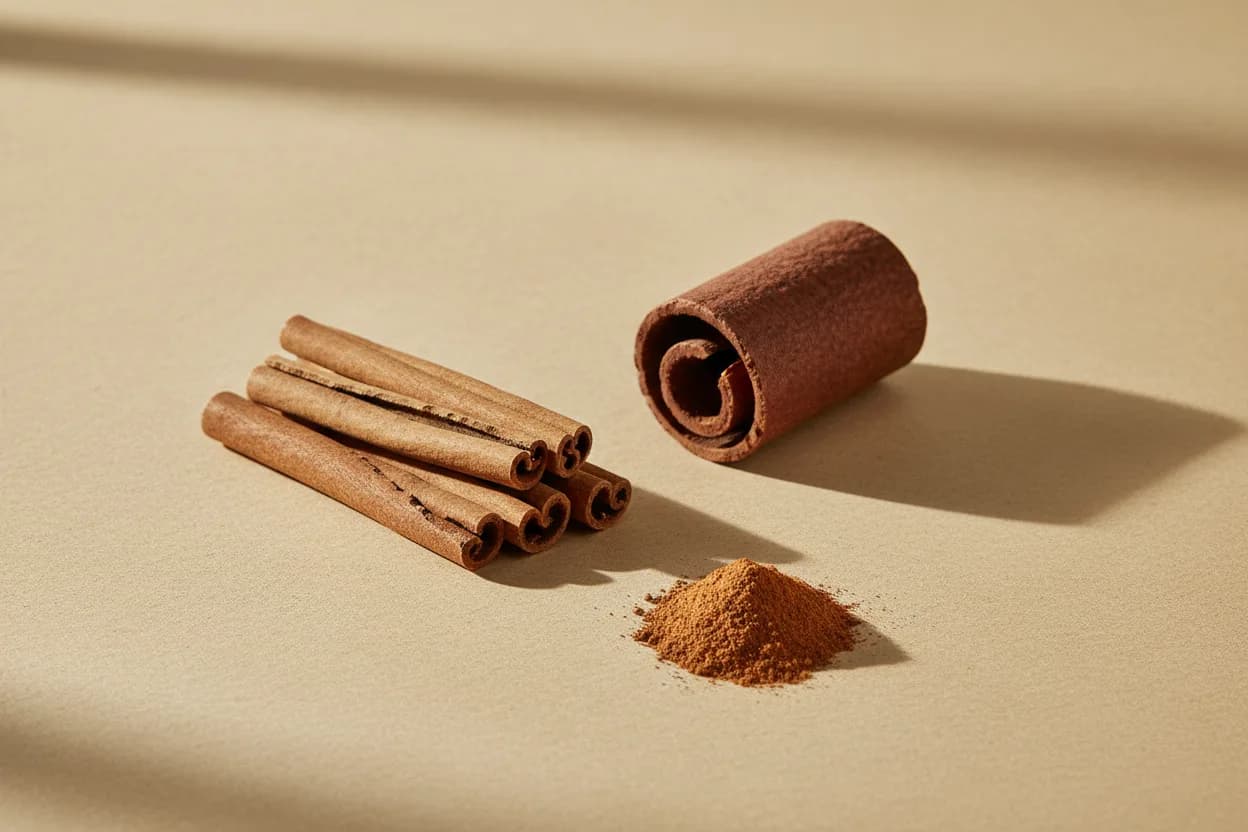
There are four commercially important species. Cinnamomum verum, from Sri Lanka, is true or Ceylon cinnamon. The other three are cassias: C. cassia from China, C. burmannii from Indonesia, and C. loureiroi from Vietnam. 2 In most of the world, including nearly all of the United States, the thing sold as cinnamon is cassia.
You can tell them apart in your hand. Ceylon cinnamon is made only from the thin inner bark, and many paper-thin layers are rolled together into one quill, so it is light, fragile, and crumbles under a thumbnail. Cassia uses the full thickness of the bark, curled from one side into a single hard tube two or three millimetres thick, which is why cassia quills feel like wood and resist the grinder. Once ground, all bets are off.
The chemistry separates them more cleanly than the eye does. Cinnamaldehyde, C₉H₈O, dominates the bark oil of both and is the smell everyone means by cinnamon. The divergence is elsewhere: true cinnamon carries eugenol and benzyl benzoate, and essentially no coumarin. Cassia carries little eugenol, and a great deal of coumarin.
How much is a great deal
This is where the difference stops being a connoisseur's point. Germany's Federal Institute for Risk Assessment compiled the measurements. In one analytical comparison, Ceylon cinnamon ran from undetectable up to about 190 milligrams of coumarin per kilogram, while cassia samples ran from 700 to 12,200. German official monitoring of cinnamon powder, effectively all cassia, found 2,300 to 3,300 milligrams per kilogram. 3 An independent survey of sixty ground cinnamon samples from Czech retail found means between 2,650 and 7,017 milligrams per kilogram, with a Ceylon control sample imported straight from a Sri Lankan plantation coming back essentially coumarin-free. 5
Coumarin matters because it is hepatotoxic in a susceptible minority of people. The European Food Safety Authority set a tolerable daily intake of 0.1 milligrams per kilogram of body weight per day, derived from a no-observed-adverse-effect level of 10 mg/kg in a chronic dog study, divided by a hundredfold uncertainty factor. 4
Run the arithmetic and it gets uncomfortably small. A sixty-kilogram adult has a daily allowance of six milligrams of coumarin. At roughly three milligrams per gram, which is what supermarket cassia measured, that allowance is used up by about two grams of cinnamon. A level teaspoon of ground cinnamon is around 2.6 grams. So an adult reaches the tolerable daily intake at somewhere under a teaspoon of ordinary cassia, and a fifteen-kilogram child reaches it at about half a gram, which is a fifth of a teaspoon. 3
Proportion, please
Two things are true at once and both need saying. The BfR reviewed the human clinical record on medicinal coumarin and found liver injury occurring in a small idiosyncratic subset rather than in proportion across everyone, around six per cent in one placebo-controlled trial, and generally reversible on stopping. It also noted no clear cases of liver damage attributable to ordinary dietary cinnamon as opposed to medicinal-dose coumarin. 3
So this is not a reason to be frightened of a cinnamon bun, but it is a reason to look hard at the one population genuinely exposed: people taking cassia cinnamon in capsules, daily, for months, usually to manage blood sugar. At the doses used in some early diabetes trials, up to six grams a day, coumarin intake lands at roughly three times an adult's tolerable daily intake, before counting anything else in the diet. Which raises the obvious question of whether the thing being risked for is real.
The blood sugar question, honestly
The Cochrane review on cinnamon for diabetes, covering ten randomised trials and 577 participants, concluded there was insufficient evidence to support its use in type 1 or type 2 diabetes, and found no significant effect on HbA1c, insulin, or post-meal glucose. 6 Later meta-analyses have been friendlier to a narrower claim: a 2019 analysis of sixteen trials found significant reductions in fasting blood glucose and insulin resistance, and still no significant effect on HbA1c or lipids. 7
HbA1c is the marker that reflects glucose control over months, which is the thing that actually matters clinically. A fasting-glucose blip that never shows up in HbA1c is a hint, not a treatment. Trials are small, short, heterogeneous, and frequently do not even specify which cinnamon species was used, which is remarkable given that the two species differ by orders of magnitude in the compound most likely to cause harm.
The practical upshot is unglamorous. If cinnamon is a pinch in your coffee or a stick in a pot of rice, none of this is about you. If you are taking it daily as a supplement, buy Ceylon, which costs more and crumbles in your fingers, and know that you are paying for a benefit the evidence has not yet convincingly demonstrated.
There is a nice symmetry in ending up here. Three European powers took Sri Lanka in succession, the Portuguese arriving in 1505 and holding the cinnamon lowlands until the Dutch pushed them out by 1658, who held it in turn until the British arrived in 1796. 8 All of that for a bark whose most consequential modern fact turned out to be a molecule none of them could have detected.
Sources
Every numbered claim above points here. Links go to the paper, record, or authority itself.
- 1.
Herodotus, Histories, Book 3, chapter 111, on the collection of cinnamon in Arabia. G. C. Macaulay translation.
https://lexundria.com/hdt/3.111/mcly - 2.
Chen P, Sun J, Ford P. Differentiation of the four major species of cinnamons (C. burmannii, C. verum, C. cassia, and C. loureiroi) using a flow injection mass spectrometric fingerprinting method. Journal of Agricultural and Food Chemistry. 2014;62(12):2516-2521.
https://doi.org/10.1021/jf405580c - 3.
German Federal Institute for Risk Assessment (BfR). Consumers who eat a lot of cinnamon currently have an overly high exposure to coumarin. BfR Health Assessment No. 043/2006, 16 June 2006.
https://www.bfr.bund.de/cm/349/consumers_who_eat_a_lot_of_cinnamon_currently_have_an_overly_high_exposure_to_coumarin.pdf - 4.
EFSA Panel on Food Additives, Flavourings, Processing Aids and Materials in Contact with Food (AFC). Opinion on coumarin, adopted 6 October 2004. EFSA Journal. 2004;2(12):104.
https://doi.org/10.2903/j.efsa.2004.104 - 5.
Blahová J, Svobodová Z. Assessment of coumarin levels in ground cinnamon available in the Czech retail market. The Scientific World Journal. 2012;2012:263851.
https://doi.org/10.1100/2012/263851 - 6.
Leach MJ, Kumar S. Cinnamon for diabetes mellitus. Cochrane Database of Systematic Reviews. 2012;(9):CD007170.
https://doi.org/10.1002/14651858.CD007170.pub2 - 7.
Deyno S, Eneyew K, Seyfe S, et al. Efficacy and safety of cinnamon in type 2 diabetes mellitus and pre-diabetes patients: a meta-analysis and meta-regression. Diabetes Research and Clinical Practice. 2019;156:107815.
https://doi.org/10.1016/j.diabres.2019.107815 - 8.
Encyclopaedia Britannica. Sri Lanka: The Portuguese in Sri Lanka, 1505-1658.
https://www.britannica.com/place/Sri-Lanka/The-Portuguese-in-Sri-Lanka-1505-1658