A pinch disappears into the tomatoes, a spoonful takes them over
Fenugreek is a bean whose smell changes character with dilution, so the same seed can vanish into a red sauce, coat a cured beef, and turn up in a dessert for new mothers.
Contents
Somewhere in the ninth century, the Baghdad physician Ibn Masawayh wrote down what fenugreek does to a person who eats it. It changes the breath, he said. It sweetens the smell of the stool. And it spoils the smell of the sweat and the urine. Ibn al-Baytar, writing in Damascus four hundred years later, copied the line into his entry on hulba and left it standing. 1
He was right, and he was describing a molecule that would not be named for another eleven centuries. In 1981 the New England Journal of Medicine ran a short letter under the title Maple-Syrup Urine Odor Due to Fenugreek Ingestion. 2 In 2001 a paediatric team reported newborns who smelled of maple syrup and were briefly suspected of having maple syrup urine disease, a serious inherited metabolic disorder, because their mothers had eaten fenugreek. 3 The condition even acquired a name for the false version: pseudo-maple syrup urine disease. In 2011 a French group put human armpit sweat through gas chromatography with an olfactometry port, so that a trained nose sat at the outlet of the instrument and reported what each separated peak smelled of. 4
The compound behind it is sotolon. The paediatric report says so directly: fenugreek, maple syrup and the urine of patients with the disease share one characteristic odour because they share one component. 3 The sweat study is the loose end in that account. Of the forty-four compounds the French team recovered from armpit headspace, eight appeared only after the fenugreek, and sotolon was not among them; they credited the smell on skin to that other eight instead. 4 What nobody disputes is that something leaves the body and can be smelled on a person for days. Sotolon also has a second property, and the rest of this depends on it: it does not smell like a single thing.
The seed is a bean
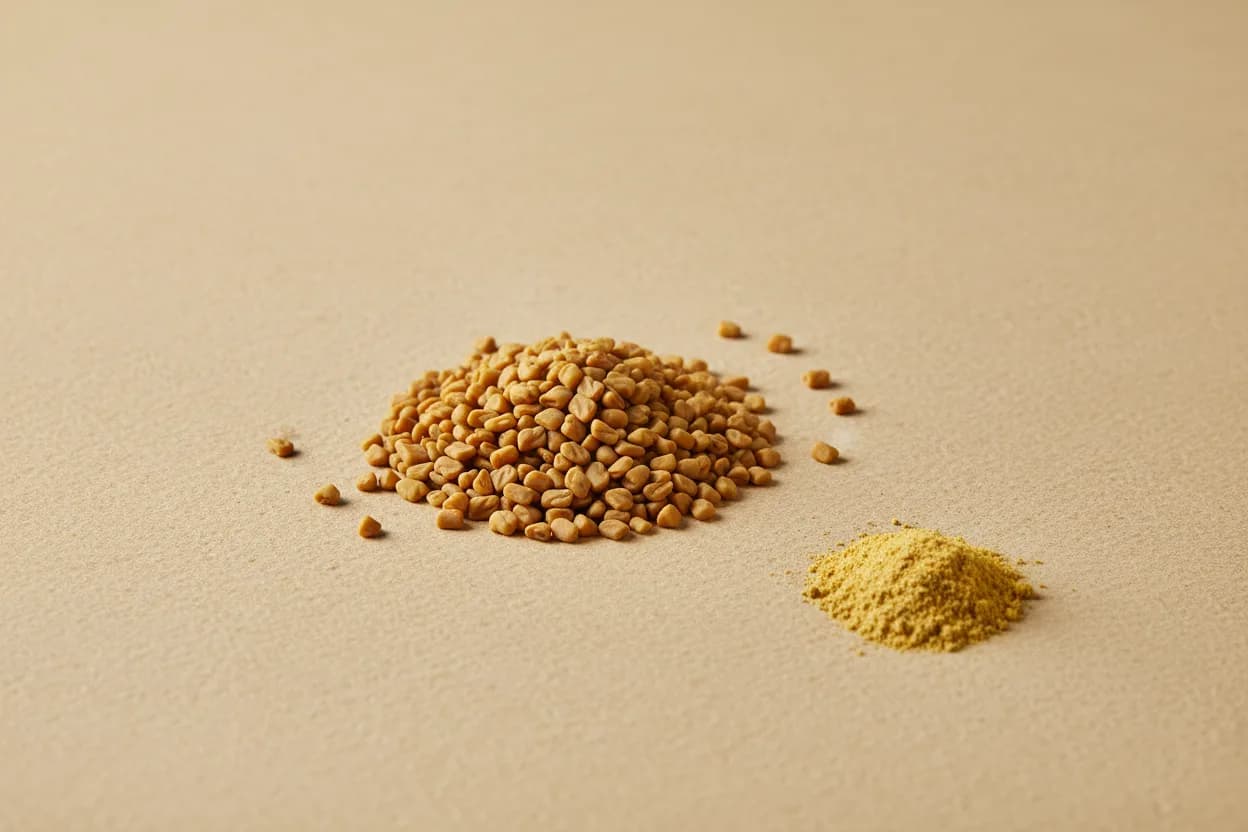
Fenugreek sits in the spice drawer and belongs in the pulse bin. Trigonella foenum-graecum is filed under Leguminosae, the same family as peas, lentils and clover. 14 It fixes nitrogen, it grows in a pod, and the hard amber thing you grind is a bean rather than a seed in the sense that a coriander seed is one.
The kitchens that know the plant best have never treated it as only a spice. Ibn al-Baytar's entry distinguishes the seed from baqlat al-hulba, the fenugreek pot-herb, which he warns will give you a headache if you eat too much of it. 1 That is the leaf, sold today in South Asian markets as methi and cooked like spinach. The same entry preserves the Greek name from Dioscorides, telis, and Galen's report that the dried seed was called ox horn for the shape of the pod. 1
The bitterness people complain about is not the aroma at all. It comes from steroidal saponins, a family of compounds that chemists now separate and quantify by liquid chromatography with mass spectrometry. 13 Saponins are water-soluble. Every traditional preparation soaks or boils the seed and pours the water away, and nobody has ever needed to soak cumin.
Why a pinch disappears into a red sauce
Sotolon has been described in the analytical literature as carrying a sweet, honeyed, nutty, walnut, spicy, curry, burnt scent, depending on its concentration and its enantiomeric distribution. 6 That is one molecule with a list of adjectives that do not obviously belong together, and the list is not a hedge. The character genuinely moves with the dose.
At the low end it does not read as fenugreek. It reads as seasoning. Sotolon is the substance that Blank and Schieberle isolated when they went looking for what makes a commercial lovage extract taste seasoning-like, 7 and it turns up again as one of the high-impact odorants of soy sauce. 8 Both of those are the smell of something savoury that has been sitting and concentrating, which is what a long-cooked tomato sauce is trying to become.
There is a second mechanism stacked on the first. A Danish group built fifteen dashi preparations and had panellists assess them with and without the use of their noses, and found that a congruent savoury aroma measurably raises perceived umami taste. 9 The effect runs on odour-taste congruency: a smell that belongs with savouriness makes the savouriness register as stronger. Cooked tomato is already dense in free glutamate. Add a trace of a broth-smelling molecule and the glutamate that was always there tastes like more of itself.
So a quarter teaspoon of ground fenugreek in a pot of Syrian-style tomato sauce adds depth to a flavour already in the pot rather than a flavour anyone could name, and it works better here than in most places because tomato brings the glutamate for it to amplify. The same trick lands in a lentil stew and does nothing much in a cucumber salad.
The failure mode is going over. Push past the point where the aroma is subliminal and the curry note arrives all at once, and it does not blend backwards into the sauce. This is a seasoning with a cliff in it, and the whole practical skill is staying on the near side. Toast the seed lightly, grind it fine, start at a quarter teaspoon for a family-sized pot, and add it early enough that it has an hour to settle into everything else.
The other end of the scale is cemen, the paste smeared over pastirma across Anatolia and the Levant and eaten in Aleppo as basterma. The traditional formulation runs to fifty per cent fenugreek seed flour, thirty-five per cent garlic and fifteen per cent sweet red pepper. 10 Half the paste is fenugreek. Nobody eating it is in any doubt about what they are tasting, and that is the point of it.
The tray that arrives after a birth
In Palestine the same bean turns up as a sweet. Hilbeh is a semolina and olive oil cake, the soaked and softened fenugreek seeds worked through the batter, baked and then drenched in sugar syrup and cut on the diagonal into diamonds. It is scattered with sesame or nigella. It is one of those dishes people are not neutral about, and it has a specific social use: a tray of it goes to a woman who has just given birth.
That practice is documented rather than merely reported. A cross-sectional survey of 350 pregnant and lactating women across the West Bank, run between November 2017 and February 2018, found fenugreek to be the single most used plant during lactation, with a use value of 0.82, ahead of cinnamon at 0.45 and sage at 0.39. 11 It is not a regional quirk either. A global compilation of 4,418 use reports covering 1,948 species found Trigonella foenum-graecum recorded 64 times for lactation and postpartum recovery, second only to fennel. 12
The idea is old enough to be in the same Damascus entry as everything else here. Among the uses Ibn al-Baytar lists is seating women in a decoction of boiled fenugreek for pains of the womb. 1 A cake is a pleasanter way to take it than a sitz bath, and it has the advantage of being something you can hand to someone.
Whether it increases milk supply is a separate question, and the honest answer is that the evidence is thin. The lactation database summarises the state of it plainly: one meta-analysis found a mild effect and an unknown safety profile, another found no good evidence of any effect at all, and a recent analysis reports very low certainty evidence that fenugreek capsules do not increase milk volume by day ten. 5 Two meta-analyses of the same literature disagreeing is usually a sign that the underlying trials are small and poorly matched, which these are.
What is not in doubt is the smell. The same database notes that the maple syrup odour reaches the urine, the sweat, the faeces and possibly the milk, and attributes it to sotolon by name. 5 So a woman given a tray of hilbeh will, within a day or so, smell faintly of it, and so will the baby.
Which means the dessert, the false diagnosis in a neonatal ward, and a Baghdad physician's note about sweat are all the same observation arriving by different routes. Ibn Masawayh had no way to know what he was smelling. He wrote it down anyway, in a list of properties that runs straight on to broken limbs and a loosening of the bowels, as though it were an ordinary thing to say about a bean.
The next time you put a quarter teaspoon into a pot of tomatoes, that is the compound going in. You will not taste it, which is the entire reason to use it. Two days later, if you used a heavy hand, you may notice it somewhere else.
Sources
Every numbered claim above points here. Links go to the paper, record, or authority itself.
- 1.
Ibn al-Baytar (Abd Allah ibn Ahmad al-Malaqi, d. 646 AH / 1248 CE, Damascus). Al-Jami li-mufradat al-adwiya wa-l-aghdhiya, entry hulba, in the ha section. Read in Arabic in volume 2 of the four-volume Arabic printing digitised by the Internet Archive. Source for Galen's report that dried fenugreek is called ox horn, for baqlat al-hulba as a pot-herb that causes headache if eaten to excess, for Ibn Masawayh on what it does to the breath, the stool, the sweat and the urine, for al-Razi on the chest and the cough, for the Greek name telis from Dioscorides, and for the practice of seating women in a fenugreek decoction for pains of the womb.
https://archive.org/details/1_20210320_20210320_0857 - 2.
Maple-Syrup Urine Odor Due to Fenugreek Ingestion. New England Journal of Medicine, 1981, 305, 467. Correspondence, no authors listed.
https://doi.org/10.1056/NEJM198108203050823 - 3.
Korman SH, Cohen E, Preminger A. Pseudo-maple syrup urine disease due to maternal prenatal ingestion of fenugreek. Journal of Paediatrics and Child Health, 2001, 37, 403-404.
https://doi.org/10.1046/j.1440-1754.2001.00617.x - 4.
Mebazaa R, Rega B, Camel V. Analysis of human male armpit sweat after fenugreek ingestion: Characterisation of odour active compounds by gas chromatography coupled to mass spectrometry and olfactometry. Food Chemistry, 2011, 128, 227-235.
https://doi.org/10.1016/j.foodchem.2011.02.063 - 5.
Fenugreek. In: Drugs and Lactation Database (LactMed), National Institute of Child Health and Human Development, Bethesda. NCBI Bookshelf NBK501779.
https://www.ncbi.nlm.nih.gov/books/NBK501779/ - 6.
Pereira V, Leca JM, Gaspar JM, Pereira AC, Marques JC. Rapid Determination of Sotolon in Fortified Wines Using a Miniaturized Liquid-Liquid Extraction Followed by LC-MS/MS Analysis. Journal of Analytical Methods in Chemistry, 2018, 2018, 4393040.
https://doi.org/10.1155/2018/4393040 - 7.
Blank I, Schieberle P. Analysis of the seasoning-like flavour substances of a commercial lovage extract (Levisticum officinale Koch.). Flavour and Fragrance Journal, 1993, 8, 191-195.
https://doi.org/10.1002/ffj.2730080405 - 8.
Steinhaus P, Schieberle P. Characterization of the Key Aroma Compounds in Soy Sauce Using Approaches of Molecular Sensory Science. Journal of Agricultural and Food Chemistry, 2007, 55, 6262-6269.
https://doi.org/10.1021/jf0709092 - 9.
Frost MB, Hartmann A, Petersen MA, Duelund L, Mouritsen OG. Odour-induced umami: Olfactory contribution to umami taste in seaweed extracts (dashi) by sensory interactions. International Journal of Gastronomy and Food Science, 2021, 25, 100363.
https://doi.org/10.1016/j.ijgfs.2021.100363 - 10.
Koker O, Kilic B, Simsek A. Effects of Cemen pastes prepared in different formulations on physicochemical, microbiological, and textural properties of beef hamburger patties during refrigerated storage. Food Science & Nutrition, 2024, 12, 4330-4341.
https://doi.org/10.1002/fsn3.4099 - 11.
Eid AM, Jaradat N. Public Knowledge, Attitude, and Practice on Herbal Remedies Used During Pregnancy and Lactation in West Bank Palestine. Frontiers in Pharmacology, 2020, 11, 46.
https://doi.org/10.3389/fphar.2020.00046 - 12.
Sibeko L, Johns T. Global survey of medicinal plants during lactation and postpartum recovery: Evolutionary perspectives and contemporary health implications. Journal of Ethnopharmacology, 2021, 270, 113812.
https://doi.org/10.1016/j.jep.2021.113812 - 13.
Krol-Kogus B, Glod D, Krauze-Baranowska M. Qualitative and quantitative HPLC-ELSD-ESI-MS analysis of steroidal saponins in fenugreek seed. Acta Pharmaceutica, 2019, 70, 89-99.
https://doi.org/10.2478/acph-2020-0013 - 14.
International Plant Names Index, record 523957-1: Trigonella foenum-graecum L., family Leguminosae. Royal Botanic Gardens Kew, Harvard University Herbaria and Australian National Botanic Gardens.
https://www.ipni.org/n/523957-1