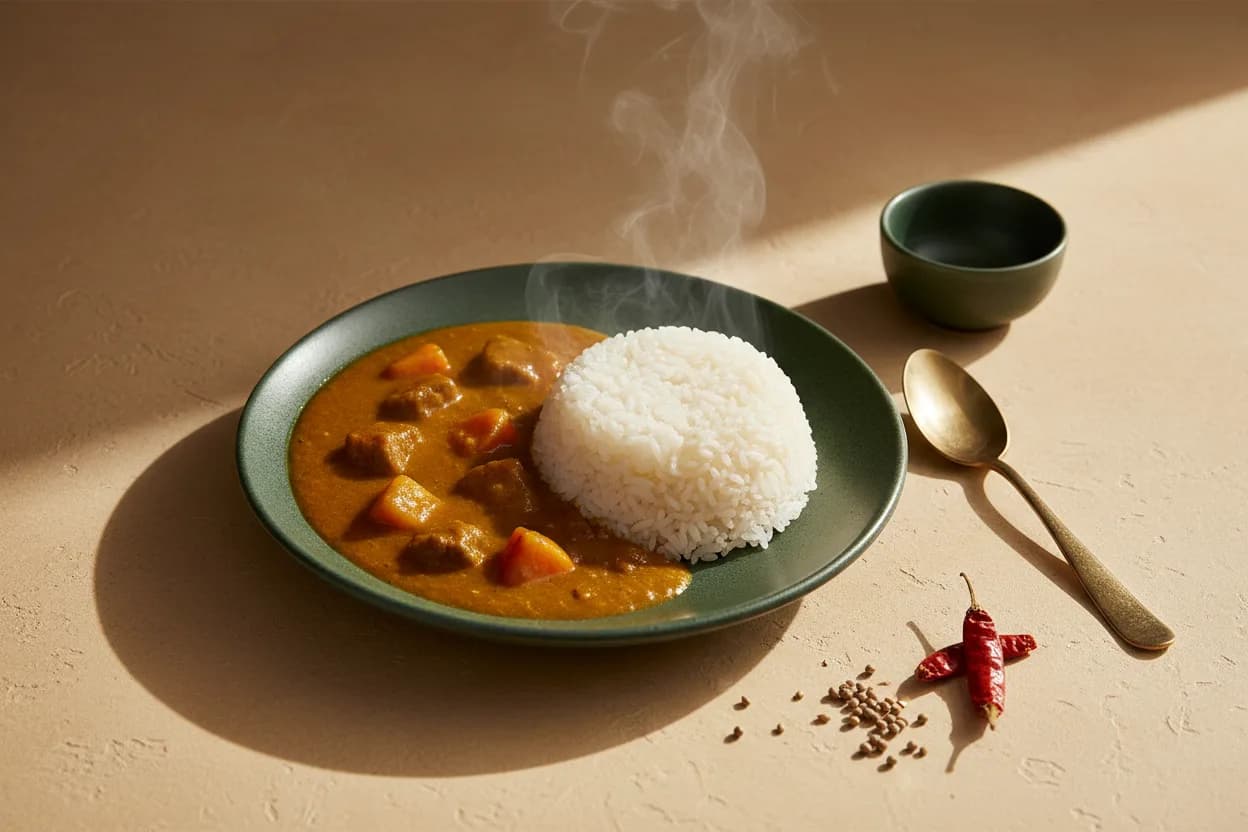
Japanese Curry Medium · about 3 hours · Forgiving · 1 pot kare raisu from scratch, roux and all 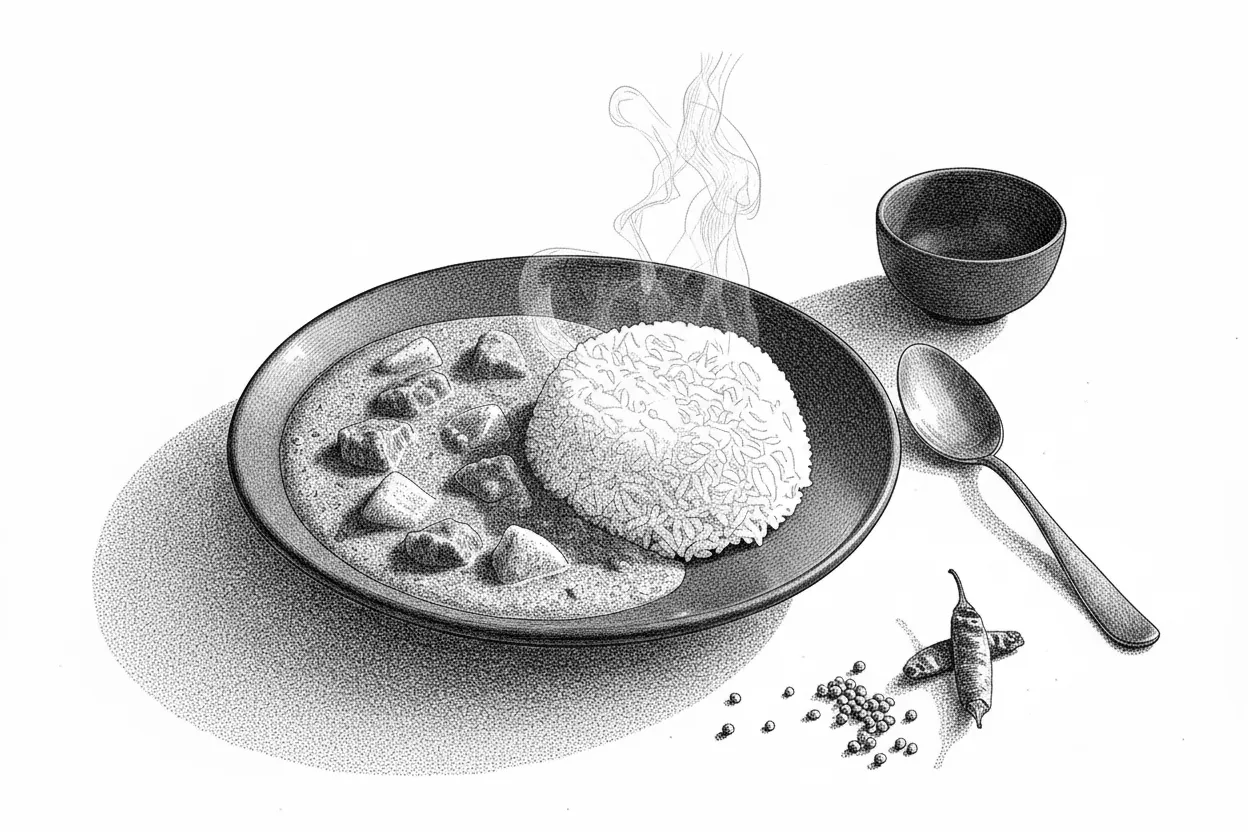 The dish the curry powder exists to make. A Japanese curry is built in two vessels: a roux browned in a skillet, and a pot where onions go dark, meat browns, and the whole thing simmers until the beef gives. The roux is what makes this Japanese rather than Indian, a French technique that arrived through the same channel the spices did, and it is what gives the sauce its gloss and its weight against the spoon. The apple and the honey are not garnish. Grated in early, they cook out of sight and leave behind the low, unplaceable sweetness that sits under every plate of kare raisu. Make the roux first and set it aside, then give the onions the forty slow minutes they actually need. INGREDIENTS - 55 g unsalted butter (unsalted, for the roux)
- 30 g all-purpose flour (all-purpose, for the roux)
- 15 ml frying oil (neutral; 1 tbsp)
- 2 medium onions (sliced thin)
- 500 g beef (chuck in 3 cm cubes, or chicken thigh)
- 3 cloves garlic (minced)
- 6 g fresh ginger (grated; 1 tbsp)
- 2 carrots (rolling-cut)
- 2 waxy potatoes (waxy, in large chunks)
- 950 ml beef stock (or chicken stock to match the meat)
- 1 apple (grated, skin and all)
- 15 ml soy sauce (1 tbsp)
- 15 ml tomato paste (1 tbsp)
- 5 ml honey (1 tsp)
- 6 g sea salt (1 tsp, plus a pinch for the onions)
- 300 g jasmine rice (dry, to steam and serve)
Method - Roux: melt the butter in a skillet over medium-low heat, whisk in the flour, and stir until it turns the colour of peanut butter. Off the heat, stir in 3 tbsp of the Japanese Curry Powder and set the skillet aside. (15 min)
- Caramelize the onions: heat the oil in a heavy pot over medium-low and cook the sliced onions with a pinch of salt until they are deep amber. This is the long, unglamorous part and there is no shortcut through it. (40 min)
- Brown the meat: raise the heat and sear the beef in batches so it colours instead of steaming. Add the garlic and grated ginger for the last 30 seconds. (10 min)
- Simmer: add the stock, grated apple, carrots, and salt. Bring it to a boil, skim, then drop to a bare simmer with the lid ajar. Chicken thigh needs only 25 minutes here. (75 min)
- Potatoes: add the potatoes to the pot and simmer until a knife meets slight resistance. Any softer and they will fall apart in the thickening. (15 min)
- Temper the roux in: whisk about 2 cups of the hot broth into the roux skillet a splash at a time, until it is loose and smooth, then return all of it to the pot. Add the soy sauce, tomato paste, and honey.
- Thicken: simmer uncovered, stirring, until the sauce holds a line when you drag a spoon through it. Salt to taste. (20 min)
- Rice: rinse the jasmine rice until the water runs clear, then steam it and let it rest covered for 10 minutes. Serve the curry over it. (20 min)
The chemistry - pyrazines (C₈H₁₂N₂) · the browned base
- glutamic acid (C₅H₉NO₄) · triple umami
- sotolon (C₆H₈O₃) · the curry note itself
- butyric acid (C₄H₈O₂) · the butter in the roux
- maltol (C₆H₆O₃) · toasted caramel
- fructose (C₆H₁₂O₆) · the hidden sweetness
- curcumin (C₂₁H₂₀O₆) · the colour
- capsaicin (C₁₈H₂₇NO₃) · background warmth
- gingerol (C₁₇H₂₆O₄) · fresh, pungent
- allicin (C₆H₁₀OS₂) · raw-garlic bite
- β-carotene (C₄₀H₅₆) · provitamin A pigment
Nutrition - Calories · 3223
- Protein · 149 g
- Total Fat · 114 g
- Saturated Fat · 52 g
- Total Carbohydrate · 392 g
- Dietary Fiber · 23 g
- Total Sugars · 52 g
- Sodium · 7326 mg
- Cholesterol · 443 mg
Storage - It is better the next day, once the spices have settled into the sauce and the starch has finished thickening it.
- Keep it refrigerated in a covered container and eat within 3 days. It reheats gently with a splash of water.
|