Garlic is not a flavour, it is an alarm
An intact clove of garlic barely smells. The moment you cut it, an enzyme meets its substrate and finishes the reaction in about thirty seconds. That smell is a chemical weapon fired at you.
Contents
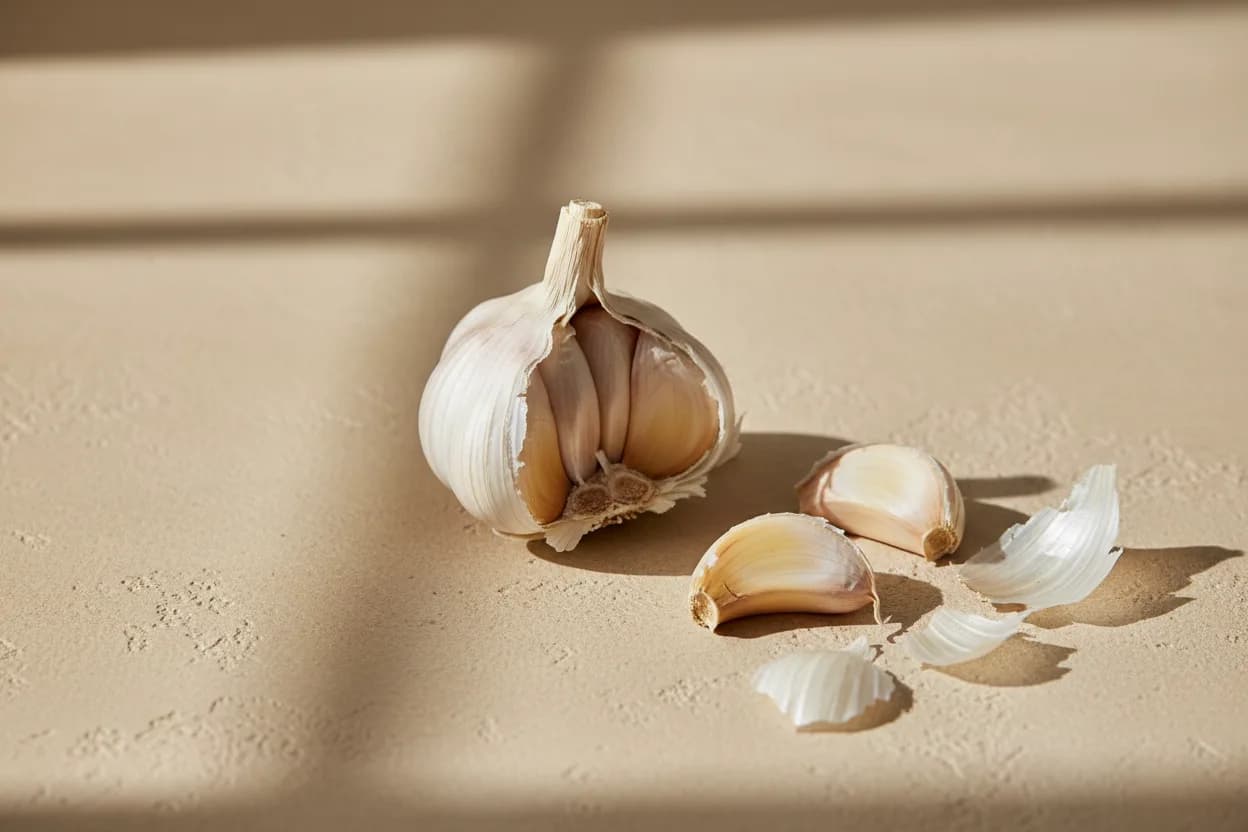
Pick up a whole clove of garlic and smell it. There is almost nothing there, a faint greenness at most. Now cut it. The smell that arrives is not stored in the clove waiting to be released; it did not exist a moment ago. You have started a reaction, and the plant meant it for something with teeth.
Two rooms, one wall
Intact garlic keeps a loaded weapon in two separate compartments. The substrate is alliin, S-allyl-L-cysteine sulfoxide, C₆H₁₁NO₃S, and it sits in the cytosol. The enzyme is alliinase, and it is held in the vacuole, concentrated in a different cell type altogether. As long as the cells are whole, the two never meet. 1
Break the wall and the reaction runs immediately. Alliinase cleaves alliin into allylsulfenic acid, pyruvate, and ammonia, and two molecules of that unstable sulfenic acid condense into one molecule of allicin, C₆H₁₀OS₂. The kinetics are the part worth memorising: at room temperature the conversion is about ninety-seven per cent complete within thirty seconds. 1 The chemistry finishes before you have put the knife down.
A ten-gram clove yields at most around five milligrams of allicin, and allicin accounts for something like sixty to eighty per cent of the thiosulfinates formed. That is a tiny mass doing an enormous amount of sensory work, which is a reliable signal that a molecule's real job is not nutrition but communication. The message is: stop chewing.
Seven years to take it apart
The unpicking of this happened fast, in a tight run of mid-century papers. Chester Cavallito and John Bailey isolated allicin in 1944 and reported it as the antibacterial principle of garlic. 2 Arthur Stoll and Ewald Seebeck then found the precursor, publishing the isolation of alliin in 1948, 3 and followed it the next year with the enzymology, describing alliinase and how it degrades alliin. 4 By 1951 they had synthesised alliin outright.
So the arc runs: here is the smell, here is what it comes from, here is the enzyme that makes it, here is how to build the precursor from scratch. Seven years. Worth keeping the two compounds straight, since they are constantly confused: Cavallito and Bailey found allicin, the product. Stoll and Seebeck found alliin, the precursor. One letter, four years, two different laboratories.
Why cooked garlic is a different ingredient
Allicin is not built to last. It decomposes on its own into diallyl disulfide and trisulfide, vinyldithiins, and ajoene, and it will do so within hours even at room temperature. Heat accelerates the breakdown into that same family of sulfur compounds, so long-cooked garlic smells rounded and sweetish rather than sharp: you are not smelling allicin, you are smelling its wreckage.
The enzyme is the other lever. Alliinase is inactivated by acid and by heat. In whole cloves dropped into boiling water, its activity is fully gone within about two minutes for small cloves, and the interior of a clove reaches roughly ninety-five degrees within four. 5 Cook a clove whole and you denature the enzyme before the tissue is ever disrupted, so most of the alliin never becomes allicin at all. That is the actual mechanism behind roasted garlic being mild and sweet, alongside a separate and genuine contribution from the browning of its sugars. Crushing before heating and heating before crushing are two different recipes.
About the ten-minute rule
The advice to let crushed garlic rest for ten minutes before it hits the pan is real, and it is more approximate than the way it usually gets repeated. It descends from work showing that heating garlic promptly after crushing blocked its ability to suppress carcinogen-DNA adduct formation, and that a rest before heating preserved that activity. 6 The mechanism is sound: give the enzyme its window before you destroy it.
Two caveats. That work was done in rodent tissue, not in a human trial of any cooking instruction. And allicin formation itself, as above, is essentially finished in half a minute, so ten minutes is not what the allicin needs; it is a round number that got attached to a broader downstream effect. Treat it as research-informed kitchen habit, which costs nothing, rather than as a validated dose.
What the clinical evidence supports
Garlic has been medicine for as long as it has been food. It appears throughout the Ebers Papyrus around 1550 BC, and Pliny devotes a long passage to its use among Roman country people. The Israelites in Numbers, listing what they missed about Egypt, name garlic alongside the fish and the melons. This is a plant humans have never stopped making claims about.
The modern evidence is real and modest. A meta-analysis of eleven randomised trials found garlic reduced systolic blood pressure by around 4.6 mmHg overall against placebo, and by roughly 8.4 mmHg in people who were actually hypertensive. 7 A far larger recent synthesis pooling 108 trials and over seven thousand participants found improvements in triglycerides, cholesterol fractions, glucose, blood pressure, and inflammatory markers, and explicitly no effect on several others including body weight and BMI. 8
Read those as biomarkers, not outcomes. No trial has shown that garlic prevents a heart attack or a stroke, the trials are mostly around twelve weeks, and the products tested vary wildly. That last problem is worse than it sounds: measured alliin content varied by a factor of seven and a half across commercial garlic powder supplements. 5 The US National Center for Complementary and Integrative Health puts it plainly, describing a small effect on cholesterol, limited evidence on blood pressure, and two real cautions: garlic supplements can raise bleeding risk for anyone on anticoagulants, and raw garlic applied to skin causes chemical burns. 9
That last detail is the whole essay in miniature. Raw garlic burns skin because allicin is a cytotoxin, and it is a cytotoxin because a plant with no legs and no teeth had to solve the problem of being eaten. We took the alarm and built half a cuisine on it. The plant is still shouting; we just find it delicious.
Sources
Every numbered claim above points here. Links go to the paper, record, or authority itself.
- 1.
Borlinghaus J, Foerster J, Kappler U, et al. Allicin, the Odor of Freshly Crushed Garlic: A Review of Recent Progress in Understanding Allicin's Effects on Cells. Molecules. 2021;26(6):1505.
https://doi.org/10.3390/molecules26061505 - 2.
Cavallito CJ, Bailey JH. Allicin, the Antibacterial Principle of Allium sativum. I. Isolation, Physical Properties and Antibacterial Action. Journal of the American Chemical Society. 1944;66(11):1950-1951.
https://doi.org/10.1021/ja01239a048 - 3.
Stoll A, Seebeck E. Über Alliin, die genuine Muttersubstanz des Knoblauchöls. Helvetica Chimica Acta. 1948;31(1):189-210.
https://doi.org/10.1002/hlca.19480310140 - 4.
Stoll A, Seebeck E. Über den enzymatischen Abbau des Alliins und die Eigenschaften der Alliinase. Helvetica Chimica Acta. 1949;32(1):197-205.
https://doi.org/10.1002/hlca.19490320129 - 5.
Lawson LD, Hunsaker SM. Allicin Bioavailability and Bioequivalence from Garlic Supplements and Garlic Foods. Nutrients. 2018;10(7):812.
https://doi.org/10.3390/nu10070812 - 6.
Song K, Milner JA. The influence of heating on the anticancer properties of garlic. Journal of Nutrition. 2001;131(3s):1054S-1057S.
https://doi.org/10.1093/jn/131.3.1054S - 7.
Ried K, Frank OR, Stocks NP, Fakler P, Sullivan T. Effect of garlic on blood pressure: a systematic review and meta-analysis. BMC Cardiovascular Disorders. 2008;8:13.
https://doi.org/10.1186/1471-2261-8-13 - 8.
Behrouz V, Zahroodi M, Clark CCT, et al. Effects of Garlic Supplementation on Cardiovascular Risk Factors in Adults: A Comprehensive Updated Systematic Review and Meta-Analysis of Randomized Controlled Trials. Nutrition Reviews. 2026;84(1):1-35.
https://doi.org/10.1093/nutrit/nuaf090 - 9.
National Center for Complementary and Integrative Health (US National Institutes of Health). Garlic: Usefulness and Safety.
https://www.nccih.nih.gov/health/garlic