The flour does not contain any gluten
Gliadin and glutenin sit in the wheat endosperm as storage protein. Gluten is what water and work make out of them, and five minutes of mixing drives the polymer to half the level sitting in the undisturbed flour. The proline that builds the network is the same proline no human protease can cut.
Contents
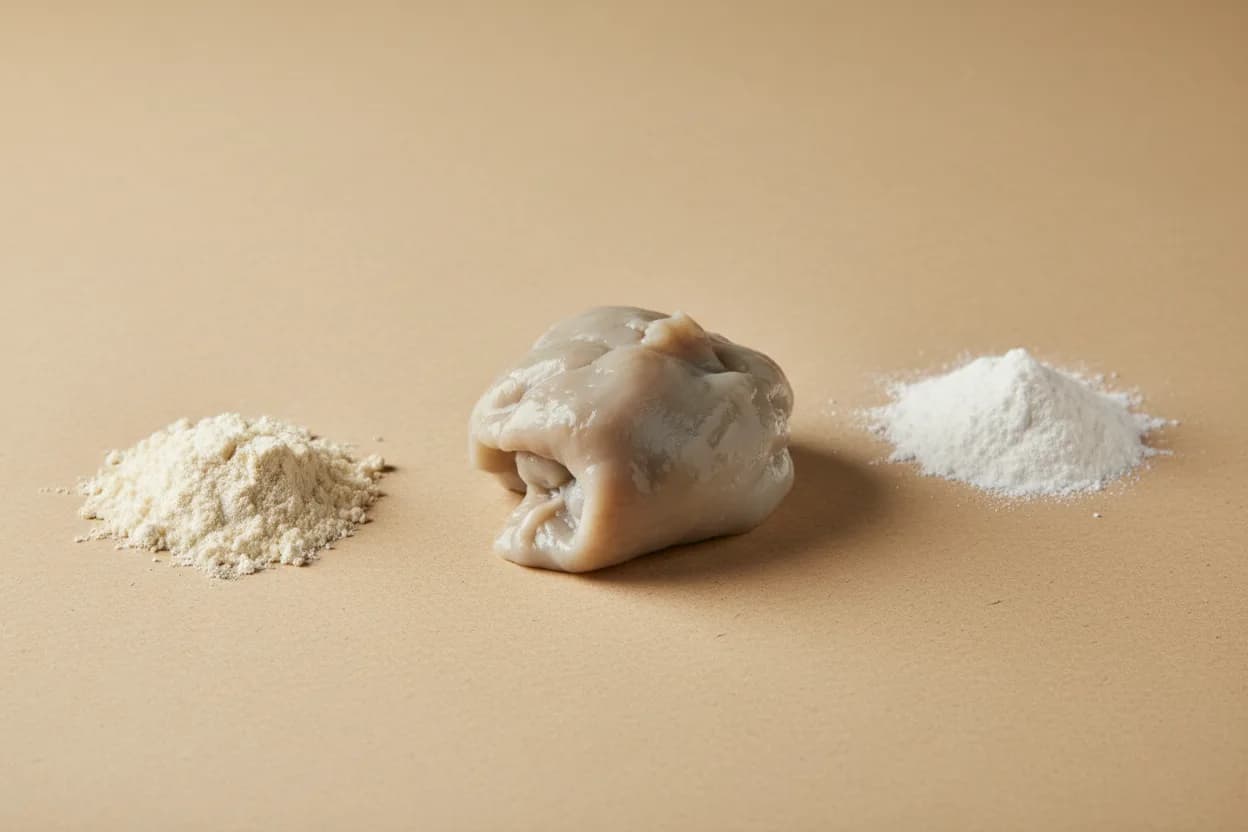
Make a stiff dough from flour and water, leave it half an hour, then hold it under a running tap and work it gently between your fingers. The water runs white and keeps running white for a long time. What stays in your hand at the end is a grey-beige lump the size of a plum, cool and slack and disconcertingly like something out of an animal rather than a plant. Stretch it and it thins without tearing. Let it go and it pulls back.
The first description of that lump was published in 1745, by Jacopo Beccari, professor of chemistry at the University of Bologna, in a paper called De frumento, from a lecture he had given in 1728.1 It is one of the earliest proteins anyone isolated, and it was isolated by washing bread dough in a sink.
What is actually in the bag
Here is the part that surprises people who bake often. The flour in the bag contains no gluten at all. What it contains is two families of storage protein, gliadins and glutenins, laid down in the starchy endosperm cells of the developing grain to feed a seedling that never happened.2 Gluten is not an ingredient. It is what those proteins become once water reaches them and something moves them around, and the standard review language is exact about this: food processing develops and sets the gluten protein network.3
The two families divide the labour, and the division is a matter of size. Gliadins are monomers, single chains of 28,000 to 55,000 daltons. Glutenins are aggregates linked by disulphide bonds, running from 500,000 to more than 10,000,000.4 That is a gap of two orders of magnitude between the two proteins sitting side by side in the same grain.
What produces the gap is one of the most elegant things in food chemistry, and it is not a difference in bond type. Both families are held together by disulphide bridges between cysteine residues. The difference is where those bridges point. Intrachain bonds, present in every type except the omega-gliadins, fold a molecule inward and stabilise its own three-dimensional shape. Interchain bonds, mainly linking the high and low molecular weight glutenin subunits, reach outward and generate oligomers and polymers.5 Gliadin ties itself in a knot and stays a single compact molecule. Glutenin ties itself to its neighbours and builds something without end.
So glutenin supplies the structure, and the high molecular weight subunits in particular have been called the elastic backbone of gluten.2 Gliadin supplies flow. The current account of extensibility is that dough stretches through slippage between the noncovalently bound gliadins and the glutenin polymers when force is applied,1 which is a more useful picture than the usual line about gliadin providing viscosity: the small molecules are lubricating the movement of the large ones past each other. By weight, gluten runs to roughly 50 per cent monomeric gliadins, 15 per cent oligomeric high molecular weight gliadins and 35 per cent polymeric glutenins.5
What the network is for
All of that exists, from a baker's point of view, to hold gas. A dough that can hold a bubble has to do something specific under stretch: as a wall thins it must get harder to thin further, so that the thinnest part of the wall stops being the weakest part. That property is strain hardening, and it is measured as the exponent in a power law relating true stress to strain. The index has to exceed 1 for gas cells to expand without disproportionation and coalescence.6
Where the hardening comes from is molecular. It is thought to originate in entanglement coupling between large glutenin molecules, above a threshold molecular weight below which stable entanglements do not form.6 Which invites the obvious conclusion that longer glutenin is always better, and that conclusion is wrong. Strain hardening index and test bake loaf volume both rise with increasing molecular weight distribution up to an optimum, and then decline.6 There is a best size, and past it the dough gets worse.
The same work argues that the gluten and starch matrix is not doing the job alone. Thin liquid films stabilised by surface-active compounds act as a second mechanism, taking over as discontinuities begin to appear in the primary matrix during late proving and early baking.6 The evidence for the split is neat: adding natural flour lipids back into defatted flour changed loaf volume substantially while barely touching the strain hardening index. Something other than rheology was moving the loaf.
Kneading takes apart more than it builds
Now the part that contradicts almost every recipe ever written. In 2021 Feng and colleagues tracked the glutenin macropolymer, the large insoluble glutenin fraction that carries most of a dough's strength, through mixing and resting. Going from three minutes of mixing to five cut the macropolymer content by 20.20 per cent, from 8.17 per cent down to 6.52.7 Mechanical force was depolymerising it, breaking the large particles into small ones: the fraction under 11 microns rose from 31.12 per cent in the flour to 38.52 per cent straight after mixing.
The number that reframes the whole operation is the flour baseline. Undisturbed flour sat at 13.31 per cent.7 Five minutes of mixing had driven the polymer to roughly half of what was quietly sitting in the bag before anyone touched it. Kneading does not assemble the macropolymer. It hydrates, distributes and shears, and along the way it tears the largest structures apart.
Rest is what puts them back. Resting significantly increased both free thiol groups and disulphide content, recovery peaked at 60 minutes and had begun to fall away by 90, and the particle size distribution shifted back toward the large end.7 The instruction to let the dough sit has measurable polymer chemistry behind it. The instruction to knead harder does not.
One honest caveat, because the temptation here is to declare no-knead bread vindicated. What this paper demonstrates is rest recovering a network that mixing broke. It does not show that a rest-only method reaches the same endpoint as kneading, and I could not find a primary study that does. That step is still craft knowledge, and it is worth saying so rather than dressing it in a citation it has not earned.
The same sequence, read by an immune system
Gluten proteins are extraordinarily rich in two amino acids, proline and glutamine. Proline is the one with the ring, the residue that kinks a backbone and refuses to sit in an extended chain. That is part of why gluten behaves as it does. It is also the reason a small proportion of people cannot eat it.
In 2002 Lu Shan, Oyvind Molberg and colleagues identified a 33 amino acid fragment of alpha-2 gliadin, residues 57 to 89, that survives digestion whole. Their description of it is unusually absolute: stable toward breakdown by all gastric, pancreatic and intestinal brush border membrane proteases.89 Count the published sequence and the reason is plain. Thirteen of its 33 residues are proline and ten are glutamine, so 23 of 33 are one or the other, and the entire peptide is built from only five distinct amino acids. Human digestive enzymes have essentially no ability to cut after proline. Bacteria have that enzyme. We do not.
What happens next needs the glutamine. Tissue transglutaminase deamidates specific glutamine residues to glutamate, an ordered and specific modification that creates an epitope binding efficiently to HLA-DQ2.10 A neutral side chain becomes a negatively charged one, the positively charged pockets of the DQ2 and DQ8 molecules grip it far harder, and gluten-specific T cells in the gut wall respond. The enzyme that performs the modification is itself the main autoantigen of the disease, and that is the reason the blood test for coeliac disease looks for antibodies against transglutaminase rather than against gluten. Shan's peptide induced T cell lines from 14 of 14 patients, and homologues of it are found in all food grains toxic to coeliac patients and absent from all the nontoxic ones.8
The scale is smaller than the shelf space suggests. Pooling 96 studies, global seroprevalence of coeliac disease is 1.4 per cent across 275,818 people, and biopsy-confirmed prevalence is 0.7 per cent across 138,792.11 For those people the response is permanent and the diet is not optional.
For the much larger group who avoid gluten without that diagnosis, the evidence has moved somewhere genuinely interesting. Jessica Biesiekierski's Monash group reported in 2011 that gluten caused symptoms in people without coeliac disease. In 2013 the same group ran the trial again in 37 subjects, this time reducing fermentable carbohydrates in the background diet first, and the effect evaporated: symptoms improved on the low FODMAP run-in and worsened equally on gluten or on whey, with gluten-specific effects in only 8 per cent.12 An Oslo group then challenged 59 people with gluten, fructan or placebo concealed in muesli bars. Fructan scored significantly worse than gluten, there was no difference between gluten and placebo, and 22 of the 59 felt worst of all on the placebo bar.13
It would be easy and wrong to conclude that non-coeliac gluten sensitivity is imaginary. Pooling ten double-blind challenge trials in 1,312 adults, 38 of 231 patients, 16 per cent, did show genuinely gluten-specific symptoms, while 40 per cent had a nocebo response.14 And a trial that gave 4.375 grams of gluten a day in capsules against a rice starch placebo, a design with no fermentable carbohydrate on either side, found a real effect on bloating, pain and, oddly, on foggy mind and depression.15 The symptoms are real and measurable. In most people the trigger has been misattributed, in a minority it has not, and there is no test that tells an individual which group they are in.
One practical thing falls out of the chemistry and deserves stating plainly, because it is a common and dangerous hope. Sourdough fermentation does not make bread safe for coeliacs. In a 60 day trial, baked goods hydrolysed only partway, to 2,480 parts per million of residual gluten, produced patients with no clinical complaints who nonetheless developed subtotal villous atrophy.16 Full hydrolysis to 8 parts per million was safe, but that is an engineered ferment with added fungal proteases, not a household starter. United States labelling law makes the same judgement from the other direction: a fermented or hydrolysed food may only be called gluten-free if it was gluten-free before fermentation, because the standard analytical methods cannot measure gluten once it has been broken into fragments.17
What can stand in for it
Nothing replaces gluten with a single substance, because gluten was never doing a single job. A gluten-free formula has to restage the whole division of labour: something to build a continuous phase, something to hold gas, something to bind water, something to set in the heat. The interesting part is that the best-known answer works by a mechanism precisely opposite to the one people assume.
Hydroxypropyl methylcellulose, the additive in most commercial gluten-free bread, gels when you heat it and melts when you cool it. This is lower critical solution temperature behaviour, and it is the reverse of gelatin.18 Below the transition the polymer chains are wrapped in ordered cages of water around their hydrophobic methoxy groups and the solution flows. Heat destroys the cages, the exposed hydrophobic groups find each other, the chains self-assemble into fibrils and the whole thing sets. Differential scanning calorimetry resolves that into separate events near 50 degrees, 55 to 70, and 65 to 72, with the transition range running anywhere from 30 to 80 degrees depending on substitution and molecular mass.19 The practical consequence is that the loaf acquires its structure inside the oven, at exactly the moment a gluten network would have been setting.
Against that, psyllium husk and xanthan are the usual comparisons, and the honest finding is that no ranking survives a change of flour. In one head to head, HPMC gave higher specific volume than either, and psyllium behaved much like xanthan; but with maize starch HPMC produced a soft crumb, while with rice flour it produced a harder bread than psyllium or xanthan did.20 Psyllium taken up to 13.2 grams per 100 grams of flour and starch increases dough elasticity and also increases crumb gumminess and crust hardness.21 It does earn its reputation on staling, giving the softest and most resilient crumb and significantly slowing the rate of crumb hardening.22
The one substitute that behaves like gluten rather than merely substituting for it is zein, the storage protein of maize, and it comes with a temperature. Schober and colleagues measured its glass transition at about 29 degrees. Above that, hydrated zein aggregates into something they were willing to call zein gluten: a viscoelastic mass that can be extended into sheets, mixed at 40 degrees with maize starch into a real dough. With HPMC added it baked to a specific volume of 3.16 millilitres per gram against 2.72 without, and the authors describe the result as resembling wheat bread, with a regular fine crumb and a round top.23 Lawton had reported in 1992 that 35 degrees sufficed, and that with a second plasticiser the minimum fell to 28, close to the transition itself.
And then the failure mode, which is the best detail in the whole subject. Cool that dough below 29 degrees and the network turns glassy and brittle. A mechanical knock shatters the protein strands into small pieces with a chiselled appearance, and reheating above the transition and mixing again does not rebuild them. Dough that was allowed to go cold and then warmed produced loaves with large void spaces beneath the crust, because expanding bubbles broke strands that had gone brittle.23 A gluten substitute with a working temperature window you can miss by two degrees.
Most real formulas end up combining several of these. An optimised whole sorghum bread, built from psyllium husk for gas and water holding, egg white for foaming and emulsifying, and milk powder for a protein network, moved from 1.7 to 2.8 cubic centimetres per gram of specific volume while crumb firmness fell from 10.6 to 3.7 newtons.24 Those are gains from tuning an entire seven-ingredient formulation, not from any one addition. And the starting figures are a fair picture of how poor an unoptimised gluten-free loaf is.
The structural limits are candid in the literature. Gluten-free doughs are soft and batter-like, so they are generally baked in tins, and that consistency makes them prone to collapse, to holes in the middle of the crumb and dense patches at the bottom. Shaping such a dough into pretzels, baguettes or anything braided remains, in the words of the people who have spent careers on it, virtually impossible.23
What the loaf is actually missing
One last correction, and it runs opposite to the received wisdom. A survey of United Kingdom supermarket products found gluten-free white bread carried 7 grams of fibre per 100 against standard white bread's 3, a difference significant at p below 0.001, and fibre was higher in every gluten-free bread category.25 That makes sense once you know how much psyllium and hydrocolloid goes into one. Protein was the real loss, 4 grams against 9 in white bread.
The largest gap, though, had nothing to do with nutritional chemistry: it was fortification. All standard white bread met the four mandatory United Kingdom requirements for calcium, iron, niacin and thiamin. Among gluten-free breads, 5 per cent did, only 2 of 14 manufacturers fortified anything, and not one gluten-free pasta product was fortified.25 The deficit is regulatory and commercial rather than intrinsic, which also means it is fixable by decision rather than by chemistry.
Go back to the lump under the tap. Ten minutes of patient washing gets you one, and everyone who tries it is startled by how much like meat it feels. Nothing in the bag felt like that an hour earlier. For almost everybody the only consequence of that proline-rich run of residues is that bread rises. For the 0.7 per cent it is the reason a loaf has to be built some other way: out of a cellulose that sets when it gets hot, or a corn protein you have to keep warm or it shatters like glass.
Sources
Every numbered claim above points here. Links go to the paper, record, or authority itself.
- 1.
Shewry P. Wheat grain proteins: past, present, and future. Cereal Chemistry. 2023;100:9-22. Source for the first description of gluten published in 1745 by Jacopo Beccari, professor of chemistry at the University of Bologna, in De frumento, and for the 1728 date of the underlying lecture as translated by Bailey (1941). Also the source of the account of dough extensibility as slippage between the noncovalently bound gliadins and glutenin polymers under applied force.
https://doi.org/10.1002/cche.10585 - 2.
Shewry PR, Halford NG, Belton PS, Tatham AS. The structure and properties of gluten: an elastic protein from wheat grain. Philosophical Transactions of the Royal Society B. 2002;357(1418):133-142. Gluten proteins are the major storage proteins deposited in the starchy endosperm cells of the developing grain; the high molecular weight glutenin subunits are described as the elastic backbone of gluten.
https://doi.org/10.1098/rstb.2001.1024 - 3.
Delcour JA, Joye IJ, Pareyt B, Wilderjans E, Brijs K, Lagrain B. Wheat gluten functionality as a quality determinant in cereal-based food products. Annual Review of Food Science and Technology. 2012;3:469-492. Source for the statement that wheat-based food processing develops and sets the gluten protein network, and for sulfhydryl oxidation and thiol-disulphide interchange as the reactions producing the cross-links.
https://doi.org/10.1146/annurev-food-022811-101303 - 4.
Wieser H. Chemistry of gluten proteins. Food Microbiology. 2007;24(2):115-119. Gliadins are monomeric at 28,000 to 55,000 daltons; glutenins are disulphide-linked aggregates from 500,000 to more than 10,000,000; on reduction the subunits separate into high molecular weight (67,000 to 88,000) and low molecular weight (32,000 to 35,000) glutenin subunits.
https://doi.org/10.1016/j.fm.2006.07.004 - 5.
Wieser H, Koehler P, Scherf KA. Chemistry of wheat gluten proteins: qualitative composition. Cereal Chemistry. 2023;100(1):23-35. The intrachain versus interchain disulphide distinction quoted in this note, with omega-gliadins as the stated exception, and the composition figures of approximately 50 per cent monomeric gliadins, 15 per cent oligomeric high molecular weight gliadins and 35 per cent polymeric glutenins.
https://doi.org/10.1002/cche.10572 - 6.
Sroan BS, Bean SR, MacRitchie F. Mechanism of gas cell stabilization in bread making. I. The primary gluten-starch matrix. Journal of Cereal Science. 2009;49(1):32-40. Source of the power-law strain hardening index and the requirement that it exceed 1, of entanglement coupling above a threshold molecular weight, of the non-monotonic relationship between molecular weight distribution and loaf volume, of the dual gas-cell stabilisation mechanism with secondary liquid lamellae, and of the flour-lipid result that moved loaf volume without moving the strain hardening index. The companion paper on the secondary liquid lamellae is Sroan BS, MacRitchie F, Journal of Cereal Science 2009;49:41-46, doi 10.1016/j.jcs.2008.07.004.
https://doi.org/10.1016/j.jcs.2008.07.003 - 7.
Feng Y, Zhang H, Wang J, Chen H. Dynamic changes in glutenin macropolymer during different dough mixing and resting processes. Molecules. 2021;26(3):541. Open access. Mixing from 3 to 5 minutes reduced glutenin macropolymer content by 20.20 per cent, from 8.17 to 6.52 per cent, against a flour baseline of 13.31 per cent; particles under 11 microns rose from 31.12 to 38.52 per cent; resting raised thiol and disulphide content and recovered the macropolymer, peaking at 60 minutes and declining by 90.
https://doi.org/10.3390/molecules26030541 - 8.
Shan L, Molberg O, Parrot I, Hausch F, Filiz F, Gray GM, Sollid LM, Khosla C. Structural basis for gluten intolerance in celiac sprue. Science. 2002;297(5590):2275-2279. The 33-mer peptide stable toward breakdown by all gastric, pancreatic and intestinal brush border membrane proteases; a potent inducer of gut-derived T cell lines from 14 of 14 patients; homologues present in all food grains toxic to coeliac patients and absent from all nontoxic ones; detoxified in vitro and in vivo by a bacterial prolyl endopeptidase.
https://doi.org/10.1126/science.1074129 - 9.
Balakireva A, Zamyatnin A. Properties of gluten intolerance: gluten structure, evolution, pathogenicity and detoxification capabilities. Nutrients. 2016;8(10):644. Open access. Source for the immunodominant 33-mer occupying residues 57 to 89 of alpha-2 gliadin. The proline and glutamine tally quoted in this note is a direct residue count of that published 33-residue sequence, not a figure quoted from a paper.
https://doi.org/10.3390/nu8100644 - 10.
Molberg O, McAdam SN, Korner R, Quarsten H, Kristiansen C, Madsen L, Fugger L, Scott H, Noren O, Roepstorff P, Lundin KE, Sjostrom H, Sollid LM. Tissue transglutaminase selectively modifies gliadin peptides that are recognized by gut-derived T cells in celiac disease. Nature Medicine. 1998;4(6):713-717. Ordered and specific deamidation of gliadins creating an epitope that binds efficiently to DQ2; transglutaminase identified as the main target of coeliac-associated anti-endomysium autoantibodies.
https://doi.org/10.1038/nm0698-713 - 11.
Singh P, Arora A, Strand TA, Leffler DA, Catassi C, Green PH, Kelly CP, Ahuja V, Makharia GK. Global prevalence of celiac disease: systematic review and meta-analysis. Clinical Gastroenterology and Hepatology. 2018;16(6):823-836.e2. Ninety-six studies included; pooled global seroprevalence 1.4 per cent (95% CI 1.1 to 1.7) in 275,818 individuals; pooled biopsy-confirmed prevalence 0.7 per cent (95% CI 0.5 to 0.9) in 138,792 individuals.
https://doi.org/10.1016/j.cgh.2017.06.037 - 12.
Biesiekierski JR, Peters SL, Newnham ED, Rosella O, Muir JG, Gibson PR. No effects of gluten in patients with self-reported non-celiac gluten sensitivity after dietary reduction of fermentable, poorly absorbed, short-chain carbohydrates. Gastroenterology. 2013;145(2):320-328.e1-3. Double-blind crossover in 37 subjects after a two-week reduced-FODMAP run-in; symptoms improved on the run-in and worsened to a similar degree on gluten or on whey protein; gluten-specific effects observed in only 8 per cent. The same group's earlier positive trial is Biesiekierski JR et al., American Journal of Gastroenterology 2011;106(3):508-514.
https://doi.org/10.1053/j.gastro.2013.04.051 - 13.
Skodje GI, Sarna VK, Minelle IH, Rolfsen KL, Muir JG, Gibson PR, Veierod MB, Henriksen C, Lundin KEA. Fructan, rather than gluten, induces symptoms in patients with self-reported non-celiac gluten sensitivity. Gastroenterology. 2018;154(3):529-539.e2. Fifty-nine individuals, gluten 5.7 g, fructan 2.1 g or placebo concealed in muesli bars for 7 days each; fructan scored significantly higher than gluten; no difference between gluten and placebo; 13 participants scored worst on gluten, 24 on fructan and 22 on placebo.
https://doi.org/10.1053/j.gastro.2017.10.040 - 14.
Molina-Infante J, Carroccio A. Suspected nonceliac gluten sensitivity confirmed in few patients after gluten challenge in double-blind, placebo-controlled trials. Clinical Gastroenterology and Hepatology. 2017;15(3):339-348. Ten double-blind placebo-controlled gluten challenge trials pooled, 1,312 adults; only 38 of 231 patients (16 per cent) showed gluten-specific symptoms, and 40 per cent had a nocebo response.
https://doi.org/10.1016/j.cgh.2016.08.007 - 15.
Di Sabatino A, Volta U, Salvatore C, Biancheri P, Caio G, De Giorgio R, Di Stefano M, Corazza GR. Small amounts of gluten in subjects with suspected nonceliac gluten sensitivity: a randomized, double-blind, placebo-controlled, cross-over trial. Clinical Gastroenterology and Hepatology. 2015;13(9):1604-1612.e3. Gluten 4.375 g per day or rice starch placebo in gastrosoluble capsules, one week each; gluten significantly increased overall symptoms (P = .034), bloating, pain, foggy mind and depression. The capsule design removes the fermentable carbohydrate confound present in the bread-based trials.
https://doi.org/10.1016/j.cgh.2015.01.029 - 16.
Greco L, Gobbetti M, Auricchio R, et al. Safety for patients with celiac disease of baked goods made of wheat flour hydrolyzed during food processing. Clinical Gastroenterology and Hepatology. 2011;9(1):24-29. Sixty days at 200 g per day in 13 patients across three arms; the partially hydrolysed arm at 2,480 ppm residual gluten produced no clinical complaints but subtotal villous atrophy, while full hydrolysis to 8 ppm by sourdough lactobacilli plus fungal proteases left anti-transglutaminase and Marsh grades unchanged.
https://doi.org/10.1016/j.cgh.2010.09.025 - 17.
United States Food and Drug Administration. 21 CFR 101.91, Gluten-free labeling of food. Issued 5 August 2013 (78 FR 47178), amended 13 August 2020 (85 FR 49260). Requires unavoidable gluten below 20 ppm, and for fermented or hydrolysed foods requires records demonstrating the food was gluten-free before fermentation or hydrolysis, because a scientifically valid method to measure gluten in such foods is not available.
https://www.ecfr.gov/current/title-21/section-101.91 - 18.
Sarkar N. Thermal gelation properties of methyl and hydroxypropyl methylcellulose. Journal of Applied Polymer Science. 1979;24(4):1073-1087. The classic reference for aqueous methylcellulose and hydroxypropyl methylcellulose solutions gelling on heating and liquefying again on cooling, and for the incipient gelation temperature concept.
https://doi.org/10.1002/app.1979.070240420 - 19.
Niemczyk-Soczynska B, Sajkiewicz P, Gradys A. Toward a better understanding of the gelation mechanism of methylcellulose via systematic DSC studies. Polymers. 2022;14(9):1810. Open access. Lower critical solution temperature behaviour with a range of 30 to 80 degrees depending on substitution degree, heating rate and molecular mass, resolved by DSC into transitions near 50, 55 to 70, and 65 to 72 degrees, corresponding to breakdown of the water network, destruction of the water cages around the methoxy groups, and hydrophobic fibril formation.
https://doi.org/10.3390/polym14091810 - 20.
Belorio M, Gomez M. Effect of hydration on gluten-free breads made with hydroxypropyl methylcellulose in comparison with psyllium and xanthan gum. Foods. 2020;9(11):1548. Open access. HPMC gave higher specific volume than the other hydrocolloids and psyllium behaved similarly to xanthan; the effect on hardness reversed with the flour used, HPMC giving a harder bread than psyllium or xanthan in rice flour formulations.
https://doi.org/10.3390/foods9111548 - 21.
Torres-Perez R, Martinez-Garcia E, Siguero-Tudela MM, Garcia-Segovia P, Martinez-Monzo J, Igual M. Enhancing gluten-free bread production: impact of hydroxypropyl methylcellulose, psyllium husk fiber, and xanthan gum on dough characteristics and bread quality. Foods. 2024;13(11):1691. Open access. Psyllium husk fibre raised to 13.2 g per 100 g of flour and starch increased dough elasticity while also increasing crumb gumminess and crust hardness.
https://doi.org/10.3390/foods13111691 - 22.
Filipcev B, Pojic M, Simurina O, Misan A, Mandic A. Psyllium as an improver in gluten-free breads: effect on volume, crumb texture, moisture binding and staling kinetics. LWT. 2021;151:112156. Psyllium gave the softest and most resilient crumb and significantly decreased the rate of crumb hardening, in buckwheat and carob based formulations.
https://doi.org/10.1016/j.lwt.2021.112156 - 23.
Schober TJ, Bean SR, Boyle DL, Park SH. Improved viscoelastic zein-starch doughs for leavened gluten-free breads: their rheology and microstructure. Journal of Cereal Science. 2008;48(3):755-767. Zein glass transition measured at about 29 degrees; viscoelastic zein-starch dough mixed at 40 degrees; specific volume 3.16 plus or minus 0.08 ml/g with HPMC against 2.72 plus or minus 0.10 without; below the transition the network becomes glassy-brittle and mechanical impact shatters the strands into chiselled fragments that reheating and remixing do not rebuild. Lawton's 1992 temperatures are reported in this paper; Lawton JW, Cereal Chemistry 1992;69:351-355 has no registered DOI, so it is cited here through Schober et al.
https://doi.org/10.1016/j.jcs.2008.04.004 - 24.
Rodriguez-Espana M, Figueroa-Hernandez CY, Suarez-Quiroz ML, Canelo-Alvarez F, Figueroa-Cardenas JD, Gonzalez-Rios O, Rayas-Duarte P, Hernandez-Estrada ZJ. Optimization of gluten-free bread formulation using whole sorghum-based flour by response surface methodology. Foods. 2025;14(17):3113. Open access. Specific volume rose from 1.7 to 2.8 cubic centimetres per gram and crumb firmness fell from 10.6 to 3.7 newtons between the initial and optimised formulation. These are gains from optimising a whole multi-ingredient formulation, not a measurement of any single additive.
https://doi.org/10.3390/foods14173113 - 25.
Allen B, Orfila C. The availability and nutritional adequacy of gluten-free bread and pasta. Nutrients. 2018;10(10):1370. Open access. A United Kingdom supermarket label survey with data collected September to December 2017. Fibre was higher in all gluten-free bread categories, 7 g against 3 g per 100 g in white bread (p below 0.001); protein was lower, 4 g against 9 g; 5 per cent of gluten-free breads contained all four mandatory fortification nutrients against 100 per cent of standard white bread, only 2 of 14 manufacturers fortified, and no gluten-free pasta was fortified.
https://doi.org/10.3390/nu10101370