fresh mint
Mentha × piperita
IN ARABIC نعناع طازج
Bright, cooling leaf.
ABOUT
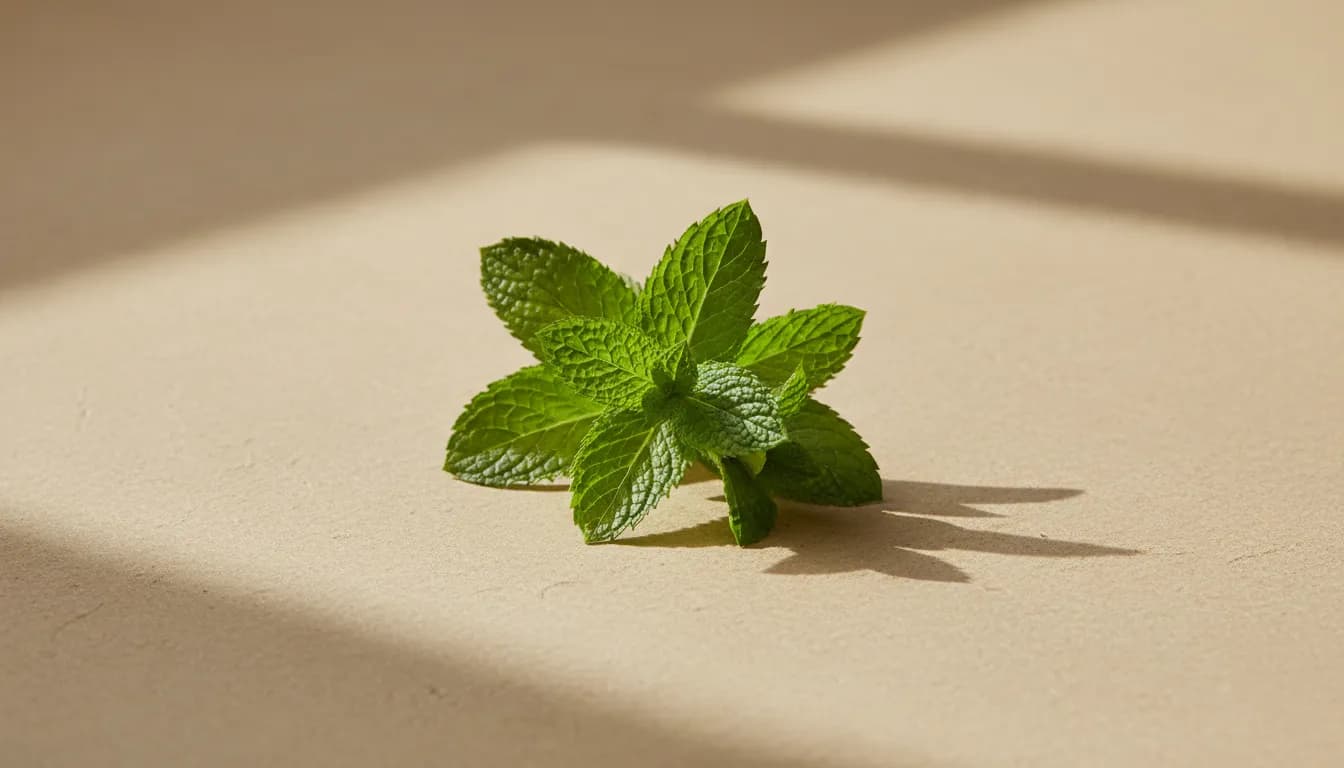
Fresh mint here is Mentha × piperita, peppermint, used as whole leaves; its dried counterpart, mintdry, is kept as a separate entity in this library because drying changes more than the leaf's texture. Fresh leaves turn up in eight recipes, seven teas and the two-kiwi smoothie, in counts from two optional leaves in deep sleep tea up to fifteen in focus tea; grape and mint wine's twelve go in lightly bruised for a long cold infusion rather than a hot steep. Several teas, desert recovery night tea and smoke recovery tea among them, add the leaf only after the simmer is off, so its cooling top note survives rather than boils away; the smoothie skips heat altogether and blends the leaves raw.
The compound this library tracks is menthol, 33.37 percent of peppermint oil and the reason a leaf reads as cold. It does not lower any temperature: it binds TRPM8, the same receptor that senses real cold, and shifts the point at which it fires toward ordinary mouth temperature, so the nerve reports cold on a tongue that has not moved at all. Peppermint itself is a sterile hybrid, first described in Hertfordshire in 1696, and among the eight possible mirror-image forms of menthol, the plant builds mostly the one, (-)-menthol, that happens to be the most potent at the human receptor. Its close relative spearmint runs on a different terpene, carvone, and tastes of mint without any cold at all, proof that the chill is one branch point in the plant's chemistry rather than a property of mintiness itself.
What mint does once swallowed is narrower than the trials that get quoted for it. The peppermint oil credited with helping irritable bowel syndrome, a relative risk of 2.23 for global improvement pooled across nine trials, is an enteric-coated capsule built to survive the stomach, not leaves steeped in a cup; the two-kiwi smoothie's own note says as much, that these leaves are here for the cool. That same relaxant action is why Low Tide, this library's reflux tea, leaves mint out on purpose: peppermint relaxes the lower esophageal sphincter, the valve that fails during heartburn, so it eases nausea and worsens the burn in the same cup.
CHEMISTRY
1The characteristic compounds documented in this ingredient, plus any the library traces to it in a recipe. Not an exhaustive phytochemistry.
USED IN
8Deep Sleep Tea
2 leaves · optional
STEP 2 Turn off the heat and add the chamomile, lavender, valerian, and mint.
Wine-Style Grape & Mint
12 leaves · lightly bruised; for the infusion
STEP 1 Mint: Lightly bruise the mint, drop it into 300 ml cold water, and refrigerate to infuse; strain.
STEP 3 Mix: Combine the grape juice, mint infusion, cold-brew tea, and the lemon juice.
Two-Kiwi Smoothie
3 g · 4 or 5 fresh leaves
STEP 2 Blend. Kiwifruit, cucumber, yogurt, ginger, mint and the cold water into the blender, and run it until the seeds are flecks.