The Malabar spice that Guatemala grows and does not eat
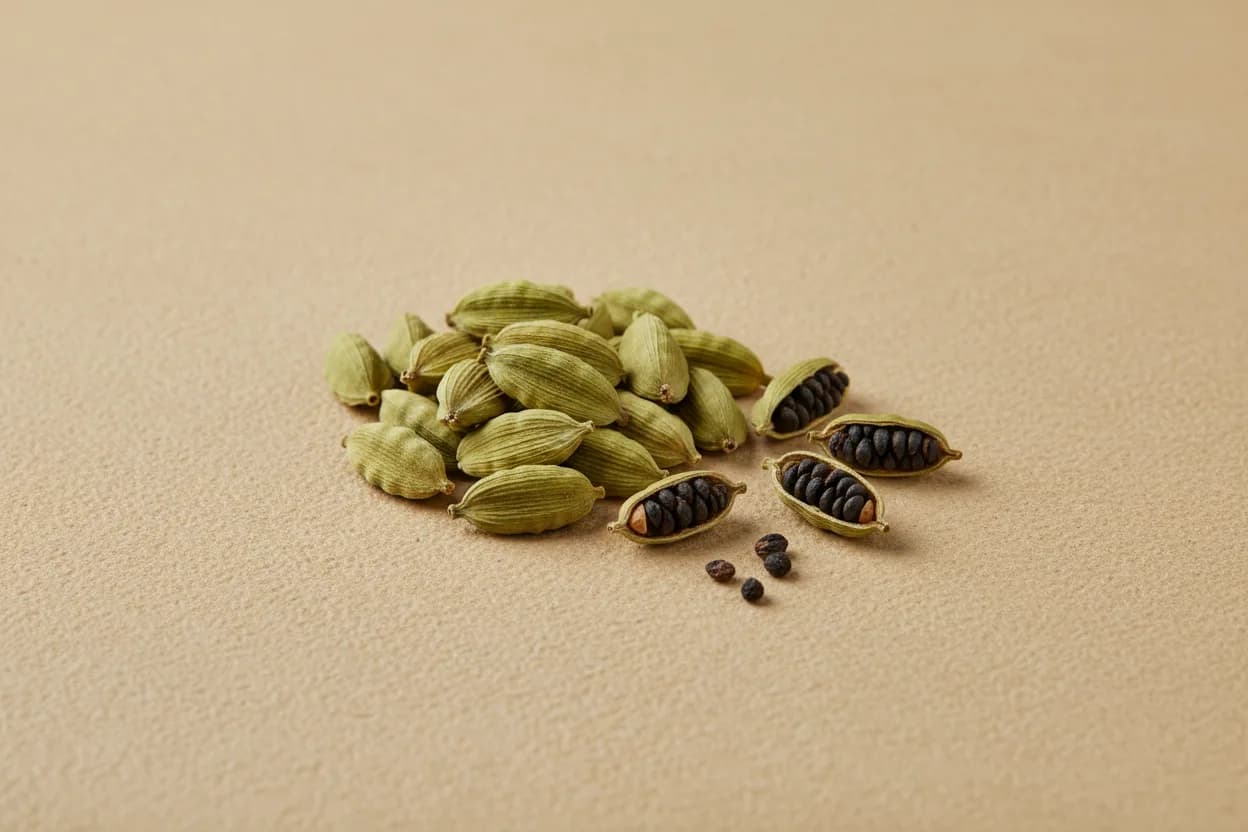
In 2023 Guatemala exported 52,692 tonnes of cardamom and India exported 6,536. Same customs line, same year, same dataset. The plant is native to a narrow band of wet forest in the Western Ghats, its nearest relatives are African, and the story everyone tells about how it reached Central America turns out to rest on nothing you can check.
Contents
Two numbers, from one dataset, for one year. In 2023 Guatemala exported 52,692 tonnes of cardamom, worth 368.8 million dollars.1 India, in the same year and under the same customs code, exported 6,536 tonnes.2 Guatemala shipped roughly eight times as much of a spice that has never grown wild anywhere near it, to a plant that has never grown wild anywhere except the wet forests of southern India and Sri Lanka.
The buyers are the same in both columns. Saudi Arabia took 114 million dollars of the Guatemalan crop and the Emirates took 84, which between them is about 54 per cent of the value; then Jordan, Bangladesh, Turkey.1 Almost none of it stays in the hemisphere where it grew.
A plant with a very small home
Elettaria cardamomum is a ginger relative from the wet evergreen forest of the southern Western Ghats, at middle elevations between roughly 600 and 1,300 metres. The United States plant germplasm register gives its native range as two entries: India, specifically Kerala, and Sri Lanka.3 Wild populations still exist, but as small isolated pockets, sitting more than 40 kilometres from the nearest cultivated stands.5
Its family arrangements were only settled recently, and the answer is not the one the market implies. A 2024 phylogenomic revision in TAXON confirmed Elettaria as confined to India and Sri Lanka and placed it as sister to Aframomum, the African genus that gives us grains of paradise, and to Renealmia, which is African and Neotropical.4 Green cardamom's closest relatives are African. The Asian genus Amomum, which everyone assumes is its near kin because black cardamom comes from it, sits elsewhere on the tree. The same paper recircumscribed Elettaria to seven species and described two of them for the first time.
That distinction is not academic once you look at where the two crops grow. India's own Spices Board reports small cardamom, the Elettaria, at 70,411 hectares producing 25,230 tonnes in 2023 to 2024, of which Kerala alone accounts for about 91 per cent. Large cardamom, Amomum subulatum, is a separate line entirely: 45,596 hectares and 9,288 tonnes, concentrated in Sikkim and the eastern Himalaya.6 Two plants, two genera, two mountain ranges, one English word.
The word itself is older than any certainty about the plant behind it. A Roman customs list preserved in Justinian's Digest, excerpting the jurist Marcian, enumerates the goods subject to duty, and cardamomum is there, thirteen entries after amomum, which Roman practice evidently treated as a different commodity.7 The company it keeps is worth reading in full: cinnamon, long pepper, white pepper, myrrh, ginger, malabathrum, Indian iron, ivory, pearls, sardonyx, emerald, diamond, beryl, raw silk, purple dye, lions and lionesses, leopards, panthers. What the list proves is that a taxable good called cardamomum crossed a Roman frontier. It does not prove the plant in the sack was this one.
What cultivation did to the flowers
Because the wild populations survive at a distance, they can be compared with the cultivars, and in 2009 Kuriakose, Sinu and Shivanna did exactly that. The divergence is dramatic. A wild clump carries about 14.75 branches and 14.84 inflorescences; a cultivated one carries 53.34 and 60.85. Total flowers per clump run to 2,573 in wild plants and 20,359 in the cultivar Njellani, roughly an eightfold increase. Nectar volume per flower rose from 3.5 to 5.2 microlitres.5
Then comes the finding that makes the paper. Wild cardamom is pollinated by solitary bees, a Megachile and two Amegilla species. Cultivated cardamom is worked by social ones, chiefly the giant honeybee Apis dorsata, which achieves 84 per cent fruit set.5 The authors present it as the first documented case of a pollinator shift tied to domestication. Growing more flowers with more nectar in dense stands changed which insect the plant does business with.
The part of the story that nobody can source
Ask how cardamom reached Guatemala and you will get a crisp answer: a German coffee planter, named, brought seed to Alta Verapaz in 1914. The name and the date are everywhere, in trade magazines, in food writing, in tourism copy, in the marketing of Guatemalan cardamom itself.
I could not verify any of it. The peer-reviewed source that covers the introduction gives a window, from India between 1910 and 1914, and names nobody, while noting that production around the municipality of Cobán was already established by 1911, which quietly makes a first planting in 1914 impossible.8 The eight-page report the United States Department of Agriculture devoted entirely to Guatemalan cardamom contains no account of the introduction at all: no date, no planter, no name.10 And the popular versions disagree with each other about the basic facts, some saying the seed came from Kerala, others that the planter wrote to his father in Germany for it. When two tellings of one anecdote cannot agree on where the seeds came from, the anecdote is doing something other than reporting.
What can be checked is the crop's DNA. In 2026 a team sampled 288 cardamom accessions across Guatemala's main producing belt and found genetic diversity strikingly low, a Shannon index of 0.316, resolving into three genetic groups. Their reading of it is the sentence this note was looking for: the low diversity is consistent with the introduction history of this crop in Guatemala, with human selection, and with later bottlenecks from Cardamom Mosaic Virus and thrips.9 The man may be unverifiable. The bottleneck he or somebody else caused is still legible in every plant in the country.
Green gold, and who holds it
By 2014 the USDA could describe Guatemala as the world's leading exporter, producing around 35,000 tonnes a year against world exports of roughly 45,000, and as having recently passed India's production.10 Official Guatemalan figures in the same report show the climb: 21,414 tonnes in 2008, 26,361 in 2011, 38,453 in 2013. About 68 per cent of it comes out of one department, Alta Verapaz.
Roughly 350,000 smallholders are involved, most of them indigenous, most farming plots that do not exceed 1.4 hectares, with an average annual income around 1,933 US dollars.10 Between them and the buyer stand as many as seven levels of intermediary, which the report lists by name: local gatherer, community buyer, community market, municipal retail buyer, benefactor, municipal wholesale buyer, and finally a wholesale marketer in Cobán. Large companies account for 80 per cent of exports. The average export price fell from 13,699 dollars a tonne in 2010 to 6,955 in 2012, a drop of about half in two years, which is the sort of movement a household on 1,933 dollars a year absorbs badly.
The USDA is blunt about the gap between the revenue and the region: although cardamom has generated large revenues for the country, this is not reflected in the development of communities, and the areas of greatest production are the ones where poverty and missing basic services are most visible. In Alta Verapaz the report cites 82 per cent extreme poverty in rural areas and 64 per cent chronic malnutrition in children under five.10
Grown here, drunk there
And they do not use it. The same report says it plainly: although its consumption is low among the Guatemalan diet, cardamom is an important crop in the economy of the region, and for many smallholders the only cash crop.10 At the National Cardamom Congress held in Santa Cruz, Alta Verapaz in August 2013, one of the actions formally adopted was to promote the consumption of cardamom in the domestic and regional market, either as food or as medicine. The largest producer on earth had to resolve, in a conference session, to try its own crop.
India is the mirror image. It produced 34,518 tonnes of the two cardamoms combined in 2023 to 2024 and exported 6,536,62 which is to say roughly four fifths of what it grows never leaves. One country keeps its cardamom and cooks with it. The other sends almost all of it away, on a journey the USDA measures in months rather than weeks: three to four, it notes, for the pods to reach Arabia.10
Whether it smells the same
Both origins are dominated by the same two volatiles, alpha-terpinyl acetate first and 1,8-cineole second: the sweet resinous note and the cool eucalyptus lift that together are what people mean by cardamom. In one paired GC-MS analysis of commercial Indian and Guatemalan oils, the Indian sample ran higher in both, 24.65 per cent against 18.71 for alpha-terpinyl acetate and 14.03 against 10.59 for cineole, with total monoterpenes at 83.24 per cent against 73.03. The Guatemalan oil carried twice the sesquiterpenes, 18.35 per cent against 9.27.11
Two samples bought in a shop are not a survey of two countries, and it would be careless to turn that table into a rule about origin. What it does suggest is that the difference cooks would report, if they were given both blind, is a matter of proportion rather than of kind. The molecules are the same molecules. The bottleneck of one narrow introduction is presumably somewhere in that too.
Crack a green pod into the coffee pot, which is where the majority of the world's cardamom ends up, and the pod in your fingers most likely grew on a hillside in Alta Verapaz, was carried down through six or seven pairs of hands, and spent a season at sea. It came from a plant whose wild ancestors are still standing in a few isolated patches of forest in Kerala, pollinated by solitary bees nobody has any commercial use for. The grower has probably never tasted the drink it was grown for.
Sources
Every numbered claim above points here. Links go to the paper, record, or authority itself.
- 1.
World Bank, World Integrated Trade Solution, drawing on UN COMTRADE. Guatemala cardamom (HS 090830) exports by partner, 2023. Total 52,691,700 kg and US$368.76 million; Saudi Arabia US$114.02M, United Arab Emirates US$84.06M, Jordan US$36.08M, Bangladesh US$18.60M, Turkey US$9.76M. HS 090830 is cardamom only, unlike the FAO commodity line, which aggregates nutmeg, mace and cardamoms together and cannot be used for this comparison.
https://wits.worldbank.org/trade/comtrade/en/country/GTM/year/2023/tradeflow/Exports/partner/ALL/product/090830 - 2.
World Bank, World Integrated Trade Solution, drawing on UN COMTRADE. India cardamom (HS 090830) exports by partner, 2023. Total 6,536,150 kg and US$102.43 million. Same dataset, same year and same customs line as the Guatemalan figure, which is what makes the eightfold comparison legitimate.
https://wits.worldbank.org/trade/comtrade/en/country/IND/year/2023/tradeflow/Exports/partner/ALL/product/090830 - 3.
United States Department of Agriculture, Agricultural Research Service, National Plant Germplasm System. GRIN-Global taxonomy record for Elettaria cardamomum (L.) Maton, family Zingiberaceae. Native distribution recorded as Asia-Tropical, Indian Subcontinent: India (Kerala), Sri Lanka; widely cultivated in the tropics.
https://npgsweb.ars-grin.gov/gringlobal/taxonomydetail.aspx?id=300197 - 4.
Poulsen AD, Fer T, Marasinghe LDK, Sabu M, Hughes M, Valderrama E, Leong-Skornickova J. The cardamom conundrum resolved: recircumscription and placement of Elettaria in the only pantropically distributed ginger lineage. TAXON. 2024;73(5):1187-1213. Elettaria confined to India and Sri Lanka, sister to Aframomum (Africa) and Renealmia (Africa and the Neotropics); the genus recircumscribed to seven species, two of them described as new in this paper.
https://doi.org/10.1002/tax.13242 - 5.
Kuriakose G, Sinu PA, Shivanna KR. Domestication of cardamom (Elettaria cardamomum) in Western Ghats, India: divergence in productive traits and a shift in major pollinators. Annals of Botany. 2009;103(5):727-733. Native range and elevation, the isolation of wild populations by more than 40 km, the branch, inflorescence, flower and nectar comparisons, and the shift from solitary to social bee pollination with 84 per cent fruit set by Apis dorsata.
https://doi.org/10.1093/aob/mcn262 - 6.
Spices Board of India, Ministry of Commerce and Industry, Government of India. Major spice, state-wise area and production of spices, 2019-20 to 2023-24. Small cardamom (Elettaria) 70,411 ha and 25,230 t all-India in 2023-24, of which Kerala 22,868 t; large cardamom (Amomum subulatum) 45,596 ha and 9,288 t, concentrated in Sikkim. The Indian fiscal production year and the calendar export year do not align perfectly, which is why the export share here is given as roughly a fifth.
https://www.indianspices.com/sites/default/files/Major%20spice%20state%20wise%20area%20production%202023-24%20web.pdf - 7.
Justinian, Digesta 39.4.16.7, excerpting Aelius Marcianus, libro singulari de delatoribus. Latin text, Roman Law Library, Universite Grenoble Alpes. The list of species pertinentes ad vectigal, goods subject to the customs duty, in which amomum and cardamomum appear as separate dutiable items. The passage does not name Alexandria; the common label of an Alexandria tariff is a modern gloss. The list attests the word, not the botanical identity of the plant.
https://droitromain.univ-grenoble-alpes.fr/Corpus/d-39.htm - 8.
Herrera-Gonzalez MP, Zamora-Jerez A, Cifuentes-Velasquez R, Arevalo-Rodriguez LA, Pereira-Lorenzo S. Comprehensive evaluation and selection of cardamom (Elettaria cardamomum (L.) Maton) germplasm using morphological traits. Plants. 2024;13(19):2786. The only peer-reviewed window found for the introduction: from India between 1910 and 1914, with production around Coban established by 1911. No individual is named.
https://doi.org/10.3390/plants13192786 - 9.
Herrera-Gonzalez MP, Coxaj L, Oliva A, Palmieri M, Zamora-Jerez A, Cifuentes-Velasquez R, Pereira-Lorenzo S. Genetic diversity and differentiation among Guatemalan cardamom (Elettaria cardamomum (L.) Maton) accessions. Plants. 2026;15(4):655. Two hundred and eighty-eight accessions, Shannon index 0.316, three genetic groups, and the authors' reading that the low diversity is consistent with the introduction history of the crop in Guatemala, human selection and later bottlenecks from Cardamom Mosaic Virus and thrips. Described as the first genetic baseline for Guatemalan cardamom.
https://doi.org/10.3390/plants15040655 - 10.
Milian SL, United States Department of Agriculture Foreign Agricultural Service. Cardamom, the 3Gs: green gold of Guatemala. GAIN Report GT-1404, Guatemala, 29 June 2014. Production and export series, the 68 per cent concentration in Alta Verapaz, the 350,000 smallholders under 1.4 hectares at about US$1,933 a year, the seven named levels of intermediary, the price fall from US$13,698.62 to US$6,955.49 per tonne, the poverty and malnutrition figures, the statement that domestic consumption is low, the 2013 National Cardamom Congress resolution to promote domestic consumption, and the three to four months in transit to Arabia. The report contains no account of how the crop was introduced.
https://apps.fas.usda.gov/newgainapi/api/report/downloadreportbyfilename?filename=Cardamom+-+The+3Gs+--+Green+Gold+of+Guatemala_Guatemala_Guatemala_7-11-2014.pdf - 11.
Alam A, Rehman NU, Ansari MN, Palla AH. Effects of essential oils of Elettaria cardamomum grown in India and Guatemala on gram-negative bacteria and gastrointestinal disorders. Molecules. 2021;26(9):2546. GC-MS composition of one paired set of commercially obtained oils: alpha-terpinyl acetate 24.65 per cent Indian against 18.71 Guatemalan, 1,8-cineole 14.03 against 10.59, total monoterpenes 83.24 against 73.03, total sesquiterpenes 9.27 against 18.35. Both samples were bought commercially rather than collected at origin, so this is one paired analysis and not a survey of the growing regions.
https://doi.org/10.3390/molecules26092546