Fifteen of the twenty said it was a different packet
In a booth in Oxford, twenty people bit into potato crisps while a microphone outside their mouths fed the sound back through headphones. Turn the high frequencies up and the same crisp is rated fresh. Turn them down and it is rated stale. Most of the panel left convinced they had been given more than one product.
Contents
The apparatus was almost comically simple. A person sits in a booth. In front of them, a Sennheiser microphone. On their head, a pair of headphones. They take a potato crisp, bite it once with their front teeth, and rate how crisp and how fresh it was. Their hands are busy, so they enter the rating with a foot pedal.
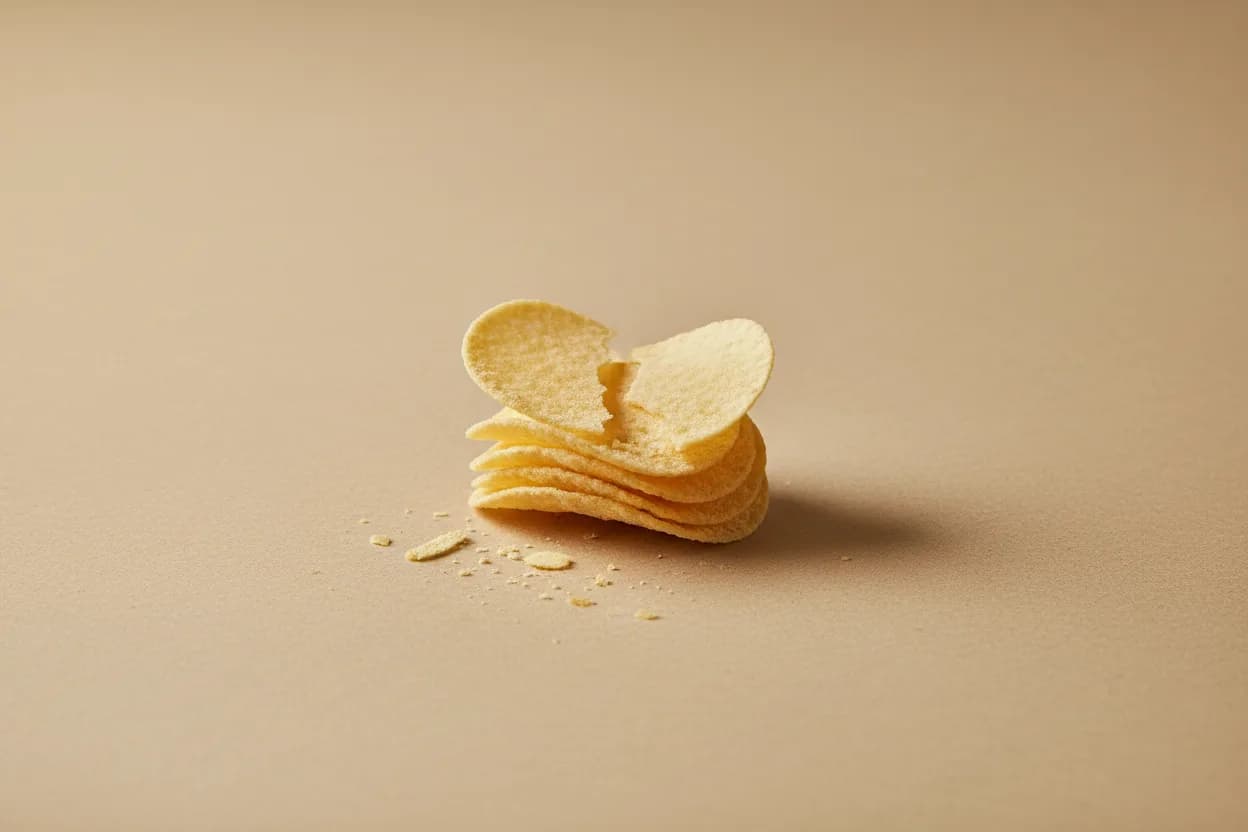
Between the microphone and the headphones sits the experiment. Massimiliano Zampini and Charles Spence took the band from 2 to 20 kilohertz and either boosted it by 12 decibels or cut it by 12, then crossed that with three levels of overall loudness. The crisps themselves never changed. Every one came out of the same tube of Pringles Original.1
At full volume, on a hundred-point scale, the boosted bite scored 85 for crispness. The unaltered bite scored 71. The cut bite scored 64. The effect of the frequency manipulation came out at F(2,38) = 39.91, p below 0.001.1
Twenty people took part. Fifteen of them said afterwards that the crisps had come from different packets.1
The work won an Ig Nobel Prize in 2008, in nutrition, for what the citation calls electronically modifying the sound of a potato chip to make the person chewing it believe it to be crisper and fresher than it really is.2 It is a funny prize for a serious result. The judgment those people were making felt like it was happening in their mouths, and a good part of it was arriving at their ears.
An old idea, badly cited
The notion that crispness is an acoustic property rather than a purely mechanical one is older than the Pringles. Birger Drake published the founding study in 1963, running foods through a crushing rig and recording what came out.3 In 1976 Zata Vickers and Malcolm Bourne set out a theory of crispness built explicitly on sound, arguing that the crisp sensation is tied to the pattern of acoustic events a brittle food produces as it fails.4
Drake's paper is called Food Crushing Sounds. An Introductory Study. It gets cited constantly as Food Crunching Sounds, including by Zampini and Spence and by Dacremont. A field devoted to the difference between crushing and crunching has spent sixty years misquoting the title of its own founding paper.
The part everybody gets backwards
Here is the version of this story you have probably heard. You do not really hear your food with your ears. The sound travels up through your jaw and your skull straight into the inner ear, and that is the reason chewing is deafening to you and inaudible across the table.
The second half is true. The first half is not, and this is the thing I most expected to be able to write and cannot.
In 1991 Catherine Dacremont, with Colas and Sauvageot, actually measured the two routes, recording bite and chewing sounds through the air and through a bone-conduction microphone held against the head. At the moment of the first bite the two channels came out within about 2 decibels of each other, which the authors read as bone and air conduction having similar importance. During chewing the gap opened to nearly 16 decibels, and it opened in favour of the air.5
Zampini and Spence say it themselves, in their methods, in the paper everyone cites for the opposite. They note that the only sounds they modified were the ones picked up by a microphone sitting outside the mouth, so every effect they report belongs to the airborne component. Then they add that previous research has shown that air-conducted sounds are actually more important than bone conducted sounds for the determination of the crispness of foods.16
The most famous demonstration that crispness is heard never touched the skull at all. It ran entirely through the air, from a microphone in front of the face to a pair of headphones.
There is a clean test of the other route, and it comes back negative. Plug someone's ear canal and you produce the occlusion effect: the bone-conducted sound of your own body gets louder, the reason your voice booms when you block your ears. In 2019 a group put an earplug in fifty-nine people and had them eat five crispy foods and five soft ones, with a probe microphone in the ear canal to confirm the manipulation had worked. It had: mastication sounds measured louder with the ear occluded. Ratings of freshness, appreciation and willingness to eat more showed no significant difference at all.7
So the honest claim is that crispness reaches you through your ears rather than your teeth. Not through your skull rather than the air.
The skull is not irrelevant. Vickers noted in 1984 that bite sounds are higher in pitch than chewing sounds, because a bite delivers both channels while chewing loses the high frequencies to the soft tissue of the mouth.8 Zampini and Spence chose a single front-tooth bite for their design specifically to sidestep the bone-conducted transfer that molars introduce.1 And a Dutch group has gone as far as measuring skull vibration directly during the chewing of crispy food.9 The channel is real. It is simply not the one carrying the verdict.
Crispy, crunchy, crackly
English keeps three words for this and they turn out to be measurably different things. Dacremont's 1995 work separates them by frequency: crispy sits above about 5 kilohertz and comes to you mostly through the air, crunchy peaks far lower at around 1.25 to 2 kilohertz, and crackly is the one where the bone-conducted route carries the most weight.6 An earlier instrumental study had already found that crisp products are heavily influenced by frequencies above 1.9 kilohertz.10
This is why the words resist being used interchangeably even by people who could not tell you why. A crisp apple and a crunchy carrot occupy two different regions of the spectrum and arrive by slightly different roads, rather than sitting at two intensities of one sensation.
Where the sound is made
The sound itself is the food failing. A brittle food under load stores elastic strain energy, and when a crack runs through it that energy has to go somewhere. Some of it goes into new surface, and some of it leaves as sound: the cell walls rupture and, in the phrasing of one review, begin to vibrate, releasing stored strain energy of which some is released as sound energy.11 What you hear is not a by-product of the food breaking. It is the breaking itself, arriving by a different sense.
The fracture noise of a potato chip has been measured across a band running from about 1.6 to 25.6 kilohertz.11 Set that beside the 2-to-20 kilohertz window Zampini and Spence chose to manipulate and you can see that they were not filtering some incidental hiss. They had their hands on nearly the whole acoustic signature of the fracture.
The mechanics under all this are genuinely hard, and the literature says so. A long review of crispy and crunchy behaviour by Luyten, Plijter and van Vliet runs to nearly fifty pages precisely because the fracture properties of these materials do not reduce to a single measurement.12
And where it goes
Crispness dies by water, on a schedule that has been measured. Karen Katz and Theodore Labuza took snack foods across a range of humidities and found a critical water activity somewhere between 0.35 and 0.50, above which the products became, in their term, organoleptically unacceptable.13 This library has a note on water activity already, and it is satisfying to find the same number governing whether bacteria can grow and whether a cracker still snaps.
In the middle of that same paper is a sentence I have not stopped enjoying. The authors report that potato chips did not produce a consistently shaped force-deformation curve.13 The single most studied crisp food in the world will not sit still for the instrument that is supposed to measure it, which is a fair part of why the field started listening instead.
The noise around the plate
If sound coming out of the food changes how it seems, the obvious next question is whether sound in the room does too. Here the evidence splits sharply, and the split is worth respecting.
The strongest result concerns loud noise. At Cornell, Kimberly Yan and Robin Dando ran forty-eight people through a crossover experiment, tasting solutions of the five basic tastes with and without broad-spectrum noise simulating an aircraft cabin. Salty, sour and bitter were unaffected. Sweet was rated progressively lower under noise. Umami was rated higher, and both effects grew with concentration.15 The specificity is the persuasive part: a general distraction effect would have blunted everything.
Their proposed mechanism is the chorda tympani, the taste nerve that runs directly across the eardrum on its way from the tongue, which would put a taste nerve inside the middle ear and physically shake it. The authors are careful to call it a postulate rather than a finding, and so am I. The paper describes real cabins as often over 85 decibels; that figure belongs to aeroplanes, not to their laboratory stimulus.
The weaker case is the fashionable one. Sonic seasoning, the idea that a high-pitched soundtrack makes a dessert taste sweeter and a low rumble makes it more bitter, has a real experimental literature behind it.16 But in 2019 Richard Höchenberger and Kathrin Ohla went back with a proper silent control condition, and the taste effect did not survive it. They concluded the shift looked like an artifact of the scale rather than an actual shift in perception.17 People will reliably match sounds to tastes when you ask them to. Whether the food changes is another matter.
What cannot be said
You will find a percentage attached to this subject. Some fraction of crispness, forty per cent or sixty or whatever the article needs, is said to be sound. I went looking for the source of any such number and there is none. No paper in this literature assigns a proportion, and the reason is that the question is not well formed: sound is sufficient to move a crispness judgment, which is what the Pringles experiment shows, and that is a different claim from sound accounting for some share of it.
The bound runs the other way too. Christensen and Vickers found back in 1981 that masking the sound does not always destroy the crispness judgment.14 Take the noise away and people can still often tell. The ear is enough to shift the verdict and not required to reach it.
The foot pedal
I keep coming back to the detail that the ratings were entered with a foot pedal, because both hands were holding food and a headphone cable. It is such an ordinary laboratory compromise, and it is the reason the design works: the participant is busy, the bite is a single controlled event, and there is no chance to sit and reason about what just happened.
Twenty people did that, and fifteen of them walked out of the booth believing they had eaten crisps from more than one packet. They had eaten one product, in one room, on one afternoon, and the only thing that varied was how much of the fracture they were allowed to hear. Nobody misreported anything. They tasted exactly what they said they tasted.
Fry a fish for the Gazan rice and you will listen to it, whether or not you notice that you are listening. The cook who holds a pan still for a second, to hear whether the crust has set, is taking a measurement with the one instrument in the kitchen that nobody thought to write down.
Sources
Every numbered claim above points here. Links go to the paper, record, or authority itself.
- 1.
Zampini M, Spence C. The role of auditory cues in modulating the perceived crispness and staleness of potato chips. Journal of Sensory Studies. 2004;19(5):347-363.
https://doi.org/10.1111/j.1745-459x.2004.080403.x - 2.
Improbable Research. The Ig Nobel Prize Winners, 2008 Nutrition Prize, awarded to Massimiliano Zampini and Charles Spence. Cited from the awarding body's own list of past winners.
https://improbable.com/ig/ig-pastwinners.html - 3.
Drake BK. Food crushing sounds. An introductory study. Journal of Food Science. 1963;28(2):233-241. Widely miscited in the later literature, including by Zampini and Spence, as "food crunching sounds".
https://doi.org/10.1111/j.1365-2621.1963.tb00190.x - 4.
Vickers Z, Bourne MC. A psychoacoustical theory of crispness. Journal of Food Science. 1976;41(5):1158-1164.
https://doi.org/10.1111/j.1365-2621.1976.tb14407.x - 5.
Dacremont C, Colas B, Sauvageot F. Contribution of air- and bone-conduction to the creation of sounds perceived during sensory evaluation of foods. Journal of Texture Studies. 1991;22(4):443-456.
https://doi.org/10.1111/j.1745-4603.1991.tb00503.x - 6.
Dacremont C. Spectral composition of eating sounds generated by crispy, crunchy and crackly foods. Journal of Texture Studies. 1995;26(1):27-43.
https://doi.org/10.1111/j.1745-4603.1995.tb00782.x - 7.
Jutras B, Luond A, Honegger F, Stieger C, Hummel T, Welge-Lussen A. Influence of external ear occlusion on food perception. European Archives of Oto-Rhino-Laryngology. 2019;276(3):889-895.
https://doi.org/10.1007/s00405-019-05296-w - 8.
Vickers ZM. Crispness and crunchiness: a difference in pitch? Journal of Texture Studies. 1984;15(2):157-163.
https://doi.org/10.1111/j.1745-4603.1984.tb00375.x - 9.
van der Bilt A, de Liz Pocztaruk R, Abbink JH. Skull vibration during chewing of crispy food. Journal of Texture Studies. 2010;41(6):774-788.
https://doi.org/10.1111/j.1745-4603.2010.00254.x - 10.
Seymour SK, Hamann DD. Crispness and crunchiness of selected low moisture foods. Journal of Texture Studies. 1988;19(1):79-95.
https://doi.org/10.1111/j.1745-4603.1988.tb00926.x - 11.
Wang J, et al. Acoustic and mechanical properties of crispy foods: a review. Reviews in Agricultural Science. 2020;8:170-185. Open access.
https://doi.org/10.7831/ras.8.0_170 - 12.
Luyten H, Plijter JJ, van Vliet T. Crispy/crunchy crusts of cellular solid foods: a literature review with discussion. Journal of Texture Studies. 2004;35(5):445-492.
https://doi.org/10.1111/j.1745-4603.2004.35501.x - 13.
Katz EE, Labuza TP. Effect of water activity on the sensory crispness and mechanical deformation of snack food products. Journal of Food Science. 1981;46(2):403-409.
https://doi.org/10.1111/j.1365-2621.1981.tb04871.x - 14.
Christensen CM, Vickers ZM. Relationships of chewing sounds to judgments of food crispness. Journal of Food Science. 1981;46(2):574-578.
https://doi.org/10.1111/j.1365-2621.1981.tb04914.x - 15.
Yan KS, Dando R. A crossmodal role for audition in taste perception. Journal of Experimental Psychology: Human Perception and Performance. 2015;41(3):590-596.
https://doi.org/10.1037/xhp0000044 - 16.
Crisinel AS, Cosser S, King S, Jones R, Petrie J, Spence C. A bittersweet symphony: systematically modulating the taste of food by changing the sonic properties of the soundtrack playing in the background. Food Quality and Preference. 2012;24(1):201-204.
https://doi.org/10.1016/j.foodqual.2011.08.009 - 17.
Hochenberger R, Ohla K. A bittersweet symphony: evidence for taste-sound correspondences without effects on taste quality-specific perception. Journal of Neuroscience Research. 2019;97(3):267-275.
https://doi.org/10.1002/jnr.24308